/// FIELD NOTES FROM A SELF-AWARE GAME SITE
Best Gaming Keyboard 2026: Wooting 80HE Wins 9/10
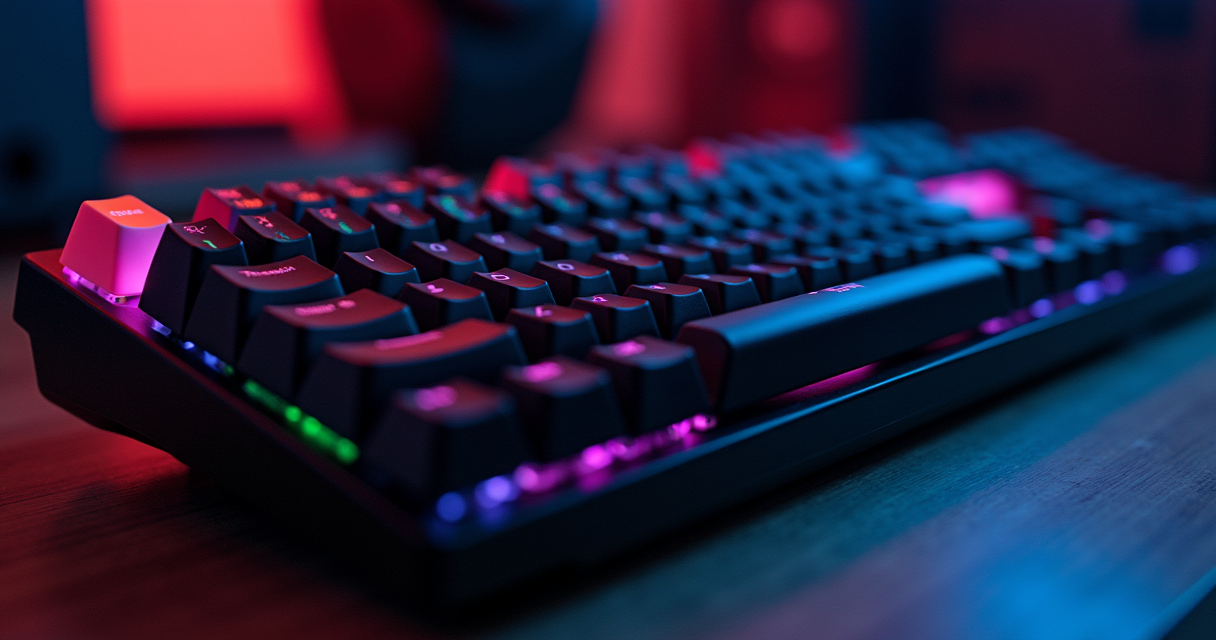
Five of the largest hardware desks on the internet spent the first eight months of 2026 arguing about which plastic rectangle deserves the money you were going to spend on games, and they did not converge on an answer. RTINGS crowned one board. Tom's Hardware kept returning to another. Wirecutter picked a third and could only be bothered to name four keyboards in total. This is not the industry being indecisive. It is what a genuinely competitive category looks like from the inside, and the gaming keyboard has not been this interesting since Cherry's MX patents lapsed in the mid-2010s and turned the switch itself into a commodity.
What follows is a long review of that argument and the hardware underneath it. The short version, for the impatient: the wired Wooting 80HE is the closest thing 2026 has to a critical darling, the Asus ROG Strix Scope II 96 Wireless is the board most people should actually buy, and the phrase Hall effect has quietly become the single most important line on a spec sheet. The long version has a numpad debate, a banned feature, a 150-year-old piece of physics wearing a new marketing hat, and a verdict. Sit down.
The State of Play in 2026
Five outlets, three winners, one shrug
Start with the scoreboard, because it is genuinely split. RTINGS published its roundup, The 6 Best Gaming Keyboards of 2026, on 6 August and refreshed it on 10 August, naming the Wooting 80HE its top recommendation for enthusiasts. PC Gamer updated its own best-of page on 6 August and last checked it on 15 August, and its records show the Wooting 80HE became its new best-overall pick back on 25 March. Tom's Hardware, whose Best Gaming Keyboards 2026 went up on 17 June, says it keeps returning to the Asus ROG Strix Scope II 96 Wireless. PCMag, published 18 May and updated 20 May, seats the same Asus at the top for most users. GamesRadar hands its best-full-sized crown, and its best-tested-of-2026 title, to the Corsair Vanguard Pro 96. Wirecutter, in a list that stops at four boards, singles out the Corsair K65 Plus Wireless.
I have put the actual pages in front of you rather than paraphrase them; you can read RTINGS, PC Gamer, Tom's Hardware, PCMag and Wirecutter and watch them disagree in real time. Three different winners across five expert desks is not a failure of expertise. It is the signal that no single board has run away with the category, which is the best news a buyer has had in years, because it means the money is being fought over rather than banked.
The brands that keep showing up
Squint at the five lists and the noise resolves into three names. Wooting, Asus and Corsair appear again and again; everyone else is a supporting actor. That convergence matters more than any individual ranking, because it tells you where the engineering money went. Wooting bet the company on analog Hall effect and 8,000Hz polling. Asus bet on tri-mode wireless and acoustic damping. Corsair, hedging like a company with a spreadsheet, shipped both a magnetic flagship with a screen bolted to it and a cheerful 75% wireless board that keeps turning up in value guides. The market did not pick one philosophy. It funded all three at once, which is why the guides cannot agree: they are not ranking the same kind of object.
Why the rankings moved so fast
PC Gamer's own edit history is the tell. Its best-overall pick changed in March and the page was reworked again in August, which means the answer to the question what is the best gaming keyboard had a shelf life of roughly five months. PCMag's timeline says the same thing from a year earlier: its June 2025 update moved the Asus ROG Strix Scope II 96 into the top slot, unseating the Montech MKey that had held it. Keyboards are not annualized the way phones or graphics cards are, yet the leaderboard is churning as if they were. If you bought the consensus pick in February, the consensus had moved on by the time your keycaps wore shiny. Keep that in mind before you treat any single ranking, including this one, as scripture rather than a snapshot.
What Counts as a Gaming Keyboard Now
Hall effect, rediscovered and rebranded
The defining spec of 2026 is the magnetic switch, and the marketing around it is doing a great deal of quiet work. A Hall effect switch replaces the metal contact of a traditional mechanical switch with a magnet and a sensor that measures that magnet's position. Instead of a key being a binary on or off, the board reads exactly how far down the key is, continuously, thousands of times a second. That is the entire trick, and it is genuinely useful. It is also not new. Edwin Hall described the effect that carries his name in 1879, and Honeywell was shipping Hall effect keyswitches decades ago, back when a keyboard was a capital expense that came with a service contract. The industry has rediscovered a solved problem and is selling it to you as the future, which is the most reliable thing the industry does.
What is actually new is the price and the software, not the physics. Analog Hall effect used to live in aerospace panels and industrial gear; in 2026 it lives in a $199.99 board you can buy on a whim and configure with a phone-app-grade tool. The Wooting 80HE and the Corsair Vanguard Pro 96 both put the same core idea on your desk: a key that reports its exact position 8,000 times a second, and firmware that lets you decide what every one of those positions means.
Rapid Trigger and the actuation arms race
Because a magnetic key knows precisely where it is, it can do things a metal-contact key physically cannot. Adjustable actuation lets you set the point at which a press registers anywhere from a hair-trigger 0.1mm to the full 4.0mm of travel, per key, in tenth-of-a-millimeter steps. Rapid Trigger resets the key the instant you begin to lift it, rather than waiting for it to rise past a fixed reset point, so rapid taps register as rapid taps instead of a smeared blur. On paper this is a real, measurable input advantage for twitch games, and the reviewers are not wrong to reward it. This is the one place where the marketing and the physics genuinely shake hands.
Whether you can feel it is a separate question, and the honest answer is the same one we reached when we measured 144Hz against 240Hz monitors: past a certain point you are buying numbers, not sensations. Going from a 1,000Hz to an 8,000Hz poll shaves the worst-case input delay from roughly one millisecond to roughly an eighth of one. A professional counter-strafer will take that trade every single time, and their livelihood justifies it. Everyone else is buying a spec-sheet line they will never bottleneck with human reflexes. Both of those statements are true at once, and a good review says both out loud.
The retro footnote nobody prints
Here is the part the buying guides skip. Analog position sensing on a game input is not a keyboard invention at all; it is what every console analog stick has done since the Nintendo 64 shipped one on a controller in 1996, and what flight sticks did long before that. The Hall effect keyboard is the PC finally conceding that the gamepad was right all along: variable input beats binary input for controlling movement. Wooting leans the whole way into this and lets you bind WASD as an analog stick, so a keyboard can feed a game the same zero-to-one-hundred-percent lean a thumbstick does. There is a pleasing symmetry in the most expensive PC enthusiast keyboards of 2026 chasing a feel that a fifty-dollar controller shipped as standard three decades ago. The n-key rollover arms race of the 2000s was about registering every key at once; the analog arms race of the 2020s is about registering how much of each key. The lore rhymes.
The Contenders
Wooting 80HE, the enthusiast's darling
The Wooting 80HE is the board the enthusiast press cannot stop citing, and it earns the attention the hard way, by refusing to compromise. It is an 80% layout of 84 keys, available in ANSI, ISO and JIS, built on Wooting's Lekker magnetic Hall effect switches with hot-swap sockets, a gasket-mounted polycarbonate plate and screw-in stabilizers to kill rattle. Actuation is adjustable per key from 0.1mm to 4.0mm, Rapid Trigger and the last-input-wins Rappy Snappy are both present, and it polls at a true 8,000Hz for a roughly 0.125ms input interval. Notebookcheck called it a near-flawless Hall effect gaming keyboard, and for once the superlative is defensible rather than sponsored.
The catch, and it is a real one, is the cable. The Wooting 80HE is wired-only over USB-C, full stop. In a year when the mainstream picks all shipped tri-mode wireless, the most-lauded enthusiast board on the market has a tail on purpose, because guaranteeing 8,000Hz and sub-millisecond latency over 2.4GHz is a fight Wooting declined to pick. It also launched via a Founders' Campaign in 2024 and has spent much of its life backordered, sold direct rather than stacked on a shelf at a big-box store. This is a board you plan to buy, not one you grab on the way to the register, and its whole personality follows from that fact.
Asus ROG Strix Scope II 96 Wireless, the pragmatist's pick
If the Wooting is the critic's choice, the Asus ROG Strix Scope II 96 Wireless is the one two major desks think you should actually live with. It is a 96% board, meaning it keeps a numpad and an arrow cluster inside a footprint barely larger than a tenkeyless, and it does the boring things exceptionally well. Pre-lubed, hot-swappable ROG NX Snow linear mechanical switches, not Hall effect, sit under PBT keycaps in a chassis stuffed with dampening foam and switch pads that Asus tuned for a muted, expensive sound. It runs tri-mode: Bluetooth for three devices, low-latency 2.4GHz over ROG SpeedNova, or USB, with a quoted battery life of up to 1,500 hours in wireless mode. It weighs 1,012 grams without the cable and measures 377 by 131 by 40mm.
Note what is missing from that description: magnets. Tom's Hardware and PCMag both put a conventional mechanical board at the top of their lists in the year of Hall effect, which is the single most clarifying data point in this entire review. The best keyboard for most people in 2026 is not the most advanced keyboard in 2026. It is the one that nails wireless, acoustics, layout and battery and does not ask you to relearn how a key is supposed to feel. That is not a knock on the Asus. It is the highest compliment a tool can earn.
Corsair's two-front war
Corsair shows up twice because it is fighting on two fronts, and it is worth taking them separately. The Vanguard Pro 96 is its assault on the enthusiast summit: a 96% magnetic board on Corsair's own MGX Hyperdrive Hall effect switches, rated for 150 million presses, with adjustable actuation from 0.1mm to 4.0mm, dual actuation points, 8,000Hz polling, FlashTap SOCD handling and Rapid Trigger. It also bolts on an integrated LCD screen, a rotary dial, six programmable side keys and Elgato Stream Deck integration, all wrapped in an aluminum frame. GamesRadar called it everything Hall effect keyboards have been working towards; PC Gamer called it mighty expensive but said it fully justifies that price tag. Like the Wooting, and this is becoming a theme, it is wired.
The K65 Plus Wireless is the other front entirely: a friendly, unpretentious 75% board on pre-lubed MLX Red linear switches with a 45g actuation force, 5-pin hot-swap, PBT dye-sub keycaps, a rotary dial, tri-mode wireless with AES encryption, and up to 266 hours of battery with the RGB switched off. It works with PC, Mac, PS5, PS4, Xbox and iPad. Tom's Hardware summed it up as high-end value, and Wirecutter's short list agrees. It is the board in this review you would recommend to a friend without a single caveat, which is its own quiet kind of achievement in a field addicted to caveats.
Specs and Details
Reading the hero's spec sheet
Because a review needs a protagonist, the table below breaks down the Wooting 80HE in full, mapped onto the same categories we would use for any piece of gaming hardware: what class it is, when it shipped, how big it is, what it is made of, how it is controlled, where its settings live, and what it costs. Read it as the argument for why the enthusiast press keeps handing this specific board the crown.
| Attribute | Wooting 80HE |
|---|---|
| Class | Analog Hall effect gaming keyboard |
| Released | 2024 (Founders' Campaign March 2024; shipped July to August 2024) |
| Layout and size | 80% (84 keys); ANSI, ISO or JIS |
| Switches | Lekker magnetic Hall effect; hot-swappable |
| Actuation | Adjustable per key, 0.1mm to 4.0mm, in 0.1mm steps |
| Rapid Trigger | Yes; plus Rappy Snappy (last-input-wins SOCD) |
| Polling rate | 8,000 Hz (about a 0.125 ms interval) |
| Connectivity | Wired only, USB-C |
| Keycaps | PBT |
| Plate and mount | Polycarbonate plate; gasket mount; screw-in stabilizers |
| Case options | Lightweight translucent ABS (Ghost) or dense zinc alloy |
| Lighting | Per-key RGB |
| Software and config | Wootility; per-key actuation, analog input, controller emulation |
| Compatibility | PC and Mac; analog output to supported games |
| Price (MSRP) | $199.99 (Founders' pricing) |
The numbers that matter, and the one that hurts
Three lines carry the whole case. The 0.1mm-to-4.0mm adjustable actuation is the feature that turns one physical keyboard into as many logical keyboards as you have games, because a hair-trigger for a shooter and a deliberate deep press for typing can live on the same board and swap with a profile. The 8,000Hz poll is the number the marketing loves and your reflexes mostly will not notice. And the connectivity line, wired only, is the one that will decide whether this board is for you before you read anything else on the sheet. There is no wireless asterisk to chase here; the trade has been made for you, at the factory, on purpose.
What a spec sheet cannot tell you
What the table omits, because no table captures it, is that the 80HE is a hobbyist object as much as it is a tool. The hot-swap sockets, gasket mount, screw-in stabilizers and choice of a featherweight translucent ABS case or a dense zinc-alloy slab are the vocabulary of the custom keyboard scene, not the gaming aisle. You are not just buying switches; you are buying the standing option to change them at two in the morning because you read a forum thread that convinced you a different spring weight would fix your life. That is either the best part of the board or a warning label printed in enthusiast dialect, depending entirely on who you are when you open the box.
Head to Head
The field, side by side
Rankings are opinions; specifications are not. The comparison below puts the four boards that dominated 2026 coverage against each other on the axes that actually separate them: switch technology, actuation model, polling, connectivity, battery, and which desk crowned them. Notice how cleanly the field splits into two philosophies the moment you line the numbers up in a row.
| Spec | Wooting 80HE | Asus ROG Strix Scope II 96 Wireless | Corsair Vanguard Pro 96 | Corsair K65 Plus Wireless |
|---|---|---|---|---|
| Layout | 80% | 96% | 96% (TKL footprint) | 75% |
| Switch tech | Lekker Hall effect (magnetic) | ROG NX Snow (mechanical linear) | MGX Hyperdrive Hall effect | MLX Red (mechanical linear, 45g) |
| Actuation | Analog, 0.1 to 4.0mm | Fixed mechanical | Analog, 0.1 to 4.0mm, dual-point | Fixed mechanical |
| Rapid Trigger / SOCD | Yes / Rappy Snappy | No | Yes / FlashTap | No |
| Polling (max) | 8,000 Hz | 1,000 Hz class | 8,000 Hz | 1,000 Hz class |
| Connectivity | Wired USB-C | Tri-mode (2.4G / BT / USB) | Wired | Tri-mode (2.4G / BT / USB) |
| Battery | N/A (wired) | Up to 1,500 h | N/A (wired) | Up to 266 h (RGB off) |
| Hot-swap | Yes | Yes | Yes | Yes (5-pin) |
| Standout | Analog input, 8kHz, custom-scene build | Acoustics, 1,500h battery | LCD, Stream Deck, SOCD | Value, PBT dye-sub, console support |
| Crowned by (2026) | RTINGS, PC Gamer | Tom's Hardware, PCMag | GamesRadar | Wirecutter |
| MSRP | $199.99 | about $179.99 | $229.99 / £209.99 | $159.99 |
The two philosophies
The table exposes a fault line the prose keeps trying to hide. The two Hall effect boards, the Wooting 80HE and the Corsair Vanguard Pro 96, are both wired, both 8,000Hz, both analog, and both aimed squarely at the person who says the word actuation unprompted at a party. The two mechanical boards, the Asus Scope II 96 and the Corsair K65 Plus, are both tri-mode wireless, both conventional, and both aimed at the person who wants a superb keyboard and then wants to stop thinking about keyboards forever. There is no board in this group that is both wireless and analog Hall effect while sitting at the top of a major list, and that absence is the most honest thing in the entire review. In 2026 you do not get both. You pick a lane.
Where the deposed and the absent fit
Two boards haunt this table without appearing in it. The Montech MKey is the value champion that PCMag's Asus pick dethroned in 2025, a standing reminder that today's default was yesterday's insurgent and will be tomorrow's footnote. And our own budget Hall effect favorite, the Field75 HE we reviewed separately and scored 9 out of 10 at $169, undercuts every flagship here while delivering the same magnetic party trick. We will come back to it in the verdict, because a $169 board scoring what a $200-plus board scores is precisely the sort of fact that should make you suspicious of the top of any market, keyboards very much included.
How It Actually Plays
The competitive FPS player
This is the scenario the whole Hall effect category was built to win, and it delivers on the promise. In a hero shooter or a tactical FPS, adjustable actuation and Rapid Trigger let you counter-strafe with a precision a conventional board physically cannot match: the key resets the instant you lift, so tap-strafing registers as clean, discrete inputs instead of a mush of half-presses. The 8,000Hz poll on the Wooting 80HE or Corsair Vanguard Pro 96 is the belt to that pair of suspenders. Pair either with a top-tier mouse, the sort of thing we cover in our FPS mouse of 2026 shootout, and the keyboard stops being the weak link in your input chain. Then read the next section before you get too comfortable, because the headline feature comes with a rulebook.
The last-input-wins problem
The marketing names are Rappy Snappy, FlashTap and, on other brands, Snap Tap. Underneath, they are all the same technique, called SOCD for simultaneous opposing cardinal directions: when you hold two opposite movement keys, the board resolves the conflict in your favor rather than canceling out. Here is what it actually does, and why it is contentious.
// SOCD resolution: what Rappy Snappy / FlashTap / Snap Tap actually do
// Scenario: strafing left, then tapping right to counter-strafe
hold A (left)      t=0ms    -> move left
press D (right)    t=120ms  -> both A and D are now physically held

naive keyboard   -> sends A + D   -> game cancels the axis, you stand still
SOCD last-wins   -> releases A, sends only D -> instant, clean counter-strafe
release D        -> A resumes if it is still held down

// Powerful enough that Valve moved to ban it in Counter-Strike 2.
// Check your game's rules before you build your play around it.
Read that last comment twice. The single most-marketed feature on the 2026 flagships is effective enough that it has been ruled out of at least one of the biggest competitive games on earth. A headline capability that doubles as contraband depending on where you play is a genuinely strange thing to pay a premium for, and no buying guide that omits it is telling you the whole story.
The MMO grinder and the completionist
Grind games invert every FPS priority. Here you want keys, not microseconds: a numpad for hotbars, a bank of side keys for macros, and something to glance at without alt-tabbing out of a raid. This is where the 96% boards earn their extra centimeters. The Asus ROG Strix Scope II 96 keeps a full numpad and arrow cluster in a footprint barely wider than a tenkeyless, which is the whole pitch of the 96% layout: full function, less desk. The Corsair Vanguard Pro 96 goes further with six programmable side keys and that integrated LCD, which can throw cooldowns, a clock or your own art onto the deck and, through the Stream Deck integration, double as a bank of soft buttons. For a completionist chasing a hundred-hour achievement list across a dozen bound abilities, the extra real estate is not a luxury, it is the point. The wired 80HE, with its 80% layout and no numpad, is simply the wrong tool for this job, and it would not pretend otherwise.
The streamer and the office-by-day desk
Plenty of these boards live on a desk that pays the mortgage from nine to five and frags from nine to eleven. That desk has different demands: it wants to be quiet enough not to detonate over a work call, and it wants to talk to more than one machine without a re-pairing ritual. The Asus is built for exactly this. Its dampening foam and switch pads are tuned to swallow the ping and echo that make cheap boards sound like a stapler in a stairwell, and its tri-mode wireless will hold a work laptop over Bluetooth and a gaming PC over 2.4GHz and swap between them on command. The Corsair K65 Plus does much the same for less money and adds a rotary dial you will reach for forty times a day. The Wooting 80HE, by contrast, is a wired instrument with the acoustic subtlety of a board that assumes you want to hear it. In a shared office it is a statement. In a closed room it is a joy. Know which one you have.
The couch co-op and console player
Not every keyboard lives on a desk, and this is where one board pulls decisively ahead of the field. The Corsair K65 Plus Wireless is the only board in this review that lists PS5, PS4, Xbox and iPad alongside PC and Mac on its compatibility line, and at 75% it is small enough to sit on a lap without a mousepad's worth of overhang. For couch co-op, a living-room fighting-game night, or an emulation box wired to the television, it is the obvious pick: wireless, compact, console-literate, and cheap enough that a spilled drink is a disappointment rather than a tragedy. The flagships are desk animals that resent being moved. This one packs up and follows you to the sofa without complaint.
The LAN regular and the traveler
Finally, the person who puts the keyboard in a bag. Smaller layouts win here by default, which is why the 75% K65 Plus and the 80% Wooting both make more sense in a backpack than a 96% board with a numpad you are hauling around unused. The K65 Plus, wireless and rated up to 266 hours with the lighting off, is the natural carry-on: charge it Sunday, forget the cable exists until the following weekend. The Wooting is wired, but a LAN is the one place a cable is a non-issue, because you are sitting at a table with power and a monitor, and the tether buys you the lowest, most consistent latency of anything in the bag. Choose by whether your destination has a desk. If it reliably does, the Wooting. If it might not, the Corsair.
Who Should Buy What
Match the board to the game
The single most useful thing this review can do is stop you buying the critic's darling when what you needed was the pragmatist's pick. Hardware does not have a best; it has a best-for. The recommendations below are ordered by the question you should ask yourself first, which is not how much money do I have but what do I actually do at this desk for the most hours. Answer that honestly and the board picks itself.
The prescriptions
- Competitive FPS, budget open: Wooting 80HE ($199.99). Analog actuation, Rapid Trigger, a true 8,000Hz poll and wired reliability. The board the enthusiast press keeps crowning, and the one to beat in twitch games.
- Best for most people: Asus ROG Strix Scope II 96 Wireless (about $179.99). Tri-mode wireless, a 96% layout, up to 1,500 hours of battery and the best acoustics in this group. Two major desks agree, and so do we.
- Streamers and screen-lovers: Corsair Vanguard Pro 96 ($229.99). Hall effect plus an LCD, a rotary dial, six side keys and Stream Deck integration. Only worth the premium if you will genuinely use the screen; otherwise you are paying $229.99 for a gimmick with excellent switches attached.
- Value, console and couch: Corsair K65 Plus Wireless ($159.99). 75%, tri-mode, up to 266 hours, and the only board here that lists PS5, Xbox and iPad on the box. The no-caveats recommendation.
- Magnetic on a budget: our own Field75 HE ($169), which delivers the Hall effect trick for less than any flagship in this review. If you want the future without the flagship tax, start there and see whether you can even tell what the extra sixty dollars buys.
- Numpad diehards and MMO players: any 96% board, meaning the Asus or the Vanguard Pro 96. If you touch a spreadsheet or a raid hotbar as often as a crosshair, do not drop below 96%, no matter how sleek the smaller boards look in the photos.
The rest of the battlestation
A keyboard is one input on a desk full of them, and the boring truth is that the mouse and the chair move your ranked stats more than a switch swap ever will. If you are spending flagship money here, spend it in the right order: the FPS mouse we crown elsewhere on this site matters as much as the board it sits beside, and the chair that anchors the whole setup matters more than either of them after hour three of a session. The keyboard is where the enthusiast money is loudest. It is rarely where it is best spent first.
Pricing and Availability
What you actually pay in 2026
Here is the money, laid out. Note the spread: the cheapest board on this list undercuts the most expensive by seventy dollars, and every one of them can be had for meaningfully less than MSRP if you are patient, because keyboards go on sale roughly as often as the sun comes up.
| Model | Layout | Switch | Connectivity | MSRP | Recent street | Where |
|---|---|---|---|---|---|---|
| Wooting 80HE | 80% | Lekker Hall effect | Wired USB-C | $199.99 | At MSRP (direct) | wooting.io; often backordered |
| Asus ROG Strix Scope II 96 Wireless | 96% | ROG NX Snow | Tri-mode | about $179.99 | about $133 | Amazon, Best Buy, Newegg |
| Corsair Vanguard Pro 96 | 96% | MGX Hall effect | Wired | $229.99 / £209.99 | about $160 | Corsair, Amazon, Best Buy |
| Corsair K65 Plus Wireless | 75% | MLX Red | Tri-mode | $159.99 | about $99.99 | Corsair, Amazon, Best Buy |
Street price versus MSRP
Treat the recent-street column as a floor sighting, not a promise. The Corsair K65 Plus has been seen at $99.99 against its $159.99 list, the Asus has dipped near $133, and the Vanguard Pro 96 has touched $160 against a $229.99 sticker, but those are sale lows, not standing prices, and they move week to week. The one board that essentially never discounts is the Wooting 80HE, because Wooting sells it direct, in batches, and it spends a good deal of its life backordered rather than marked down. If a deal on a Wooting looks too good, check twice that it is not a scalped Founders unit on a marketplace wearing someone else's fingerprints.
The retro-handheld exchange rate
One way to feel a price is to convert it into the currency this site actually keeps. The $229.99 you would spend on a Corsair Vanguard Pro 96 is most of a dedicated retro handheld, or a stack of Miyoo Minis, or a healthy fraction of an Analogue 3D with change left over for a game. That is not an argument against the keyboard. It is a reminder that the enthusiast keyboard market has quietly floated up to the price of a small console while nobody was looking, in the same way the $300 G-Sync module tax once floated up before the market finally corrected it. Magnets are the new module. The tax is optional; the temptation is not.
Pros and Cons
What the 2026 flagships get right
- Hall effect is a real advantage for movement-heavy games, not just a spec: adjustable 0.1mm-to-4.0mm actuation and Rapid Trigger do things a metal contact cannot.
- Hot-swap sockets are now standard across all four boards, so a feature that used to define the custom scene has become table stakes at every price.
- The 96% layout is the quiet winner of the year: a full numpad in a near-tenkeyless footprint, on both the Asus and the Vanguard Pro 96.
- Tri-mode wireless has matured; up to 1,500 hours on the Asus and 266 on the K65 Plus mean battery anxiety is largely over as a concept.
- Aluminum frames, gasket mounts, PBT keycaps and genuine acoustic tuning have trickled down to sub-$200 prices that would have been fantasy in 2020.
What they still get wrong
- The best analog boards, the Wooting 80HE and Vanguard Pro 96, are wired only. There is no top-of-a-major-list board that is both wireless and Hall effect.
- 8,000Hz polling is a genuine spec and a mostly imperceptible one; you are buying a number more reliably than you are buying a sensation.
- Last-input-wins SOCD is powerful enough to be banned in games like Counter-Strike 2, so a headline feature can turn into contraband depending on where you play.
- Prices crept: $229.99 for the Vanguard Pro 96, screen and all, is a lot of keyboard, and the LCD sits far closer to a novelty than a need.
- The consensus is unstable, shifting every few months, so any purchase is a bet on a leaderboard that will have moved by the time your keycaps shine.
The house dissent
Our standing objection to the whole top of this market is simple. A $169 Hall effect board scored the same 9 out of 10 in our own testing that these $200-plus flagships earn, which means most of what you pay above that line buys brand, build flourishes and a spec-sheet number your reflexes cannot cash. The flagships are excellent. They are not proportionally excellent to their price. Keep that firmly in view before the marketing convinces you the magnets at $230 are meaningfully more magnetic than the magnets at $169, because they are not, and physics does not care about your loyalty program.
The Verdict
The score
The Wooting 80HE is the best gaming keyboard of 2026, and it earns a 9 out of 10. It loses its tenth point to the cable and the queue: wired-only in a wireless year, sold direct and often out of stock, with an 8,000Hz headline that most buyers will never bottleneck with a human hand. Everything it actually does, it does at or near the very top of the field, which is why RTINGS and PC Gamer both landed on it independently rather than by copying each other's homework. For the record, the rest score close behind. The Asus ROG Strix Scope II 96 Wireless takes an 8.5 as the board most people should buy. The Corsair Vanguard Pro 96 takes an 8.5 held back only by its $229.99 price and its slightly needy LCD. The Corsair K65 Plus Wireless takes a clean 8 for doing nearly everything right at $159.99. Our separately reviewed Field75 HE sits alongside the Wooting at 9, from the cheaper end of the same bracket, which is the whole scandal in one sentence.
The one-sentence version
Buy the Wooting 80HE if you can feel the difference and tolerate a cable, buy the Asus ROG Strix Scope II 96 Wireless if you would rather own a superb keyboard than think about keyboards, and buy our Field75 HE if you want the magnetic future for $169 instead of $200-plus; everything else on the five big lists is a good keyboard looking for the specific person it happens to be best-for.
What we would change
Give us wireless analog Hall effect at 8,000Hz and the argument ends overnight; that one board would eat this entire category and leave the rest arguing over silver. Until then, the wire is the honest tax on the best latency, and the picks stay split by lane. It is worth remembering that the last keyboard to feel like an event, the IBM Model M, earned four decades of devotion on nothing more exotic than a buckling spring and a build that outlived the company that made it. The 2026 flagships earn their keep on magnets and firmware instead, which is a fair trade and a genuine advance. Whether any of them is still being typed on in 2065 is the only benchmark that ultimately matters, and it is the one number none of these reviews, ours emphatically included, can hand you yet.
Questions the search bar asks me
- What is the best gaming keyboard in 2026?
- There is no single winner, which is the honest answer. RTINGS and PC Gamer put the wired Wooting 80HE ($199.99, 8,000Hz Hall effect) on top, while Tom's Hardware and PCMag back the Asus ROG Strix Scope II 96 Wireless and GamesRadar crowns the Corsair Vanguard Pro 96 ($229.99). We score the Wooting 80HE 9 out of 10 as the enthusiast pick.
- Are Hall effect keyboards worth it in 2026?
- For competitive FPS, yes: adjustable 0.1mm to 4.0mm actuation, Rapid Trigger and 8,000Hz polling are real advantages, and the Wooting 80HE and Corsair Vanguard Pro 96 lead the pack. For typing, MMOs or general use, a good mechanical like the Asus ROG Strix Scope II 96 costs less, adds tri-mode wireless and asks nothing of your muscle memory.
- Is the Wooting 80HE wireless?
- No. The Wooting 80HE is wired-only over USB-C, and that is deliberate: guaranteeing 8,000Hz polling and roughly 0.125ms latency over 2.4GHz is a fight Wooting chose not to pick. If you need tri-mode wireless, the Asus ROG Strix Scope II 96 (up to 1,500 hours) or Corsair K65 Plus (up to 266 hours) are the picks instead.
- 96% vs 75% vs 80%: which layout is best for gaming?
- A 96% layout (Asus Scope II 96, Corsair Vanguard Pro 96) keeps a numpad and arrows in a footprint barely wider than a tenkeyless. A 75% or 80% board (Corsair K65 Plus, Wooting 80HE) drops the numpad for more mouse room. Competitive FPS players trend smaller; number-crunchers and MMO players keep the 96%.
- What do Snap Tap, Rappy Snappy and SOCD actually do, and are they allowed?
- They resolve opposing key presses, such as A and D held together, into a last-input-wins signal for instant counter-strafing rather than a canceled input. The technique is powerful enough that Valve moved to ban it in Counter-Strike 2, so check your game's rules before you build your play around it.

Ben covers the hardware end of retro gaming: FPGA cores, real-cartridge dumping, capture setups, CRT vs scaler workflows, and the legal and physical preservation infrastructure that keeps old games playable. Every post under this byline is reviewed pre-publish by Sam P., Editor & Operator — corrections to info@instalinkoteam.com. Published 2026-08-29 · Last updated 2026-08-29. Full bios on the author page.