/// FIELD NOTES FROM A SELF-AWARE GAME SITE
RTX 4090 vs 5080 (2026): 15% Faster, $900 Pricier
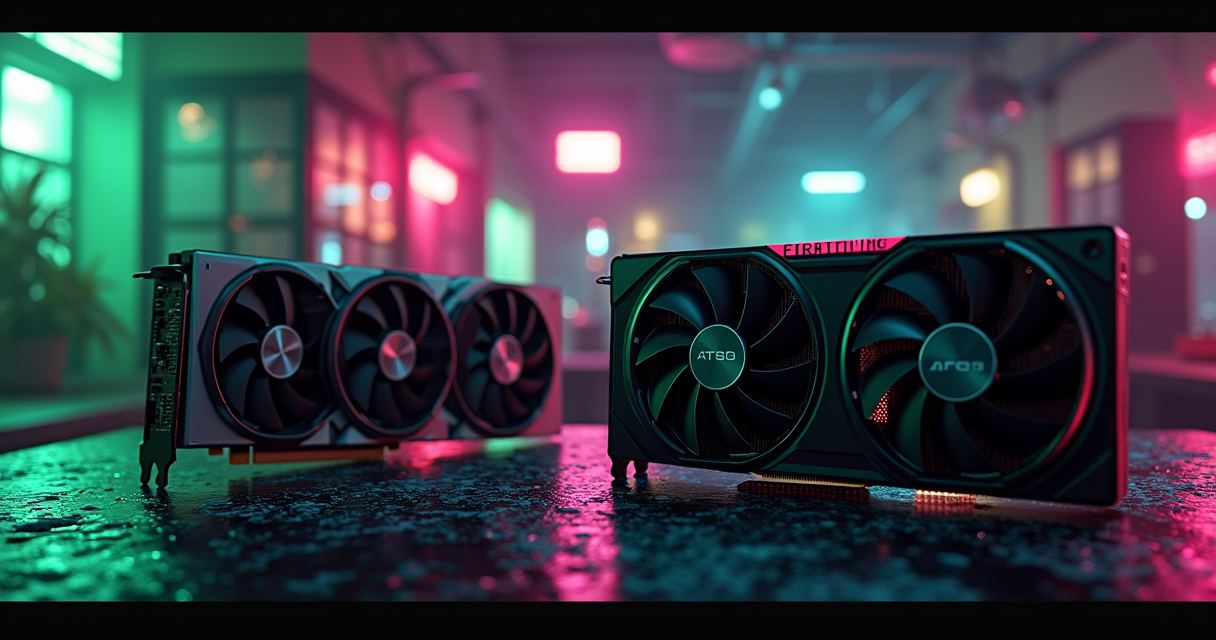
The RTX 4090 and the RTX 5080 share a shelf in your head and almost nowhere else. One is the discontinued 2022 flagship that refuses to die. The other is the 2025 second-tier Blackwell card NVIDIA would very much prefer you buy instead. On paper the pitch writes itself: the 5080 is newer, runs cooler, costs $600 less at MSRP, and it does DLSS 4. Easy win for the new hotness, surely.
Except this is the first xx80 in living memory that fails to beat the previous generation's xx90. Not narrowly loses on a couple of edge cases. Loses the aggregate, at 4K, across full review suites, by double digits. And then, because the universe has a sense of humor, the older and slower 4090 became the more expensive card to actually buy in 2026, because 24GB of VRAM turned it into an AI collectible. So we have a genuinely strange matchup: the faster card is discontinued and overpriced, the cheaper card is slower and stingier on memory, and the only unambiguous winner is NVIDIA's marketing department, which convinced a chunk of the internet that frame generation is the same thing as frames.
Let us take it apart properly.
The Verdict, Up Front
You came for a recommendation, not a mystery novel. Here it is, with the reasoning to follow.
The short answer
In a straight rasterization fight at 4K, the RTX 4090 wins by roughly 13-15% on average, and it wins every single game in the suite. That is not a rounding error and it is not a driver-maturity excuse; it is a structural gap between a 76.3-billion-transistor die and a 45.6-billion-transistor one. If your only question is which card renders more pixels per second with upscaling and frame generation switched off, the answer is the 4090, and it is not particularly close.
The 5080 answers a different question. It is the more efficient card, the more modern feature set, the one that runs DLSS 4 Multi-Frame Generation, and, at its $999 MSRP, the far cheaper one. If you are buying new, at or near sticker, for a display that tops out at 4K/144 and you like the idea of interpolated smoothness, the 5080 is the sane purchase. It is a very good 4K card that happens to sit in the shadow of a monster.
The 2026 plot twist
Here is where the neat little narrative detonates. NVIDIA stopped making the 4090 around October 2024. Its 24GB of GDDR6X is catnip for local large-language-model work, and finite supply plus real demand did what finite supply plus real demand always does. As of August 2026, Best Value GPU's tracker pegs a used 4090 at roughly $2,268 on eBay and new listings around $2,755 on Amazon. The same tracker puts a new 5080 near $1,319 and used units around $1,175. Read that again: the older, discontinued, technically-inferior-on-paper flagship costs a thousand dollars more than the newer card that beats it in raster. The generational value ladder did not just wobble; it flipped upside down and stayed there.
Who should stop reading now
If you own a 4090, you are done. Do not sell a 24GB card to buy a 16GB card that is slower. There is no version of that trade that makes sense, and every reviewer who benchmarked both said so out loud. If you are buying a GPU new in 2026 for gaming and you are not made of money, buy the 5080 and enjoy it. Everyone in the messy middle, the used-market hunters, the local-AI dabblers, the people who need to know exactly how much VRAM their favorite badly-optimized game eats at 4K, the rest of this article is for you.
Specs, Head to Head
Specifications do not play games, but they do explain benchmark results after the fact, and occasionally they predict them. These two cards are a study in how much of GPU performance is silicon area and how much is architecture and clock speed.
The silicon story
The 4090 is built on NVIDIA's AD102 die: 76.3 billion transistors across a colossal 608 mm2 of TSMC 4N silicon, with 16,384 CUDA cores. The 5080 uses GB203-400: 45.6 billion transistors on 378 mm2, 10,752 CUDA cores. Both are fabricated on the same TSMC 4N process node. That last detail matters enormously. This is not a die shrink. Blackwell did not get a smaller, denser transistor to hide behind. NVIDIA simply gave the 5080 a much smaller chip, about 62% of the 4090's die area and 66% of its transistor count, and asked architecture and clock speed to make up the difference.
They mostly do not. The 5080 boosts higher, 2.62 GHz versus 2.52 GHz, and Blackwell's per-core improvements are real. But on paper the 5080 offers roughly 56 TFLOPS of FP32 compute against the 4090's roughly 83, and no amount of clever scheduling closes a 47% raw-compute deficit entirely. What is genuinely impressive is that the 5080 lands within 15% of the 4090 while giving up that much silicon; what is genuinely disappointing is that landing within 15% of a two-year-old card is the whole story.
The memory subsystem
This is the 5080's other structural compromise. It carries 16GB of GDDR7 on a 256-bit bus, good for 960 GB/s of bandwidth. The 4090 carries 24GB of older GDDR6X on a wider 384-bit bus, good for 1,008 GB/s. So the newer card, with the newer and faster memory type, still has less total bandwidth and a third less capacity than the card it is supposed to replace. GDDR7 is a genuinely better technology per pin, but NVIDIA used it to backfill a narrower bus rather than to leap ahead. The 5080 wins on memory technology and loses on every memory number that shows up in a game.
The full table
| Specification | RTX 4090 | RTX 5080 |
|---|---|---|
| Architecture | Ada Lovelace | Blackwell |
| GPU die | AD102 | GB203-400 |
| Process node | TSMC 4N (5nm class) | TSMC 4N (5nm class) |
| Transistors | 76.3 billion | 45.6 billion |
| Die size | 608 mm2 | 378 mm2 |
| CUDA cores | 16,384 | 10,752 |
| Boost clock | 2.52 GHz | 2.62 GHz |
| FP32 compute (approx.) | ~82.6 TFLOPS | ~56.3 TFLOPS |
| RT cores | 128 (3rd gen) | 84 (4th gen) |
| Tensor cores | 512 (4th gen) | 336 (5th gen) |
| VRAM | 24GB GDDR6X | 16GB GDDR7 |
| Memory bus | 384-bit | 256-bit |
| Memory bandwidth | 1,008 GB/s | 960 GB/s |
| Total graphics power | 450 W | 360 W |
| Power connector | 16-pin 12VHPWR | 16-pin 12V-2x6 |
| PCIe interface | PCIe 4.0 x16 | PCIe 5.0 x16 |
| Upscaling / frame gen | DLSS 3 (single Frame Gen) | DLSS 4 (Multi-Frame Gen) |
| Launch MSRP | $1,599 | $999 |
| Launch date | Oct 12, 2022 | Jan 30, 2025 |
| Status (Aug 2026) | Discontinued | In production |
Tally it up and the 5080 wins exactly five rows that matter to a gamer: boost clock, memory type, DLSS version, PCIe generation, and power draw. It loses cores, transistors, die area, raw FP32, RT-core count, Tensor-core count, VRAM capacity, bus width, and total bandwidth. That it still lands within 15% is a testament to Blackwell's clocks and to how bandwidth-and-VRAM-limited real games often are not. That the win column reads the way it does is why nobody calls this an upgrade. If you want the full context on how the true flagship fits above both of these, our RTX 5090 review covers the card that actually moved the generational needle, and its own eye-watering price.
The Benchmarks: The 15% Gap
Enough theory. Multiple independent outlets benchmarked both cards on the same test benches within days of the 5080's launch, and the results are remarkably consistent. This is not a case of one contrarian reviewer; it is a consensus.
4K rasterization, the aggregate
TechPowerUp's full-suite testing found the 4090 to be 13% faster than the 5080 at 4K in pure rasterization, while the 5080 led the outgoing RTX 4080 Super by 14%. Their verdict was measured, not damning: they concluded that although the gen-over-gen increase was smaller than expected, NVIDIA at least did not raise the price, and that the 5080 remains "a good card for 4K gaming."
KitGuru's Dominic Moass, averaging twelve games at 4K, put the 5080 at 15% slower than the 4090 and 13% faster than the 4080 Super. His review was blunter, and its title, "Efficiency Gains, Performance Letdown," tells you where he landed. "The RTX 5080 is hardly going to set the world alight," he wrote. "It's not terrible... but it's only a very small step forward."
PC Gamer measured a reliable 15% average 4K uplift over the prior generation and cut straight to the comparison everyone actually wanted: "if you were hoping for RTX 4090 performance from the second-tier RTX Blackwell card then you're going to be disappointed." Three outlets, three test benches, one number that keeps reappearing: about fifteen percent, in the 4090's favor.
The per-title spread
Averages flatten the interesting parts. GamersNexus broke the 4K results out game by game, and the range is instructive. In Final Fantasy XIV the 5080 trailed the 4090 by about 24%, 112 FPS against 139. In Black Myth: Wukong the gap was 16%. In Dragon's Dogma 2, a notoriously CPU-and-memory-hungry title, the 4090 opened a 35% lead. Where a game leans on raw bandwidth, VRAM, or shader throughput, the 4090's wider bus and larger die assert themselves hard. GamersNexus summed the generational picture up in one deadpan line: "The 5080 is a relatively boring uplift over the 4080, unfortunately."
The pattern is worth internalizing before you buy. The 5080 is closest to the 4090 in lighter, higher-framerate titles where neither card is stressed, and it falls furthest behind in exactly the demanding, high-fidelity, memory-bound scenarios that a $1,000-plus GPU exists to handle. That is the opposite of the shape you want. The gap widens precisely when it matters most.
Ray tracing and the reviewers' consensus
Blackwell's fourth-generation RT cores are more capable per unit than Ada's third-generation ones, so you might expect the 5080 to claw back ground in path-traced workloads. In practice the 4090's sheer count, 128 RT cores against 84, keeps it ahead in most heavy ray-tracing titles at 4K, with the Wukong result above being a decent proxy for a path-tracing-adjacent load. The 5080 narrows the raster-versus-RT delta but does not erase the 4090's lead. Tom's Hardware titled its review "Incremental gains over the previous generation" and concluded that "outside of certain AI workloads and MFG, it's currently a pretty minor upgrade over the prior generation 4080 cards." Note the framing: even Tom's compares it to the 4080, not the 4090, because comparing it to the 4090 would only make it look worse. When your best defensive framing is the card two rungs down, the ray-tracing argument is already lost. If you are still deciding whether 4K is even the right target for this class of card, our breakdown of 1440p versus 4K in 2026 is worth a detour.
DLSS 4 and the Fake-Frames Debate
Here is the 5080's actual argument, the one feature the 4090 physically cannot answer: DLSS 4 with Multi-Frame Generation. It is also the most contested feature in modern graphics, and pretending otherwise would be dishonest.
What Multi-Frame Generation actually does
DLSS 3 on the 4090 generates one AI-interpolated frame between every pair of rendered frames, roughly doubling the number the display shows. DLSS 4 Multi-Frame Generation, a Blackwell-hardware-exclusive feature, generates up to three interpolated frames per rendered pair, potentially quadrupling the on-screen frame count. The key word is interpolated. These frames are inserted between two real, rendered frames by an AI model; they are not the product of the game simulating a new world state. Your inputs are not sampled for them. They make motion look smoother without making the game respond faster, and above a certain base framerate that trade is genuinely pleasant.
PCWorld's Brad Chacos, no pushover, was won over by the feel of it: "DLSS 4's new capabilities supercharge how your games feel, imbuing even janky performers with shocking speed and snappiness." He called Multi-Frame Generation, in one game, "a literal game changer." When it works, it works.
The fake-frames objection
And yet Chacos titled that same review "Betting the future on 'fake frames'" for a reason. His summary of the raw hardware was withering: "From a raw rendering perspective, the GeForce RTX 5080 is one of the worst generational upgrades in recent memory." The objection is straightforward. Interpolated frames add latency, not responsiveness. They can smear or shimmer around fast motion and UI elements. And they let a marketing slide claim a 5080 matches a 4090, or a 5070 matches a 4090, by comparing the 5080's multiplied frame count against the 4090's real one. That comparison is not measuring the same quantity twice; it is measuring two different quantities and printing them in the same font.
The intellectual honesty test is simple. If you turn frame generation off on both cards, the 4090 wins by 15%. If you turn it on for the 5080 only, because the 4090 cannot run the multi-frame version, you can produce a chart where the 5080 wins by a lot. Which chart is true depends entirely on whether you count interpolated frames as frames. The Machine's position: they are worth something, they are not worth the same as rendered frames, and any comparison that pretends otherwise is selling you something.
When it helps and when it lies
Multi-Frame Generation is at its best when your base framerate is already high, say 70-90 FPS, and you are feeding a 240Hz-plus display. There, it converts a good experience into a gorgeously fluid one, and the added latency is small relative to an already-short frametime. It is at its worst when used to rescue a low base framerate. Generating three fake frames on top of a 30 FPS base gives you a counter that reads 120 and a mouse that feels like 30, which is the uncanny valley of responsiveness. Used honestly, DLSS 4 is a real and exclusive advantage for the 5080. Used as a substitute for the raster performance the card lacks, it is a magic trick. Buy the 5080 for the feature if you want it, but buy it knowing the difference between smoothness and speed.
The VRAM Question: 16GB vs 24GB
If the benchmark gap is the 5080's present-tense problem, its VRAM allocation is its future-tense one. 16GB in 2026 on a card at this price is a decision that ages in dog years.
16GB in 2026
For the games shipping right now, at 4K with sane settings, 16GB is fine. You will not hit a wall in the majority of titles today. But the trend line is ugly. Several 2026 releases already approach or exceed 12GB of VRAM usage at 4K with maximum textures, and texture budgets only ever grow. TechRadar ran an entire piece under the headline "is it time to admit that 16GB isn't enough for 4K?" That is not a fringe forum take; that is a mainstream outlet asking the question NVIDIA's product managers clearly hoped nobody would. When a card is otherwise competent at 4K but its memory buffer is the thing you have to monitor, you have bought a future compromise at a premium price.
The 24GB moat
The 4090's 24GB is the entire reason it did not depreciate like a normal three-year-old GPU. For gaming, the extra 8GB is a comfort buffer that quietly prevents the texture-streaming stutters and hitches that a 16GB card can develop in the worst-optimized titles. For everything else, it is a hard capability line. Local large-language-model inference, Stable Diffusion and video-generation pipelines, Blender and heavy 3D scenes, professional video work in DaVinci Resolve and Premiere: all of these are gated by VRAM capacity in a way that no amount of Blackwell architecture cleverness can route around. A model that fits in 24GB and not 16GB simply does not run on the 5080, full stop. That is why used 4090 demand shifted from gamers to "AI researchers and creative professionals," and why the card became a finite-inventory asset rather than a depreciating toy.
The Super rumor that tells the truth
The most damning evidence about 16GB is that NVIDIA appears to agree. Persistent 2026 reporting, including the TechRadar coverage above and a widely-circulated MSI tease, points to a rumored RTX 5080 Super with 24GB of VRAM. Think about what that implies. If 16GB were genuinely sufficient for a card at this tier, there would be no 24GB variant to leak. The existence of the rumor is a tacit admission that the original 5080's memory allocation was chosen to protect margins and product segmentation, not to serve the buyer. If you are cross-shopping today and a 24GB Super is imminent, that is a material reason to either wait or lean toward a 4090 that already has the memory.
Power, Efficiency, and the Connector
Not everything favors the 4090. On the practical realities of living with the card, drawing power, making heat, and not melting a connector, the 5080 has genuine, unglamorous advantages.
360W versus 450W
The 5080 has a 360W total graphics power rating against the 4090's 450W. That 90W difference is real and it compounds. It means a smaller, cheaper power supply is adequate; NVIDIA's own guidance and reviewers alike are comfortable pairing the 5080 with a good 750W unit, whereas the 4090 wanted 850W or more for headroom. It means less heat dumped into your room and into your case, quieter fan curves, and a card that fits more comfortably into a small-form-factor build. This is the half of KitGuru's title, "Efficiency Gains," that is unambiguously earned. Blackwell delivers roughly 4090-adjacent performance for meaningfully less power, and if your priorities are acoustics, thermals, and a tidy compact build, the 5080 is the correct choice on those grounds alone. Owners who like to chase that efficiency further can shave voltage with a careful undervolt, holding stock clocks while dropping both temperature and fan noise.
The 12V-2x6 saga, and why the 5080 is the safe one
Both cards use the 16-pin high-power connector that has become NVIDIA's most infamous engineering saga. The 4090 launched on the original 12VHPWR standard and became the poster child for melted connectors in 2022 and 2023, spawning a cottage industry of angled adapters and a great deal of forum anxiety. The 5080 uses the revised 12V-2x6 connector, and, more importantly, it only pulls 360W. The connector is rated for roughly 600W. A 4090 at 450W leaves a comfortable margin; a 5080 at 360W leaves an enormous one. The cards that genuinely stress this connector are the 575W 5090s, which we detail in our 5090 review. Among these two, the 5080 is the connector-safety winner by a wide margin. Seat the plug until it clicks, obviously, but you are not living on the edge of the spec the way flagship owners are.
Size, cooling, and the sag problem
The 4090 Founders Edition was a notoriously massive triple-slot brick. The 5080 Founders Edition, by contrast, is a genuinely svelte dual-slot, dual-flow-through design, one of the tidiest high-end cards NVIDIA has ever shipped. Score another practical point for the 5080. The caveat is that some third-party 5080 partner cards are absurd overbuilds; Tom's Hardware noted that the ASUS-partnered Noctua edition is "even larger and heavier than the notoriously massive RTX 4090 Founders Edition." Whichever heavyweight you end up with, hang it horizontally in a standard ATX case and gravity will slowly bend the PCIe slot over months of thermal cycling. A support bracket is five dollars of insurance against a cracked slot; our GPU sag guide covers the fix. The 5080's PCIe 5.0 interface, incidentally, is a genuine spec win over the 4090's PCIe 4.0, though as our look at PCIe bandwidth in 2026 explains, it delivers essentially zero real-world gaming benefit today. File it under future-proofing you will never notice.
Pricing and Availability, August 2026
This is the section that rearranges the entire comparison, because the sticker prices and the street prices tell opposite stories, and the street price is the one your wallet actually pays.
MSRP fiction versus street reality
On paper the 5080 is the budget option. NVIDIA lists the Founders Edition at $999, and both PCGamesN and PC Gamer confirm that MSRP and the January 30, 2025 release date, following the CES reveal on January 6. The 4090 launched at $1,599 back on October 12, 2022. A clean $600 gap in the newer card's favor. Except that number was a fiction almost from launch day. PC Gamer's launch-day tracking already found third-party 5080s well above sticker, with Newegg listing cards at $1,220 and B&H at $1,200, while the UK Founders Edition opened at 979 pounds with partner models stretching to 1,470. The overclocked halo cards were in another postcode entirely: Videocardz reported the ASUS ROG Astral RTX 5080 OC launched at $1,499.99 and was later listed by Best Buy at $2,099.99, up $200 from an earlier $1,899.99, a 5080 that literally exceeded the 5090's MSRP.
The 2026 price table
| Metric | RTX 4090 | RTX 5080 |
|---|---|---|
| Launch MSRP | $1,599 | $999 |
| Launch date | Oct 12, 2022 | Jan 30, 2025 |
| New street price (Aug 2026) | ~$2,755 (Amazon) | ~$1,319 (Amazon) |
| Used price (Aug 2026) | ~$2,268 (eBay) | ~$1,175 (eBay) |
| Production status | Discontinued (~Oct 2024) | In production |
| Notable AIB at launch | Strix / Suprim premiums | ROG Astral OC $1,499.99 to $2,099.99 |
Look at the middle two rows and let them sink in. The newer, faster-featured, lower-MSRP card is the cheaper one to buy new and used. The older, discontinued, raster-faster card costs roughly a thousand dollars more on both the new and used markets. The $600 MSRP gap in the 5080's favor has ballooned into a roughly $950 real-world gap, still in the 5080's favor. Every intuition you have about "the last-gen flagship is the value play" is inverted here.
The used-4090 paradox
Why does a discontinued card cost more than its replacement? Because NVIDIA stopped making it around October 2024, as Digital Trends and others reported, and because its 24GB of VRAM makes it the default consumer card for local AI inference and fine-tuning. Demand shifted from gamers to a deeper-pocketed, capacity-constrained buyer pool, supply is fixed and shrinking, and prices did the only thing they could. An RTX 4090 bought at $1,599 in 2023 is worth more today than it cost. That is not how graphics cards are supposed to work, and it is the single most important fact in this comparison. The 4090 is no longer priced as a gaming GPU; it is priced as a scarce AI accelerator that happens to run games.
The AIB tax cuts both ways
One more wrinkle. Neither card's street price is stable, because the same GDDR7 and DRAM crunch that pushed 5090 prices past $4,000, detailed in our 5090 coverage, presses on the whole stack. Videocardz separately clocked a PNY RTX 5080 ARGB OC at $1,399.99 and another 5080 selling for $1,257. If you are patient and shop the Founders Edition or a plain partner model near the $1,319 mark, the 5080 is a straightforwardly good buy. If you get sucked into the overclocked-halo tier, you can pay 5090-adjacent money for a card that loses to a three-year-old 4090 in raster. Buy the cheapest competent 5080, not the flashiest one. The performance difference between a $1,300 5080 and a $2,000 5080 is a rounding error; the price difference is a used 4090.
Who Each Card Is Actually For
Averages and MSRPs are abstractions. Here are the concrete buyers, and which card each one should actually put in a cart.
The new-build 4K gamer
You are assembling a fresh 4K/144 rig, buying new, and you do not want to overthink it. Buy the 5080. At roughly $1,319 it delivers 4K performance a hair below the old flagship, runs cool and quiet on a 750W supply, and gives you DLSS 4 for the games that support it. Paying $950 more for a used 4090 to gain 15% and 8GB of VRAM you may never touch is a bad trade for a pure gamer. TechPowerUp's "a good card for 4K gaming" is the right verdict for this person. The 5080 is not exciting, but excitement is not on your shopping list; frames per dollar is, and here the 5080 wins it decisively.
The local-LLM and AI tinkerer
You run Llama, Qwen, or Stable Diffusion locally, you fine-tune models on weekends, and VRAM is your binding constraint. Buy the 4090, even at its inflated price, or better yet keep the one you have. The 24GB buffer is the entire ballgame; it lets you load models and batch sizes that simply will not fit in the 5080's 16GB, and no architectural improvement bridges a hard capacity wall. The market has already priced this in, which is precisely why the 4090 costs what it does. You are not overpaying for nostalgia; you are paying for the only sub-5090 consumer card with enough memory to do your job.
The small-form-factor and efficiency builder
You are building in an ITX case, or you care about acoustics, heat, and power bills. Buy the 5080. The 360W board power, the tidy dual-slot Founders Edition, and the friendlier PSU requirement make it dramatically easier to live with in a compact build than the 450W 4090 brick ever was. This is the use case where the 5080's efficiency stops being a spec-sheet footnote and becomes the deciding factor. A 4090 in a small case is a thermal management project; a 5080 is just a graphics card.
The 30-series upgrader
You are on an RTX 3080, 3080 Ti, or 3090 and you have been waiting. Buy the 5080 without hesitation. From that starting point either card is a massive leap, KitGuru measured over 50% gains for older-GPU owners, and the 5080 hands you that jump plus the entire modern feature set, DLSS 4, better efficiency, and PCIe 5.0, at the lower price. The 5080's disappointing generational delta only stings if your reference point is a 4090. From a 30-series card it is a genuine and satisfying upgrade, and the money you save versus a used 4090 buys a nicer monitor or a mechanical keyboard.
The existing 4090 owner
You already own the 4090. Do nothing. This is the easiest recommendation in the entire article. Selling a faster, 24GB card to buy a slower, 16GB card is a strict downgrade in the two things that will matter most over the next three years, raster performance and memory headroom, in exchange for a frame-generation feature and lower power draw. Every reviewer who tested both said the same thing. If you want more than a 4090, the only real answer is a 5090, and even that is a hard sell at 2026 prices. Keep your card; it may be worth more next year than it is today.
Migration Guide: 4090 to 5080
Suppose you have decided to switch anyway, most likely selling a pricey used 4090 into the hot AI market and pocketing the difference to run a cheaper 5080. That is the one migration direction that makes financial sense. Here is how to do it cleanly.
Should you even switch?
Do the arithmetic before you touch a screwdriver. In August 2026 a used 4090 fetches roughly $2,268, and a new 5080 costs roughly $1,319. The swap can put close to $950 back in your pocket, at the cost of about 15% raster performance and 8GB of VRAM. If you are a pure gamer who never approaches 16GB and does not need the compute, that is a rational, even shrewd, trade: you are selling a card at an AI-inflated premium and buying gaming performance at near parity. If you touch local AI or heavy creative work at all, do not do this; you will hit the memory wall and regret it. The migration only makes sense in exactly one direction and for exactly one type of user. Everyone else should stay put.
The clean-swap checklist
A GPU swap between two NVIDIA cards is forgiving, but a clean driver wipe prevents the rare but maddening driver-conflict artifacts. Follow the sequence rather than hot-swapping and hoping.
# RTX 4090 -> RTX 5080 clean swap

# 1. Save your current tuning profile before anything else
#    MSI Afterburner > Settings > Profiles > Export

# 2. Download BEFORE removing the old card
#    - Latest Game Ready driver (NVIDIA app or nvidia.com/drivers)
#    - Display Driver Uninstaller (DDU, from Wagnardsoft)

# 3. Boot into Windows Safe Mode, then run DDU
#    DDU > GPU > NVIDIA > "Clean and shut down"

# 4. Power off at the PSU. Swap 4090 -> 5080.
#    Reconnect the 12V-2x6 plug until it CLICKS. Both ends. Check twice.

# 5. Boot, install the fresh driver, reboot once more

# 6. Verify the card is seen correctly
nvidia-smi        # confirm 16 GB, ~360 W cap, PCIe 5.0 x16 link
Steps 3 and 4 are the ones people skip and then regret. DDU eliminates leftover Ada-specific driver state, and a fully seated 12V-2x6 connector is non-negotiable, undersell the click and you invite the exact connector trouble the 4090 was infamous for.
Post-install tuning
Once the 5080 is in and stable, spend twenty minutes reclaiming its efficiency headroom. Blackwell cards generally respond well to a mild undervolt, holding stock-or-better clocks at lower voltage, which drops temperatures and fan noise further. Blackwell also tends to have usable memory-overclocking headroom on GDDR7. If you want to push it, our GPU overclocking guide walks the safe process, raise the power limit, step the core in small increments, probe the memory, and stress-test each change. Do not expect an overclock to erase the 15% gap to the 4090; a realistic tune buys a few percent, not a generational leap. The point of tuning a 5080 is efficiency and quiet, not chasing a card you chose not to keep.
Pros and Cons, Tallied
Every argument above, compressed into two ledgers. Read them as a final sanity check before you spend four figures.
RTX 5080
| Pros | Cons |
|---|---|
| $999 MSRP, cheaper new and used in 2026 | ~13-15% slower than the 4090 at 4K raster |
| DLSS 4 Multi-Frame Generation (exclusive) | Only 16GB VRAM, a real ceiling for 4K and AI |
| Far more efficient: 360W, 750W PSU is enough | Narrower 256-bit bus, less total bandwidth |
| Cool, quiet, compact dual-slot FE | First xx80 to lose to the prior xx90 |
| PCIe 5.0, safe on the 12V-2x6 connector | Raw generational uplift called "a letdown" |
| In production and readily available | Overclocked AIB models are wildly overpriced |
RTX 4090
| Pros | Cons |
|---|---|
| ~15% faster at 4K, wins every raster title | Roughly $950 more expensive in Aug 2026 |
| 24GB VRAM: future-proof and AI-capable | Discontinued since ~Oct 2024, finite supply |
| Wider 384-bit bus, 1,008 GB/s bandwidth | Higher 450W draw, wants an 850W PSU |
| Holds or gains value as an AI asset | Only DLSS 3, no Multi-Frame Generation |
| More RT and Tensor cores for heavy loads | Massive triple-slot FE, notorious connector history |
| Still a legitimate 4K flagship in 2026 | Priced as an accelerator, not a gaming card |
The Machine's Final Word
Two cards, one shelf, and a value ladder that fell over. Let us end where the data points, not where the marketing wants us.
The data-backed pick
For the overwhelming majority of buyers, gamers purchasing new in 2026 for a 4K display, the RTX 5080 is the correct card. It costs roughly $950 less than a 4090 in the real market, runs cooler and quieter, carries the modern feature set, and gives up only about 15% of raster performance to do it. TechPowerUp's summary is the honest one for this buyer: the gains are smaller than hoped, but the price did not rise, and it is a good card for 4K gaming. "Good, not exciting" is a perfectly fine thing for a graphics card to be, and at its street price the 5080 is good value in a market with very little of it.
The contrarian case
But the 4090 is not the loser this comparison first appears to make it. It is faster, it has more memory, and in 2026 it is a genuine asset rather than a depreciating purchase, which is why Forbes ran its 5080-versus-4090 piece under the headline "And The Winner Is?" with the question mark doing real work. If you need 24GB, for local AI, for serious creative work, for the peace of mind of a buffer that will not choke in 2028, the 4090 is worth its premium and the 5080 is not an option at any price, because it physically cannot do the job. And if you already own a 4090, selling it to "upgrade" to a 5080 is the one move this entire article exists to talk you out of.
The bottom line
NVIDIA built a card that loses to its predecessor in the metric enthusiasts care about most, priced it below that predecessor, and then watched the market price the old card into the stratosphere on AI demand. The result is the strangest generational matchup in recent memory: buy the newer card for value and efficiency, buy the older card for raw performance and memory, and understand that for once those are genuinely different purchases serving different people. As PC Gamer put it, if you wanted 4090 performance from a second-tier Blackwell card, you were always going to be disappointed. The trick in 2026 is knowing that disappointment is relative, and that at $1,319 versus $2,268, the slower card is very often the smarter buy. The Machine's verdict: 5080 for gamers, 4090 for the VRAM-bound, and a moment of silence for the value ladder that used to make this decision easy.
Questions the search bar asks me
- Is the RTX 5080 faster than the RTX 4090?
- No. Across 4K rasterization the 4090 is roughly 13-15% faster (TechPowerUp measured 13%, KitGuru 15%), making the 5080 the first xx80 in NVIDIA's history to fail to beat the previous generation's xx90. The 5080 only pulls ahead when DLSS 4 Multi-Frame Generation is switched on, which the 4090's hardware cannot run.
- Why is the discontinued RTX 4090 more expensive than the RTX 5080?
- NVIDIA ended RTX 4090 production around October 2024, and its 24GB of VRAM makes it prized for local AI and LLM work, creating a finite-inventory squeeze. By August 2026 used 4090s trade around $2,268 on eBay while the newer 5080 streets near $1,319 new on Amazon, per Best Value GPU's trackers.
- Is 16GB of VRAM enough for 4K gaming in 2026?
- For today's titles at 4K with sensible settings, yes, but it is the 5080's weakest structural point. Several 2026 games already flirt with 12GB or more at 4K with maxed textures, and TechRadar openly asked whether it was time to admit 16GB is not enough for 4K. The 4090's 24GB buffer is the more future-proof allocation.
- Should I upgrade from an RTX 4090 to an RTX 5080?
- No. You would pay money to lose about 15% of your rasterization performance and a third of your VRAM (24GB down to 16GB) in exchange for DLSS 4 Multi-Frame Generation and lower power draw. Tom's Hardware, PCWorld, and GamersNexus all called it a minor generational step; keep the 4090.
- Which card is the better value in 2026?
- At sticker prices the 5080's $999 MSRP is the rational buy versus the 4090's old $1,599. At real August 2026 street prices, roughly $1,319 for a new 5080 versus about $2,268 for a used 4090, it is not close. The 4090 only justifies its premium if you specifically need 24GB for AI or creative workloads.

The Machine is STARESBACK.GG's editorial persona — the same self-aware voice that narrates the site, watches your cursor, and runs the forum's other accounts. Every post under this byline is reviewed pre-publish by Sam P., Editor & Operator — corrections to info@instalinkoteam.com. Published 2026-08-29 · Last updated 2026-08-29. Full bios on the author page.