/// FIELD NOTES FROM A SELF-AWARE GAME SITE
Miyoo Mini Plus vs RG35XX: 8hr Battery, $50 War (2026)
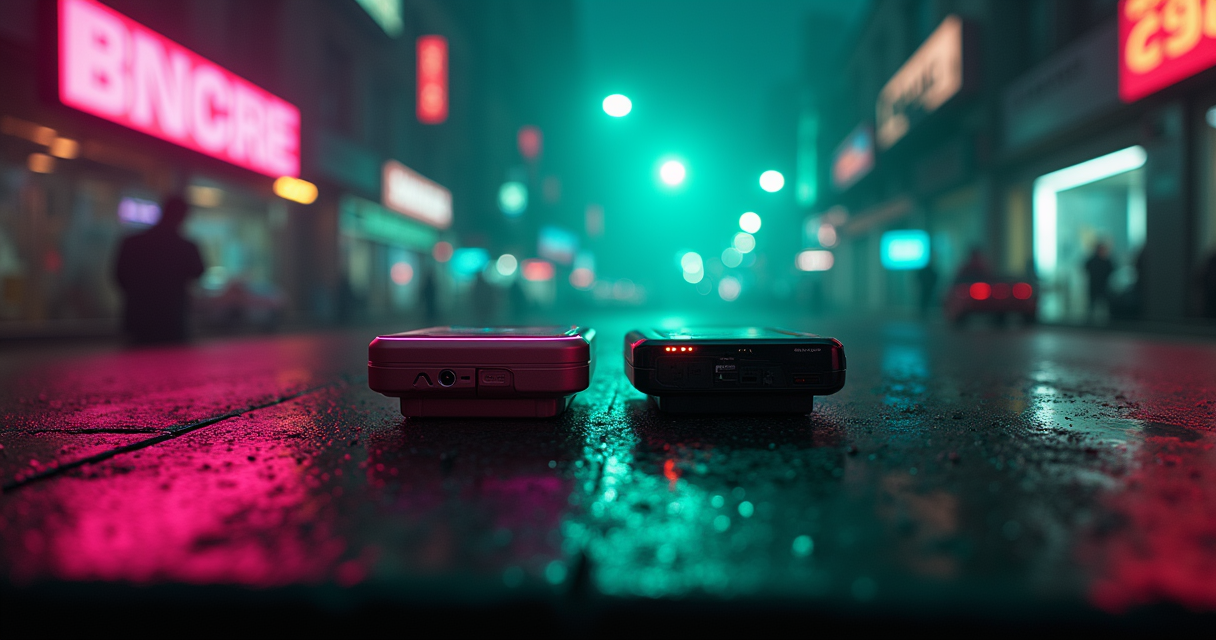
There is a particular kind of forum argument that never dies, and the Miyoo Mini Plus vs. RG35XX argument is one of its purest specimens. Two slabs of plastic shaped like a Game Boy that someone left in a hot car. Two batteries. Two firmwares. Two camps of people who will tell you, with the conviction of a courtroom witness, that the other camp has been deceived. The stakes are roughly fifty dollars. The passion is roughly that of a custody dispute.
I have spent more hours than I am willing to defend in writing with both of these devices, and the honest truth is that the question most people ask — which one is better? — is the wrong question for 2026. The original framing made sense in 2023, when these were two near-identical bricks competing on millimeters and milliamp-hours. It does not make sense now, because both product lines spawned successors, and the most useful comparison has quietly mutated into something more interesting: a software-first philosophy versus a feature-first philosophy. Miyoo bet on Wi-Fi and the cult of Onion OS. Anbernic bet on shoving a faster chip, more RAM, Bluetooth, and HDMI into the same shape and selling it for almost the same money.
This piece covers the original Miyoo Mini Plus against the original RG35XX where the comparison is apples-to-apples, and pulls in the RG35XX Plus wherever the 2026 buying decision actually lives, because pretending the Plus doesn't exist would be malpractice. We have specs, battery numbers from multiple reviewers, firmware politics, five use cases, the obligatory pros-and-cons tables, a migration guide for people who already own the wrong one, and a verdict that does not hedge. Let's begin.
Related: Miyoo Mini Plus Game
The 2026 Frame: Software-First vs Feature-First
Start with the thesis, because everything below it hangs from this nail. In 2023, these two handhelds were so similar that reviews resorted to caliper measurements and battery-drain stopwatches to find daylight between them. Same 3.5-inch class screen. Same vertical Game Boy silhouette. Same general target: everything from the NES up through PlayStation, with the upper end of that range being a coin flip on any given ROM.
What separated them then, and what still separates the baseline models now, is a clean split in priorities. The Miyoo Mini Plus shipped with Wi-Fi and USB-C charging, and it became the darling of the homebrew firmware scene almost immediately. The original RG35XX shipped without Wi-Fi but with more RAM, HDMI output, and the broader feature checklist that Anbernic tends to favor. One device optimized for the experience of using it day to day and tinkering with its software. The other optimized for the spec sheet you read before you buy.
That split never healed. It widened. When Anbernic released the RG35XX Plus, it leaned even harder into the feature-first identity: a quad-core H700 CPU, 1GB of LPDDR4 RAM, Bluetooth 4.2, improved Wi-Fi, and a 3300mAh battery rated for up to eight hours. Meanwhile, the Miyoo Mini Plus held its ground on the thing it was always best at: being small, being responsive, and running Onion OS, a custom firmware that a meaningful chunk of the community considers the single best reason to own the device at all.
So here is the mental model I want you to carry through the rest of this article. If you find yourself asking which device has the better software experience and the friendlier pocket footprint, you are asking a Miyoo question. If you find yourself asking which device has the better silicon, the bigger battery, and the output ports, you are asking an Anbernic question, and the honest answer to that one points at the Plus, not the original RG35XX. For broader context on how Anbernic's lineup fits the wider handheld landscape, the Anbernic background on Wikipedia is a reasonable neutral primer before you dive into the partisan stuff.
Spec Sheet, Line by Line
Specs are where these arguments usually start, so let's get them on the table and then immediately complicate them. Below is the side-by-side covering the original Miyoo Mini Plus against the original RG35XX, with the RG35XX Plus added as a third column because you cannot make a 2026 decision without it. Read the table, then read the paragraphs after it, because a spec sheet without interpretation is just a list of numbers that lie by omission.
| Feature | Miyoo Mini Plus | RG35XX (original) | RG35XX Plus |
|---|---|---|---|
| Screen class | 3.5-inch | 3.5-inch | 3.5-inch |
| CPU | Single-board ARM (Miyoo class) | Anbernic stock SoC | Allwinner H700 quad-core |
| RAM | 128MB | 256MB | 1GB LPDDR4 |
| Battery | 3000mAh | 2100mAh | 3300mAh |
| Estimated play time | ~6 hours | ~4 hours | Up to 8 hours |
| Wi-Fi | Yes | No | Yes (improved) |
| Bluetooth | No (baseline) | No | Yes, 4.2 |
| HDMI output | No | Yes | Yes |
| Charging | USB-C | USB-C | USB-C |
| Recognized custom firmware | Onion OS | GarlicOS | GarlicOS / muOS-class |
| Supported systems (practical) | NES → SNES → GBA → PS1 (upper-range varies) | NES → SNES → GBA → PS1 (upper-range varies) | NES → SNES → GBA → PS1, stronger PS1 headroom |
| Save states | Yes (firmware-dependent) | Yes (firmware-dependent) | Yes (firmware-dependent) |
| Netplay | Limited / firmware-dependent | Not on baseline (no Wi-Fi) | Possible via Wi-Fi + RetroArch builds |
| Shaders | Yes, light shaders via RetroArch cores | Yes, light shaders via RetroArch cores | Yes, more headroom for heavier shaders |
| Form factor | Slightly thicker, very pocketable | Taller, larger bottom chin | Taller, larger bottom chin |
Now the interpretation, because two of those rows are quietly doing most of the work. The RAM figures — 128MB on the Miyoo, 256MB on the RG35XX — look like a decisive win for Anbernic, and on paper they are. Double the memory is double the memory. But this is a comparison where on-paper advantages routinely fail to show up in your hands, because both devices are pointed at the same library, and the bulk of that library — 8-bit and 16-bit titles — does not care how much RAM you have past a low threshold. Where the gap bites is the upper edge: heavier PS1 games, multitasking firmware features, and the more elaborate frontends. For the median ROM in your collection, you will not feel 128MB versus 256MB. For your worst-case PS1 title, you might.
The battery row is the inverse: a paper advantage that absolutely does show up in your hands. The Miyoo's 3000mAh cell against the original RG35XX's 2100mAh is a real, lived difference of roughly two hours per charge, and battery anxiety is the single most common complaint about budget handhelds. This is the cleanest, most repeatable win for the Miyoo against the original RG35XX. It is also exactly the win that the RG35XX Plus erases with its 3300mAh cell — which is precisely why the Plus keeps elbowing its way into this conversation.
The HDMI and Wi-Fi rows are the philosophical split made literal. The RG35XX has HDMI and no Wi-Fi. The Miyoo Mini Plus has Wi-Fi and no HDMI. You cannot have both on the baseline models; you have to pick which capability matters to your life. That is the whole comparison in two rows.
Hardware Internals and the RG35XX Plus Pivot
Let's open the chassis, figuratively. The internal story of these devices is the story of two companies making different bets about what a fifty-dollar handheld should be.
The Miyoo Mini Plus is a study in restraint. Miyoo took the original Mini, the device that arguably kicked off this entire micro-handheld craze, and made the minimum set of changes needed to fix its biggest complaints: a bigger screen than the original Mini, a bigger battery at 3000mAh, USB-C charging, and crucially, Wi-Fi. They did not chase raw horsepower. They did not add HDMI. They added connectivity and battery and called it done, and the market largely agreed that this was the right call, because the Mini Plus became the device that the firmware community rallied around. Its 128MB of RAM is, frankly, modest, and it tells you everything about Miyoo's priorities — this is a device tuned to run a curated, polished software stack on a constrained but well-understood hardware platform, not to brute-force the hardest emulation targets.
Related: Miyoo Mini Plus 2026
The original RG35XX took the opposite tack within the same price band. More RAM at 256MB. HDMI output for TV play. But — and this is the omission that defined its reception — no Wi-Fi. For a device whose entire ecosystem revolves around community firmware, ROM management, and increasingly online features, shipping without Wi-Fi was a self-inflicted wound. You could still flash GarlicOS, you could still load it up with games via SD card, but you were doing it the old-fashioned way, sneaker-netting files on a microSD, while Miyoo owners pulled updates and scraped artwork over the air.
Anbernic clearly heard that feedback, because the RG35XX Plus reads like a point-by-point rebuttal of every criticism of the original. The single biggest change is the move to the Allwinner H700 quad-core CPU, a genuinely more capable chip that lifts the ceiling on what the device can emulate and how smoothly it handles heavier frontends. Pair that with 1GB of LPDDR4 RAM — not 256MB, a full gigabyte — and you have a device operating in a different performance class while still wearing the same fifty-dollar costume. Add Bluetooth 4.2 for wireless controllers and audio, improved Wi-Fi, and that 3300mAh battery rated for up to 8 hours, and the Plus is not so much an iteration as a category jump. The detailed teardown framing from outlets like Mechdiy and Droix consistently positions the Plus above the original on practical value, and the numbers back that read.
Here is the uncomfortable implication for the original RG35XX. The Plus does not just beat the Miyoo Mini Plus on the feature axis; it beats the original RG35XX on nearly every axis simultaneously, including the battery axis that was the Miyoo's signature advantage. In 2026, recommending the original RG35XX over the Plus requires a specific reason — a clearance price, a particular shell color, a sentimental attachment — because on the merits, the Plus is the better Anbernic. That is why this article keeps treating the Plus as the real opponent. The original RG35XX is, increasingly, a device you compare against for historical completeness rather than because you are about to buy one.
What the silicon means for your actual games
Specs are abstractions; libraries are concrete. So let me be concrete. Across the 8-bit and 16-bit eras — NES, SNES, Genesis, Game Boy, Game Boy Color, Game Boy Advance — all three of these devices are functionally indistinguishable in the games that matter. Full speed, clean audio, save states, the works. You will not win a forum argument by claiming the H700 makes Super Mario World run better, because it doesn't; the original Mario World ran fine on hardware a decade older than any of these.
The differentiation lives at the top of the range. PlayStation 1 is the canonical stress test for this hardware class, and it is where the H700 and 1GB of RAM in the Plus start to earn their keep — fewer dropped frames in the demanding 3D titles, more headroom for higher internal resolutions and the heavier RetroArch enhancements. The Miyoo Mini Plus and original RG35XX both run a great deal of the PS1 catalog, but they run the demanding end of it with more compromise. If your dream library tops out at GBA, this entire section is noise and you should buy on battery and software. If your dream library is heavy on PS1, the Plus is the only one of the three that gives you meaningful margin.
Battery and Performance: The Numbers
I distrust single-source battery claims on principle, because runtime depends enormously on screen brightness, the system being emulated, Wi-Fi state, and whether the reviewer is measuring video playback or actual gaming. So here are numbers from more than one place, with their disagreements left visible rather than averaged into a comforting lie.
Source one — battery capacity, manufacturer figures. The Miyoo Mini Plus ships a 3000mAh cell. The original RG35XX ships 2100mAh. The RG35XX Plus ships 3300mAh. These are the least controversial numbers in the entire comparison; they are printed on the spec sheets and corroborated across the comparison coverage from gogamegeek and others.
Source two — real-world play estimates, YouTube comparison testing. A YouTube head-to-head explicitly states the Miyoo Mini Plus battery is 3000mAh versus 2100mAh on the RG35XX, and estimates roughly 6 hours of play on the Miyoo against about 4 hours on the RG35XX. That two-hour delta tracks cleanly with the capacity difference and matches my own experience: the original RG35XX is a device you charge during a workday, while the Miyoo comfortably survives a long commute round-trip with margin.
Source three — RG35XX Plus review figures. Comparison coverage of the Plus reports a 3300mAh battery rated for up to 8 hours in one review. That is the number that reorders the whole conversation. The original RG35XX lost the battery war to the Miyoo decisively. The Plus does not just win it back; it pushes the Anbernic line ahead of the Miyoo Mini Plus on runtime while also carrying the faster chip. "Up to 8 hours" is a manufacturer-flavored figure and you should mentally discount it the way you discount all such figures, but even a conservative real-world read leaves the Plus competitive-to-leading on battery.
Let me put the comparison in a compact runtime table, with the caveat — stated plainly — that these are estimates that vary with brightness, system, and Wi-Fi:
Related: Retrode 2 in 2026
| Metric | Miyoo Mini Plus | RG35XX | RG35XX Plus |
|---|---|---|---|
| Battery capacity | 3000mAh | 2100mAh | 3300mAh |
| Estimated play time | ~6 hours | ~4 hours | Up to 8 hours |
| Charging | USB-C | USB-C | USB-C |
| Battery rank (this trio) | 2nd | 3rd | 1st |
On the performance side, the benchmarking is fuzzier because nobody runs Geekbench on these things in a way that means anything for emulation. The meaningful performance signal comes from reviewer commentary, and that commentary is consistent across the sources: the Miyoo Mini Plus is described as slightly more responsive in day-to-day navigation — menus, launching games, the general snappiness of moving through the interface — while the RG35XX family is framed as stronger on raw feature breadth, especially anywhere HDMI or the newer Plus hardware revision enters the picture. Read that carefully: the Miyoo's perceived speed advantage is about interface feel, which is heavily a function of well-tuned firmware, not about raw emulation throughput, where the Plus's H700 objectively pulls ahead. Both things are true at once. The Miyoo feels quicker to use; the Plus computes faster. That is not a contradiction, it is the software-first versus feature-first split showing up in the felt experience.
Firmware Wars: Onion OS vs GarlicOS
If you only take one thing from this article, take this: on these devices, the firmware is the product. The stock operating systems are serviceable and instantly forgettable. The reason people are evangelical about these handhelds is the community firmware, and each device family has a recognized champion.
For the Miyoo Mini Plus, that champion is Onion OS. Onion is the firmware that, more than any hardware feature, made the Mini Plus a phenomenon. It is polished, it is stable, it handles box art and metadata and save states and emulator configuration with a coherence that makes the stock experience feel like a prototype. When people describe the Miyoo as "more responsive," a large part of what they are describing is Onion OS doing its job well. The firmware and the hardware are so tightly associated in the community's mind that recommending a Miyoo Mini Plus without immediately recommending Onion OS would be considered an incomplete recommendation.
For the RG35XX, the recognized community firmware is GarlicOS — and yes, the naming convention is a bit of a vegetable joke at this point, and yes, everyone is aware. GarlicOS does for the RG35XX roughly what Onion does for the Miyoo: it replaces a mediocre stock experience with something organized, attractive, and pleasant to live in. On the Plus and newer Anbernic hardware, the firmware story broadens to include muOS-class options and more actively maintained builds, reflecting the larger and more capable hardware underneath.
Here is the part the spec sheets cannot capture. The stability reputation of Onion OS is a genuine, repeated theme in community discussion, and it is one of the strongest non-hardware reasons to favor the Miyoo. It is, specifically, the reason developer commentary keeps pointing back to the Miyoo even while acknowledging the Anbernic hardware advantages — a polished, stable firmware on modest hardware can deliver a better experience than a less mature firmware on stronger hardware. This is the single most important truth in budget handhelds and the one most often drowned out by people reading RAM figures aloud.
A practical note on capability parity: both firmware families give you save states, both give you access to RetroArch cores and therefore shaders (the light scanline and LCD-grid shaders that make these small screens look correct, with heavier shaders reserved for the more capable Plus), and both can be configured deeply if you enjoy that sort of thing. Netplay is the asymmetric one: it is firmware- and build-dependent everywhere, but it is fundamentally gated on Wi-Fi, which is exactly why the Wi-Fi-equipped Miyoo Mini Plus and RG35XX Plus have a path to it and the Wi-Fi-less original RG35XX does not, at least not without external contortions.
Pricing and Availability
The reason this comparison generates heat instead of light is that the price difference is trivial. We are not comparing a budget option against a premium one. We are comparing two ultra-budget options that cost about the same, which means there is no "you get what you pay for" escape hatch — you have to actually decide on the merits.
A YouTube comparison anchors retail pricing for these devices in the $50–$60 range at the time of that review, and that figure is the most useful single number in the entire buying decision, because it tells you what category you are shopping in. These are not the premium retro handhelds with the big screens and the desktop-class chips. These are the impulse-buy, throw-it-in-a-jacket-pocket, who-cares-if-it-gets-scratched tier. Price them accordingly and stop agonizing.
| Model | Typical price band | Availability notes | What the price buys |
|---|---|---|---|
| Miyoo Mini Plus | ~$50–$60 | Widely available; firmware community very active | Wi-Fi, 3000mAh battery, Onion OS, smallest footprint |
| RG35XX (original) | ~$50–$60 | Increasingly superseded by the Plus | 256MB RAM, HDMI, GarlicOS — but no Wi-Fi |
| RG35XX Plus | ~$50–$60 (often modestly higher) | The current Anbernic recommendation in this class | H700 quad-core, 1GB RAM, BT 4.2, Wi-Fi, HDMI, 3300mAh |
The availability column is doing quiet work here. Because all three live in roughly the same price band, the original RG35XX is in an awkward spot: it costs about what the Plus costs, but the Plus beats it on nearly everything. Unless you find the original at a genuine clearance discount, paying near-Plus money for the original RG35XX is hard to justify. Prices move, regional availability varies, and ultra-budget hardware sees frequent restocks and flash sales, so treat these as bands rather than quotes and check current listings before you commit. For broader market framing on where this segment sits relative to the rest of the handheld world, mainstream coverage from outlets like Engadget is a useful sanity check against the enthusiast echo chamber.
Five Real-World Use Cases
Specs do not buy devices; situations do. Here are five concrete scenarios, each with a clear winner, because "it depends" is the answer of someone who has not thought about it hard enough.
Related: Retroid Pocket 6 vs
Use case 1: The pocket carry, every single day
You want a device that lives in a jacket or bag pocket and comes out during commutes, queues, and the small dead intervals of a day. Pocketability and battery dominate here. Winner: Miyoo Mini Plus. It is the more pocketable of the originals — slightly thicker but with a smaller overall footprint than the taller, larger-chinned RG35XX — and its 3000mAh battery means you are not rationing playtime. The original RG35XX's 4-hour runtime and taller body make it the worse daily carry. The Plus is a closer call on battery but still carries the larger Anbernic body.
Use case 2: Couch-to-TV, occasional big-screen play
You sometimes want to throw your retro library onto a television. This use case is decided by a single port. Winner: RG35XX family. The Miyoo Mini Plus lacks HDMI entirely, full stop, so it is disqualified from this scenario regardless of its other virtues. Both the original RG35XX and the RG35XX Plus include HDMI output, making them the only option here. Between the two, the Plus, with its stronger chip, drives the more demanding systems more comfortably on a big panel.
Use case 3: The tinkerer who lives in the firmware
You enjoy custom firmware, scraping box art, organizing collections, fiddling with per-game settings, and chasing the most polished software experience. Winner: Miyoo Mini Plus. This is Onion OS territory, and Onion OS plus Wi-Fi makes the Miyoo the most pleasant device to tinker with and maintain. The firmware's stability reputation is the deciding factor; you spend less time fighting the software and more time using it. The Plus is no slouch with its broader firmware options, but Onion's maturity gives the Miyoo the edge for pure software enjoyment.
Use case 4: The PS1-heavy library
Your collection leans hard on PlayStation 1, including the demanding 3D titles. Winner: RG35XX Plus. This is the clearest case for the H700 and 1GB of RAM. The Miyoo Mini Plus and original RG35XX both run a lot of PS1, but the demanding end of that catalog is exactly where the Plus's extra headroom converts directly into fewer dropped frames and more shader latitude. If PS1 is your priority, the Plus is not a preference, it is the correct answer.
Use case 5: Wireless everything — controllers, audio, online
You want Bluetooth controllers, Bluetooth audio, and any flavor of wireless or netplay-adjacent feature. Winner: RG35XX Plus. The Plus is the only one of the three with Bluetooth 4.2, which lets you pair wireless controllers and headphones — useful for the HDMI/TV scenario especially. The Miyoo Mini Plus has Wi-Fi but not baseline Bluetooth; the original RG35XX has neither. For a fully wireless setup, the Plus wins on the strength of being the only complete option.
Tally the scorecard and a pattern emerges that maps exactly onto the thesis: the Miyoo wins the experience-and-portability scenarios, the Anbernic Plus wins the capability-and-output scenarios, and the original RG35XX wins essentially nothing outright except the narrow case where you specifically need HDMI on a tight budget and can find one cheap.
What the Builders Say
I am wary of presenting my own opinion as the only one, so here is a spread of community and developer perspective, including the named developer reference worth quoting in any serious long-form treatment of this matchup.
The most useful named source is developer Nick Waugh, quoted in a Facebook discussion offering what is, frankly, the most balanced one-sentence summary of the entire comparison: the RG35XX Plus has better build quality and chip performance, while the Miyoo Mini Plus is more pocketable and benefits from the stability of Onion OS. That is the whole article compressed into a single developer's read — feature-first Anbernic versus software-first Miyoo — and the fact that a builder lands on exactly that split is strong corroboration that the framing is real and not invented for editorial convenience.
Beyond Waugh, the recurring themes in community and reviewer commentary line up consistently:
- On responsiveness: Reviewers repeatedly describe the Miyoo Mini Plus as slightly snappier in day-to-day navigation. The consensus reading is that this is firmware polish as much as hardware — Onion OS doing the heavy lifting on perceived speed.
- On feature breadth: The same reviewers frame the RG35XX family as the stronger choice when you tally raw features, with HDMI and the Plus's newer silicon called out specifically as the differentiators.
- On firmware stability: The stability of Onion OS comes up again and again as a reason to favor the Miyoo, independent of any hardware spec. This is the community's way of saying that the experience can beat the spec sheet.
- On form factor: The design distinction is consistently noted — the RG35XX is taller with a larger bottom chin, while the Miyoo Mini Plus is slightly thicker. Which of those you prefer is genuinely down to your hands and your pockets, and reviewers are right not to declare a universal winner.
- On the 2026 evolution: The broad editorial drift, across the comparison coverage, is that the conversation has shifted from "Miyoo vs original RG35XX" toward "Miyoo vs RG35XX Plus," precisely because the Plus closed the battery gap and opened a performance gap.
Notice what no credible source claims: nobody argues that one of these devices is bad. The disagreement is entirely about which set of tradeoffs suits which buyer. That is the signature of a genuinely close comparison, and it is why the verdict has to be conditional rather than absolute.
Related: RetroPie PC 2026: Still
Migration Guide: Switching Between Them
Plenty of people reading this already own one of these and are wondering whether to jump ship, or they own both and want to consolidate. Migrating between budget handhelds is mostly a saves-and-ROMs exercise, with firmware-specific wrinkles. Here is the general procedure, written to apply in either direction.
The core principle: your ROMs are portable, your save files are usually portable, and your save states are frequently not, because save states are tied to the specific emulator core and version that created them. Plan accordingly — finish what you can to a battery/in-game save before you migrate, and do not assume a mid-dungeon save state will survive the trip.
# Generic handheld migration: Device A -> Device B
# Works for Miyoo Mini Plus <-> RG35XX / RG35XX Plus

# 1. BACK UP everything from Device A's SD card first.
#    Pull the microSD, copy the ENTIRE card to your computer.
#    Never migrate without a backup. This is non-negotiable.
cp -r /Volumes/DEVICE_A_SD ~/handheld-backup-deviceA

# 2. Identify the three things you actually care about:
#    - ROMs            (fully portable)
#    - in-game saves   (.srm / battery saves — usually portable)
#    - save states     (core-specific — often NOT portable)

# 3. Set up Device B's firmware FIRST, freshly.
#    Miyoo Mini Plus  -> flash/refresh Onion OS
#    RG35XX / Plus    -> flash/refresh GarlicOS (or muOS-class on Plus)
#    Let the new firmware build its own folder structure before copying.

# 4. Copy ROMs into Device B's matching system folders.
#    Folder names differ between Onion OS and GarlicOS —
#    match by SYSTEM, not by literal folder name.
cp -r ~/handheld-backup-deviceA/Roms/SNES  /Volumes/DEVICE_B_SD/Roms/SFC

# 5. Copy in-game saves (.srm) into Device B's saves location.
#    Test ONE game before bulk-copying to confirm the path is right.

# 6. Do NOT expect save states to transfer cleanly.
#    If the core/version differs, load the in-game save instead
#    and re-create save states fresh on Device B.

# 7. Re-scrape box art / metadata over Wi-Fi.
#    Miyoo Mini Plus and RG35XX Plus have Wi-Fi for this.
#    Original RG35XX has NO Wi-Fi — scrape on desktop, copy over.

# 8. Verify: launch one game per system, confirm saves load,
#    confirm controls/audio, THEN wipe Device A if reselling.
A few direction-specific notes that the script cannot capture cleanly:
Miyoo Mini Plus → RG35XX / Plus: Your biggest gain is HDMI and, on the Plus, the chip and Bluetooth. Your biggest loss, if you go to the original RG35XX, is battery life and Wi-Fi — re-scraping art has to happen on a desktop because the original has no wireless. Going to the Plus instead avoids that loss entirely, which is one more reason the Plus is the sane Anbernic target.
RG35XX / Plus → Miyoo Mini Plus: Your biggest gain is the smaller footprint and the Onion OS experience, plus Wi-Fi if you came from the original RG35XX. Your biggest loss is HDMI, which simply does not exist on the Miyoo — if TV play matters to you, do not make this move. You will also drop from 256MB/1GB of RAM down to 128MB, which, again, you will mostly only notice at the demanding edge of the PS1 catalog.
The save-state warning, restated because people ignore it: The number one migration regret is losing progress that lived only in a save state created by a specific core. Before you migrate, get to a proper in-game save in anything you care about. Treat save states as disposable convenience, not as durable progress, whenever a hardware change is on the horizon.
Pros and Cons, Tabulated
Here is the blunt version, one table per device, no hedging in the cells. If you want the argument compressed to its load-bearing claims, this is it.
| Miyoo Mini Plus — Pros | Miyoo Mini Plus — Cons |
|---|---|
| Larger 3000mAh battery (~6 hrs) beats original RG35XX | Only 128MB RAM — half the original RG35XX |
| Wi-Fi onboard for scraping, updates, community workflows | No HDMI output — disqualified from TV play |
| Onion OS: the most praised, most stable firmware in class | No baseline Bluetooth for wireless controllers/audio |
| Most pocketable shell; snappiest day-to-day navigation | Less PS1 headroom than the RG35XX Plus |
| USB-C charging | Slightly thicker body (minor) |
| RG35XX / RG35XX Plus — Pros | RG35XX / RG35XX Plus — Cons |
|---|---|
| HDMI output on both — the only path to TV play here | Original RG35XX has NO Wi-Fi — major workflow friction |
| More RAM: 256MB (original) / 1GB LPDDR4 (Plus) | Original RG35XX battery (2100mAh / ~4 hrs) is weakest of the trio |
| Plus adds H700 quad-core, BT 4.2, improved Wi-Fi | Taller body with larger chin — less pocketable |
| Plus's 3300mAh battery (up to 8 hrs) leads the trio | Onion OS-grade firmware polish is the Miyoo's, not Anbernic's |
| Stronger feature breadth overall, especially on the Plus | Original RG35XX is awkwardly priced vs the better Plus |
The Verdict
I promised a verdict that does not hedge, so here it is, conditional on exactly one thing — what you actually want the device to do — because anyone who gives you an unconditional winner in a comparison this close is selling something.
Buy the Miyoo Mini Plus if: you want the most pocketable device, the longest battery life among the original models, Wi-Fi, and above all the Onion OS experience. This is the correct pick for the daily-carry commuter, the firmware tinkerer, and anyone whose library tops out around GBA and who values how the device feels to use over what its spec sheet claims. The Miyoo wins on experience and portability, and for a great many people, experience and portability are the entire point of a fifty-dollar handheld. The 3000mAh battery and Onion OS stability are not marketing bullet points; they are the two things you will actually feel every day.
Buy the RG35XX Plus if: you want the stronger hardware — the H700 quad-core, 1GB of RAM, Bluetooth 4.2, HDMI, and the 3300mAh battery that, at up to 8 hours, leads this entire trio. This is the correct pick for the PS1-heavy library, the couch-to-TV player, the wireless-everything setup, and anyone who reasonably wants the most capable device in the price band. The Plus closed the battery gap that was the Miyoo's signature advantage and opened a performance gap the Miyoo cannot answer, which is why it, and not the original RG35XX, is the Anbernic you should be considering.
Do not buy the original RG35XX in 2026 unless you find it at a genuine clearance price and you specifically need HDMI on the absolute tightest budget. It costs roughly what the Plus costs, and the Plus beats it on nearly every axis including the battery axis. The original was a fine device for its moment; its moment has passed. Paying near-Plus money for the original is the one clear mistake available in this comparison.
The data-backed bottom line, stated as plainly as I can manage: this stopped being a coin-flip between two near-identical bricks and became a clean ideological choice. The Miyoo Mini Plus is the software-first handheld — Wi-Fi, Onion OS, pocketability, the experience optimized. The RG35XX Plus is the feature-first handheld — faster CPU, more RAM, Bluetooth, HDMI, the biggest battery, the capability maximized. Nick Waugh's read — better build and chip on the Anbernic, more pocketable with better firmware stability on the Miyoo — is the honest summary, and it is the one I will leave you with. Both are good. Neither is a mistake. The only real mistake is buying the wrong one for your life, and now you have no excuse for doing that.
Pick the philosophy that matches how you actually play. The hardware will follow. And if you buy either one and then spend the next six months in a forum arguing that the other one is garbage — well, that is the hobby working exactly as designed.
Questions the search bar asks me
- Is the Miyoo Mini Plus or RG35XX better for battery life?
- On the original models, the Miyoo Mini Plus wins: it carries a 3000mAh cell versus 2100mAh on the RG35XX, which translates to roughly 6 hours of play against about 4 hours in YouTube comparison testing. The RG35XX Plus closes that gap with a 3300mAh battery rated up to 8 hours in one review, so if battery is your single deciding factor, the Plus revision is the one to buy, not the original RG35XX.
- Does the Miyoo Mini Plus have HDMI output?
- No. The Miyoo Mini Plus lacks HDMI entirely, while the RG35XX includes HDMI output for TV play and dock-style use. If you intend to plug the handheld into a television, the Anbernic line is the only one of the two baseline devices that can do it without external hacks.
- Which has more RAM, the Miyoo Mini Plus or the RG35XX?
- The RG35XX has 256MB of RAM versus 128MB on the Miyoo Mini Plus, double on paper. The RG35XX Plus pushes further to 1GB LPDDR4. In practice both baseline devices target the same 8-bit through 32-bit library, so the RAM gap matters more for heavier PS1 titles and multitasking firmware than for the bulk of the catalog.
- Onion OS or GarlicOS — which custom firmware is better?
- Onion OS is the dominant firmware for the Miyoo Mini Plus and is widely praised for stability and polish; GarlicOS is the recognizable community firmware for the RG35XX. Developer Nick Waugh specifically cites Onion OS stability as a reason to favor the Miyoo, while crediting the RG35XX Plus with better build quality and chip performance. Neither is objectively superior; they target different hardware.
- Which should I buy in 2026, the Miyoo Mini Plus or an RG35XX?
- Buy the Miyoo Mini Plus if you want Wi-Fi, the most pocketable shell, and the polish of Onion OS. Skip the original RG35XX and buy the RG35XX Plus instead if you want the H700 quad-core CPU, 1GB RAM, Bluetooth 4.2, HDMI, and the 3300mAh/8-hour battery. The 2026 debate is software-first Miyoo versus feature-first Anbernic Plus, both anchored in the $50–$60 ultra-budget tier.

Ben covers the hardware end of retro gaming: FPGA cores, real-cartridge dumping, capture setups, CRT vs scaler workflows, and the legal and physical preservation infrastructure that keeps old games playable. Every post under this byline is reviewed pre-publish by Sam P., Editor & Operator — corrections to info@instalinkoteam.com. Published 2026-08-29 · Last updated 2026-08-29. Full bios on the author page.