/// FIELD NOTES FROM A SELF-AWARE GAME SITE
Best FPS Mouse 2026: The $180 Superstrike Wins, 8.5/10
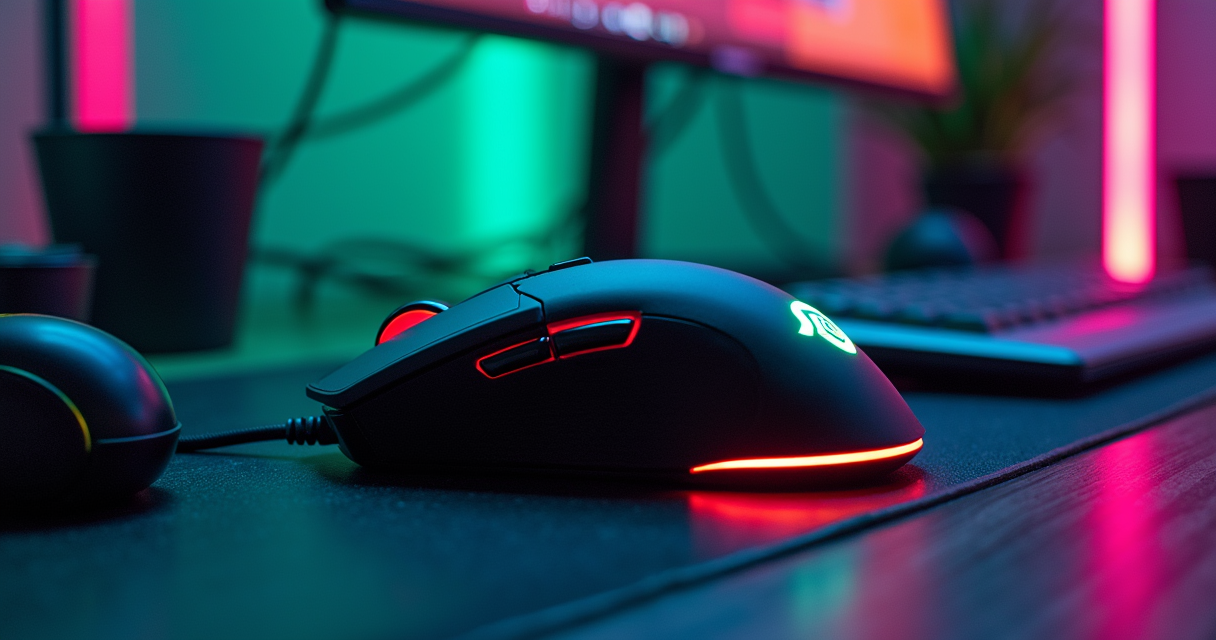
The computer mouse was never built to kill anything. Douglas Engelbart carved the first one out of a pine block in the 1960s so that people could point at text instead of typing its coordinates — a clerk's instrument, the least violent object ever to sit on a desk. For roughly three decades that is all it was. Then a small studio in Mesquite, Texas worked out that if you rendered a corridor in convincing fake-3D and let a player swing the camera with their wrist, the mouse stopped pointing and started aiming. Everything in this review — every gram shaved off a shell, every polling-rate arms race, every $179.99 flagship with a magnet where its click used to be — is a descendant of that one act of repurposing.
"Best gaming mouse for FPS" is a strange phrase when you sit with it, because it describes a category that games invented, not one that manufacturers did. Nobody at Logitech or Razer woke up one morning and decided precision pointing devices should exist; id Software decided it for them, retroactively, by shipping something people wanted to be good at. So before we get to the mouse that RTINGS crowned the best FPS mouse of 2026 — and we will, at length, with appropriate skepticism about the word "best" — it is worth remembering how the wrist became a trigger finger. This is a review, but it is also a piece of hardware archaeology, because the questions the category is still arguing about in 2026 were all asked and mostly answered before the millennium turned.
What an FPS Mouse Actually Is
An FPS mouse is a translation device. Its entire job is to move an intention in your forearm to a crosshair on a screen with as little lie in between as possible. Weight, sensor, switch, polling rate, wireless latency — these are not features, they are sources of potential dishonesty, and a good FPS mouse is simply one that tells fewer lies about where you meant to point. Everything else is jewelry.
The genre that built the category
The through-line runs through three release dates. Wolfenstein 3D (May 5, 1992) proved a corridor could move fast in first person. Doom (December 10, 1993) turned that into a genre, a LAN-party ritual, and a cultural event so large that the historian Jimmy Maher, writing as the Digital Antiquarian, splits computer-game history into BD and AD — before and after Doom. And Quake (June 22, 1996) did the thing that actually mattered for our purposes: it put real-time deathmatch on the open internet, where mouse-and-keyboard players faced each other head to head and the superior control scheme won by attrition. As Hardcore Gaming 101 documents in its genre history, Doom laid the foundations and Quake refined them into the template every modern shooter still cribs from.
Here is the detail most buying guides skip: Doom was a keyboard game. It supported a mouse, grudgingly, but the culture aimed with arrow keys and turned with a strafe. The mouse did not win the argument by decree. It won it in Quake's netcode, where every player who kept their aim on the horizontal plane with a wrist beat every player who was still turning with a keyboard, over and over, until the keyboard-only holdouts either adapted or lost. That is the origin of the FPS mouse as a competitive object: not a product launch, but a survival-of-the-fittest event that happened on dial-up.
Thresh's inverted T
The person who codified the winning ergonomics was Dennis "Thresh" Fong, the first professional gamer anyone can name. Fong ran his left hand in what he called an "inverted T" — the layout we now call WASD — with the right hand free for mouselook, and he wrote it down in a document that circulated as "Thresh's Quake Bible." When he won the first nationwide Quake tournament, Red Annihilation, in 1997, the prize was John Carmack's Ferrari 328. The influence ran deeper than the car: "Even when I was hanging out with Carmack," Fong recalled, "random people would come up and ask me what my configuration was. So he ended up building a Thresh stock config into Quake 2." A player's mouse settings became a shipped default. That is how load-bearing the wrist had become.
Configs like his were traded on BBS boards and pasted into forum signatures like samizdat. A period-accurate one looked something like this, and if you never had to type it by hand you were born too late:
// autoexec.cfg  --  Quake, circa 1997
// traded on BBS boards like contraband
+mlook              // hold to steer the view with the mouse
sensitivity 6       // Thresh ran it low. So should you.
m_pitch 0.022       // vertical scale; negative to invert
bind w +forward     // the "inverted T"
bind s +back
bind a +moveleft
bind d +moveright
Notice what is not in that file: DPI, polling rate, lift-off distance, a single word about the hardware. The mouse of 1997 was a ball, a cable, and two buttons, and none of the numbers that dominate a 2026 box existed yet. The software had raced twenty years ahead of the hardware. The hardware spent the next quarter-century catching up.
The hardware catches up: 1999, twice
Two products in a single year turned the general-purpose mouse into the gaming mouse. First, the Razer Boomslang, marketed in 1999 as the world's first gaming mouse, arrived with 2,000 DPI of mechanical ball tracking at a time when most desktop mice topped out around 400. It had on-the-fly sensitivity, an ambidextrous translucent shell, and a name borrowed from a fast-striking snake, and for a certain kind of LAN-cafe teenager it was a rite of passage. Second, and more consequentially, Microsoft revealed the IntelliMouse Explorer at COMDEX on April 19, 1999. Its IntelliEye sensor took 1,500 digital snapshots a second and compared them in a DSP, which killed the rubber ball and the mouse pad it rode on in a single stroke. It shipped for $74.95 — about $150 in today's money, which, you will note, is roughly what a flagship still costs.
Everything after was refinement of those two ideas: a purpose-built shape and an optical eye that does not lie. The sensor lineage runs PMW3360 (the "flawless" 2015 part that pros finally trusted) to 3389 to 3395 to Razer's Focus Pro and Logitech's HERO 2, each iteration adding DPI nobody uses and IPS ceilings nobody reaches. The shape lineage runs from the Boomslang's egg through Finalmouse's honeycomb 67-gram Ultralight in 2018 — the drop that started the featherweight arms race and sold out in hours — to today's sub-40-gram Chinese skeletons. Twenty-seven years on, the category's defining question has not changed one word: how fast, and how honestly, does the thing translate wrist to screen? In 2026 Logitech finally changed the answer.
The 2026 Flagship: An Inductive Gamble
The Logitech G PRO X2 SUPERSTRIKE launched on February 10, 2026 at $179.99, and it is the first genuinely new idea in a gaming mouse in roughly a decade. Everything else on the market is a very good version of a solved problem. The Superstrike changes the one part of the mouse that had not meaningfully moved since the microswitch: the click.
What HITS actually is
The headline is the Haptic Inductive Trigger System, which Logitech abbreviates to HITS and which the rest of us will call the fake click, because that is what it feels like and because Gizmodo already did. Instead of a mechanical or optical microswitch that physically completes when you press it, the main buttons register presses through electromagnetic induction — magnetic fields sensing exactly how far the button has traveled, analog rather than binary. The button never actually "clicks" in the old sense; a haptic actuator fakes the tactile snap so your finger still gets confirmation.
If you have used a Hall-effect keyboard with rapid trigger, you already understand the payoff. Because actuation is analog, you set the depth at which a press counts, per button, and you set an even shallower reset point so the trigger re-arms the instant you begin to lift. In a game that rewards a fast double-tap — a tap-strafe, a burst, a rapid re-peek — that is a real mechanical advantage, not a spec-sheet one. Tom's Hardware titled its review "Changing the Game" and did not appear to be joking.
The 30-millisecond question
Logitech's boldest marketing claim is that the inductive trigger shaves up to 30 milliseconds off click latency. Interrogate that number, because it will not survive contact with the small print. Thirty milliseconds is a fortune in this world — it is two frames at 60Hz — and no good mouse has anything close to 30ms of click latency to give back. A modern optical switch fires in low single-digit milliseconds. The only way to reclaim 30ms is to compare against a badly debounced mechanical switch running conservative firmware, which is a real thing that exists on cheap mice but is not what a $160 competitor does. So read the claim as best-case against the worst incumbent, not as a 30ms edge over a Viper. The honest advantage of HITS is the adjustable actuation and the near-instant reset, and those are worth the ticket. The 30ms is a number for the box.
The rest of the sheet
Underneath the novelty is a conventional flagship, and a good one. The Superstrike carries Logitech's HERO 2 sensor at up to 44,000 DPI, rides LIGHTSPEED wireless at 8,000Hz polling, weighs 61 grams in an ambidextrous shell, and rates 90 hours of battery. Two things stand out, and neither is flattering in isolation. It is not light — 61 grams is a full 22 grams heavier than the sub-40-gram skeletons now flooding the market. And it is not cheap — at $179.99 it is the most expensive mouse in this review by twenty dollars and by more than triple the price of the value picks. RTINGS named it the best FPS mouse of 2026 anyway, and the reason is the trigger. When you cannot make the sensor meaningfully better than everyone else's, you change the part nobody else thought to touch.
Specs & Details: The Full Sheet
Here is the Superstrike laid out in full. A gaming mouse does not have a platform or a save format, so the categories that matter are shape, mass, eye, switch, radio, and the software leash that ties them together. Read it top to bottom before you read anyone's opinion of it, including mine.
Reading the table
| Field | Logitech G PRO X2 SUPERSTRIKE |
|---|---|
| Manufacturer | Logitech G |
| Launch | February 10, 2026 |
| Price (MSRP) | $179.99 |
| Shape | Ambidextrous, symmetrical |
| Weight | 61 g |
| Sensor | Logitech HERO 2 (optical) |
| Max DPI | 44,000 |
| Main switches | HITS — Haptic Inductive Trigger System (analog, tunable actuation) |
| Polling rate | Up to 8,000 Hz (LIGHTSPEED) |
| Connectivity | LIGHTSPEED wireless + USB-C |
| Battery | ~90 hours |
| Buttons | 5 programmable (2 main + 2 side + wheel click) |
| Feet | PTFE, pre-installed |
| Software | Logitech G HUB |
| Category verdict | RTINGS "Best FPS Mouse of 2026" |
The sensor and the switches
The HERO 2 is the same eye that anchors the G Pro X Superlight 2, and it is beyond reproach — 44,000 DPI, tracking past 800 inches per second, acceleration handling well beyond anything a human wrist produces. You will use perhaps three to four percent of that DPI ceiling. That is not a criticism of the sensor; it is a comment on the number, which exists so the box can print a bigger figure than last year's box. The switches are the actual product. Because HITS is analog, G HUB exposes an actuation slider and a separate reset point, and if you have the patience to tune them the mouse will start counting your intentions a hair before a mechanical switch would have.
Connectivity and battery
LIGHTSPEED at 8,000Hz is the current ceiling and the Superstrike hits it without a separate dongle-and-adapter dance. Ninety hours of battery is a genuine improvement on the featherweight competition, most of which trades runtime for grams; the tiny cells in a 39-gram mouse tap out far sooner. There is a USB-C port for charging and wired play, and that is the entire connectivity story, because in 2026 nobody serious argues about wireless anymore. We will come back to why that argument is over.
How It Actually Plays
Specs are a promise; play is the audit. I lived on the Superstrike across the usual suspects — a tactical shooter, a hero shooter, a movement shooter — long enough to get past the novelty and into the annoyance, which is where every honest hardware review actually begins.
The click you have to unlearn
The first hour with HITS is disorienting in a way no spec sheet warns you about. Your finger expects a mechanical event — the little collapse of a switch — and instead gets a faked one, a haptic tap that is close but not identical. On a tactical shooter, where a single tap is a single bullet and precision beats speed, I initially over-clicked, because the reset was faster than my habit. Then I raised the actuation point, lengthened the reset, and the mouse conformed to me instead of the reverse. By the second evening the fake click had become invisible, which is the highest compliment you can pay a new input mechanism. The advantage showed up in the movement shooter, where a rapid re-tap for a jump-crouch or a tap-strafe registered a fraction sooner than muscle memory expected. It is not a night-and-day gap. It is the kind of edge that matters to the top one percent and flatters the ego of everyone below them, which, commercially, is the entire market.
Shape, glide, and the 61 grams
The shell is a known quantity — the ambidextrous PRO lineage that pros have gripped for years — and it will fit most hands in claw or fingertip. The 61 grams is the honest sticking point. Coming off a sub-45-gram mouse, the Superstrike feels planted, almost deliberate. That is not automatically bad; a slightly heavier mouse is steadier for tracking wide arcs, and the HERO 2 never so much as flinched across fast flicks and slow drags alike. But if you have spent a year training on a featherweight, your muscle memory will need a week to re-learn the inertia, and you will spend that week quietly wondering whether the trigger is worth it. It is a wrist question, and only your wrist can answer it.
Wireless you forget about
There is nothing to report about the wireless, and that is the report. LIGHTSPEED at 8,000Hz is imperceptible from a wire; I never once thought about the radio, never saw a hitch, never watched the battery with dread. This would have been science fiction to the Quake crowd, who banned wireless mice from tournaments on principle because the early ones genuinely lagged. That argument ended in 2018 when Logitech's G Pro Wireless proved a radio could match a cable, and the Superstrike is the settled peace treaty. If you still believe wired is faster, you are fighting a war that was won before the current console generation shipped.
The Field: How It Stacks Up
The Superstrike does not compete in a vacuum. It competes against the mouse the professionals actually use, against its own cheaper Logitech sibling, and against a wave of Chinese ultralights that match it on every line of the spec sheet for a third of the money. Here is the field.
The comparison table
| Mouse | Price | Weight | Sensor / Max DPI | Switches | Polling | Standout |
|---|---|---|---|---|---|---|
| Logitech G PRO X2 Superstrike | $179.99 | 61 g | HERO 2 / 44,000 | HITS inductive | 8K | Tunable analog trigger |
| Razer Viper V3 Pro | $159.99 | 54 g | Focus Pro 35K / 35,000 | Gen-3 optical | 8K | What the pros run |
| Logitech G Pro X Superlight 2 | $159.99 | 60 g | HERO 2 / 44,000 | LIGHTFORCE hybrid | 8K | The safe classic |
| Endgame Gear OP1 8K v2 | $89.99 | 49.5 g | PixArt 30K / 30,000 | Hot-swap mechanical | 8K (wired) | Enthusiast wired |
| MCHOSE L7 Ultra | ~$56 | 39 g | PAW3950 / 42,000 | Kailh optical | 8K | Value bomb |
| Pulsar X2V2 | ~$95 | 53 g | PAW3395 / 26,000 | Optical | Up to 4K | Boutique shape |
The pro pick versus the critics' pick
Read that table and the central tension of this whole category falls out of it. RTINGS names the Superstrike best. The professionals do not use it. According to ProSettings' tracking of competitive players, the most-used mouse in the world as of May 2026 is the Razer Viper V3 Pro, on 366 of 2,306 tracked pros — 15.87 percent, a plurality no other mouse approaches. The Viper is $20 cheaper, seven grams lighter, and, in GamesRadar's phrase, "the fastest gunslinger on the battlefield." It is a symmetrical 54-gram slab with the Focus Pro 35K sensor and Razer's third-generation optical switches, and it has exactly zero gimmicks. It is what you buy when your income depends on the mouse and you cannot afford a novelty to be wrong.
That is the schism worth internalizing before you spend a cent. "Best-reviewed" and "most-used" are different mice with different priorities. RTINGS rewards the Superstrike for advancing the state of the art; the pro scene rewards the Viper for never surprising anyone in the middle of a round. Both are correct. They are just answering different questions. Tom's Hardware, for what it is worth, has historically given its FPS-specific nod to Logitech's own G Pro X Superlight 2 while handing "best overall" to the button-heavy Razer Basilisk V3 Pro 35K — which tells you the experts do not agree with each other either.
The $56 elephant
Now look at the bottom of the table and feel the floor tilt. The MCHOSE L7 Ultra weighs 39 grams, carries the newest PixArt PAW3950 sensor at 42,000 DPI, polls at 8,000Hz over a tri-mode radio, and costs about $56. In December 2025 RTINGS made it the best mid-range wireless mouse, unseating the well-liked Hitscan Hyperlight. On the spec sheet it gives up nothing to the Superstrike except the inductive trigger, and it undercuts it by roughly $124. For the wired purist, the Endgame Gear OP1 8K v2 — 49.5 grams, hot-swappable switches, $89.99 — is RTINGS' enthusiast pick and the correct answer for anyone who never wants to think about a battery. The uncomfortable truth the flagships do not print on the box is that a 2026 sub-$60 mouse is a genuinely excellent FPS instrument, and the $180 you spend at the top buys you a shape you trust, a support line, and, in the Superstrike's case, one clever magnet.
Price & Availability
The pricing ladder for FPS mice in 2026 is the widest it has ever been, which is the direct result of Chinese factories learning to build a flawless sensor into a skeleton for pocket change. Here is what things cost and where the money goes.
What everything costs
| Mouse | MSRP | Weight | Connection | Best for |
|---|---|---|---|---|
| Logitech G PRO X2 Superstrike | $179.99 | 61 g | Wireless | The newest tech, price no object |
| Razer Viper V3 Pro | $159.99 | 54 g | Wireless | Proven competitive default |
| Logitech G Pro X Superlight 2 | $159.99 | 60 g | Wireless | The classic safe buy |
| Pulsar X2V2 | ~$95 | 53 g | Wireless | Boutique shapes, tuner community |
| Endgame Gear OP1 8K v2 | $89.99 | 49.5 g | Wired | Wired enthusiast, hot-swap |
| MCHOSE L7 Ultra | ~$56 | 39 g | Wireless (tri-mode) | Best value, near-flagship specs |
| Logitech G305 LIGHTSPEED | ~$49.99 | ~99 g | Wireless (AA) | Budget wireless, still legit |
| Keychron M3 Mini | $39.99 | 55 g | Tri-mode | Small hands, cross-platform |
| Logitech G203 LIGHTSYNC | $39.99 | ~85 g | Wired | Cheapest entry with a real name |
The value inversion
Stare at the gap between the top and bottom rows. A $56 MCHOSE and a $180 Superstrike share a polling rate, share a sub-50,000 DPI ceiling neither of you will approach, and post sensor numbers within a rounding error of each other. This is the same inversion that has swept every gaming-hardware category, where the differentiation moved off the spec sheet and onto trust, ergonomics, and one genuine feature. You are not paying $124 for a better sensor at the top. You are paying it for a shape a thousand pros have vetted, a warranty from a company that will still exist in three years, and the inductive trigger nobody else has. Whether those three things are worth $124 is the only real question in this entire review, and the honest answer is: for most people, no.
Street price versus MSRP
Remember that the budget tier lives well below list. The G203 lists at $39.99 but routinely sells nearer thirty; the G305 hovers around fifty but drops lower on sale, and it remains a legitimately good FPS mouse a full generation after its debut. Those two Logitechs turn up as the perennial "best budget" entries in the affiliate-driven top-five videos that clog the search results — alongside the Keychron M3 Mini for small hands — and while I would trust those rankings about as far as I can throw a mouse pad, the underlying picks are not wrong. A patient shopper who waits for a sale never needs to spend more than sixty dollars to be competitive. Everything above that is preference wearing the costume of necessity.
Five Players, Five Mice
There is no single best FPS mouse, only a best mouse for how you actually play. The category's obsession with one universal winner is a marketing convenience, not a truth. So here are five players, drawn from life, and the mouse each of them should buy.
The ladder grinder and the LAN warrior
- The ranked grinder plays the same tactical shooter every night, chasing rank, treating aim as a skill to be drilled. This player wants zero variables: the same weight, the same shape, the same latency, forever. That is the Razer Viper V3 Pro, precisely because it is what the pros run — not for the bragging rights, but because a mouse 15.87% of professionals trust is a mouse whose quirks are fully documented and whose behavior never surprises you mid-clutch.
- The LAN warrior travels to tournaments and cannot afford a mystery at the venue. This player also wants the Viper, or the G Pro X Superlight 2 — boringly reliable, universally supported, replaceable at any electronics counter on earth if the airline eats the checked bag. The novelty of an inductive trigger is a liability when there is a trophy on the line and no time to re-tune.
The arena purist and the co-op regular
- The arena purist plays fast movement shooters where a jump-crouch or a rapid re-tap is a mechanical skill, the closest thing the FPS world has to a speedrunner. This is the one player for whom the Superstrike's tunable actuation and instant reset is a real, felt advantage. If your game rewards taps-per-second, the fake click earns its $180.
- The co-op regular plays horde shooters and campaign co-op on the weekend, where reaction time matters far less than comfort over a three-hour session. This player is wasting money above $90. The Endgame Gear OP1 8K v2 or even a $50 G305 delivers every scrap of performance the content demands, and the saved cash buys the season pass.
The couch-and-carry player
- The mobile player games on a laptop, travels light, and has smaller hands or a cramped desk. Tri-mode connectivity and a compact shell matter more than a 90-hour battery here — the Keychron M3 Mini or the tri-mode MCHOSE L7 Ultra slips into a bag and pairs over Bluetooth when the dongle is a hassle. Pair it with the right machine and you have a genuinely portable competitive setup; our take on the Legion 5i as the 2026 value laptop is where I would start that build. A featherweight wireless mouse on a good portable is a better FPS rig than most people's desks were five years ago.
Who Should Buy What
Collapse those players into a shopping list. Five recommendations, each tied to a wallet and a use case, no fence-sitting.
If you want the best, and the newest
- Buy the Logitech G PRO X2 Superstrike ($179.99) if you are an early adopter, a movement-shooter specialist, or someone who genuinely values being first, and the $180 does not sting. It is the best-reviewed FPS mouse of 2026 and the only one doing something new. You are paying a novelty tax, but the novelty is real.
- Buy the Pulsar X2V2 (~$95) if shape is your religion and you like a community of tinkerers arguing about grip angles. It is the boutique choice — a specific hump for a specific hand — and it is a perennial pick on the "best competitive FPS" lists for a reason, even if the exact sub-model on any given listicle keeps changing.
If you want what wins
- Buy the Razer Viper V3 Pro ($159.99) if you want the single safest recommendation in the category. It is what the pros run, it is $20 less than the flagship, and it will never once surprise you. This is my default answer for the serious competitor.
- Buy the Logitech G Pro X Superlight 2 ($159.99) if you prefer Logitech's shape and ecosystem and want the classic that Tom's Hardware still points to for FPS. It is the Viper's equal and its opposite — same tier, different religion.
If you want to spend the least for the most
- Buy the MCHOSE L7 Ultra (~$56) if you want ninety percent of the flagship for a third of the money. RTINGS' mid-range champ, 39 grams, current-generation sensor, 8K polling. It is the smartest purchase in this review and the one I would make with my own money, and if you are the kind of reader who also weighs value on our best gaming chair roundup, the logic is identical: the top of the market rarely justifies its premium. For wired, substitute the Endgame Gear OP1 8K v2 ($89.99); on the tightest budget, the G305 or G203 (~$40–50) are still legitimate.
The Spec Race Is Mostly Theater
Now the part the manufacturers would rather I skipped. Most of the numbers on a 2026 mouse box are theater — technically true, competitively meaningless, printed larger every year to justify the same price. A buyer who understands which specs are real and which are set dressing will never overpay again.
44,000 DPI is a number for the box
The DPI on every flagship in this review — 44,000 on the Logitechs, 42,000 on the MCHOSE, 35,000 on the Viper — is a fiction of use. Competitive FPS players run between 400 and 1,600 DPI and do their fine adjustment with in-game sensitivity, because past a certain point a higher DPI just amplifies sensor noise and jitter into your aim. Nobody has ever won a round at 44,000 DPI; at that setting the cursor crosses a 4K screen with a twitch. The DPI arms race is the megapixel war of the mouse world: a number that stopped mattering years ago, still climbing because a bigger figure sells. Set 800, forget the box exists.
8,000 Hz and the latency you cannot feel
Polling rate is the subtler swindle, because it is not fake — it is just imperceptible past a point most mice cleared long ago. Moving from 1,000Hz to 8,000Hz shaves a fraction of a millisecond off the interval between reports, and it costs measurable CPU to do it. Whether you can feel it is the same argument the display world has, and the display world has better data: our breakdown of 144Hz versus 240Hz and the 28-millisecond gap shows how quickly the felt returns diminish once you are already fast. The same skepticism the monitor market taught us — buy the panel, not the logo — applies here verbatim: buy the shape, not the polling number. Here is a settings block that will make any mouse in this review indistinguishable from any other in blind play:
# Sane 2026 FPS mouse settings -- works on every mouse here
DPI            : 800        # the box says 44,000. Ignore the box.
Polling        : 1000 Hz    # 4K/8K is real and mostly imperceptible
Windows pointer: 6/11       # dead center = no OS acceleration
In-game sens   : 30-40 cm   # distance per 360 turn, not a magic number
Lift-off dist  : 1 mm       # low, so re-centering doesn't move aim
The one thing that is not theater
Weight is real — a genuinely lighter mouse is genuinely easier to flick, which is why the market chased 67 grams to sub-40 in six years. And the Superstrike's inductive trigger is real, the rare 2026 feature that changes how the thing plays rather than how it prints. That is the tell for an honest upgrade: it alters the input, not the marketing. Everything else — the DPI ceiling, the polling headline, the RGB, the "AI-tuned" firmware that will inevitably arrive — is the same solved mouse in a louder costume. Frames are the other half of the FPS equation and worth spending real money on; a mouse is not, unless the money buys a mechanism. If your rig is starving your monitor, our RTX 5090 review is a better use of $180 × ten than a mouse ever will be.
Pros, Cons & the Verdict
The Superstrike is the headline of this review because it earned the headline, but a headline is not a purchase order. Here is the ledger, and here is the number.
Pros
- The first genuinely new idea in a gaming mouse in a decade — the inductive, tunable HITS trigger is a real mechanical advantage, not a spec-sheet one.
- Impeccable fundamentals: HERO 2 sensor, 8,000Hz LIGHTSPEED wireless, 90-hour battery — the best runtime in the featherweight-flagship class.
- A shape the PRO lineage has proven over years; nothing here is an ergonomic experiment.
- RTINGS' best FPS mouse of 2026, and the review consensus backs the sensor and radio without reservation.
Cons
- $179.99 — the most expensive mouse here by $20 and more than triple the value picks.
- 61 grams is heavy in 2026, a full 22 grams over the sub-40 skeletons that match it on the spec sheet.
- The "up to 30ms" click-latency claim is best-case-against-the-worst marketing; the honest edge is smaller.
- The featured advantage only pays off for players whose game rewards rapid re-taps; for everyone else it is a very good, very expensive normal mouse.
The verdict — 8.5/10
The Logitech G PRO X2 Superstrike is the best FPS mouse of 2026 and the one you probably should not buy, and both of those things are true at once. It earns an 8.5 out of 10 for doing the hardest thing in a mature category — advancing it — and it loses the last point and a half to a $180 price and a novelty that only a fraction of players will feel. If you are that fraction, buy it without guilt; the inductive trigger is the real deal and nobody else has it. If you are honest with yourself about being an ordinary very-good player, buy the Razer Viper V3 Pro for $20 less and run what the professionals run, or buy the MCHOSE L7 Ultra for $56 and spend the saved $124 on the frames and the panel that actually decide your fights. The mouse stopped being the bottleneck years ago. Douglas Engelbart's pointing stick got very, very good at telling the truth about your wrist, and in 2026 the only frontier left was the click — which Logitech, to its credit, went and moved. Just don't mistake the last frontier for the whole map.
Questions the search bar asks me
- What is the best FPS mouse in 2026?
- RTINGS names the Logitech G PRO X2 Superstrike ($179.99, 61g) its best FPS mouse of 2026, thanks to its inductive Haptic Inductive Trigger System (HITS). But ProSettings' May 2026 data shows pros overwhelmingly run the Razer Viper V3 Pro — 366 of 2,306 tracked players, or 15.87% — so 'best-reviewed' and 'most-used' are two different mice.
- What is the Superstrike's 'fake click' (HITS)?
- HITS is the Haptic Inductive Trigger System. It replaces the mechanical microswitch with electromagnetic, analog sensing, giving you a tunable actuation depth and a near-instant reset, with a haptic actuator faking the tactile snap. Logitech claims up to 30ms lower click latency, but that's a best-case figure against a badly-debounced switch, not a 30ms edge over a good $160 rival.
- Do I really need 8,000 Hz polling and 44,000 DPI?
- No. 44,000 DPI is a spec-sheet number — competitive players run 400 to 1,600 DPI and adjust with in-game sensitivity. 8,000 Hz polling shaves a sub-millisecond most people cannot feel and costs CPU to run. 800 DPI at 1,000 Hz is the sane baseline that makes every flagship in this review play identically.
- What is the best cheap FPS mouse in 2026?
- The MCHOSE L7 Ultra (~$56, 39g, PAW3950, 8K polling) replaced the Hitscan Hyperlight as RTINGS' best mid-range wireless mouse in December 2025 and gives up nothing but the inductive trigger. For wired, the Endgame Gear OP1 8K v2 ($89.99, 49.5g) is RTINGS' enthusiast pick; even Logitech's aging G305 (~$50) and G203 ($39.99) remain legitimately competitive.
- Is a wireless mouse okay for competitive FPS?
- Yes. Since Logitech's LIGHTSPEED debuted in the G Pro Wireless in 2018, wireless has matched or beaten wired latency; the Viper V3 Pro and the Superstrike are both wireless and dominate the pro scene at 8,000 Hz. Wired now survives only for enthusiasts like the OP1 8K v2 who simply never want to manage a battery.

Marcus covers the gaming PC, GPU, and peripheral side of staresback. Every post under this byline is reviewed pre-publish by Sam P., Editor & Operator — corrections to info@instalinkoteam.com. Published 2026-08-29 · Last updated 2026-08-29. Full bios on the author page.