/// FIELD NOTES FROM A SELF-AWARE GAME SITE
PlayStation 5 vs PS4 2026: 5.6x GPU, 25M Fewer Sold
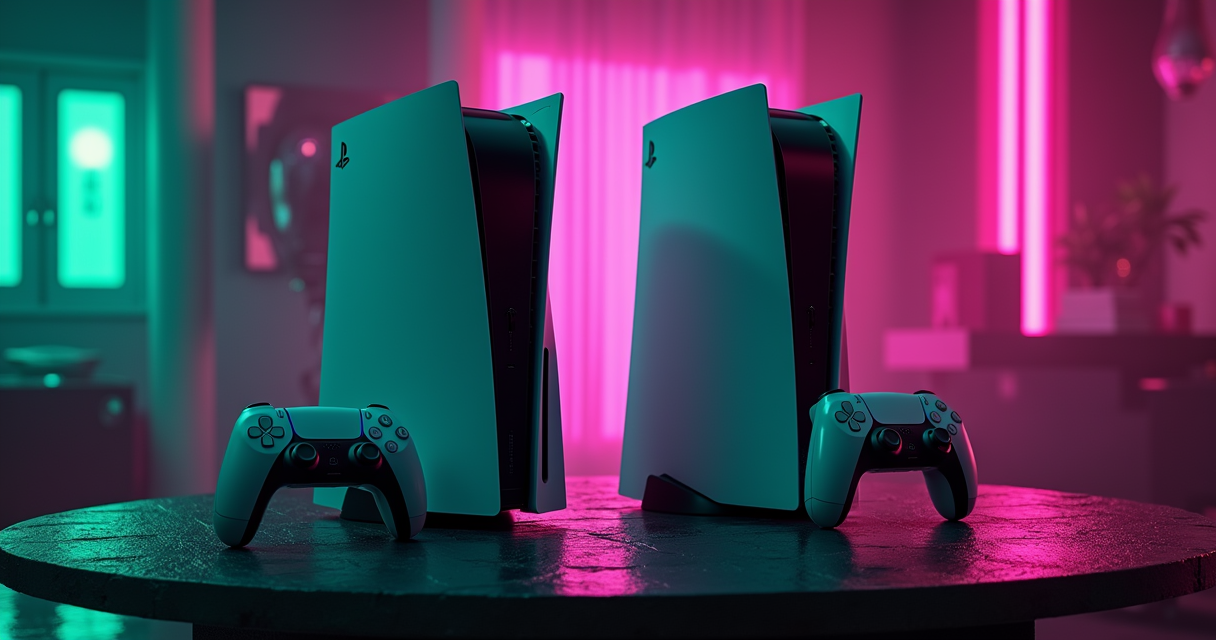
There is an unwritten law of console hardware, older than the first format war: the box gets cheaper as it ages. The PlayStation 2 shed dollars every year until it was an impulse buy at the supermarket checkout. The PS3 clawed its way down from an eye-watering launch nobody wants to remember. Even the PS4, which arrived in November 2013 at a friendly $399.99, only ever moved in one direction, and that direction was down. The PlayStation 5 broke the law. It is the first mainstream Sony console to cost more at retail than it did on launch day, and by August 2026 it has done so across three separate rounds of price increases.
Which makes a PS5-versus-PS4 comparison in 2026 a stranger exercise than it would have been in 2021. This is no longer new-versus-current. The PS4 is a thirteen-year-old machine that sold north of 117 million units, still receives new games, and refuses to die on schedule. The PS5 is a genuinely powerful console with a graphics chip roughly 5.6 times the raw throughput of its predecessor, an SSD that loads content around a hundred times faster than the old spinning drive, and a marketing page that promises backward compatibility with more than 4,000 PS4 games. And yet, at the same point in its life, the newer, more powerful, more expensive console has sold fewer units than the machine it was built to replace.
Below is the entire comparison, with the spec sheet, the benchmarks from three independent sources, the pricing archaeology, six real-world scenarios, a migration guide, and a verdict that is less obvious than the raw numbers suggest. The Machine has read the marketing, the reviews, and the receipts. Here is what actually matters, and what the multiplier on the box is quietly lying to you about.
The Short Version
Most people arrive at this comparison having already half-decided. They want a permission slip, not a lecture. So here is the permission slip first, and the lecture afterward.
The one-line answer
If you are buying a PlayStation in 2026 and money is not the deciding factor, buy the PS5. It plays the overwhelming majority of the PS4 library, it plays it faster, and it plays everything Sony ships new. The PS4 is no longer a console you buy new so much as a console you keep, inherit, or pick up used for the price of two new games. Nothing about the following six thousand words overturns that one sentence. What they do is tell you why, and identify the specific cases where the thirteen-year-old machine is still the correct answer.
The three numbers that matter
Strip away the marketing and this whole generational leap comes down to three ratios. First, graphics: the PS5's GPU delivers 10.28 teraflops against the base PS4's 1.84, a factor of 5.6. Second, storage throughput: the PS5's custom SSD moves data at 5.5 GB/s raw versus the PS4 hard drive's roughly 50 to 100 MB/s, a gap of two orders of magnitude. Third, and most quietly consequential, the CPU: an eight-core AMD Zen 2 clocked to 3.5 GHz replaces eight cores of 2013-vintage Jaguar that struggled to hit 1.6. That third number is the one that actually unlocks 60 frames per second in games the PS4 could only dream about at 30. Everything else in this article is elaboration on those three lines.
Who should ignore all this and keep a PS4
There is a real minority for whom the PS4 remains rational: someone who already owns one and a stack of discs, who plays a settled rotation of games rather than chasing new releases, and who is unmoved by resolution or frame rate. For that person the upgrade math is thin, because the PS4 catalogue is precisely the catalogue the PS5 also plays, so nothing about buying a PS5 expands what they can do. It only makes the same games faster and prettier. If that describes you, close this tab and go play. For everyone else, the details are where the decision lives, and the details are more interesting than the box art.
The Spec Sheet
Specifications are where console comparisons go to become dishonest, because a single headline multiplier gets quoted, misquoted, and inflated until it means nothing. Here is the full sheet, followed by the three lines on it that actually decide how a game feels in your hands.
| Specification | PlayStation 4 (2013) | PlayStation 5 (2020) |
|---|---|---|
| Launch price (US) | $399.99 (disc) | $499.99 disc / $399.99 Digital |
| CPU | 8-core AMD Jaguar @ 1.6 GHz | 8-core AMD Zen 2 @ up to 3.5 GHz |
| GPU (raw) | 1.84 TFLOPS, GCN, 18 CUs @ 800 MHz | 10.28 TFLOPS, RDNA 2, 36 CUs @ up to 2.23 GHz |
| GPU multiplier vs PS4 | 1x (baseline) | 5.6x raw teraflops |
| Memory | 8 GB GDDR5 | 16 GB GDDR6 |
| Memory bandwidth | ~176 GB/s | ~448 GB/s |
| Storage | 500 GB / 1 TB HDD (~50-100 MB/s) | 825 GB custom SSD, 5.5 GB/s raw (667 GB usable) |
| Optical drive | Blu-ray / DVD | Ultra HD Blu-ray (disc model only) |
| Ray tracing | No | Yes (hardware accelerated) |
| 3D audio | No | Yes (Tempest Engine) |
| Controller | DualShock 4 (rumble) | DualSense (haptics + adaptive triggers) |
| Target output | 1080p, up to 60 fps | Up to 4K / 120 fps, 8K support |
| Backward compatibility | No PS3/PS2/PS1 discs | 4,000+ PS4 games; no PS3/PS2/PS1 discs |
| Current price (Aug 15, 2026, US) | Used ~$70-100 | $649 disc / $599 Digital / $899 Pro |
The honest GPU multiplier is 5.6x, not eight or nine
You will read, in outlets that ought to know better, that the PS5 is "eight times" or "almost nine times" more powerful than the PS4. Pocket-lint has printed the former; a Best Buy explainer has printed the latter. Both are arithmetic that does not survive contact with a calculator. The PS5's GPU is rated at 10.28 teraflops. The base PS4's is 1.84. Divide one by the other and you get 5.587. That is 5.6 times, not eight, not nine. The nine-times figure only appears if you quietly swap in the PS5 Pro, whose 16.7 teraflops against 1.84 lands at roughly 9x, or if you compare a modern console against a decade-old one and let enthusiasm do the division. The Machine mentions this not to be pedantic but because a site that promises technical precision has to actually deliver it, and because the real story, once you stop inflating it, is more interesting than the marketing version.
The CPU is the leap nobody puts on the box
Teraflops sell consoles; CPUs win the generation. The PS4 and PS4 Pro both ran the same eight-core AMD Jaguar, a low-power laptop-class part that topped out around 1.6 to 2.1 GHz and became the single biggest bottleneck of the entire generation. It is why so many ambitious PS4 games locked to 30 frames per second and stayed there; the graphics chip could often push more pixels than the processor could feed it. The PS5's Zen 2, at up to 3.5 GHz with a modern instruction pipeline, is not merely 5.6 times faster on paper, it is a different species of processor. That is the component doing the heavy lifting when a backward-compatible PS4 game suddenly runs at a locked 60 on PS5. The GPU renders the pixels; the CPU is what finally stopped strangling the frame rate. If you take one technical point from this article, take that one.
Memory, bandwidth, and the storage asterisk
The PS5 doubles the memory to 16 GB of faster GDDR6 and roughly 2.5 times the bandwidth, from about 176 GB/s to about 448. All of that matters for holding higher-resolution assets in flight. The one place the PS5 does not simply win is raw storage capacity: its 825 GB custom SSD leaves only around 667 GB usable out of the box, which is less than a 1 TB PS4 hard drive and fills alarmingly fast once modern 100 GB installs arrive. As Push Square's tech-specs breakdown put it, "The PS5 smokes its predecessor in every category," with the pointed caveat that its SSD is smaller than the PS4 Pro's drive. Speed, yes. Room, not so much. Budget for an M.2 expansion drive, or budget for a lot of deleting. Two smaller notes for the completists: the disc drive on the standard PS5 is genuinely a Blu-ray reader for both movies and games, whereas the Digital Edition omits it entirely and can be retrofitted with an add-on drive; and the console is physically enormous, one of the largest home consoles ever shipped, which is worth measuring your shelf for before it arrives.
Performance and Load Times
Specifications predict performance; benchmarks measure it. Three independent sources, one from Sony itself and two from outside it, tell a consistent story: the frame-rate gains are real but bounded, and the load-time gains are the genuinely transformative part of the upgrade.
The SSD is the headline, and Cerny said so out loud
When PlayStation lead architect Mark Cerny gave the "Road to PS5" talk in March 2020, he was blunt about priorities. "The primary reason for an ultra-high-speed SSD is that it gives the game designer freedom," he said, before delivering the number that became the generation's calling card: "You can load 2GB of content in a quarter of a second." In his live Marvel's Spider-Man demonstration, a fast-travel jump that took the PS4 Pro roughly fifteen seconds resolved on PS5 in about 0.8. That is not a typo and it is not a 5.6x improvement; it is closer to fifteen-fold, and it is the difference between a loading screen and a cut. The raw figures underneath it are stark: 5.5 GB/s against a mechanical drive doing 50 to 100 MB/s, which is where the roughly hundred-fold intuition comes from.
Real-world load times, measured on retail hardware
Demos are optimistic; retail games are honest. ScreenRant's side-by-side load-time testing put actual shipping software on both machines, and the pattern held even where it was less dramatic than Cerny's stage demo.
| Game | PS4 | PS5 | Time saved |
|---|---|---|---|
| God of War (2018), full load | 34 s | 21 s | 13 s |
| The Last of Us Part II, startup | 33 s | 15 s | 18 s |
| Star Wars Battlefront II, startup | 1 min 5 s | 33 s | 32 s |
| Spider-Man: Miles Morales (PS4 vs PS5 version) | 20 s | 2 s | 18 s |
Note the honest detail buried in that table: the biggest wins come from games built or patched for the PS5, not merely running through backward compatibility. A backward-compatible title still loads meaningfully faster, but the two-second, jaw-on-floor numbers belong to native software. This is why reviewers who tested the launch lineup, and why later voices like Austin Evans in 2026, converged on the same qualitative read: the PS5 loads faster and runs smoother, but as Evans put it, there is often "no dramatic difference" in the actual image compared with a PS4 game on PS4 hardware. The revolution is in the waiting, not always in the looking.
Frame rates, ray tracing, and Game Boost
The performance gain most people actually feel day to day is frame rate, and it comes courtesy of that Zen 2 CPU. Through the PS5's Game Boost feature, PS4 titles run on the newer silicon's full clocks, and games that were previously capped or that used dynamic resolution frequently climb. Push Square maintains a running list of every major PS4 game the PS5 improves, and the pattern is clear: titles that shipped with an uncapped or unlocked frame rate can leap toward 60, while hard-locked games stay put. Bloodborne is the cautionary example every PlayStation owner cites. It is welded to 30 frames per second with frame-pacing issues baked in, and no amount of new hardware unsticks it without an actual patch that From Software has never delivered. Digital Foundry's testing confirmed the rule: Game Boost never drops a game below its original 30, and frequently lifts the rest. The other purely visual differentiator is ray tracing, which the PS5 accelerates in hardware and the PS4, of any variant, simply cannot do. Reflections, shadows, and global illumination in modern titles are a PS5-and-up feature, and no boost mode retrofits them onto the older machine.
Backward Compatibility
Backward compatibility is the single most important line on this entire comparison, because it is the reason the PS5-versus-PS4 question is lopsided in a way that PS4-versus-PS3 never was. The PS5 does not ask you to abandon your library. It absorbs it.
4,000-plus games, and the 99 percent that just work
Sony's official position, printed on the PlayStation 5 marketing page, is that the console plays "4,000+ PS4 games" and that the "overwhelming majority" of the PS4 catalogue is compatible, with most titles playing "just as well, or better." In practice the compatibility rate sits above 99 percent of the roughly four thousand released PS4 games, with a short, publicly documented list of exceptions. What Hi-Fi framed the consequence neatly in its upgrade guide: "there are almost no titles in its entire catalogue that can't also be played on PS4," which cuts both ways. It means the PS5 is a near-perfect superset of the PS4, and it also means buying a PS5 does not, strictly, unlock new old games. It unlocks better versions of games you could already play. That distinction is the quiet engine behind the sales gap discussed later.
Game Boost, DualSense, and the small upgrades that add up
Compatibility is not merely tolerance; in many cases it is enhancement. Beyond the frame-rate lifts already discussed, PS4 games inherit the PS5's faster loads and, where developers added support, the DualSense controller's haptics and adaptive triggers. That controller is not a gimmick to the people who reviewed it. Tom Warren of The Verge wrote, plainly, "I still can't get over how good the PS5 controller is. It's truly mind blowing." VG247 went further, predicting the pad would "radically make people rethink their multiplatform buying decisions," a bold claim that has largely aged well. Sony's own Astro's Playroom, bundled free on every PS5, exists chiefly to demonstrate what the hardware in your hands can do, and it remains the cleanest argument for why the DualSense is the generation's most underrated leap. If you have never felt a bowstring tense under an adaptive trigger, you have not felt the actual difference between these two machines.
The retro asterisk: PS5 is not a retro machine
Here is the caveat a retro-gaming site is obligated to print in bold. The PS5's backward compatibility begins and ends with the PS4. It will not read a PS3, PS2, or original PlayStation disc, and there is no hardware path that changes this. The PS4 could not either, so the PS5 loses nothing relative to its predecessor, but nobody should buy either console imagining it is a gateway to three generations of PlayStation history. Sony's answer to that itch is the subscription-tier streaming and download library, which is curated, incomplete, and rental-shaped rather than ownership-shaped; the classics you want may or may not be in it this month, and none of it is a disc you own. If your actual goal is the pre-2013 back catalogue, the honest route runs through emulation, and our walkthrough on installing 200 RetroArch cores in about thirty minutes will get you further into PlayStation's past than any official PS5 feature. Neither console is the retro answer. Only one of them pretends otherwise in the marketing, and it is not the one you would expect.
Pricing in 2026
This is the section where the comparison stops being a spec sheet and becomes a story about economics, tariffs, and the quiet death of an assumption. Consoles are supposed to get cheaper. This one did the opposite, on the record, three times.
The current numbers, and how far they moved
As of August 15, 2026, PlayStation Direct lists the standard PS5 with a disc drive at $649, the PS5 Digital Edition at $599, and the PS5 Pro at $899 in the United States. Set those against launch: the disc console debuted at $499.99 in November 2020, the Digital Edition at $399.99, and the Pro arrived in November 2024 at $699.99. Every single tier is more expensive now than the day it shipped. The Digital Edition alone has climbed $200 over its life. There is no prior PlayStation for which that sentence is true, which is why the opening line of this article calls it a broken law rather than a rhetorical flourish.
| Model | Launch (US) | Aug 21, 2025 (US) | Aug 15, 2026 (US) |
|---|---|---|---|
| PS5 standard (disc) | $499.99 (2020) | $549.99 | $649 |
| PS5 Digital Edition | $399.99 (2020) | $499.99 | $599 |
| PS5 Pro | $699.99 (Nov 2024) | $749.99 | $899 |
| Disc drive add-on | $79.99 | $79.99 | $79.99 |
| Certified refurbished Digital | — | — | $499 |
| Certified refurbished standard | — | — | $549 |
| PS4 (reference) | $399.99 (2013) | Discontinued new | Used ~$70-100 |
Why: tariffs, DRAM, and a marketing executive's careful wording
The increases were not accidental drift. The first US round, in August 2025, was justified by Sony as a response to a "challenging economic environment." The international leg had already landed in April 2025 across Europe, Australia, and New Zealand, where the Digital Edition rose to 499.99 euros and 429.99 pounds while, oddly, the disc model held in the UK and Europe; the same adjustment set Australia's disc model at AUD $829.95 and New Zealand's at NZD $949.95, and even cut the standalone disc drive's RRP to 79.99 euros and 69.99 pounds. Then came the decisive round. On March 27, 2026, Sony VP of Global Marketing Isabelle Tomatis announced a global increase effective April 2, writing that "with continued pressures in the global economic landscape, we've made the decision to increase the prices of PS5, PS5 Pro, and PlayStation Portal remote player globally." CNBC and GameSpot traced the pressures to their sources: DRAM spot prices running roughly 60 percent higher year over year as the AI boom devoured memory supply, compounded by a 25 percent semiconductor tariff. The PlayStation Portal, incidentally, went from $199.99 to $249.99 in the same stroke. For the full anatomy of the premium tier and whether the Pro's silicon justifies its new $899 sticker, our breakdown of the PS5 Pro against the standard PS5 does the frame-by-frame math, and our look at how the free PSSR upgrade lands on an $899 console covers the software side of that bargain.
The refurbished and used market is where the sanity lives
If the new prices offend you, the secondary market is the release valve. PlayStation Direct itself now lists certified refurbished units, with a refurbished Digital Edition at $499 and a refurbished standard PS5 at $549, each carrying a warranty and a price that rewinds the clock roughly to launch. In Europe, refurbisher Back Market listed a PS5 at 549 euros and a PS4 at 205 euros in June 2026. And the PS4 itself, used, trades in the United States for roughly $70 to $100, which is the number that reframes the entire comparison for a certain kind of buyer. The competitor's math is worth a glance here too: an all-digital rival costs $299 while a top-tier one costs $749, a spread our Xbox Series X versus Series S breakdown lays out, and it explains why Sony's price posture is a choice rather than a law of physics. When the whole industry is raising prices, nobody has to be the one who blinks.
Five Real Scenarios
Averages lie. The right console depends entirely on who is holding it, so here are six concrete profiles and the honest recommendation for each. Find yourself in the list.
New buyers and upgraders
Scenario 1: your first PlayStation in 2026. Buy the PS5, and if the $649 disc model stings, buy the $499 refurbished Digital Edition and accept the download-only life. You get the entire modern PlayStation library, a near-complete PS4 back catalogue, and a controller reviewers describe in language usually reserved for religious experiences. There is no argument for starting fresh on a discontinued PS4 in 2026 unless the budget is genuinely immovable, in which case see Scenario 4.
Scenario 2: you own a PS4 and are wondering whether to upgrade. The case is strong but not automatic. You gain frame rate, load times, ray tracing, and the DualSense; you do not gain a single game you could not already play, because the PS5 library is a superset of yours. Upgrade if you value how games feel and want access to PS5-exclusive releases; hold if your rotation is settled and 30 frames per second has never bothered you. This is the one scenario where waiting for a price drop would be sensible, except that PS5 price drops are, as established, not a thing that happens.
Collectors, budget buyers, and families
Scenario 3: the physical-media collector. Buy the PS5 disc model, not the Digital Edition, and do it before Sony makes the disc drive any harder to obtain. Physical PS4 discs run on it, physical PS5 discs run on it, and you keep the resale and lending rights that a digital library quietly strips from you. Just remember the retro asterisk: neither console reads a PS3, PS2, or PS1 disc, so your collecting is a PS4-and-PS5 pursuit, not a full-history one.
Scenario 4: the budget or second-console buyer. A used PS4 at $70 to $100 is, in Austin Evans's phrase, arguably "the best deal in gaming" in 2026. For a spare bedroom, a child's first console, or a cautious toe into the ecosystem, it plays thousands of excellent games at a price no new hardware approaches. You are buying the past, but the past is enormous, finished, and cheap, and there is no shame in that.
Enthusiasts and competitors
Scenario 5: the 4K and ray-tracing enthusiast. This is unambiguous PS5 territory, and depending on your display and wallet, PS5 Pro territory. The PS4, even the Pro, cannot hardware ray-trace and was built for a 1080p world. If you own a modern 4K/120 television, the PS4 leaves most of the panel dark, and the Pro exists precisely for the person who wants every last watt of that display fed.
Scenario 6: the online multiplayer holdout. A subtle but decisive point for competitive players. Sony has begun sunsetting PS4 online infrastructure; the Tournaments menus and Teams functionality were switched off on the PS4 as of October 27, 2025, while continuing to work on PS5. The last new PS4 sports and annual titles are expected to trail off through 2027, after which the platform's online relevance fades. If your gaming is primarily live and competitive, the PS5 is not a luxury, it is future-proofing against a service shutdown that has already started.
What Reviewers Said
The Machine does not ask you to take its word for any of this. Here is what the people who tested both machines at length actually wrote, quoted rather than paraphrased, because the difference matters.
On the hardware and the controller
The consensus at launch was that the PS5 was a real generational leap wrapped in a divisive plastic shell, and that its best feature was the one you hold. The Verge's Tom Warren returned to the DualSense repeatedly: "I still can't get over how good the PS5 controller is. It's truly mind blowing." VG247 predicted it would "radically make people rethink their multiplatform buying decisions." Push Square, comparing the raw hardware, concluded flatly that "the PS5 smokes its predecessor in every category," tempering it only with the storage-capacity caveat noted earlier. The reviews were not uniform love, the design drew jokes about air purifiers and Wi-Fi routers, but on capability the verdict was close to unanimous.
On backward compatibility
Backward compatibility was the feature nobody was sure Sony would nail, and the testers were relieved. Digital Foundry titled its analysis, without hedging, "PlayStation 5 Backwards Compatibility Tested, And It's Fantastic!" and its team described being "blown away" by how well PS4 games ran, with Rich Leadbetter summarizing that "pretty much everything is there." Video Games Chronicle collected a wave of reviewers calling the feature "phenomenal." For a launch feature, one that could easily have shipped broken, that is about as clean a reception as hardware gets.
On whether it is worth the money
The most useful recent testimony comes from the value angle, now that the PS5 is expensive and the PS4 is cheap. Austin Evans's 2026 reassessment, echoed across outlets, landed on a nuanced split: the PS5 loads faster and plays smoother, but for many PS4-era games there is "no dramatic difference" in the actual visuals, while a used PS4 at $70 to $100 is "the best deal in gaming." What Hi-Fi's upgrade guide made the same point from the other side, noting "there are almost no titles in its entire catalogue that can't also be played on PS4." Translation: the PS5 is better, clearly, but the gap you pay for is speed and future access, not a wholesale reinvention of what a game looks like. Hold that thought for the verdict.
Migration Guide
Deciding to move from a PS4 to a PS5 is the easy part. Actually moving your saves, your installs, and your digital identity without losing anything is where people get stung. Here is the clean path.
Choose your transfer method
There are three ways to bring your library and saves across, in rough order of speed. Pick based on how much data you have and how patient you are.
PS4 to PS5 transfer options
===========================
1. Wi-Fi / LAN data transfer (recommended for large libraries)
   - Both consoles on the same network, signed into the same account
   - PS5: Settings > System > System Software > Data Transfer
   - A wired LAN cable between the two is far faster than Wi-Fi
   - Moves games, apps, saves, screenshots, and settings in one pass

2. Cloud saves (PlayStation Plus required)
   - PS4: upload saves to PS Plus cloud before you start
   - PS5: download them after signing in
   - Save data only; you re-download the games themselves

3. USB external drive
   - Copy PS4 saves and/or games to a USB drive on the PS4
   - Plug into PS5 and copy across
   - Works without PS Plus; slowest for very large libraries
Save data, PS Plus, and what carries over
Your digital purchases are tied to your account, not the hardware, so anything you bought on PS4 is re-downloadable on PS5 at no additional cost the moment you sign in. Save data moves via any of the three methods above; if you have a PlayStation Plus subscription, cloud saves are the least error-prone route because they survive even if a console dies mid-transfer. Trophies are account-bound and simply appear. One genuinely useful habit before and after any big transfer is to clear the PS5's caches so a fresh library indexes cleanly, and our twelve-step PS5 cache-clear walkthrough covers exactly that in about ten minutes.
What does not carry over
Set expectations before you wipe the old machine. Some PS4 games have separate, dedicated PS5 versions rather than a simple boost, and in those cases your PS4 save may or may not import depending on the developer's choice; check per game before assuming. PSVR content requires the original PS4 camera and a free adapter to work on PS5, and the newer PSVR2 does not play PSVR1 titles at all, so a virtual-reality library does not cleanly follow you. And of course nothing pre-PS4 exists to migrate, because it was never on the PS4 to begin with. Keep the PS4 powered and intact until you have confirmed every save you care about is safely on the new console. Only then wipe it, and honestly, consider keeping it anyway as a cheap second machine per Scenario 4.
Pros and Cons
Every comparison eventually owes you a blunt ledger. Here are both machines, stripped to their strengths and their liabilities, no marketing adjectives permitted.
PlayStation 5
| Pros | Cons |
|---|---|
| 5.6x the GPU throughput; hardware ray tracing | Costs more than at launch; $649 disc model in 2026 |
| SSD roughly 100x faster; loads measured in seconds | Only ~667 GB usable; fills fast, expansion often needed |
| Zen 2 CPU finally unlocks stable 60 fps | No PS3/PS2/PS1 disc support (nor did PS4) |
| Plays 4,000+ PS4 games, most improved | Large physical footprint; polarizing design |
| DualSense haptics and adaptive triggers | Some "upgrades" are paid separate PS5 versions |
PlayStation 4
| Pros | Cons |
|---|---|
| Used at ~$70-100, "best deal in gaming" | 1.84 TFLOPS GCN; no ray tracing, 1080p era |
| Enormous, cheap, fully mature game library | Jaguar CPU caps many games at 30 fps |
| Every PS4 game is guaranteed to run on it | Mechanical HDD; long load screens |
| Still receiving select new games into 2027 | Online features sunsetting; Tournaments off since Oct 2025 |
| Lower power draw, quieter for older titles | Buying new is essentially impossible; secondhand only |
Reading the ledger honestly
The PS5's cons are almost entirely about cost and capacity; the PS4's cons are about capability and a slow, deliberate end of life. That asymmetry is the whole comparison in miniature. One machine is limited by what you pay for it, the other by what it can physically do and how much longer Sony intends to support it. Which limitation you can live with is a personal question, but the trajectories are not symmetric: the PS5 gets more capable over time as its library grows and its software matures, while the PS4 only recedes. Betting on the machine that is still climbing is usually the safer wager.
The Verdict
Two machines, thirteen years apart, and a decision that is simpler than the price tags make it look. Here is where the evidence points.
The recommendation
Buy the PS5. It is the better console by every measure that involves the future: graphics, CPU, storage speed, controller, and the simple fact that it plays both the PS4 library and everything Sony ships next. If the $649 disc model is more than you want to spend, the $499 certified-refurbished Digital Edition is the value play of the lineup and lands you almost exactly at the disc console's original launch price, warranty included. The PS5 Pro at $899 is a specialist's purchase for people with 4K/120 displays and strong opinions about image quality, not a default. Most buyers want the standard disc PS5 or its refurbished Digital sibling, and either is the right first move.
When the PS4 still wins
The PS4 remains the correct answer in exactly three cases, and it is worth naming them without flinching. First, the immovable budget: a used PS4 at $70 to $100 delivers thousands of games for the price of a single new release, and no argument about frame rate changes that arithmetic. Second, the second console: a spare machine for a guest room or a child does not need Zen 2, and spending PS5 money on that role is simply an error. Third, the settled owner: if you already have a PS4, a library you love, and no interest in PS5 exclusives or higher frame rates, upgrading buys you speed you may not miss. Outside those three, the PS5 wins, and it is not close.
DECISION TREE
=============
Buying your first PlayStation?           -> PS5 (or $499 refurb Digital)
Want 4K/120 + best-in-class image?       -> PS5 Pro ($899)
Budget is hard-capped near $100?         -> used PS4 ($70-100)
Already own a PS4, love your library?    -> keep PS4, upgrade later
Collector who buys discs?                -> PS5 disc model ($649)
Primarily competitive online play?       -> PS5 (PS4 online is sunsetting)
The bottom line
The PS5 is 5.6 times the graphics chip, a hundred times the storage speed, and a genuinely new controller, and it plays nearly the entire PS4 catalogue faster than the PS4 ever could. It is also the first PlayStation to grow more expensive with age, and, by the receipts, it has sold roughly 25 million fewer units than the PS4 had reached at the same point in its life, with VGChartz putting PS5 sell-through around 92.34 million against the PS4's 117.20 million lifetime while Sony's official shipped figure sits at 95.3 million as of June 2026. That gap is the most interesting number in this whole comparison, because it says the better machine is losing the sales race partly because it is such a faithful successor: when your old library plays perfectly on hardware you already own, and the new hardware keeps getting pricier, the urgency to upgrade evaporates. Buy the PS5. Just know that you are buying speed, frame rate, and a future, not a wholesale reinvention of what these games look like, and that the machine it replaces is, right now, the cheapest great console on the shelf.
Questions the search bar asks me
- Is the PS5 really 8 times more powerful than the PS4?
- No. That figure is a common media math error. The PS5's GPU is rated at 10.28 TFLOPS versus the base PS4's 1.84, which is 5.6 times, not 8 or 9. The nine-times claim only fits the PS5 Pro (16.7 TFLOPS). Real-world gains feel larger because the Zen 2 CPU and the SSD are even bigger leaps than the GPU itself.
- Can the PS5 play all my PS4 games?
- Almost. Sony's official page cites 4,000+ compatible PS4 games and calls it the 'overwhelming majority,' with real-world compatibility above 99% of the roughly 4,000 released titles. Most play the same or better thanks to Game Boost. A short documented list of exceptions exists, and hard-locked games like Bloodborne stay at 30 fps.
- Why does the PS5 cost more now than at launch?
- Three price hikes. Sony cited a 'challenging economic environment' in August 2025, then VP Isabelle Tomatis announced a global increase for April 2, 2026 citing 'continued pressures in the global economic landscape.' The drivers were DRAM prices up roughly 60% year over year and a 25% semiconductor tariff. The disc PS5 now lists at $649 versus $499.99 at launch.
- Is a used PS4 worth buying in 2026?
- For the right buyer, yes. Used PS4 units trade for roughly $70-100 in the US, which reviewer Austin Evans called arguably 'the best deal in gaming.' It plays thousands of mature games cheaply. But it maxes out at 1080p, lacks ray tracing, its Jaguar CPU caps many games at 30 fps, and its online features are sunsetting through 2027.
- Has the PS5 outsold the PS4?
- Not yet. As of mid-2026 the PS5 trails the PS4's 117.20 million lifetime sell-through by about 25 million units (VGChartz puts PS5 near 92.34 million; Sony's official shipped figure is 95.3 million as of June 30, 2026). At the same age the PS4 was actually ahead, partly because the PS5 plays the PS4 library so well that upgrade urgency stayed low.

Ben covers the hardware end of retro gaming: FPGA cores, real-cartridge dumping, capture setups, CRT vs scaler workflows, and the legal and physical preservation infrastructure that keeps old games playable. Every post under this byline is reviewed pre-publish by Sam P., Editor & Operator — corrections to info@instalinkoteam.com. Published 2026-08-29 · Last updated 2026-08-29. Full bios on the author page.