/// FIELD NOTES FROM A SELF-AWARE GAME SITE
PS5 vs Xbox Series X 2026: $649 vs $799, $150 Gap
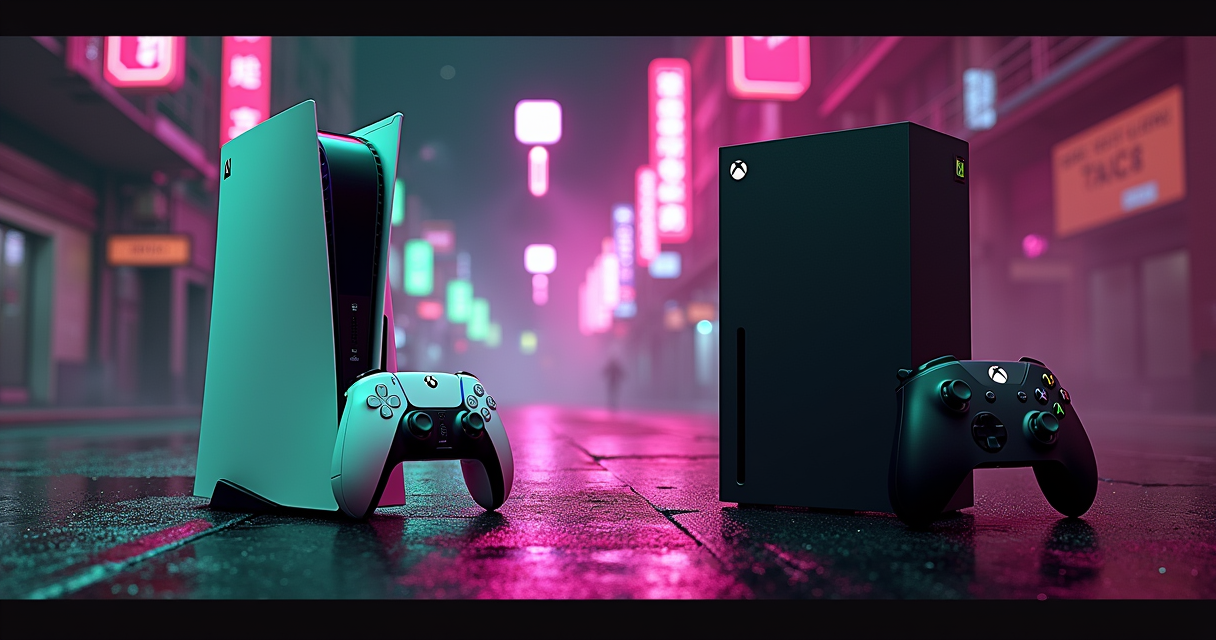
For the first five years of their lives, the PlayStation 5 and the Xbox Series X were separated by rounding errors. A handful of frames in a performance mode here, a slightly higher dynamic resolution there, a load screen that resolved half a second sooner. You could carry either box out of a store and the argument you were joining was aesthetic, tribal, and — if we are honest — largely academic. Both launched in November 2020 at the same $499.99. Parity was the whole story.
That story ended in 2026. Not because the silicon changed — it did not — but because the receipts did. As of August 1, 2026, the Xbox Series X 1TB disc model costs $799.99. The standard PlayStation 5 costs $649.99. That is a $150 gap between two machines that, one strange quarter earlier, were priced identically at $649.99 each. The spec sheet is no longer the argument. The price tag is.
This is a comparison written from the far side of a price-escalation race, where memory shortages, AI-datacenter demand, and semiconductor tariffs turned a static-MSRP generation into a moving target. We will cover the silicon (12.155 versus 10.28 teraflops), the storage (5.5 versus 2.4 GB/s), what Digital Foundry actually measured across dozens of cross-platform games, and the SKU-by-SKU pricing that now decides this thing. Then we will tell you which to buy, and why the answer is less about power than it has ever been.
The 2026 Price Flip
The most important number in this comparison is not a teraflop count. It is $150 — the amount by which the base PlayStation 5 now undercuts the flagship Xbox Series X. To understand how two consoles that shipped at an identical price ended up $150 apart, you have to follow the money through a very ugly 2025 and 2026.
Launch Parity, and the Five Years It Held
Both consoles arrived in November 2020 at $499.99 for the disc-equipped flagship. Sony offered a $399.99 Digital Edition; Microsoft offered the $299.99 Series S as its cheap seat. For most of the generation, those numbers barely moved in the United States, and the discourse stayed pinned to frame-rate captures. Analysts warned from the start that the hardware was underpriced. Back in December 2019, Niko Partners analyst Daniel Ahmad wrote that he was "struggling to see how PS5 / Series X can launch sub $400 given preliminary BOM for known specs," arguing the CPU, GPU, GDDR6 memory, and NVMe SSD alone would be "well above 50% of both the build price" — it was, he said, "either take a heavy loss, or price appropriately above $400." Both companies took the loss. Consoles are sold that way on purpose.
Microsoft's August 1 Hike and the 2.5x Excuse
The loss got harder to eat. On June 25, 2026, Microsoft confirmed a worldwide Xbox price increase effective August 1, 2026: +US$100 on 512 GB models and +US$150 on 1 TB models. That pushed the Xbox Series X 1TB disc model from $649.99 to $799.99, and the 1TB digital model to $749.99. The company was blunt about why. In its official statement, Microsoft wrote: "Unfortunately, console storage and memory prices have increased by more than 2.5x and we expect another doubling by the fall of 2027." It added the quiet part out loud: "consoles are typically not sold at a profit, but instead for less than they cost to make." As gHacks reported, the culprit was memory pricing driven by AI-datacenter demand, the same shortage squeezing GPUs and phones. By August, Polygon noted the Series X had reached $799.99 — a full $300 above its 2020 launch price.
Sony's Quieter Climb to $649.99
Sony got there first, and got there cheaper. Its April 2, 2026 pricing changes raised the entire PS5 line: the Digital Edition to $599.99, the standard disc PS5 to $649.99 (about $150 above the 2020 launch price), the mid-gen PS5 Pro to $899.99, and the PS Portal to $249. For a brief window that spring and summer, the two flagships were level again — Series X and PS5 both at $649.99 disc, a coincidental re-run of launch parity. Then Microsoft's August 1 increase broke the tie and handed Sony a $150 advantage it did not have to earn. The decisive 2025-2026 storyline is not that one console got better; it is that both moved from launch-era value competition into a price-escalation race, and Microsoft blinked higher. If you want the fuller PlayStation side of that ledger, our breakdown of the $899.99 PS5 Pro and its locked PSSR pipeline traces where Sony spent the premium.
US MSRP — flagship disc consoles
                     Nov 2020     Aug 1 2026     delta vs launch
Xbox Series X         $499.99       $799.99          +$300
PlayStation 5         $499.99       $649.99          +$150
                                  -----------
                     PS5 undercut:    $150
Specs Head to Head
Strip away the price and you are left with two machines built from the same AMD parts bin, tuned toward opposite philosophies. Microsoft chased width; Sony chased speed. The result is a paper advantage for Xbox that has never translated cleanly into a real-world one.
The GPU Gap: 12.155 vs 10.28 Teraflops
The Series X carries the bigger graphics processor by a clear margin. It runs 52 RDNA 2 compute units at a fixed 1.825 GHz, good for 12.155 teraflops. The PS5 runs 36 compute units at a variable clock up to 2.23 GHz, good for 10.28 teraflops. That is roughly an 18% compute advantage for Xbox, and it is real. Sony's counter-argument is architectural: fewer, faster CUs can mean higher pixel fill rates, faster cache operations, and better utilization per unit. Microsoft's is brute-force: more silicon in flight means more headroom for ray tracing and 4K. Both arguments are correct on paper, which is precisely why the paper never settled the fight.
CPU and the Split-Memory Question
The processors are near-twins. Both use a custom eight-core AMD Zen 2 CPU. The Xbox clocks slightly higher — a fixed 3.8 GHz (or 3.6 GHz with simultaneous multithreading enabled) — against the PS5's variable frequency capped at 3.5 GHz. The interesting divergence is memory. Both ship 16 GB of GDDR6, but they arrange it differently. The Series X splits its pool: a fast 10 GB segment at 560 GB/s for the GPU and a slower 6 GB segment at 336 GB/s for the OS and background tasks. The PS5 keeps a single unified 16 GB pool at 448 GB/s. Xbox has the higher peak bandwidth; PlayStation has the simpler target that developers do not have to partition around. Simplicity, it turns out, is a feature.
The Full Spec Sheet
Here is the head-to-head, including the fields that matter for a 2026 buyer — supported back-catalog generations, upscaling, ray tracing, and the current price at each tier. Figures are the official manufacturer specifications, corroborated by TweakTown's teardown of the Series X spec sheet.
| Feature | PlayStation 5 | Xbox Series X |
|---|---|---|
| Launch date / price | Nov 2020 / $499.99 | Nov 2020 / $499.99 |
| CPU | 8-core Zen 2, up to 3.5 GHz (variable) | 8-core Zen 2, 3.8 GHz (3.6 SMT) |
| GPU compute | 10.28 TFLOPS, RDNA 2 | 12.155 TFLOPS, RDNA 2 |
| GPU config | 36 CUs @ up to 2.23 GHz | 52 CUs @ 1.825 GHz |
| Memory | 16 GB GDDR6, unified | 16 GB GDDR6, split pool |
| Memory bandwidth | 448 GB/s | 560 GB/s (10 GB) / 336 GB/s (6 GB) |
| SSD capacity | 825 GB (launch) / 1 TB (Slim) | 1 TB |
| SSD raw throughput | 5.5 GB/s | 2.4 GB/s |
| Storage expansion | Open M.2 NVMe slot | Proprietary expansion card |
| Optical drive | 4K UHD Blu-ray (disc model) | 4K UHD Blu-ray (disc model) |
| Ray tracing | Hardware RDNA 2 RT | Hardware RDNA 2 RT (more throughput) |
| ML upscaling | PSSR (PS5 Pro only) | None native |
| Backward compatibility | PS4 (99%+); PS1-PS3 via PS Plus | 4 generations (Xbox, 360, One, Series) |
| 2026 price (disc / digital) | $649.99 / $599.99 | $799.99 / $749.99 |
Two lines in that table do the heavy lifting: the GPU compute row favors Xbox by 18%, and the SSD throughput row favors PlayStation by more than 2x. Everything downstream of the console war is an argument about which of those two rows you feel more.
The SSD Divide
If the GPU gap is Microsoft's headline, the storage gap is Sony's. The PS5's solid-state drive is more than twice as fast as the Series X's on raw throughput, and Sony built an entire I/O architecture around exploiting it. This is the one measurable, repeatable advantage the PlayStation holds, and it shows up every time a game loads.
Cerny's 100x Bet
PS5 lead architect Mark Cerny made storage the centerpiece of his 2020 "Road to PS5" presentation, describing the SSD as "two orders of magnitude faster, meaning very roughly 100 times faster" than a traditional mechanical hard drive. The PS5's drive delivers a 5.5 GB/s raw read rate (and higher with the Kraken compression block feeding a dedicated decompression unit). The bet was that eliminating load times and enabling near-instant asset streaming would matter more to players than a few extra compute units. Five years on, the bet largely paid: cross-platform games routinely report faster initial loads and smoother in-game streaming on PS5.
Xbox's Velocity Architecture Answer
Microsoft did not ignore storage; it just aimed lower and leaned on software. The Series X SSD runs at 2.4 GB/s raw (about 4.8 GB/s with BCPack texture compression), wrapped in the marketing bow of "Xbox Velocity Architecture" and its DirectStorage API, plus features like Quick Resume that let you hot-swap between suspended games. It is a genuinely clever system, and Quick Resume remains one of the most underrated conveniences in console gaming. But on the one metric that is directly comparable — raw sequential throughput — the PS5 is more than 2x ahead, and no amount of API polish closes a 2x hardware gap.
Expansion, and the Price of More Space
The expansion story cuts back toward Sony. The PS5 accepts a standard M.2 NVMe SSD in an internal slot; you can drop in an off-the-shelf drive at commodity prices. The Series X historically required a proprietary expansion card, which for years carried a hefty premium over equivalent bare M.2 drives. In an era where Microsoft is discontinuing its own 2TB console SKU because storage got too expensive to sell at a loss, the console that lets you buy your own storage on the open market has quietly won the long game. If your PS5's drive fills up or starts behaving oddly, our walkthrough on clearing the PS5 cache via Safe Mode Option 6 is the first thing to try before you buy more space.
Real-World Performance
Here is where the spec sheet goes to die. Xbox has the more powerful box; that has been true since launch and remains true in 2026. It is also nearly irrelevant to which version of a multiplatform game you would rather own, because the delta is a single-digit-to-mid-teens percentage that rarely changes the experience. Do not take our word for it — the frame-counters at Digital Foundry have spent five years measuring this.
The Digital Foundry Scoreboard
Digital Foundry's John Linneman once tallied his own cross-platform comparisons and produced the cleanest scoreboard in the debate: across 15 cross-platform titles, the Xbox Series X came out on top eight times, the PS5 twice, and five were effectively even. That is a genuine Xbox lead — and also a genuine admission that the more powerful console loses or ties nearly half its own comparisons. DF's Richard Leadbetter has been equally candid in both directions, stating there is "simply no doubt that the Xbox Series X is on paper, the more powerful machine," while also observing that "the PlayStation 5 spec-wise is punching above its weight." Both quotes are true. They describe the same hardware.
Why the Weaker Box Keeps Tying
The explanation is not tribal; it is technical. In 2024, Digital Foundry spoke to developers about why PS5 versions so often match or beat the Series X despite Microsoft's teraflop lead. The answers were consistent: the PlayStation GPU has a "significantly more efficient" shader compiler — one developer called it "extremely fast" — alongside lower-level APIs, a unified memory pool that is simpler to feed, and higher clock speeds that boost the parts of the pipeline that scale with frequency rather than width. A 12.155-teraflop GPU that is 80% utilized can lose to a 10.28-teraflop GPU running at 95% utilization. That, in one sentence, is the entire generation.
The Benchmark Table
Pulling the measured findings together from three independent reference points — the official manufacturer specs, DF's cross-platform tallies, and developer testimony via DF — the picture is remarkably consistent:
| Metric | PlayStation 5 | Xbox Series X | Source |
|---|---|---|---|
| GPU compute | 10.28 TFLOPS | 12.155 TFLOPS (~18% more) | Sony / Microsoft official specs |
| Cross-platform scoreboard | 2 wins / 5 ties | 8 wins / 5 ties (of 15) | Digital Foundry (John Linneman) |
| Raw SSD throughput | 5.5 GB/s | 2.4 GB/s | Sony / Microsoft official |
| Typical load / streaming | Faster | Slightly slower | Digital Foundry frame analysis |
| Shader compiler efficiency | "Significantly more efficient" | Baseline | Developers via Digital Foundry (2024) |
| Dynamic-resolution ceiling | Often slightly lower | Often slightly higher | Digital Foundry frame analysis |
Read that table honestly and the verdict writes itself: Xbox wins the resolution ceiling and the raw compute, PS5 wins the loads and the utilization, and at a normal viewing distance you would struggle to tell most of it apart. The one thing you can always tell apart is the price sticker.
Pricing and Availability
Because pricing is now the deciding factor, it deserves a full accounting rather than a headline number. Every current SKU, its storage, and its 2026 MSRP is below. Note the collisions — several Xbox tiers now bump into PlayStation's premium hardware.
Every SKU, Priced
| Model | Storage | Optical drive | 2026 MSRP (US) | Note |
|---|---|---|---|---|
| PS5 Digital Edition | 1 TB (Slim) | None | $599.99 | Apr 2, 2026 hike |
| PS5 (disc) | 1 TB (Slim) | 4K UHD Blu-ray | $649.99 | +$150 vs launch |
| PS5 Pro | 2 TB | Add-on disc drive | $899.99 | Mid-gen, PSSR |
| PS Portal | N/A | Streaming handheld | $249 | Remote Play device |
| Xbox Series S | 512 GB | None | $499.99 | +$100 (Aug 1) |
| Xbox Series X Digital | 1 TB | None | $749.99 | Aug 1, 2026 |
| Xbox Series X (disc) | 1 TB | 4K UHD Blu-ray | $799.99 | +$300 vs launch |
| Xbox Series X 2TB Galaxy Black | 2 TB | 4K UHD Blu-ray | $799.99 | Discontinued |
The 2TB Discontinuation
The most telling entry in that table is the one being deleted. GameSpot's hardware-price tracker listed the Xbox Series X 2TB Galaxy Black Special Edition at $799.99 before it was marked discontinued — Microsoft "sunsetting" its own highest-capacity console because, per its June statement, memory costs had risen "more than 2.5x" with "another doubling" expected by fall 2027. When a platform holder pulls its premium storage SKU rather than raise it further, that is not a product decision; it is a distress signal about the component market. It also means the open M.2 slot on the PS5 quietly became a bigger deal than it looked in 2020.
The Pro Tier and the $899.99 Ceiling
Above both flagships sits the PS5 Pro at $899.99, Sony's mid-generation refresh with a wider GPU and its machine-learning PSSR upscaler. It is $100 more than a Series X disc model and $250 more than a base PS5, and it does not include a disc drive in the box. Whether it is worth the premium is its own debate — we dug into the free PSSR upgrade and the pricier retail box separately — but for this comparison the takeaway is structural: Sony now fields a $649.99 value flagship and a $899.99 halo, while Microsoft fields a single $799.99 box that sits awkwardly between them. If you want the cheapest way onto Xbox's platform, the Series S at $499.99 remains the entry point, and we compared it directly to its big sibling in our look at the $799 Series X versus the $499 Series S and its 3x GPU deficit.
Game Libraries and Back-Compat
Hardware sells the first console; software sells the second, third, and fourth. This is the category where the two platforms diverge most sharply, and where your existing library and subscriptions probably matter more than any teraflop count.
Sony's Exclusive Machine
PlayStation's pitch has always been the exclusives, and the install base reflects it. Sony's first-party studios continue to anchor the platform, and the network effect is enormous: per VGChartz sales tracking, the PS5 had sold 93,306,112 units as of June 2026 against the Xbox Series X|S's 35,046,439 — a lead of more than 58 million and roughly a 72.7% to 27.3% current-gen split. Where an exclusive lands, the larger audience follows, and the September 2025 State of Play cadence kept seeding the pipeline, with titles like Whisper of the House dated for PS5 on August 27, 2026. If you buy a console for games you cannot get anywhere else, the math has not been close for years.
Xbox's Four Generations and Game Pass
Microsoft counters with breadth and value. The Series X's backward compatibility spans four generations — original Xbox, Xbox 360, Xbox One, and Series titles — many of them auto-enhanced with higher resolutions and frame rates, plus HDR and Quick Resume. The catch, and it is a real one, is that the back-compat program has been frozen since 2021: the thousands of titles already in the library work beautifully, but nothing new is being added, so a game never selected for inclusion has no path onto the console. Layer on Game Pass — still the best raw value in gaming when the library aligns with your taste — and Xbox's argument is not "more exclusives" but "more games, more cheaply, from more eras." For a certain kind of player, that beats any single blockbuster.
Cross-Platform Reality in 2026
The dirty secret underneath the exclusive war is that the vast majority of what people actually play ships on both boxes. Major third-party releases in 2026 continued to launch simultaneously across Xbox Series X|S, PS5, and even Switch 2 — BlazBlue Entropy Effect X, for instance, hit all three on February 12, 2026. For the multiplatform-first buyer, the library question collapses back into the hardware and price question: same game, same-ish performance, $150 cheaper on PlayStation. That is why the price flip matters so much more than it would have in a generation where the exclusives actually diverged.
Which Console Fits Whom
Generic "which is better" answers are useless because buyers are not generic. Below are the real-world profiles this comparison actually serves, and the box each one should take home. Match yourself to a row and you have your answer without reading the verdict.
Match the Box to the Player
| Player profile | Best pick | Why |
|---|---|---|
| Multiplatform-first, price-sensitive | PS5 ($649.99) | Ties on frames, wins on loads, saves $150 |
| Value maximizer / subscriber | Xbox Series X or S | Game Pass depth beats per-title buying |
| Single-player exclusive chaser | PS5 | First-party slate and 93M-strong ecosystem |
| Retro / back-catalog collector | Xbox Series X | Four native generations of back-compat |
| 4K OLED image-quality obsessive | PS5 Pro ($899.99) | Wider GPU plus PSSR machine-learning upscaling |
| Budget entry / second console | Xbox Series S ($499.99) | Cheapest current-gen door, same ecosystem |
| Handheld / remote streamer | PS5 + PS Portal ($249) | Best-in-class Remote Play stack |
The Value Table, in Plain Terms
Three of those rows deserve a sentence more. The multiplatform-first buyer is the largest group and the easiest call: identical games, near-identical performance, $150 saved on the PS5 — done. The value maximizer is the one group that can rationally pay more for Xbox, because Game Pass plus four generations of back-compat changes the cost equation over years, not launch day. And the image-quality obsessive is the only profile for whom spending goes up rather than down, because the honest top of the image-quality stack in 2026 is the $899.99 PS5 Pro, not either base console.
Edge Cases and Second Consoles
Two profiles get overlooked. The handheld-adjacent player should weight the PlayStation ecosystem heavily, because the $249 PS Portal and the broader Remote Play stack are genuinely strong — our guide to getting PS Remote Play to 1080p shows how far it has come. And the second-console buyer, adding a cheap box for a kid's room or a spare TV, should look hard at the $499.99 Series S rather than a full-price flagship; it is the cheapest legitimate door into current-gen gaming, and Quick Resume makes it feel more expensive than it is.
Pros and Cons
Every comparison eventually owes you a blunt ledger. Here is each console's honest balance sheet in 2026 — not the marketing version, the buyer's version.
PlayStation 5 — The Ledger
| Pros | Cons |
|---|---|
| $150 cheaper than Series X at the disc tier | Weaker on-paper GPU (10.28 vs 12.155 TFLOPS) |
| 2x+ faster SSD; measurably quicker loads | Retro back-catalog locked behind paid PS Plus Premium |
| Deeper first-party exclusive slate | PS5 Pro halo costs $899.99 |
| Unified memory is simpler for developers | Cloud saves require a PS Plus subscription |
| Open M.2 slot for cheap storage expansion | Pro ships without a disc drive in the box |
| 93M+ install base and network effect | Digital Edition still $599.99 |
Xbox Series X — The Ledger
| Pros | Cons |
|---|---|
| More raw GPU power (12.155 TFLOPS) | Most expensive non-Pro flagship at $799.99 |
| Four generations of backward compatibility | Back-compat program frozen since 2021 |
| Game Pass is the best value in gaming | Thin exclusive slate versus PlayStation |
| Quick Resume hot-swaps suspended games | Roughly 35M install base (vs 93M) |
| Higher peak memory bandwidth (560 GB/s) | Split memory is more complex to optimize for |
| Series S offers a cheap $499.99 entry | Historically pricier proprietary storage expansion |
The One-Line Summary
PlayStation 5 is the cheaper, faster-loading, exclusive-rich box with the weaker paper GPU. Xbox Series X is the more powerful, back-compat-deep, Game-Pass-anchored box that now costs $150 more and sells a third as well. Neither ledger has a fatal flaw; they simply optimize for different buyers, and in 2026 the price column tilts the average buyer toward Sony.
Switching Sides: Migration
Maybe you already own one and the price flip — or a Game Pass craving, or an exclusive — has you eyeing the other. Switching consoles is more disruptive than switching phones, because almost nothing crosses the moat. Here is exactly what survives the jump and what you rebuy.
What Actually Transfers (and What Doesn't)
- Digital game libraries do not transfer. A game bought on PlayStation stays on PlayStation. Crossing platforms means repurchasing, full stop.
- Cross-progression saves travel only for games that support it through a publisher account — EA, Ubisoft, Epic, Blizzard, Bungie, and most large live-service titles. Your Fortnite locker or Call of Duty progress follows the account, not the console.
- Subscriptions are platform-locked. PS Plus does not become Game Pass and vice versa. Budget for a new subscription on the other side.
- Controllers do not cross over. A DualSense will not run an Xbox; an Xbox Wireless Controller will not natively drive a PS5. Plan on new pads.
- Physical discs are platform-specific. A PS5 disc will not boot in a Series X. Trade-in value is your only recovery on the old library.
- Friends and cross-play generally survive — most multiplayer games let you re-add friends by username and keep cross-play lobbies intact.
PlayStation to Xbox, Step by Step
- Audit your PlayStation library for cross-progression titles; link each to its publisher account (EA App, Ubisoft Connect, Epic, etc.) before you sell anything.
- Back up any local saves you care about to a USB drive or PS Plus cloud — you cannot move them to Xbox, but you may want them if you keep the PS5.
- Decide on Game Pass tier first; it changes the math on which games you rebuy versus stream.
- Re-download cross-play titles on Xbox and sign into the same publisher accounts to restore progress.
- Sell or keep the PS5 deliberately — with the $150 price gap, a used PS5 retains strong resale value as a second box.
Xbox to PlayStation, Step by Step
- List the Xbox exclusives and Game Pass titles you actually play; anything Game-Pass-only will need buying outright on PS5.
- Link cross-progression accounts on Xbox first, then sign into them on PS5 to carry live-service progress across.
- Budget for PS Plus if you play online or want cloud saves — unlike Xbox, PS5 cloud saves are gated behind the subscription.
- Buy a DualSense and, if you want the retro tiers, consider PS Plus Premium for PS1-PS3 streaming.
- Keep the Series X if you value its four-generation back-compat library — it makes an excellent dedicated retro and Quick-Resume machine even after you switch primaries.
The Verdict
After five years of frame-counting and one brutal year of price hikes, the recommendation is simpler than the discourse suggests. The Xbox Series X is the more powerful console. The PlayStation 5 is the one most people should buy. Those statements do not contradict each other; they just weigh the same facts against a $150 price gap.
If You're Buying Your First Box Today
Buy the PS5 at $649.99. It costs $150 less than a Series X, loses only a marginal, viewing-distance-invisible amount of image quality, wins on load times, and gives you the deeper exclusive library and the larger multiplayer population. The one clean exception is the value maximizer: if you will genuinely live inside Game Pass and you want four generations of backward compatibility, the Series X at $799.99 earns its premium over years of subscription value — just go in knowing you are paying more up front for a box that sells a third as well and hosts a thinner exclusive slate. Everyone chasing the absolute top of the image-quality stack is really shopping the $899.99 PS5 Pro, not either base console.
WHICH ONE?
|- Cheaper box + PlayStation exclusives?
|     -> PS5 ($649.99). Save $150.
|- Live in Game Pass + want 4 gens of back-compat?
|     -> Xbox Series X ($799.99).
|- Chase the top image quality on a 4K OLED?
|     -> PS5 Pro ($899.99); marginal over Series X on paper.
|- Mostly multiplatform, price-sensitive?
      -> PS5. Ties on frames, wins on loads, costs less.
If You Already Own One
Do nothing. Neither console received a hardware revision that justifies a sideways move, and the migration moat — no library transfer, no controller reuse, new subscriptions — eats most of the value of switching. The only owners who should consider a second box are Game Pass devotees adding a cheap Series S at $499.99, and PlayStation loyalists weighing the PS5 Pro for image quality rather than the Series X for anything.
The Next-Gen Shadow
One last variable hangs over any 2026 purchase: the successor consoles. There is no fixed PlayStation 6 release date, and the supply-chain signals — the same memory shortage driving these price hikes — point toward 2028 at the earliest, as we lay out in our look at why the RAM math says 2028, not sooner. That means a console bought today has at least two years of flagship relevance ahead of it. The price-escalation race that defined 2025 and 2026 is not a reason to wait; if anything, with Microsoft forecasting "another doubling" of memory costs by fall 2027, these are the cheap prices. Buy the box that fits your library and your budget, and let the teraflops argue among themselves.
Questions the search bar asks me
- Is the PS5 or Xbox Series X more powerful in 2026?
- On paper the Xbox Series X, with 12.155 teraflops of RDNA 2 compute against the PS5's 10.28 — roughly 18% more. But Digital Foundry's cross-platform testing found the Series X winning about 8 of 15 comparisons, the PS5 taking 2, and 5 landing even; the PS5's 5.5 GB/s SSD and more efficient shader compiler erase most of the gap in practice.
- Why does the Xbox Series X cost more than the PS5 now?
- Microsoft raised the Series X 1TB disc model to $799.99 effective August 1, 2026 — a $150 jump — citing storage and memory prices that had 'increased by more than 2.5x.' Sony's April 2026 hike only took the standard PS5 to $649.99, leaving a $150 gap in PlayStation's favor at the disc tier.
- How much do the PS5 and Xbox Series X cost in 2026?
- As of August 2026: PS5 Digital $599.99, PS5 disc $649.99, PS5 Pro $899.99, PS Portal $249. Xbox side: Series X Digital $749.99, Series X disc $799.99, Series S $499.99. The Series X 2TB Galaxy Black edition sat at $799.99 before Microsoft discontinued it.
- Which console has better backward compatibility?
- The Xbox Series X, comfortably. It natively plays four generations — original Xbox, Xbox 360, Xbox One, and Series titles — though the program has been frozen since 2021. The PS5 runs 99%+ of PS4 games and streams older PS1-PS3 catalog through PS Plus Premium, but nothing matches Xbox's native back-compat depth.
- Should I buy now or wait for the PS6?
- There is no fixed PS6 date, and memory-supply signals point to 2028 at the earliest, so a 2026 purchase gets at least two years of flagship use. If you buy today, the $649.99 PS5 is the value pick and the $799.99 Series X the Game Pass and back-catalog pick; Microsoft itself forecasts another memory-cost doubling by fall 2027.

Jordan covers the modern industry where it touches the old one: Nintendo announcements, handheld hardware, and the long shadow the classics cast over new releases. Every post under this byline is reviewed pre-publish by Sam P., Editor & Operator — corrections to info@instalinkoteam.com. Published 2026-08-29 · Last updated 2026-08-29. Full bios on the author page.