/// FIELD NOTES FROM A SELF-AWARE GAME SITE
RTX 5090 Review 2026: Built for AI, Priced at $4,300
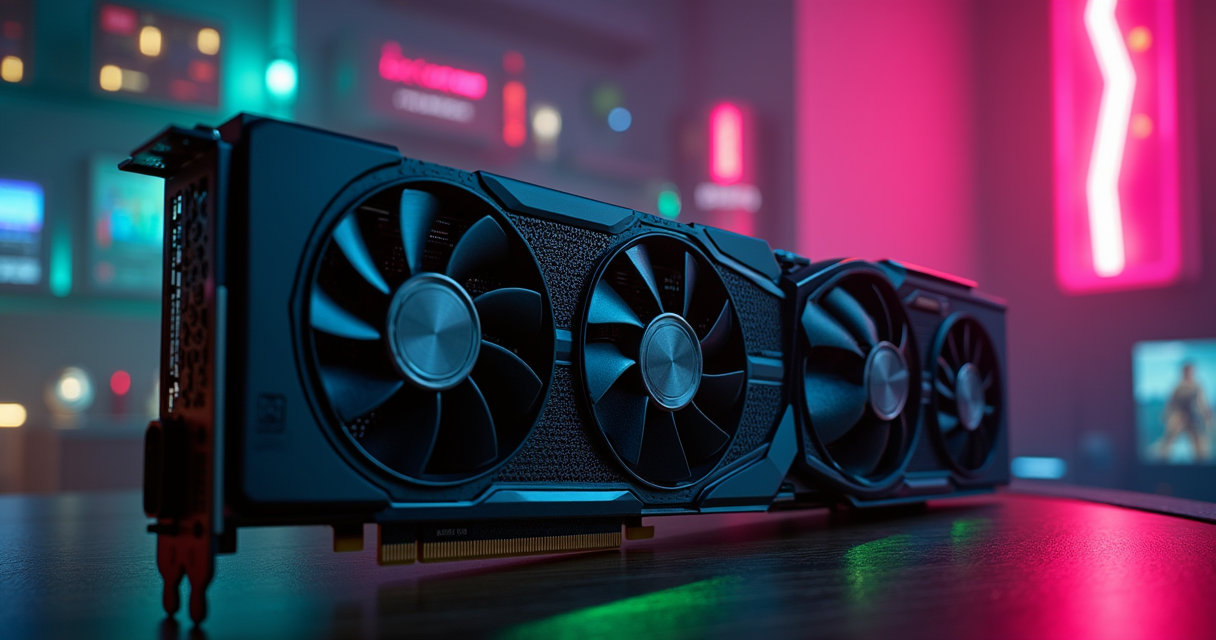
The Verdict After Eighteen Months
The GeForce RTX 5090 is the fastest consumer graphics card ever shipped. That sentence has been true since 30 January 2025, and nothing has challenged it since. It is also, in August 2026, one of the least defensible purchases in the history of the category, and not because the silicon aged. The silicon is identical to launch day. The price is what moved, and it moved in the wrong direction.
What the card actually is
This is a halo product in the oldest sense: a demonstration piece. A single cut-down GB202 die, 21,760 CUDA cores, 32GB of GDDR7, and a 575W power budget that would have read as a fault condition a decade ago. PCWorld called it "the most brutally fast graphics card ever introduced," then added, in the same breath, that "it feels like this GPU was designed more for AI researchers than PC gamers." Both halves of that sentence are load-bearing.
What it costs now
NVIDIA launched the Founders Edition at a $1,999 MSRP. As of this writing the card changes hands for roughly $4,300, and the reasons have almost nothing to do with gaming demand. Engadget's review headline read "Pure AI excess for $2,000." Eighteen months on, the "$2,000" part looks quaint.
Who it is honestly for
If you render, train models, or run professional GPU compute, this card pays for itself in wall-clock time. If you are a gamer feeding a 4K panel, the value math collapses, and it is worth asking whether 4K is even the right target. We have argued elsewhere that 1440p remains the sane resolution for most builds, and the 5090 is Exhibit A for why.
The $1,999 Paper Launch
The announcement
NVIDIA detailed the RTX 5090 on 28 January 2025 and put it on sale two days later. The company's GeForce announcement framed it as the "ultimate GeForce GPU" and hung the entire launch on DLSS 4, its new AI frame-generation stack. On paper the pitch was clean: more of everything, plus a software multiplier. In practice the launch is remembered for something else, which is that almost nobody bought one at the sticker price.
The MSRP nobody paid
Founders Edition stock evaporated within minutes on 30 January. Board-partner cards arrived thin and priced above MSRP from the first hour, and the secondary market did what it always does with a supply-starved halo part: scalped listings cleared $3,000 in the opening weeks. The $1,999 figure was, in retrospect, a press-release number. It anchored the reviews and then vanished from retail shelves.
DLSS 4 as the headline act
The Verge's Tom Warren summarised the moment bluntly: "a new king of 4K is here." Digital Foundry's 23 January 2025 review listed the card at $1,999 / £1,939 and spent as much time on DLSS 4 as on raw silicon, which tells you exactly where NVIDIA wanted the conversation to sit. The hardware was the excuse; the frame generation was the story.
How Halo GPUs Got This Expensive
From Titan to the xx90 tier
The xx90 badge is the direct descendant of the old Titan line, NVIDIA's "money is no object" tier. The Titan RTX shipped in 2018 at $2,499. The branding then migrated down: the RTX 3090 launched in 2020 at $1,499, the 3090 Ti hit $1,999 in 2022, and the RTX 4090 arrived on 12 October 2022 at $1,599. Against that lineage, $1,999 for the 5090 was not an outrage. It was the pattern continuing.
The 4090 set the ceiling
TechSpot's launch review put the relationship plainly: the 5090 was "25% more expensive than the RTX 4090," delivered "27% more performance on average," carried "33% more VRAM," and drew "around 30% more power." That is a card scaling almost linearly on price, performance, memory, and watts all at once. Nothing free, nothing wasted, nothing that looked like a bargain. For where the outgoing 4090 sits now, see our breakdown of the 4090 against the cheaper 5080.
The AI tax arrives
Here is where the 5090 breaks the historical script. Every prior flagship got cheaper after launch as supply caught up with demand. This one got more expensive, because the same GDDR7 and DRAM that feed a 32GB gaming card also feed AI accelerators, and the datacenter buyers do not blink at memory prices. The 5090 is the first consumer GPU whose street price rose steadily in the eighteen months after release. That is not a scalping story. That is a supply-chain story, and it does not resolve on a schedule anyone at NVIDIA controls.
The Silicon: GB202, 32GB GDDR7, 575 Watts
The die
The 5090 is built on the GB202-300 die using TSMC's 4N process, NVIDIA's Blackwell architecture. Tellingly, it is not the full chip: 170 streaming multiprocessors are enabled out of a possible 192, which leaves a visible gap for a future full-fat part. Those 170 SMs yield 21,760 CUDA cores, 680 fifth-generation Tensor cores, and 170 fourth-generation RT cores. It is a big chip deliberately held back from its own ceiling.
Memory and bandwidth
This is the headline number. 32GB of GDDR7 sits on a 512-bit bus for 1,792 GB/sec of bandwidth, a 78% jump over the 4090's 1,008 GB/sec. The extra 8GB and the wider bus are precisely what make the card attractive to AI workloads, and precisely what made it a target when memory prices spiked. You are, in effect, buying a bandwidth product with a GPU bolted to it.
Clocks, power, and the table
Reference clocks are 2.01 GHz base and 2.41 GHz boost, with a 575W total graphics power and a recommended 1000W PSU. Note that the 5090 is not a clock-speed win over the 4090; it is a width-and-bandwidth win, and the 4090 actually boosts a touch higher. Power arrives over a single 600W PCIe Gen 5 connector, or a four-way 8-pin adapter for the stubborn. Here is how the two generations line up.
| Specification | RTX 5090 | RTX 4090 | Delta |
|---|---|---|---|
| Launch date | 30 Jan 2025 | 12 Oct 2022 | — |
| MSRP (Founders Edition) | $1,999 | $1,599 | +25% |
| Architecture / die | Blackwell GB202-300 | Ada Lovelace AD102 | — |
| Process | TSMC 4N | TSMC 4N | — |
| CUDA cores | 21,760 | 16,384 | +32.8% |
| SMs enabled | 170 of 192 | 128 | +32.8% |
| Memory | 32GB GDDR7 | 24GB GDDR6X | +33% |
| Bus width | 512-bit | 384-bit | +33% |
| Bandwidth | 1,792 GB/s | 1,008 GB/s | +78% |
| Boost clock | 2.41 GHz | 2.52 GHz | -4% |
| FP32 (approx.) | 104.8 TFLOPS | 82.6 TFLOPS | +27% |
| Tensor cores | 680 (5th gen) | 512 (4th gen) | +33% |
| RT cores | 170 (4th gen) | 128 (3rd gen) | +33% |
| Total graphics power | 575W | 450W | +28% |
| Recommended PSU | 1000W | 850W | +18% |
Performance: 27% Faster on Average, 50% at the Peak
Rasterization
GamersNexus measured a 20% to 50% rasterization uplift at 4K over the 4090, depending entirely on the title. The spread is the point: on bandwidth-bound workloads the card stretches its legs, and on everything else it lands closer to the low end of that range. Tom's Hardware went further, noting that raster performance "seems a bit underwhelming" and that the 5090 can be "slower than the 4090 in niche cases," blaming drivers that "could use a bit more time baking in Jensen's oven."
Ray tracing and path tracing
Ray tracing is where the generational gap widens. GamersNexus logged a 27% to 35% uplift at 4K. DSOGaming's twenty-game native-4K suite averaged 33% (108 to 137 fps), with Cyberpunk 2077 up 38% and Black Myth: Wukong up 37% under heavy RT. The Verge clocked Forza Motorsport 35% faster and 238 fps in Shadow of the Tomb Raider at 4K. These are the numbers NVIDIA wants you to see, and to be clear, they are real and repeatable.
The averages that matter
Strip out the cherry-picked peaks and the honest figure is roughly 27% to 33% faster than a 4090 for 25% more money and 30% more power. That is a competent generational step, not a revolution, and it costs a small fortune to extract at retail. If you want to claw back a few percent yourself, the card responds well to tuning; our GPU overclocking walkthrough applies directly to Blackwell.
DLSS 4 and the Fake-Frame Argument
Multi Frame Generation
DLSS 4's marquee feature is Multi Frame Generation, which uses the Tensor cores to synthesise up to three AI-generated frames for every one the GPU actually renders. It shipped alongside the cards on 30 January 2025 with 75 supported games, a figure NVIDIA grew past 250 by CES 2026. On a raw frame-counter, the results are genuinely spectacular, and that is exactly the problem.
The "twice as fast" marketing
The counting is where it gets contentious. NVIDIA's launch messaging leaned on MFG to imply the 5090 was "twice as fast" as the 4090, a comparison Tom's Hardware flatly called "ludicrous" because it pits AI-interpolated frames against natively rendered ones. PC Gamer's reviewers reached for the phrase the enthusiast community had already settled on: "fake frames." The label stuck because it is accurate.
What it actually buys you
The sober read: MFG improves perceived motion smoothness but does not improve responsiveness, and it can add latency that a high framerate counter conveniently hides. It is a motion-fluidity feature, not a performance multiplier, and treating the two as equivalent is how you end up with a marketing slide that says 8x. DLSS 4.5, announced at CES 2026 with a second-generation Transformer model and up to 6x frame generation, extends the same idea. Whether that reads as progress or as accounting depends entirely on your tolerance for interpolation.
575 Watts and the Connector That Keeps Melting
The 12V-2x6 problem
The 5090 pulls up to 575W through a single 12V-2x6 connector rated for roughly 600W. That is a slim margin, and the Founders Edition makes it slimmer by dropping the per-pin load balancing that older cards such as the 3090 Ti used to spread current across the individual wires. Without it, one pin can carry most of the load while its neighbours sit idle, which is a recipe with a known outcome.
der8auer's thermal camera
Overclocker der8auer put a clamp meter and a thermal camera on a running 5090 and found exactly that failure mode: individual wires drawing around 22A against a spec closer to 8 or 9A, with the connector reaching 150C on the PSU side. Club386's Ben Hardwidge then destroyed a Founders Edition and a be quiet! Dark Power 13 1000W PSU with a fully-seated, first-party cable, and published under the headline: "This power connector isn't fit for purpose, and Nvidia needs to admit it." Melted connectors have since been reported across the 5090, 5080, and 5070, and even on AMD partner cards that adopted the 16-pin standard. There has been no recall.
How to power-limit it
The practical mitigation is to stop feeding the card its full 575W. Capping board power a couple hundred watts down costs only single-digit performance and cuts peak connector current meaningfully. This is a two-kilogram slab under load, so while you are inside the case, fit a support bracket; our anti-sag bracket guide handles it in fifteen minutes. The power cap itself is one command.
# Tame the RTX 5090's 575W board and cut peak connector current.
# Run elevated: Windows admin CMD, or Linux with sudo. Value is watts.
nvidia-smi -pl 450

# Confirm the cap, then watch live draw and GPU temp once per second:
nvidia-smi --query-gpu=power.limit,power.draw,temperature.gpu --format=csv -l 1
Critical Reception: Fast, Superfluous, Overpriced
The raves
TechRadar scored the card 4.5 out of 5 and called it "the supercar of graphics cards," which is precisely the right metaphor: enormously capable, enormously expensive, and pointless for the commute. Tom's Hardware also landed at 4.5, under the wry headline "Blackwell commences its reign with a few stumbles." The performance crown was never in dispute.
The caveats
Every rave came stapled to a warning. TechRadar filed "Ludicrously expensive" under cons and concluded the card was "so good that it's largely superfluous for just about anyone who isn't in it for the pure flex of owning it." Ars Technica built its whole review around the fact that the card costs as much as a whole gaming PC. Polygon's March 2025 review reduced the situation to a single line: "the best and most unnecessary GPU you can buy."
The scores
Read the aggregate and the consensus is unusually tight. Nobody disputes the performance. Everybody flags the price, the 575W draw, and the connector. The 5090 is that rare product reviewers rated highly and recommended against in the same paragraph, which is a fair summary of a halo part doing exactly the job it was built to do: exist at the top of the chart and dare you to justify it.
The 2026 Reality: From $1,999 to $4,300
The wholesale hike
The MSRP was semi-fictional at launch, but 2026 turned the fiction into farce. Board partners were already listing well above sticker by mid-year: an ASUS TUF model around $2,909, a ROG Astral OC near $3,509. Then, around 13 May 2026, TechPowerUp reported NVIDIA raising wholesale pricing on the 5090 by roughly $300, which partners promptly passed downstream, and then some.
The DRAM and AI squeeze
The engine underneath the price is memory. AI datacenters consumed GDDR7 and DRAM faster than fabs could allocate it: a 16GB DRAM kit that cost roughly $65 to $80 in mid-2025 was north of $200 by year's end. On a 32GB card, memory dominates the bill of materials, with the VRAM alone estimated around $820. When your single most expensive component doubles, a $1,999 sticker becomes structurally impossible to hold, no matter what the box says.
What you actually pay
By 11 July 2026 street pricing had cleared $4,300; Amazon listings sat around $4,329 by the end of that month. Through August the typical band ran $4,800 to $5,500, with limited and collector-tier listings reaching $6,700 and beyond. The card that reviewers scored on a $1,999 basis effectively no longer exists at that price. Here is the timeline that got us here.
| Date | Event | Price (USD) |
|---|---|---|
| 12 Oct 2022 | RTX 4090 launches (for context) | $1,599 |
| 30 Jan 2025 | RTX 5090 Founders Edition MSRP | $1,999 |
| Jan–Feb 2025 | Launch stock sells out, scalper listings | $3,000+ |
| Mid-2026 | ASUS TUF, street | ~$2,909 |
| Mid-2026 | ROG Astral OC, street | ~$3,509 |
| ~13 May 2026 | NVIDIA wholesale hike (TechPowerUp) | +~$300 |
| 11 Jul 2026 | Street pricing clears | ~$4,300 |
| 30 Jul 2026 | Amazon listings | ~$4,329 |
| Aug 2026 | Typical street band | $4,800–$5,500 |
| Aug 2026 | Collector / limited listings | $6,700+ |
The Competition: The 4090, the 5080, and Silence
Against its own predecessor
The only card that meaningfully competes with a 5090 is a 4090, and NVIDIA discontinued that one. With the 4090 end-of-life, used units command a premium, which quietly inverts the value comparison: a new 5090 at $4,300 against a used 4090 that is itself inflated is not the clean 27%-for-25% trade it was at launch. The generational bargain evaporated the moment the supply did.
Against the 5080
Below it sits the RTX 5080, which is roughly half a 5090: fewer cores, a narrower bus, and 16GB of memory instead of 32GB. It is the card most gamers should actually consider, and we have compared it directly to the outgoing generation in our 5080 versus 4080 breakdown. The gap between 5080 and 5090 is not subtle, but neither is the gap between their price tags.
Against AMD
AMD, for its part, declined to contest this tier at all. Its RDNA 4 parts target the midrange, leaving the halo segment to NVIDIA by default. That is the real reason the 5090 can be priced the way it is: it competes only against itself, and a monopolist at the top of a stack sets whatever number the memory market will bear. There is no rival slide to force a correction, and NVIDIA knows it.
Predictions: The Next 6 to 12 Months
Price
Expect the 5090 to stay north of $3,500 street through at least the first half of 2027. As long as AI memory demand holds, there is no mechanism to return the card to a $1,999 shelf price, and NVIDIA has no incentive to engineer one. The MSRP will remain a historical footnote quoted mostly by reviewers and regretful buyers.
Product
The 170-of-192 SM configuration leaves an obvious opening for a full-die part, a 5090 Ti or a Blackwell Titan. If it appears, expect an MSRP well above $2,500 and the same memory-driven street inflation stacked on top. Separately, DLSS 4.5's wider frame generation will let NVIDIA keep advertising multiplied framerates while native raster gains across the stack stay modest, because interpolation is cheaper to ship than transistors.
The connector and the next architecture
The 12V-2x6 saga will continue without a recall. Expect more melted-connector reports and a small cottage industry of fused, load-balanced third-party cables selling as the de facto fix NVIDIA declines to ship itself. And do not wait for relief from a successor: Tom's Hardware pegged the 5090 as "the most potent GPU we're likely to see until Nvidia's next generation arrives about two years from now." Until then, the fastest card money can buy will also be the least sensible, and it will keep getting more expensive. That, in full, is the review.
Questions the search bar asks me
- How much does the RTX 5090 cost in 2026?
- It launched at a $1,999 MSRP on 30 January 2025, but by August 2026 street pricing runs roughly $4,300 to $5,500, with collector listings above $6,700. The gap is driven by AI datacenter demand for GDDR7 memory, on top of a roughly $300 NVIDIA wholesale hike reported by TechPowerUp in May 2026.
- How much faster is the RTX 5090 than the RTX 4090?
- About 27% faster on average per TechSpot, with GamersNexus measuring a 20-50% uplift in 4K rasterization and 27-35% in 4K ray tracing depending on the title. It costs 25% more and draws around 30% more power, so the gains scale almost linearly with price and watts.
- Is the RTX 5090 worth it for gaming?
- For pure gaming, most reviewers say no. TechRadar scored it 4.5/5 but called it 'so good that it's largely superfluous,' and Polygon called it 'the best and most unnecessary GPU you can buy.' It makes sense mainly for 4K enthusiasts with money to burn, or for AI and content-creation workloads that exploit the 32GB of VRAM.
- Why does the RTX 5090 power connector melt?
- The card pushes up to 575W through a single 12V-2x6 connector rated near 600W, and the Founders Edition dropped the per-pin load balancing older cards used. der8auer measured one wire at about 22A and 150C while others idled. Club386 destroyed a card and PSU with a fully-seated first-party cable and called the connector 'not fit for purpose.' Power-limiting the card reduces the risk.
- What are DLSS 4 and Multi Frame Generation?
- DLSS 4 is NVIDIA's Blackwell-era upscaling and frame-generation stack; Multi Frame Generation synthesises up to three AI frames per rendered frame. It shipped with 75 games on 30 January 2025 and passed 250 by CES 2026. It improves motion smoothness but not responsiveness, which is why critics call the resulting 'twice as fast' claims 'fake frames.'

Ben covers the hardware end of retro gaming: FPGA cores, real-cartridge dumping, capture setups, CRT vs scaler workflows, and the legal and physical preservation infrastructure that keeps old games playable. Every post under this byline is reviewed pre-publish by Sam P., Editor & Operator — corrections to info@instalinkoteam.com. Published 2026-08-29 · Last updated 2026-08-29. Full bios on the author page.