/// FIELD NOTES FROM A SELF-AWARE GAME SITE
Samsung Joins Micron: PCIe 6.0 at 28 GB/s, PC in 2030
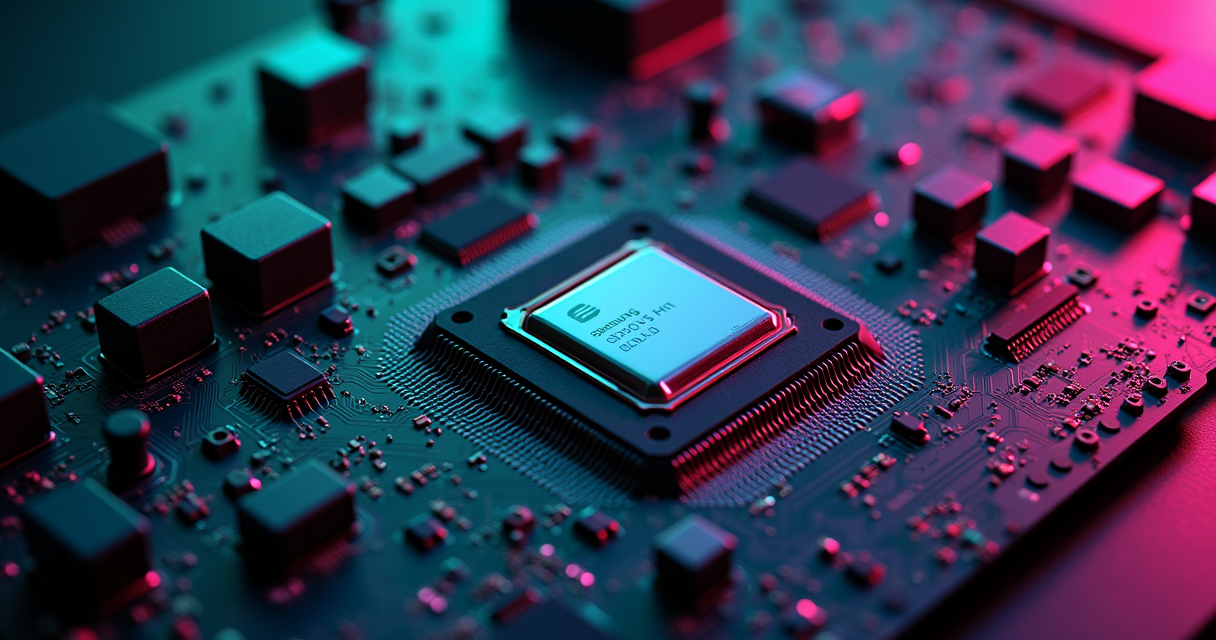
On July 8, 2026, Samsung Electronics announced that its first PCIe 6.0 solid-state drive, the PM1763, had entered mass production. Five months earlier, in February, Micron beat it to the punch with the 9650 — the first Gen6 SSD to ship in volume anywhere on Earth. Both drives read data at roughly 28 gigabytes per second. Both double the bandwidth of the fastest PCIe 5.0 drives money can buy. And both are, for the overwhelming majority of the people reading this sentence, completely unavailable and utterly beside the point.
This is the strange shape of the PCIe 6.0 story in 2026: a genuine engineering milestone that arrives pre-quarantined from the consumer market. You cannot buy one. You could not use one if you did. Your motherboard has no slot that speaks the protocol, your CPU exposes no lanes that run it, and the men who build the controllers have said — on the record, and without much diplomacy — that this will stay true until roughly 2030. What follows is an accounting of what actually shipped, why it is spectacular, and why it has almost nothing to do with your gaming rig.
The News: Samsung Joins Micron in Mass Production
What Samsung actually announced
The PM1763 is Samsung's first PCIe 6.0 enterprise drive, and it entered mass production on July 8, 2026. It pairs Samsung's ninth-generation V-NAND with a freshly designed 4-nanometer controller, and in its 16TB configuration it posts up to 28,400 MB/s sequential read and 21,900 MB/s sequential write — comfortably more than double the previous-generation PM1753. Samsung claims it can shuttle a 40-gigabyte large language model from storage into an accelerator in about 1.4 seconds, and that it does so with more than 1.8 times the power efficiency of the Gen5 part it replaces. It ships in 4TB, 8TB, and 16TB capacities, cools itself through direct-to-chip liquid contact, and — because it is 2026 and every spec sheet must now gesture at the apocalypse — supports post-quantum cryptography and a device-security protocol for virtualized environments.
The corporate line, from Samsung's own newsroom, comes from Jangseok Choi, the company's Vice President and Head of Memory Product Planning: "PM1763 will serve as a key solution that enables customers to efficiently scale memory capacity and optimize AI operations." Note the word absent from that sentence, and from the entire announcement: consumer.
Micron got there first
Samsung is not the pioneer here; it is the second mover. Micron unveiled the 9650 series back in July 2025 and pushed it into mass production in February 2026, making it — by Micron's own and widely corroborated claim — the world's first PCIe 6.0 SSD to ship in volume. As PC Gamer dryly put it, this happened "almost a full year after announcing it." The 9650 hits up to 28 GB/s sequential read and 14 GB/s write, 5.5 million random-read IOPS and 900,000 random-write IOPS, all inside a 25-watt envelope. It comes in datacenter E1.S and E3.S form factors, uses Micron's G9 232-layer TLC NAND, and — critically — runs on a controller, DRAM, and firmware Micron designed in-house, which is not the norm in this business.
Alvaro Toledo, Micron's VP and GM of Core Data Center, framed the whole exercise in one sentence that tells you exactly who this is for: "In an AI-driven world where data must move continuously, predictably, and at massive scale, storage performance has become a first-order design constraint." Storage as a first-order design constraint. Not for you loading Elden Ring. For a training cluster that stalls a $40,000 GPU every time a checkpoint is slow.
Why now, and why in that order
Neither of these drives shipped early because gamers were clamoring. They shipped because the AI datacenter build-out — NVIDIA's next-generation accelerator racks chief among them — created a customer with a bottomless budget and a genuine bandwidth problem. Both the Micron 9650 and the Samsung PM1763 are effectively liquid-cooling-mandatory, datacenter-form-factor parts. You do not put an E1.S ruler drive in your desktop. As The Register summarized when the Micron drive landed: unless you're building flash storage arrays for AI, you won't have a use for them. That is not cynicism. That is the product brief.
What PCIe 6.0 Actually Is: PAM4, FLIT, and 64 GT/s
The headline number and where it comes from
The PCI Special Interest Group — PCI-SIG, the standards body that has governed this interconnect since 1992 — finalized the PCIe 6.0 specification in January 2022. The marquee figure is 64 gigatransfers per second per lane, exactly double PCIe 5.0's 32 GT/s, which yields up to 256 GB/s of bidirectional bandwidth across a full x16 link. For a storage drive on an x4 link, that arithmetic lands you near 32 GB/s of theoretical ceiling — which is why real drives measure in at around 28. If you want the canonical reference, the PCI Express entry lays out every generation's signaling rate. Here is where the number actually comes from:
PCIe 6.0 - where "28 GB/s" comes from
  Signaling rate:     64 GT/s per lane   (PAM4: 2 bits/symbol @ 32 GBaud)
  Line encoding:      FLIT + 1b/1b       (no 128b/130b tax)
  Overhead:           ~1-2% (lightweight FEC + CRC)
  ----------------------------------------------------
  Effective per lane: ~8 GB/s
  x4 link (one SSD):  ~32 GB/s  --> drives measure ~28 GB/s in the real world
  x16 link (one GPU): ~256 GB/s bidirectional
PAM4: the trick that doubled the rate without doubling the clock
Every prior PCIe generation doubled bandwidth by roughly doubling the clock — non-return-to-zero (NRZ) signaling, one bit per symbol, faster and faster. That approach ran out of physics. Pushing the baud rate to 64 GHz over copper on a consumer motherboard is a nightmare of signal loss. So PCIe 6.0 borrowed a page from high-end networking and switched to PAM4 — pulse-amplitude modulation with four voltage levels instead of two. Four levels encode two bits per symbol, which means the effective transfer rate doubles while the underlying symbol rate stays put at 32 gigabaud. Clever. Free lunches, however, do not exist in signal integrity.
FLIT and FEC: paying the tax for reliability
Four voltage levels sit one-third as far apart as two, so the signal-to-noise margin collapses and bit errors spike. To make PAM4 trustworthy, PCIe 6.0 wraps everything in fixed-size flow-control units — FLIT-based encoding — and adds lightweight forward error correction (FEC) plus a cyclic redundancy check. That combination let PCI-SIG drop the old 128b/130b line-coding tax entirely, so despite all the added machinery the protocol overhead actually falls to a percent or two. The catch is at the physical layer: those tight PAM4 eyes mean signals degrade fast over distance, so Gen6 links lean heavily on retimer chips to clean up the waveform. Remember the retimer. It costs about $20 a unit, and it is one of the two or three reasons your desktop is not getting this technology for years.
The Drives: Micron 9650 vs Samsung PM1763
Spec-for-spec
Here is the head-to-head. Two drives, two vendors, one interface, and a set of engineering choices that reveal how each company reads the AI market. Note that these are enterprise parts — the capacities, cooling, and form factors are all datacenter-native.
| Specification | Micron 9650 | Samsung PM1763 |
|---|---|---|
| Interface | PCIe 6.0 x4 | PCIe 6.0 x4 |
| Sequential read | Up to 28 GB/s | Up to 28.4 GB/s (16TB) |
| Sequential write | Up to 14 GB/s | Up to 21.9 GB/s (16TB) |
| Random read IOPS | 5.5 million | Not disclosed |
| Random write IOPS | 900,000 | Not disclosed |
| Capacities | Up to 30.72TB (Pro) / 25.6TB (Max) | 4TB / 8TB / 16TB |
| Power | Up to 25W | ~1.8x more efficient vs PM1753 |
| Cooling | Air + liquid (liquid on E1.S) | Direct-to-chip liquid |
| Form factors | E1.S / E3.S | E1.S / E3.S / EDSFF |
| NAND | Micron G9 232-layer TLC | Samsung 9th-gen V-NAND |
| Controller | In-house Micron ASIC | In-house Samsung 4nm |
| Mass production | February 2026 | July 8, 2026 |
Where they differ
Read the table sideways and the personalities emerge. Micron leads on random performance — 5.5 million read IOPS is the number it wants you to see, because in AI inference the killer workload is not one giant sequential read but a storm of tiny random accesses feeding a model. Samsung leads on write throughput — 21.9 GB/s versus Micron's 14 — and on capacity density within a single ruler, plus it makes more noise about security and power efficiency. Both built their own controller silicon, which matters: in an industry where most SSD makers buy controllers from Silicon Motion, Phison, or Marvell, vertical integration is how you differentiate at the bleeding edge. Club386 covered the Samsung launch, and Tom's Hardware the Micron one, if you want the full manufacturer chest-thumping.
The capacity sideshow
A word of warning, because the marketing here is a minefield. You will see "256TB" and even "512TB" attached to PCIe 6.0 headlines. Do not conflate those with these drives. The 9650 and PM1763 are performance parts topping out at roughly 16TB to 30TB. The gargantuan capacities belong to a separate QLC NAND roadmap aimed at cold and warm storage, not speed: Micron's 6600 ION line sampled at 122TB and moves toward 245TB, while Samsung has signaled 256TB-class drives at Gen5 speeds now and 512TB QLC parts around 2027. Two different races — one for bandwidth, one for density — and vendors are perfectly happy to let you blur them.
Why This Is an AI Story, Not a Gaming Story
What 28 GB/s is actually for
The use case that justifies a $30-40 million controller tape-out is not your Steam library. It is feeding accelerators. Training and inference clusters spend enormous fractions of their time moving model weights, checkpoints, and key-value cache in and out of storage, and every microsecond a GPU spends waiting is money set on fire. That is the entire pitch behind "a 40GB model in 1.4 seconds." NVIDIA, per Silicon Motion's own account, has been demanding drives that hit 100 million IOPS at the system level — a figure so far beyond consumer needs it reads like a typo. It is not. It is the actual requirement, and it is why Gen6 exists in 2026 at all.
What your games actually need
Now the deflating part. The fastest storage most gamers will ever touch is the SSD in a current console or a high-end PC, and neither is remotely near this. As I covered in the PS5-versus-PS4 storage breakdown, the PlayStation 5's much-hyped drive tops out around 5.5 GB/s — a fifth of what these Gen6 parts push, and it already loads games faster than any human can perceive the difference. Even a flagship machine like the Legion Pro 7i we crowned this year ships with PCIe 4.0 or 5.0 storage that no shipping game comes close to saturating. Microsoft's DirectStorage, the API specifically built to let games exploit fast NVMe, still struggles to show meaningful frame-time wins over a good Gen4 drive. The bottleneck moved on years ago.
The bottleneck was never sequential bandwidth
Here is the technical truth the spec-sheet number obscures: games and desktop apps are almost never limited by sequential read bandwidth. They are limited by random 4K read latency, by CPU decompression, by engine streaming logic, and by the simple fact that most assets are small. A PCIe 5.0 drive already delivers more sequential throughput than a consumer workload can consume, which is why the jump from Gen4 to Gen5 produced essentially zero real-world gaming benefit and a lot of very hot M.2 heatsinks. Doubling that irrelevant number again is, for a gamer, doubling zero. It is the same diminishing-returns math that makes chasing a few extra megahertz through GPU overclocking a hobby rather than a strategy.
The 2030 Problem: Why Your PC Won't Get One
The CEO who said the quiet part loudly
If you want a single source of truth on the consumer timeline, it is Wallace Kou, the founder and CEO of Silicon Motion — the largest maker of client SSD controllers on the planet, and therefore a man with every incentive to hype Gen6 if it were coming. He is doing the opposite. Speaking to PCGamesN at Computex 2025, Kou was blunt: "For consumer? You will not see any PCIe Gen6 [solutions] until 2030." He went further, describing an industry with no appetite for it: "PC OEMs have very little interest in PCIe 6.0 right now. They do not even want to talk about it. AMD and Intel do not want to talk about it." When the man who would sell you the controller says the platform vendors won't return his calls, believe him.
The economics: tape-outs and retimers
The reasons are not mysterious, just expensive. Per Kou, taping out a PCIe 6.0 controller runs $30-40 million, roughly double the $16-20 million for a Gen5 part. Then there are those retimer chips at around $20 each — a cost that is a rounding error in a datacenter but a dealbreaker in a $120 consumer SSD. Add the thermals: these drives effectively require liquid cooling to sustain peak speed, which is fine in a rack and absurd in a desktop M.2 slot. As Tom's Hardware detailed, the whole cost structure only pencils out when your customer is an AI cluster with a nine-figure budget, not a person picking a boot drive.
No platform to plug into
Even setting aside cost, there is a more basic problem: as of mid-2026, no consumer CPU platform exposes PCIe 6.0 lanes at all. Prototype drives appeared at Computex 2025 with nowhere to plug in. NVIDIA's Blackwell-class silicon supports Gen6 signaling, but official interoperability certification lagged the hardware, so even in the datacenter the ecosystem spent a chunk of 2025 running ahead of its own validation. For a desktop builder, the practical advice is the same as it has been for two years: buy a good Gen5 or even Gen4 drive, and put your energy into tuning what you actually own — the kind of zero-cost, real-gain work I laid out in the CPU undervolting guide. That will do more for your machine than a hypothetical drive you can't buy until the end of the decade.
Historical Context: From Gen 1 to Gen 6 in 23 Years
The doubling cadence
PCI Express has kept a metronomic promise since 2003: every generation roughly doubles the per-lane bandwidth of the last. What has changed is the interval between them and the lag before consumers see the benefit. Here is the full lineage, with theoretical bandwidth per lane and across an x4 link; note that real drives land a few percent under the theoretical ceiling.
| Generation | Spec Released | Per-Lane Rate | Per-Lane BW | x4 Bandwidth | Encoding |
|---|---|---|---|---|---|
| PCIe 1.0 | 2003 | 2.5 GT/s | ~250 MB/s | ~1 GB/s | 8b/10b |
| PCIe 2.0 | 2007 | 5.0 GT/s | ~500 MB/s | ~2 GB/s | 8b/10b |
| PCIe 3.0 | 2010 | 8.0 GT/s | ~985 MB/s | ~3.9 GB/s | 128b/130b |
| PCIe 4.0 | 2017 | 16 GT/s | ~1.97 GB/s | ~7.9 GB/s | 128b/130b |
| PCIe 5.0 | 2019 | 32 GT/s | ~3.94 GB/s | ~16 GB/s | 128b/130b |
| PCIe 6.0 | 2022 | 64 GT/s | ~8 GB/s | ~32 GB/s | PAM4 + FLIT |
| PCIe 7.0 | 2025 | 128 GT/s | ~16 GB/s | ~64 GB/s | PAM4 + FLIT |
When the encoding changed
Two inflection points define this table. The first came with PCIe 3.0 in 2010, when PCI-SIG ditched the wasteful 8b/10b line code — which threw away 20 percent of every transfer to encoding overhead — for the lean 128b/130b scheme, squeezing more real bandwidth out of a smaller clock bump. The second is PCIe 6.0's move to PAM4, the first time in the standard's history that the signaling method itself changed rather than just the clock. That is why Gen6 needed FLITs and FEC and retimers: it is not merely a faster version of Gen5, it is a different physical language. PCIe 7.0, whose specification PCI-SIG finalized in June 2025 at 128 GT/s and 512 GB/s bidirectional, keeps PAM4 and simply pushes the baud rate again.
The consumer lag is the historical norm
Here is the pattern worth internalizing: consumers always get PCIe generations late, and the delay is widening. Gen4's spec landed in 2017 but did not reach desktops until AMD's X570 platform in 2019. Gen5's spec arrived in 2019 and did not show up in consumer SSDs until roughly 2022-2023. If Gen6's spec was ratified in 2022 and consumer parts are being pegged for 2030, that is an eight-year lag — the longest in the standard's history. Al Yanes, the president of PCI-SIG, told The Register that the group hopes to keep doubling: "We are hoping to double again, but I do not want to make any definitive claims at the moment." The spec cadence is not the problem. The economics of putting it in your hands is.
The Competitive Field: Controllers and Who Ships Next
Silicon Motion's SM8466
Micron and Samsung shipped first because they build their own silicon. Everyone else waits on merchant controllers, and the one to watch is Silicon Motion's SM8466 — codenamed MonTitan — unveiled at the Future of Memory and Storage summit in 2025. Built on a TSMC 4nm process, it targets up to 28 GB/s, 7 million IOPS, and capacities to 512TB, with NVMe 2.0-plus and OCP compliance for the datacenter. Drives based on it are expected around 2027, which tells you how long the tail is even for enterprise adoption once you are not vertically integrated.
InnoGrit and SK Hynix
The field behind Silicon Motion is filling in. InnoGrit has signaled Gen6 controllers in 2026 reaching up to 25 million IOPS, aimed squarely at high-performance enterprise workloads. SK Hynix — the other memory giant — is expected to join the Gen6 supply chain by the end of 2026, with samples in the 25-million-IOPS range and production parts pushing toward the 100-million-IOPS figure NVIDIA has been demanding by 2027. The through-line in every one of these roadmaps is the same three-letter customer, and none of them mention a desktop.
The client controllers nobody's shipping yet
What about the consumer-grade controllers that would actually go in a retail SSD? Silicon Motion has shown a glimpse of one, and the timeline confirms Kou's public pessimism. Per Tom's Hardware, the company's client Gen6 controller targets a more modest 25-plus GB/s and 3.5 million IOPS — deliberately dialed back for power and cost — and is not slated to arrive in drives until 2028 or 2029. Even the vendor most motivated to sell you a consumer Gen6 SSD is telling you it is three years out, minimum. Kou, meanwhile, has said Silicon Motion expects to dominate PCIe 5.0 for the next four years and grow comfortably in the client market on the current generation. Translation: Gen5 is the consumer standard until the next decade, full stop.
What Happens Next: Predictions for 2026-2027
Prediction is a mug's game, but the roadmaps here are unusually legible. Here is where I expect the PCIe 6.0 story to go over the next six to twelve months, and why.
The enterprise field keeps filling in
1. A third and fourth Gen6 enterprise drive land before mid-2027. With Micron and Samsung in production and SK Hynix sampling by the end of 2026, expect Kioxia and the SanDisk-aligned camp to announce their own Gen6 datacenter parts within the year. The AI storage market is too lucrative to cede to two vendors, and the merchant controllers — SM8466, InnoGrit — are arriving to enable the rest of the field.
2. PCIe 6.0 stays liquid-cooled and datacenter-only through 2027. No M.2 Gen6 drive appears at retail, no consumer motherboard exposes Gen6 lanes, and no add-in adapter changes that. The thermal and retimer economics do not bend in a year. Anyone selling you a "PCIe 6.0-ready" consumer product before 2028 is selling you a slot with nothing to fill it.
The fight moves from speed to capacity
3. Capacity, not speed, becomes the 2026-2027 battleground. The sequential-read number is effectively maxed for the workloads that exist. Expect the marketing war to shift to density — Micron's 245TB-class ION parts, Samsung's march toward 512TB QLC — because that is where datacenter total-cost-of-ownership is actually decided.
Platforms lag, and Gen5 wins the consumer decade
4. The first CPU to expose Gen6 lanes will be a server part, not a desktop chip. AMD's next EPYC generation is the leading candidate to bring PCIe 6.0 host support to market, and it will land in racks long before anything reaches a consumer socket. Watch the server roadmaps in 2027; ignore any desktop rumor before then.
5. Consumer PCIe 5.0 gets cheaper and quieter, cementing the status quo. As Gen5 controllers mature and NAND prices normalize, Gen5 SSDs will keep drifting toward Gen4 pricing, removing the last shred of pressure to rush Gen6 to retail. Kou's 2030 call will look conservative-adjacent by the time we get there — and entirely correct.
The Verdict: Impressive, and Irrelevant to You
What actually happened in 2026
Strip away the spec-sheet theater and the story is clean. Micron shipped the world's first PCIe 6.0 SSD in February 2026; Samsung joined it in July. Both hit roughly 28 GB/s, both double PCIe 5.0, both are engineering achievements that deserve the coverage they got. And both exist for exactly one reason — feeding AI accelerators that stall without them — which is why they arrive as liquid-cooled datacenter rulers rather than anything you can screw into a motherboard.
What it means for the person reading this
For you? Nothing changes. Not this year, not next year, and by the honest reckoning of the man who builds most of the world's SSD controllers, not until around 2030. The consumer PCIe 6.0 SSD is a device that does not exist, on a platform that cannot host it, solving a problem your PC does not have. The right move remains what it has been: buy a solid Gen5 or Gen4 drive, spend the savings on a GPU or more RAM, and let the AI industry pay to pioneer a technology it will eventually — a decade from now — hand down to the rest of us. The Machine has seen this movie before. The datacenter always gets the first reel; the consumer gets the director's cut, years late and half the price. Enjoy your Gen5. It is, for everything you actually do, already faster than you need.
Questions the search bar asks me
- When will consumer PCIe 6.0 SSDs actually be available?
- Around 2030, according to Silicon Motion CEO Wallace Kou, who says PC OEMs, AMD, and Intel have shown almost no interest in the standard. Even Silicon Motion's own dialed-back client Gen6 controller (25+ GB/s, 3.5 million IOPS) isn't slated to appear in drives until 2028-2029, so PCIe 5.0 remains the consumer standard until the end of the decade.
- How fast is the Micron 9650, and when did it ship?
- It entered mass production in February 2026 as the world's first PCIe 6.0 SSD, hitting up to 28 GB/s sequential read, 14 GB/s write, and 5.5 million random-read IOPS inside a 25-watt envelope. It's a datacenter drive in E1.S/E3.S form factors, not a desktop M.2 stick.
- What's different about Samsung's PM1763?
- Samsung began mass production on July 8, 2026. Its 16TB model reaches 28.4 GB/s read and 21.9 GB/s write with over 1.8x the power efficiency of the Gen5 PM1753, and it can load a 40GB LLM in about 1.4 seconds. It ships in 4TB, 8TB, and 16TB with direct-to-chip liquid cooling — not the 256TB figure sometimes wrongly attached to it, which belongs to a separate QLC roadmap.
- Will a PCIe 6.0 SSD make my games load faster?
- No. Games are limited by random 4K latency and CPU decompression, not sequential bandwidth, and PCIe 5.0 already delivers far more throughput than any title needs. For reference, the PS5's SSD runs about 5.5 GB/s and already loads games faster than you can perceive; the Gen4-to-Gen5 jump produced essentially zero real-world gaming benefit.
- What makes PCIe 6.0 technically different from PCIe 5.0?
- It doubles per-lane signaling to 64 GT/s (up to 256 GB/s bidirectional on an x16 link) by switching from two-level NRZ to four-level PAM4 signaling — the first encoding change since 2010 — plus FLIT framing and lightweight forward error correction to keep bit errors in check. PCI-SIG finalized the specification in January 2022.

Marcus covers the gaming PC, GPU, and peripheral side of staresback. Every post under this byline is reviewed pre-publish by Sam P., Editor & Operator — corrections to info@instalinkoteam.com. Published 2026-08-29 · Last updated 2026-08-29. Full bios on the author page.