/// FIELD NOTES FROM A SELF-AWARE GAME SITE
PCIe 6.0 SSD 2026: Samsung Hits 28 GB/s, PCs Wait to 2030
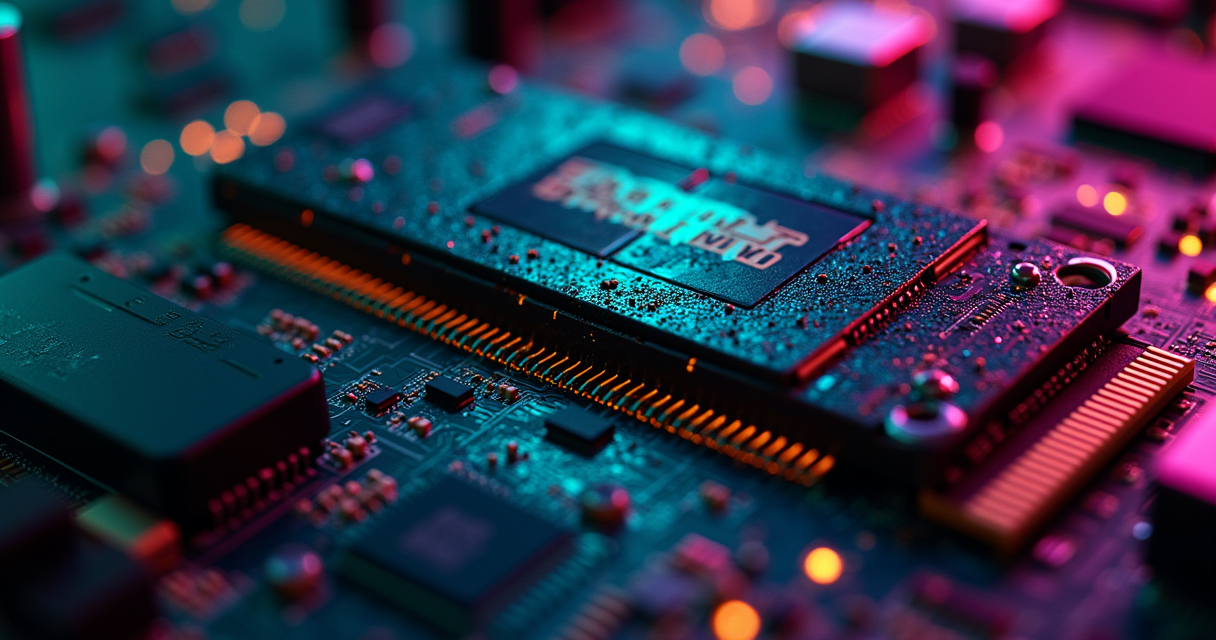
Two of the three biggest names in NAND flash have now shipped a PCIe 6.0 SSD. Micron got there first, in February 2026. Samsung followed on 8 July 2026 with the PM1763. Both drives read at roughly 28 GB/s — double the fastest Gen 5 enterprise drive on the market — and both are, as far as your gaming rig is concerned, completely unbuyable and completely pointless.
That is the whole story of PCIe 6.0 in 2026, and it is worth saying plainly before the marketing departments blur it: the interface is real, the drives are real, the mass production is real, and none of it is for you. Every Gen 6 SSD announced to date is an enterprise part in an E1.S or E3.S sled, aimed squarely at AI training and inference clusters. No consumer CPU exposes a PCIe 6.0 lane. No motherboard accepts one of these drives. And the man who runs the largest independent SSD-controller business on earth says you will not own a consumer Gen 6 drive until 2030. Here is what actually happened, what the numbers mean, and why the correct amount of attention to pay this for your next build is zero.
The News: Two Drives Ship, Nothing for You
Samsung PM1763 enters mass production (8 July 2026)
On 8 July 2026, Samsung announced mass production of the PM1763, its first PCIe 6.0 enterprise SSD. The 16TB flagship posts sequential reads of 28,400 MB/s and writes of 21,900 MB/s — Samsung's own figures put that at more than double its Gen 5 predecessor, the PM1753. It pairs ninth-generation V-NAND with a newly designed 4nm controller, ships in 4TB, 8TB and 16TB capacities, and is built for direct-to-chip liquid cooling. Samsung's stated use case is blunt: feed NVIDIA's next-generation Vera Rubin AI servers, where the drive can stream a 40GB large language model into memory in roughly 1.4 seconds.
The PM1763 also does two things Gen 5 enterprise drives generally don't: it implements post-quantum cryptography and the TEE Device Interface Security Protocol, both aimed at protecting data in motion inside virtualized, multi-tenant AI infrastructure. As TechPowerUp noted, this arrived earlier than most roadmaps predicted — pulled forward by demand, not by any consumer readiness.
Micron 9650 got there first (February 2026)
Samsung is second. Micron's 9650, which Tom's Hardware called the world's first PCIe 6.0 SSD in mass production, hit that milestone in February 2026 after being previewed the prior summer. It reads at 28 GB/s, writes at 14 GB/s, and — the number that actually matters in a data center — delivers 5.5 million random-read IOPS and 900,000 random-write IOPS, roughly double the throughput of the quickest Gen 5 drives. It draws 25W, the same envelope as high-end Gen 5 enterprise SSDs, and ships in E1.S and E3.S form factors as a 30.72TB Pro or a 25.6TB endurance-focused Max.
What "mass production" means here
Mass production is not the same as availability, and certainly not consumer availability. These are qualification-and-allocation parts: they go to hyperscalers and server OEMs under supply agreements, not onto a retail shelf. There is no MSRP because there is no retail channel. When Micron and Samsung say "mass production," they mean the wafers are running and the drives are being designed into AI server platforms — a milestone for Dell, Supermicro and the cloud giants, and a non-event for anyone building a PC.
What PCIe 6.0 Actually Is
64 GT/s per lane, 256 GB/s in an x16 slot
PCIe 6.0 was finalized by the PCI-SIG in January 2022. It runs at 64 GT/s per lane — double Gen 5's 32 GT/s — which works out to 8 GB/s of usable bandwidth per lane per direction. On the x4 link that a normal NVMe drive uses, that is a 32 GB/s theoretical ceiling; on the x16 link a GPU or accelerator uses, it is 128 GB/s in each direction, or 256 GB/s of aggregate bidirectional bandwidth. (You will see that quoted loosely as "128 GB/s bidirectional" — the precise figure is 128 GB/s per direction, doubled if you sum both.) The full lineage is on Wikipedia's PCI Express page if you want the receipts.
PAM-4 replaces NRZ
Doubling the data rate without doubling the clock required a change in how bits are put on the wire. Gen 5 and everything before it used NRZ (non-return-to-zero) signaling — one bit per symbol. Gen 6 switches to PAM-4 (pulse-amplitude modulation, four levels), encoding two bits per symbol. That is how you get 64 GT/s out of a 32 GBaud channel. The catch: four voltage levels instead of two means a far noisier signal, which is why Gen 6 leans on Forward Error Correction (FEC) and a FLIT-based (flow-control-unit) packet structure to keep the error rate in check. The math is simple enough to write out:
PCIe 6.0, per-lane throughput math
------------------------------------
32 GBaud x PAM-4 (2 bits/symbol) = 64 Gb/s raw per lane
64 Gb/s / 8 bits                 =  8 GB/s per lane
x4  (M.2 / typical NVMe link)    = 32 GB/s theoretical  ->  9650 hits 28 (~88%)
x16 (GPU / accelerator link)     = 128 GB/s per direction
x16 bidirectional                = 256 GB/s aggregate
The L0p power state
Gen 6 also adds a new low-power substate, L0p, that lets a link scale its active lane count and power draw dynamically without going fully idle. In a data center running thousands of these drives, that dynamic scaling is a real operating-cost lever. On a desktop it would be a rounding error — one more reason the consumer case is thin.
The Numbers: 28 GB/s and 5.5M IOPS
Sequential throughput versus the Gen 5 ceiling
The headline is bandwidth: 28 GB/s (Micron) to 28.4 GB/s (Samsung), against roughly 14 GB/s for the best Gen 5 client drives and a similar figure for Gen 5 enterprise parts. That is a clean doubling, and it lands at about 88% of the x4 Gen 6 theoretical ceiling — respectable engineering, given that early drives on any new generation usually leave more on the table. Back in February 2025, at DesignCon, Micron and Astera Labs had already demonstrated 27.14 GB/s across a Scorpio PCIe 6.0 switch, beating the original 26 GB/s target; by Computex that summer, prototype demos were touching 30.25 GB/s before the shipping spec settled at 28.
Random IOPS is the real story
Sequential numbers make headlines; IOPS pay the bills. Micron's 5.5 million random-read IOPS is the figure that matters for AI data pipelines, where thousands of concurrent threads pull small, scattered reads from enormous datasets. Doubling sequential bandwidth is nice; doubling random throughput is what keeps a rack of GPUs fed. This is precisely the workload no gaming PC generates — your games issue a trickle of large, mostly sequential reads, which even Gen 4 handles without breaking a sweat.
A 40GB model in 1.4 seconds
Samsung's chosen benchmark tells you exactly who this is for: loading a 40GB large language model in about 1.4 seconds. That is the entire pitch — minimize the time a multi-million-dollar accelerator sits idle waiting on storage. It is also why the comparison to a console SSD is instructive: the PS5's Gen 4 drive tops out around 5.5 GB/s, and as we covered in our PS5 Pro versus PS5 breakdown, Sony didn't even bother making the Pro's storage faster, because games weren't waiting on it in the first place.
Historical Context: 250 MB/s to 28 GB/s
The PCIe cadence, Gen 1 to Gen 6
PCI Express has doubled per-lane bandwidth on a roughly three-to-seven-year cadence since 2003. Each jump has been a straight doubling of the data rate; the interesting part is how the encoding had to change to keep going, from the wasteful 8b/10b of the early generations to the efficient 128b/130b of Gen 3 through 5, and finally to PAM-4 with error correction for Gen 6 and 7. The table below is the whole family tree at a glance.
| Generation | Spec year | Per lane | x16 (per direction) | x4 NVMe (theoretical) | Encoding |
|---|---|---|---|---|---|
| PCIe 1.0 | 2003 | 2.5 GT/s | ~4 GB/s | ~1 GB/s | 8b/10b |
| PCIe 2.0 | 2007 | 5.0 GT/s | ~8 GB/s | ~2 GB/s | 8b/10b |
| PCIe 3.0 | 2010 | 8.0 GT/s | ~16 GB/s | ~4 GB/s | 128b/130b |
| PCIe 4.0 | 2017 | 16 GT/s | ~32 GB/s | ~8 GB/s | 128b/130b |
| PCIe 5.0 | 2019 | 32 GT/s | ~64 GB/s | ~16 GB/s | 128b/130b |
| PCIe 6.0 | 2022 | 64 GT/s | ~128 GB/s | ~32 GB/s | PAM-4 + FLIT/FEC |
| PCIe 7.0 | 2025 | 128 GT/s | ~256 GB/s | ~64 GB/s | PAM-4 + FLIT/FEC |
How SSDs outran every consumer workload
The first NVMe SSDs on PCIe 3.0 x4 topped out near 3.5 GB/s and felt like magic after SATA's 550 MB/s wall. Gen 4 doubled that to 7 GB/s. Gen 5 doubled it again to about 14 GB/s. Somewhere in that climb, consumer software stopped being able to tell the difference. Game load times, application launches, even large file copies are now gated by decompression, CPU and software overhead — not by the drive's sequential ceiling. The industry kept doubling a number that stopped mattering to desktops around Gen 4.
The Gen 5 lesson nobody wants to repeat
Gen 5 consumer SSDs arrived hot, loud and expensive, needing chunky heatsinks and sometimes active fans to avoid thermal throttling, in exchange for benchmark wins that almost no real workload could feel. Gen 6 makes that trade-off worse, not better: active cooling isn't optional, it's mandatory. If Gen 5 taught the client market anything, it's that a higher PCIe number is not a reason to buy — a lesson we keep relearning, most recently when the $300 G-Sync module tax finally collapsed.
Why There's Nothing for Your PC
No CPU platform supports the interface
Start with the wall: as of July 2026, no shipping CPU — not AMD's, not Intel's — exposes a PCIe 6.0 root port. The only silicon speaking native Gen 6 x16 is NVIDIA's Blackwell-class accelerators and the next-gen Vera Rubin parts these SSDs are built to feed. Because CPUs don't provide Gen 6 lanes, these enterprise drives live behind PCIe switches and retimers inside accelerator-dense systems — which is exactly why Micron's DesignCon validation ran over an Astera Labs Scorpio switch rather than a CPU root complex. There is no path from that topology to your motherboard's M.2 slot.
The tapeout math is brutal
Controllers are the choke point, and they are staggeringly expensive to design. A single SSD-controller tapeout on TSMC's 6nm node runs $16-20 million; move to 4nm — which Gen 6's speeds and thermals effectively require — and it's $30-40 million per tapeout. No controller vendor spends that to chase a consumer market that has shown zero demand. Silicon Motion CEO Wallace Kou told PCGamesN the quiet part out loud: "PC OEMs have very little interest in PCIe 6.0 right now. They do not even want to talk about it. AMD and Intel do not want to talk about it."
Active cooling is mandatory now
Gen 5 consumer drives already flirt with thermal limits under sustained load. Gen 6 doubles the throughput and, with it, the heat — which is why every shipping drive assumes liquid cooling (Samsung's PM1763 is designed for direct-to-chip liquid, and Micron's 9650 supports it alongside air). A drive that needs a liquid loop to hit its rated speed is a non-starter in a consumer M.2 slot. If you enjoy squeezing heat and power out of your hardware, your time is far better spent on something like CPU undervolting, which actually pays off on a real desktop. For the fuller consumer timeline, see our companion piece on why gamers are stuck on Gen 5 until 2030.
The Competitive Landscape
The controller makers and their timelines
The Gen 6 field is a small club of enterprise suppliers, each on its own clock. Micron and Samsung are shipping. Phison has been developing low-level Gen 6 components — its PHY test chip is labeled PT1601 — and expects drives in the 2025-2026 window; the company notes that a new SSD design takes 16-18 months, and the enabling process-node work starts two to three years before that. Silicon Motion's enterprise SM8466 "MonTitan" (TSMC 4nm, 28 GB/s, 7 million IOPS, up to 512TB) is targeting drives around 2027. SK Hynix expects to join the supply chain by the end of 2026. InnoGrit has a Gen 6 effort in 2026 as well.
| Vendor | Product | Headline spec | Status / timing |
|---|---|---|---|
| Micron | 9650 (Pro / Max) | 28 GB/s, 5.5M IOPS | Mass production, Feb 2026 |
| Samsung | PM1763 | 28.4 GB/s read, 21.9 write | Mass production, Jul 2026 |
| Phison | PT1601 (PHY test chip) | Component development | Drives expected 2025-2026 |
| Silicon Motion | SM8466 "MonTitan" | 28 GB/s, 7M IOPS, 512TB | Drives ~2027 |
| SK Hynix | Unannounced | Roadmap toward 100M IOPS (system) | Supply chain by end-2026, production 2027 |
| InnoGrit | Gen 6 controller | Enterprise-focused | 2026 |
Silicon Motion sits Gen 6 out — on purpose
The most telling strategy is the one company choosing to wait. Silicon Motion, which dominates Gen 5 client controllers, is deliberately not rushing a consumer Gen 6 part. "We dominate PCIe 5.0, both 8-channel and 4-channel controllers," Kou said. "For the next four years, we will be in a comfortable position to continue growing in the client market." When the market leader tells you the growth is in Gen 5, believe it.
The NVIDIA pull
Everything here is downstream of one customer: NVIDIA. Blackwell brought native Gen 6, Vera Rubin cements it, and the AI-server demand curve is what pulled Samsung's PM1763 into production ahead of schedule. As ServeTheHome documented, the entire Gen 6 SSD category exists to keep accelerators fed. Consumers are not in the room.
What the Experts Actually Say
Wallace Kou's 2030 line
The single most important sentence in this whole story comes from Silicon Motion CEO Wallace Kou, who told PCGamesN in June 2025: "For consumer? You will not see any PCIe Gen6 [solutions] until 2030." That is not a hedge or a maybe. The man whose company would have to build the controller is telling you it is half a decade out, and that Gen 5 will dominate the client market in the meantime.
Micron and PCI-SIG on the roadmap
Micron frames the entire generation as an AI-storage play. "In an AI driven world where data must move continuously, predictably, and at massive scale, storage performance has become a first order design constraint," said Alvaro Toledo, Micron's VP and GM for core data center, in the company's February 2026 announcement. Meanwhile the standard keeps moving: PCI-SIG president Al Yanes, discussing what comes after the just-finalized PCIe 7.0, told The Register: "We are hoping to double again, but I don't want to make any definitive claims at the moment." The spec is already two generations ahead of anything you can plug in.
The one-sentence verdict
The cleanest summary of the consumer situation came from The Register, covering the Micron launch: "unless you're building flash storage arrays for AI, you won't have a use for them." There is nothing to add to that.
The Spec Sheet, Drive by Drive
Micron 9650 versus Samsung PM1763
The two shipping drives are close on paper, with Samsung claiming a modest edge on writes and Micron the only one publishing random-IOPS figures. Note the blanks: Samsung has not disclosed IOPS or a power number, and neither has a retail price because neither has a retail channel. Never trust a spec table that fills in numbers a vendor didn't give — here are only the ones they did.
| Spec | Micron 9650 (Pro / Max) | Samsung PM1763 |
|---|---|---|
| Interface | PCIe 6.0 x4, NVMe | PCIe 6.0, NVMe |
| Sequential read | 28 GB/s | 28.4 GB/s (16TB) |
| Sequential write | 14 GB/s | 21.9 GB/s (16TB) |
| Random read IOPS | 5.5 million | Not disclosed |
| Random write IOPS | 900,000 | Not disclosed |
| Capacities | Pro up to 30.72TB / Max up to 25.6TB | 4TB / 8TB / 16TB |
| NAND | G9 232-layer TLC | 9th-gen V-NAND |
| Controller | Micron in-house ASIC | Samsung 4nm in-house |
| Power | 25 W | Not disclosed (~1.8x Gen 5 efficiency) |
| Cooling | Air + liquid | Direct-to-chip liquid |
| Form factor | E1.S, E3.S | Enterprise (E-series) |
| Mass production | February 2026 | July 2026 |
| Retail price | None (enterprise only) | None (enterprise only) |
Reading the capacity roadmap
Capacity is the other axis of this race, and it runs on a separate line. Micron's high-capacity 6600 ION QLC family — distinct from the performance-focused 9650 — sampled a 122TB drive in the second half of 2025 and has a 245TB variant on the roadmap for the first half of 2026, aimed at AI datasets that have to sit somewhere cheap and dense. That 245TB figure belongs to the ION line, not the 9650, a distinction the spec-sheet aggregators routinely blur.
What the tables don't show
No table captures the real gating factor: these numbers only exist in E1.S and E3.S sleds inside liquid-cooled servers behind PCIe switches. The bandwidth is real. The context that makes it usable — the CPU, the cooling, the form factor, the channel — is entirely absent from any consumer platform, and will be for years.
Predictions: The Next 6-12 Months
What ships before mid-2027
Concretely, through mid-2027: (1) SK Hynix joins the Gen 6 enterprise supply chain by the end of 2026, moving from samples toward production parts in 2027. (2) Expect at least two or three more enterprise controllers — Silicon Motion's MonTitan, an InnoGrit Gen 6 part, and Phison's first shipping design — to reach sampling or qualification, all aimed at 2027 drives. (3) Micron's 245TB-class ION capacity parts move from roadmap to sampling for AI storage tiers.
What stays vaporware
What will not happen in the next 12 months: (4) No consumer AMD or Intel platform will add a PCIe 6.0 root port. Kou's "AMD and Intel do not want to talk about it" holds — the next round of desktop chipsets stays Gen 5. (5) No consumer Gen 6 SSD will be announced, let alone shipped; there is no controller, no platform, and no demand to justify a $30-40 million tapeout. The 2030 estimate stands.
What it means for your next build
If you are speccing a PC in the next year, PCIe 6.0 should not enter your thinking at any point. Buy a good Gen 4 or Gen 5 NVMe drive, spend the savings on a GPU or a monitor, and ignore the generation number entirely. The same money goes much further in almost any other component — start with our current pick for a 2026 gaming laptop if you want a concrete example of where a budget actually moves the needle.
The Bottom Line
For the data center: a genuine milestone
Give the engineering its due. For AI infrastructure, doubling both sequential bandwidth and random IOPS inside roughly the same 25W power envelope is a real win, and two vendors shipping in the same year — Micron in February, Samsung in July — signals a category that has crossed from prototype to production. If you run a training cluster, this is news you can use.
For the enthusiast: nothing to do
For anyone building a workstation or a high-end desktop, there is no action item. You cannot buy these drives, you cannot connect them, and you would not feel them if you could. The correct response is to note the milestone and move on.
For the gamer: buy Gen 5, ignore Gen 6 until 2030
And for gamers, the verdict is the simplest of all. Your games do not saturate Gen 4, let alone Gen 5. PCIe 6.0 is a data-center technology wearing a spec number that used to mean something to consumers and no longer does. Buy the drive that fits your budget and your slot, not the one with the biggest number, and check back in 2030 — when, if Wallace Kou is right, this will finally be a conversation worth having.
Questions the search bar asks me
- Can I buy a PCIe 6.0 SSD for my gaming PC in 2026?
- No. Every Gen 6 drive shipping in 2026 — Micron's 9650 and Samsung's PM1763 — is an enterprise E1.S/E3.S data-center part for AI servers, and no consumer AMD or Intel CPU exposes a PCIe 6.0 lane. Silicon Motion CEO Wallace Kou puts the first consumer Gen 6 drive at 2030.
- How fast is a PCIe 6.0 SSD?
- The shipping enterprise drives read at 28 GB/s (Micron 9650) to 28.4 GB/s (Samsung PM1763), roughly double the best Gen 5. The interface itself runs at 64 GT/s per lane — about 8 GB/s per lane, or 128 GB/s per direction on an x16 link.
- Why do PCIe 6.0 SSDs need liquid cooling?
- Doubling Gen 5's throughput roughly doubles the heat, and in dense E3.S sleds air alone can't remove it under sustained load. Micron's 9650 supports air and liquid; Samsung's PM1763 is built specifically for direct-to-chip liquid cooling.
- Will a PCIe 6.0 SSD make my games load faster?
- No. Game load times are gated by decompression, CPU and engine logic, not raw sequential bandwidth — current titles don't even saturate Gen 4's ~7 GB/s. That is why Sony didn't bother making the PS5 Pro's storage any faster than the base PS5's.
- When will consumer PCIe 6.0 SSDs actually arrive?
- Silicon Motion CEO Wallace Kou told PCGamesN in June 2025 that consumers 'will not see any PCIe Gen6 [solutions] until 2030,' and both AMD and Intel have shown no interest in Gen 6 client platforms. Expect Gen 5 to dominate the consumer market for the next four to five years.

Marcus covers the gaming PC, GPU, and peripheral side of staresback. Every post under this byline is reviewed pre-publish by Sam P., Editor & Operator — corrections to info@instalinkoteam.com. Published 2026-08-29 · Last updated 2026-08-29. Full bios on the author page.