/// FIELD NOTES FROM A SELF-AWARE GAME SITE
Switch OLED vs Switch 2 2026: The $50 Gap Doubles
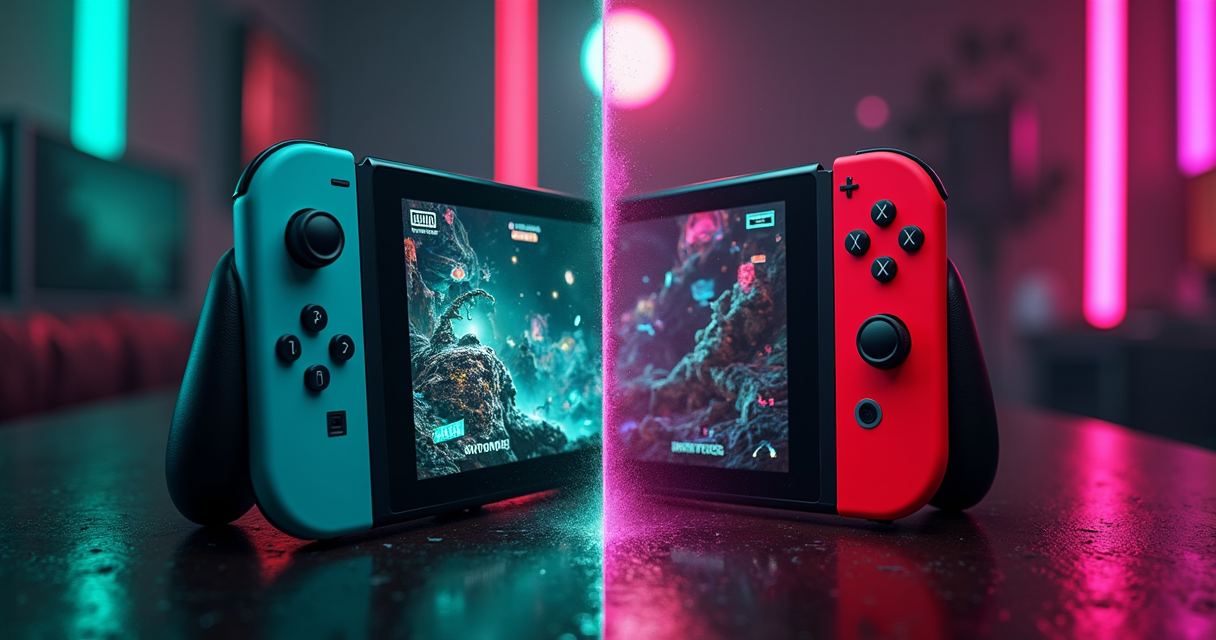
The Nintendo Switch 2 has been on shelves for more than a year. It launched globally on June 5, 2025, moved 3.5 million units in its first four days — the fastest-selling console in Nintendo's history — and crossed 19.86 million sold by March 31, 2026. Over the equivalent stretch of its life, that is enough to have outsold the PlayStation 5. This is not, whatever a stubborn corner of the internet was still muttering in early 2026, a render, a rumor, or a 'myth.' It is a real console, it is in stock, and the only genuinely interesting question left is whether you should buy it instead of the Switch OLED still sitting on the same shelf, next to it, for less money.
A note on lineage first, because it frames everything that follows. The original Switch shipped in March 2017 on Nvidia's Tegra X1. The Switch OLED, arriving October 2021, was never a new generation — it was a mid-life screen refresh of that same 2017 machine, which is exactly why it still runs the identical chip four years later. The Switch 2 is the first genuine successor in eight years. So this is not last year's model against this year's; it is a 2017 architecture wearing a nicer panel against a 2025 architecture. Keep that deficit in mind every time the OLED wins a round below — it is winning despite being four hardware generations behind.
On paper the Switch 2 wins almost everything — a bigger and sharper screen, an order-of-magnitude faster chip, four times the storage, magnetic controllers, 4K output, DLSS. The OLED wins exactly two things. Unfortunately for the spec sheet, those two things are black levels and battery life, and depending on how and where you play, they are not small things. Then there is the price, which is the part everyone gets wrong. Let's start there, because there is a clock on it.
The $50 Question That Becomes $100
Every lazy comparison of these two machines opens with a stale number. You will read that the OLED is '$349.99' and the Switch 2 is '$100 more.' Both halves of that sentence are wrong in July 2026, and the correction is the single most important fact in this entire article.
What actually changed on the price tag
The Switch OLED does not cost $349.99 anymore. Nintendo raised it to $399.99 on August 3, 2025 — the Switch Lite went from $199 to $229 at the same time — as Vietnam-assembled hardware absorbed new US tariffs. Meanwhile the Switch 2 launched at $449.99 and has held that price through its entire first year. So today the difference between them is not $100. It is $50. That is the whole ballgame: for fifty dollars, you can have the newer machine that beats the older one on nearly every axis that isn't battery or contrast.
Why both consoles got more expensive
Here is the sardonic part. Both price movements were driven by macro forces that have nothing to do with the consoles themselves. The OLED's 2025 bump was tariff law. The Switch 2's coming bump is a component shortage: the AI boom has made DRAM and NAND flash scarce and expensive, and a machine built around 12GB of LPDDR5X and 256GB of fast storage feels that squeeze directly. Nintendo president Shuntaro Furukawa flagged it in investor communications as a medium-to-long-term profitability pressure. The result is written down in black and white on Nintendo's own price-revision notice: beginning September 1, 2026, the US MSRP of the Switch 2 rises from $449.99 to $499.99. Japan already moved (¥49,980 to ¥59,980, effective May 25, 2026); Canada lands at $679.99 CAD and Europe at €499.99 on the same September date.
The window is closing
Do the arithmetic. Today: Switch 2 at $449.99, OLED at $399.99, a $50 gap. After August 31: Switch 2 at $499.99, OLED still at $399.99, a $100 gap. The premium you pay for the newer console doubles in a single day, and it doubles because of a global memory crisis rather than any change to the product in the box. If you were ever going to buy a Switch 2, the cheapest it will be for the foreseeable future is right now, before September. If you were leaning toward the OLED anyway, the September hike only strengthens your case. Either way, the decision has a deadline, and it is the end of August 2026.
The Spec Sheet, Side by Side
Before the arguing, the facts. Here is the full head-to-head, drawn from Nintendo's published tech specs and corroborated by independent teardowns. Read it once and most of the rest of this article is annotation.
The full comparison table
| Spec | Switch OLED | Switch 2 |
|---|---|---|
| Released | Oct 8, 2021 | Jun 5, 2025 |
| Price (Jul 2026) | $399.99 | $449.99 (→ $499.99 on Sep 1) |
| Screen | 7.0" OLED, 720p | 7.9" LCD, 1080p |
| Refresh rate | 60 Hz | 120 Hz, VRR |
| HDR | No | Yes (HDR10, ~500 nits peak) |
| Docked output | Up to 1080p60 | Up to 4K60 + DLSS upscaling |
| SoC | Nvidia Tegra X1 (2017) | Custom Nvidia T239 (Ampere) |
| RAM | 4 GB LPDDR4 | 12 GB LPDDR5X |
| Internal storage | 64 GB eMMC | 256 GB UFS |
| Storage expansion | microSD / microSDXC (to 2 TB) | microSD Express only for games (to 2 TB) |
| Battery capacity | 4,310 mAh | 5,220 mAh |
| Battery life | ~4.5–9 hrs | ~2–6.5 hrs (real-world ~2.5–3.5 in demanding titles) |
| Weight (with controllers) | ~420 g | 534 g |
| Dimensions | 242 × 102 × 13.9 mm | 272 × 116 × 13.9 mm |
| Controllers | Rail-slide Joy-Con | Magnetic Joy-Con 2 + mouse mode |
| Voice/video chat | Nintendo Switch App (phone) | Built-in GameChat (C button + optional camera) |
| Backward compatibility | — | 90%+ of the Switch library (hybrid, not emulation) |
Where the Switch 2 wins outright
Almost everywhere. Resolution (1080p vs 720p in the hand, 4K vs 1080p on the TV), refresh rate (double, with variable refresh on top), memory (three times as much, and a faster generation of it), storage (four times as much, and a faster interface), chip (a generational leap discussed below), controls (magnetic mounting that ends the rail as a wear point), and communication (chat baked into silicon rather than bolted on through your phone). If you build a scoring rubric out of raw numbers, the Switch 2 sweeps it. The trap is that a rubric of raw numbers is not the same thing as a rubric of experience, which is where the OLED claws back relevance.
Where the OLED refuses to die
Two rows in that table hide the OLED's entire remaining argument. The battery life row, where the older, less demanding machine simply lasts longer away from a wall. And the screen row — which lists 7.0" OLED against 7.9" LCD as if bigger and sharper automatically wins, when in fact 'OLED' is doing quiet, heavy lifting there. A 2021 panel and a 2025 panel are not competing on the same terms; they are competing on different definitions of 'good.' That is the fight worth having, so let's have it.
The Screen: OLED Blacks vs LCD Everything Else
This is the one comparison where the newer, bigger, higher-resolution panel does not automatically win, and it is the reason a four-year-old handheld still gets recommended in 2026. Nintendo made a deliberate, defensible, and slightly infuriating trade: it swapped panel technology for panel specs.
What OLED still does better
An OLED pixel emits its own light and switches fully off for black. The result is infinite contrast, perfect black levels, and the saturated, punchy color the Switch OLED became beloved for. Play a moody, dark-heavy game — a horror title, a cave, a night sky, anything with letterbox bars — and the OLED's blacks are genuinely black, not the dark-gray glow of a backlit LCD leaking through. Pixel-art and 2D indies look spectacular on it for the same reason. The Switch 2's LCD, however large and sharp, physically cannot do this; an LCD lights its pixels from behind, and 'off' is 'dimmed,' not 'off.' Digital Foundry, hardly a Luddite about new hardware, was blunt that the Switch 2's display is 'problematic in a number of ways' and that its headline features — VRR and HDR — disappoint in what it called a blurry handheld experience. When a technical-analysis outlet spends its review paragraph defending the old machine's panel, that tells you the trade was real.
Why Nintendo went LCD anyway
The honest observer owes the LCD its counterweights, because Nintendo's choice was not pure cost-cutting even if cost surely mattered. OLED panels carry a small long-term risk of burn-in from static HUD elements — health bars, minimaps, the eternally-present Zelda temperature gauge — and they are typically dimmer at peak than a good modern LCD. An LCD made it far easier to deliver the high peak brightness (~500 nits), the HDR, and the 120Hz variable refresh the Switch 2 is built to market. In other words, Nintendo traded the one thing LCD cannot do — true black — for several things OLED does poorly: brightness, motion headroom, and immunity to burn-in over an eight-year lifespan. Whether that was the right trade is precisely the argument, and reasonable people land on both sides of it.
What 1080p, 120Hz, and HDR buy you
The Switch 2's screen is not a downgrade in any absolute sense. It is 7.9 inches to the OLED's 7, it is 1080p to the OLED's 720p — a genuine jump in pixel density and sharpness — and it runs at 120 Hz with variable refresh where the OLED is locked to 60. It supports HDR10 and pushes to roughly 500 nits at peak. In practice text is crisper, motion in fast games is smoother, and bright outdoor scenes have more punch and detail. TechRadar called the 1080p LCD 'immaculate' in its 90-scored review; Tom's Guide, also at 90, called the Switch 2 'the best version of an already excellent system.' If you mostly play bright, colorful, high-motion games — racers, platformers, shooters — the Switch 2's panel is the better display even if it is the worse panel technology. You can dig into the exact numbers on Nintendo Life's screen breakdown. The professional consensus, tellingly, lands in the low 90s with an asterisk about the screen — Engadget 93, Creative Bloq 90 ('absolutely state-of-the-art. Buy it.'), Gizmodo 90 — while the display specialists at Digital Foundry flag the panel as the weakest link. Both camps are right, which is the whole point.
Raw Power: Tegra X1 vs the T239
If the screen is a genuine trade, the chip is not. This is the section where the OLED loses without argument, because the Switch OLED is running the exact same Nvidia Tegra X1 that debuted in the original Switch in 2017 — a chip that was already a couple of years old when it first shipped. The Switch 2 is running a custom Nvidia processor of an entirely different era.
The silicon, honestly assessed
The Switch 2's SoC is a semi-custom Nvidia T239, built on the Ampere architecture — the same generation as Nvidia's RTX 30-series desktop GPUs — paired with 12 GB of LPDDR5X. Against the Tegra X1's Maxwell-era GPU and 4 GB of LPDDR4, the raw shader-throughput increase is roughly an order of magnitude on paper. You will see 'nearly 10 times more powerful' repeated everywhere, and as a napkin figure for GPU FLOPS it is defensible — but treat it as a headline, not a promise. Real-world gains depend on memory bandwidth, whether a game is patched for the new hardware, and how aggressively DLSS is doing the heavy lifting. What is not in dispute is the direction and scale: this is a true generational leap in silicon, the first the Switch line has ever had. Even in pure backward-compatibility mode, old games load roughly 20–30% faster thanks to the faster storage and memory.
DLSS, and the '4K' asterisk
The headline feature is DLSS — Nvidia's machine-learning upscaling, finally inside a Nintendo box. In docked mode the Switch 2 can output up to 4K at 60Hz, but it is important to be precise about how. Digital Foundry's analysis identifies two DLSS models in play: a full-fat convolutional model that takes a roughly 720p internal image up to 1080p with excellent results, and a lighter 'DLSS Light' variant used to reach higher output resolutions up to 4K — sharper on paper, but with weaker anti-aliasing in motion. In other words, 'up to 4K' is real, but a lot of that 4K is reconstructed rather than natively rendered. That is not a criticism; it is exactly how modern GPUs hit those numbers. It just means the honest phrasing is 'DLSS-assisted 4K,' not 'native 4K.' The OLED, for the record, tops out at native 1080p docked with no upscaling at all.
What the horsepower actually unlocks
The practical payoff is third-party games the original Switch could never dream of running. Ports that were technically impossible on Tegra X1 now land on Switch 2 — as our breakdown of Elden Ring hitting Switch 2 at up to 80fps shows, this is a machine that can finally host the current generation's heavier titles, if not always at flagship settings. Worth noting for docked players: the Switch 2's dock is itself upgraded, with a built-in cooling fan to sustain the higher clocks TV mode demands and a wired LAN port as standard for stable online play — neither of which the OLED's passive dock offers. The new hardware also reframes where the Switch 2 sits against PC handhelds: it is no longer laughably behind, though it is not ahead either, as our Switch 2 versus Steam Deck comparison lays out. The Switch OLED can participate in none of this. It plays the Switch library beautifully, and that is the ceiling. If your interest is in what games the machine can run rather than how the games you own look, the chip settles it: Switch 2, no contest.
Battery Life: The OLED's Last Stand
Here the older machine takes its revenge, and it is not close. The uncomfortable truth about generational leaps is that they cost watts, and the Switch 2's fast chip and 120Hz screen are thirsty in a way the frugal Tegra X1 never was.
The capacity numbers lie a little
On the spec sheet the Switch 2 looks like it should last longer: its battery is 5,220 mAh against the OLED's 4,310 mAh, a 21% larger cell. This is the classic capacity trap. A bigger tank means nothing if the engine drinks faster, and the T239 under load can pull something like 10–20 watts where the Tegra X1 sipped a fraction of that. Nintendo's own official rating tells the story before you even turn the thing on: the OLED is rated at 4.5 to 9 hours, the Switch 2 at roughly 2 to 6.5 hours. The larger battery does not come close to offsetting the larger appetite.
Real-world drain, by the game
Official ranges are best-case; real-world use is worse, and this is where community testing and reviewer measurements converge. In demanding first-party titles, Switch 2 owners report closer to 2.5 to 3.5 hours off the charger. A graphically heavy open-world game — the exact kind the new hardware exists to run — can drain the machine to the low end of that range. Vanilla, unpatched Breath of the Wild runs the Switch 2 for around 3.5 hours. Tom's Guide, in the same 90-scored review that praised the display, singled out 'poor battery life' as the machine's headline flaw. The OLED, running a lighter chip against a lighter library, comfortably beats it — up to 6 hours in something like Tears of the Kingdom and more in lighter 2D fare. If your play sessions happen on planes, trains, and couches far from an outlet, the four-year-old console is the better handheld. That sentence should feel strange. It is nonetheless true.
Who should care
Be honest about your own habits. If your Switch spends 90% of its life in a dock and gets picked up handheld for twenty minutes before bed, battery life is a rounding error and you can ignore this entire section. If, on the other hand, you are a genuine commuter or traveler who plays for hours away from power, this is the single strongest reason to either buy the OLED or budget for a hefty USB-C power bank alongside your Switch 2. There is no firmware update coming to fix physics; a faster chip on a 120Hz panel will always drain faster than a slow chip on a 60Hz one. This is the OLED's last stand, and on this hill it wins.
Controls, Build, and the Mouse
The Joy-Con is where Nintendo quietly admitted a mistake it spent years denying in court, and also where it introduced the single strangest feature of the generation. Both deserve a clear-eyed look.
Magnetic Joy-Con 2 and the drift confession
The original Switch's rail-slide Joy-Con became infamous for Joy-Con drift — analog sticks registering movement with no input — over the platform's eight-year life. It generated class-action lawsuits, regulatory complaints on both sides of the Atlantic, and eventually a quiet free-repair program, all while Nintendo publicly said very little about root cause. The Switch 2's Joy-Con 2 attach magnetically rather than sliding along a rail, a redesign that removes the mechanical wear point the old connector introduced and makes attaching and detaching genuinely satisfying. Nintendo has not framed this as a mea culpa, because companies never do, but the engineering reads as one. The new sticks are larger and smoother; whether they prove more drift-resistant over an eight-year horizon is something only 2033 can answer, but the physical connector, at least, is a clear improvement over the design that spawned the lawsuits.
Mouse mode: clever, uncomfortable
The headline gimmick is mouse mode: each Joy-Con 2 can be turned on its edge and slid across a table to act as a mouse, opening the door to strategy games, shooters, and productivity-flavored software that a thumbstick handles poorly. It is genuinely clever, and in the right game it works. It is also, ergonomically, a compromise — you are gripping a thin controller edge-on and dragging it, which is not what a hand wants to do for long. Eurogamer described the experience as an 'ergonomic nightmare,' and having spent time with it, that is not unfair for extended sessions, even if short bursts are fine. File mouse mode under 'interesting that it exists' rather than 'reason to buy.' The OLED, naturally, has nothing like it; its Joy-Con are input devices and nothing more.
Size, weight, and the kickstand
The Switch 2 is a bigger object in every dimension except thickness. It measures 272 × 116 × 13.9 mm against the OLED's 242 × 102 × 13.9 mm — note that both are exactly 13.9 mm thick, but the Switch 2 is 30 mm wider and 14 mm taller. (If you have read elsewhere that the Switch 2 is '242 mm wide, identical to the OLED,' that is a common error; 242 mm is the OLED's width, and the Switch 2 is meaningfully larger, as GamesRadar's side-by-side confirms.) It is also heavier: 534 g with controllers attached versus roughly 420 g for the OLED, a difference of about 114 grams — noticeable over a long session, and part of why the OLED feels like the more relaxed handheld. Both keep the excellent wide, adjustable kickstand the OLED introduced. Gizmodo's size comparison calls the Switch 2 'beautifully balanced' despite the added heft, and in the dock or on a table that is true; in bed, held aloft for two hours, the extra 114 grams eventually announce themselves.
Backward Compatibility and the Library
The best thing about buying a Switch 2 is that you do not have to abandon your Switch collection. The most over-promised thing about it is exactly how completely that is true. Both statements matter.
How much of your Switch collection survives
You will see the number '100%' thrown around. It is wrong. Nintendo and independent testing put backward compatibility at 90%-plus of the Switch library — a genuinely excellent figure, but not everything. Critically, this is a hybrid hardware arrangement, not the pure software emulation that a modern PC uses to run old games; the T239 retains the ability to run Switch software close to natively, which is why compatibility and performance are as good as they are. Both physical cartridges and your digital library carry over. A minority of titles — certain games with unusual hardware dependencies or online components — have quirks, patches pending, or edge-case issues. The retro-focused YouTuber Modern Vintage Gamer, who stress-tested a wide swath of the library, summarized the situation with a characteristically terse verdict: 'It's Good!' Which is the correct framing. Very good, not flawless.
Free upgrades and paid ones
Beyond raw compatibility, many older games run better on the Switch 2 — higher resolution, steadier framerates, faster loads — and some get official enhancement patches. Here Nintendo's policy is inconsistent in a way worth knowing before you budget. Some upgrades are free: titles like Super Mario Odyssey and Splatoon 3 received no-charge Switch 2 patches, and a March 2026 wave added free updates to Doom (2016), Final Fantasy XII: The Zodiac Age, and Kirby's Return to Dream Land Deluxe, among others. Others are paid 'Switch 2 Edition' upgrades that ask you to spend again for the enhanced version of a game you already own. There is no single rule; you check per title. It is the kind of nickel-and-dime asymmetry that the deadpan observer notes and the enthusiast learns to route around.
The native library, one year in
As of mid-2026 the Switch 2's exclusive library is still filling in — which is both a caveat and a reason for optimism. A console that launched in June 2025 is, one year later, still early in its first-party cadence; the machine's value proposition increases over time as Nintendo EPD, Monolith Soft, and third-party partners ship native titles that simply cannot run on the older hardware. The OLED, by contrast, is a known quantity: its library is complete, mature, and enormous, and it will keep receiving cross-generation Switch releases for a while yet. If you buy the OLED you get everything that already exists; if you buy the Switch 2 you get all of that plus a growing pile of things the OLED will never run. The direction of travel is one-way.
Pricing and Availability in 2026
We opened on price because it is the decisive variable. Here is the full picture in table form, including the September cliff, so you can plan around it rather than get surprised by it.
The pricing table
| Item | Switch OLED | Switch 2 |
|---|---|---|
| US MSRP (now, Jul 2026) | $399.99 | $449.99 |
| US MSRP (from Sep 1, 2026) | $399.99 (unchanged) | $499.99 |
| Gap between the two | $50 now → $100 on Sep 1 | |
| Japan | ¥37,980 | ¥49,980 → ¥59,980 (from May 25, 2026) |
| Canada (from Sep 1) | — | $679.99 CAD |
| Europe (from Sep 1) | — | €499.99 |
| Bundle | Occasional game bundles at retail | 'Choose Your Game' / Mario Kart World bundle, $499.99 (ends Aug 31) |
| Internal storage | 64 GB | 256 GB |
| Storage expansion needed? | Optional (standard microSD) | microSD Express for games |
Bundles and the September cliff
There is a wrinkle in that table worth spelling out. Right now Nintendo sells a 'Choose Your Game' bundle at $499.99 — the Switch 2 console plus one of three major first-party titles (Mario Kart World, Donkey Kong Bananza, or Pokémon Pokopia). That bundle disappears after August 31, 2026. Starting September 1, the exact same $499.99 buys the console alone. Read that twice: for the same money, you currently get a free flagship game, and after the deadline you get nothing but the box. This is the sharpest version of the buy-now calculus. If a Switch 2 is in your future and one of those three games appeals to you, buying before September is functionally a free flagship game on top of a $50 hardware discount.
Where to actually buy each
Both consoles are widely, boringly available in 2026 — the launch-window scarcity that defined the Switch 2's first weeks is long over. You will find both at the usual majors and at Nintendo direct. The OLED, being the older product, shows up discounted and in refurbished channels more often, and holiday sales can nudge it below $399.99 in bundle form. The Switch 2, pre-hike, is unlikely to be discounted below MSRP by Nintendo, though retailer game-bundle deals effectively lower the per-game cost. The one thing not to do is wait passively past August in the hope of a better Switch 2 deal; the official trajectory is up, not down, for reasons — the memory shortage — that are not resolving on a consumer-friendly timeline.
Which One Fits Your Life
Specs decide arguments; use cases decide purchases. Here are the concrete profiles, and which machine each one should buy. Find yourself in the list.
Buy the Switch 2 if...
1. You play mostly on a TV and care about image quality. The Switch 2's 4K-capable, DLSS-assisted docked output is a real, visible upgrade over the OLED's 1080p, and in the dock the battery and panel-technology arguments evaporate entirely. TV-first players have the easiest decision on this list: Switch 2, before September.
2. You want current-generation third-party games. If you were frustrated that big modern ports skipped the original Switch or arrived as compromised 'impossible ports,' the T239 is the fix. This is the machine that runs the heavy stuff. The OLED cannot, ever.
3. You play with friends and want built-in chat. GameChat, mapped to a dedicated C button with optional camera support, replaces the awkward phone-app voice chat the OLED still relies on. For social and party play, it is a meaningful quality-of-life jump.
4. You are buying your first Switch-family console in 2026. Starting fresh, with no library to preserve and no battery-first travel habit, there is little reason to buy into 2017 silicon. Get the newer machine while the gap is $50, and get a bundled game while that deal lasts.
Buy the Switch OLED if...
5. You are a handheld-only, battery-first player. Commuters, travelers, and in-bed players who go hours between charges get materially more play time from the OLED. This is its single strongest use case and it is a real one.
6. You live in dark rooms and love contrast, 2D, and indies. Horror fans, pixel-art devotees, and anyone whose eye is trained on black levels will see the OLED's self-emissive panel every session and prefer it. The Switch 2's LCD cannot match true blacks.
7. You want the cheapest way into the Switch library, or a second console. At $399.99 the OLED is the budget entry to an enormous, mature catalog, and it makes a superb cheap second screen for a household that already owns a Switch 2. If your tastes run to the retro and the portable more broadly, it also slots naturally alongside the dedicated emulation handhelds we cover in our 2026 Retroid Pocket roundup — different tool, same shelf.
A decision tree
If you want it reduced to a flowchart, here it is, deadpan and unsentimental:
START
 |
 Do you play mostly docked / on a TV?
 |-- YES --> Switch 2 (4K + DLSS wins; buy before Sep 1)
 |-- NO  --> continue
 |
 Do you play hours away from a charger?
 |-- YES --> Switch OLED (battery + contrast win)
 |-- NO  --> continue
 |
 Do you want modern ports / native Switch 2 games?
 |-- YES --> Switch 2
 |-- NO, just the existing Switch library, cheaply --> Switch OLED
 |
 Still unsure? --> Switch 2 while the gap is $50, not $100.
END
For the broader handheld landscape — where a Nintendo box sits against PC handhelds and the new wave of Windows portables — our look at the ROG Xbox Ally and the state of first-party handhelds is the companion read.
Migrating From Switch OLED to Switch 2
Suppose you have decided: you own an OLED, you are moving up to a Switch 2. Nintendo has made this less painful than it used to be, but there are a couple of traps — one of which will cost you money you did not expect. Here is the clean path.
Before you start
Do three things first. One: make sure both consoles are on current firmware and charged (or plugged in). Two: confirm your Nintendo Account is the one holding your digital purchases — the transfer moves the console's local data and user, but your digital library is tied to the account, not the hardware. Three: if you use Nintendo Switch Online, verify your cloud saves are current, because not every game supports cloud backup and the ones that do not must move via the local system transfer. Do not factory-reset the OLED until the transfer completes and you have verified everything landed.
The transfer, step by step
The system transfer runs both consoles side by side over a local connection. The sequence:
1.  Charge / plug in BOTH consoles; connect both to the same Wi-Fi.
2.  Update both to the latest system firmware.
3.  On the Switch 2:  System Settings > Users > Transfer Your User Data
        > choose the "target / new console" role.
4.  On the Switch OLED: System Settings > Users > Transfer Your User Data
        > choose the "source / old console" role.
5.  Confirm the same Nintendo Account on both. Keep them close together.
6.  Start the transfer. Users, save data, and settings copy across.
7.  Re-download your digital games on the Switch 2 from the eShop
        ("Redownload") -- the license follows the account, not the wire.
8.  Move physical cartridges over by... putting them in the Switch 2.
9.  Verify saves and purchases on the Switch 2 BEFORE wiping the OLED.
10. Only then: factory-reset the OLED if you're selling / gifting it.
Note the split at steps 6 and 7: save data and users transfer console-to-console, but digital games re-download from your account rather than copying over the wire. That is normal and expected; do not panic when your game list needs re-downloading. Physical cartridges, mercifully, need no ceremony — they simply work in the new slot, subject to the 90%-plus compatibility discussed above.
The microSD Express tax
Here is the trap. Your old Switch microSD card — the cheap, ubiquitous kind you have been buying for years — will not store Switch 2 games. The Switch 2 accepts a standard microSD only for screenshots and video clips; for actual game installs it demands a microSD Express card, a faster and pricier standard. The 256 GB of built-in UFS storage (four times the OLED's 64 GB) buys you time before this bites, but any serious digital collector will hit the wall and need to spend on Express media. Budget for it. It is the one hidden cost of the move that the spec sheet's cheerful '256 GB!' line does not advertise, and it is the sort of asymmetry — new machine, new mandatory accessory standard — that the industry relies on you not reading the footnote about.
Pros and Cons, Tallied
The whole argument, compressed into two ledgers. No hedging.
Switch 2
| Pros | Cons |
|---|---|
| Generational chip (T239 Ampere, 12 GB) — runs modern ports | Battery life ~2.5–3.5 hrs in demanding games |
| 7.9" 1080p 120Hz VRR HDR screen — sharp, fast, bright | LCD can't match OLED blacks; DF calls the panel 'problematic' |
| 4K + DLSS docked output; fan-cooled dock with wired LAN | Much of that 4K is reconstructed, not native |
| 256 GB storage (4× the OLED) | Games require pricier microSD Express to expand |
| Magnetic Joy-Con 2, built-in GameChat | Mouse mode an 'ergonomic nightmare' (Eurogamer) for long use |
| 90%+ backward compatible; growing native library | $50 now, $100 premium after Sep 1; ~114 g heavier |
Switch OLED
| Pros | Cons |
|---|---|
| True-black OLED contrast; gorgeous for 2D, indies, dark games | 720p, 60Hz, no HDR — dated by 2026 standards |
| Best-in-class battery (4.5–9 hrs) | 2017-era Tegra X1 — can't run modern ports at all |
| Lighter (~420 g) and smaller — the more relaxed handheld | Docked output capped at 1080p, no DLSS |
| $399.99, cheapest way into the Switch library | 64 GB storage; rail Joy-Con with the old drift legacy |
| Uses cheap, ubiquitous standard microSD cards | Voice chat still needs the phone app |
| Mature, complete, enormous game catalog | End of the line — no future-proofing |
The honest summary
Line the two ledgers up and the shape is obvious. The Switch 2's cons are mostly trade-offs and costs — worse battery, a compromised panel technology, a mandatory new card standard, a rising price. The OLED's cons are mostly a ceiling — it cannot run the new games, it cannot output 4K, it is the end of a line. Trade-offs you can plan around. A ceiling you cannot raise. That asymmetry is the entire verdict in miniature, and it points where you think it points.
The Verdict
Two machines, one clear recommendation with two honest exceptions. Here it is, backed by the data rather than the marketing.
The data-backed recommendation
For most buyers in July 2026, the answer is the Switch 2, purchased before September 1. The reasoning is not sentiment; it is arithmetic. The Switch 2 wins the spec sheet decisively — chip, RAM, storage, resolution, refresh rate, docked output, controls, chat — and the professional reviews reflect it, clustering in the low 90s (Engadget 93, TechRadar 90, Tom's Guide 90, Creative Bloq 90) even after they dock points for the screen and battery. IGN's more reserved 7.0 called it 'a Switch but bigger and better in every sense, with all of the original's successes as well as most of its faults accounted for' — and even that lukewarm framing is a recommendation to upgrade, just an unexcited one; IGN judged the whole thing 'about as exciting as a long-overdue phone upgrade.' The Verge, scoring it 80 under the deadpan headline 'exactly good enough,' conceded it 'doesn't feel like the kind of generational leap typically associated with a new platform' while still calling it markedly better than its predecessor. The consensus, in other words, is: not thrilling, clearly better, buy it. And it is $50 more than the OLED today, $100 more in September. Buy it at $50.
The one scenario where you buy the OLED instead
The exception is specific and real: if you are a handheld-only, battery-first player, or your eye is trained on contrast and you play in the dark, the OLED is the better handheld for you despite being the worse machine on paper. Its 4.5–9 hour battery and true-black panel are things the Switch 2 physically cannot match, and no patch will change that. Add the price — $399.99, and staying there while the Switch 2 climbs — and for this particular player the four-year-old console is a defensible, even smart, purchase in 2026. There is no shame in buying the OLED. There is only a narrower set of people for whom it is correct.
Bottom line
The Switch 2 is a real, mature, well-reviewed console that out-specs the OLED on nearly everything and loses only on battery and black levels. Its price advantage over the OLED is temporary and shrinking: $50 now, $100 after August 31, 2026, thanks to a memory shortage that is not the console's fault and not going away soon. If you want the newer machine, the cheapest and best-value moment to buy it — bundled game included — is before the September cliff. If you specifically need battery life or OLED contrast, the older console is still, improbably, the right tool, and cheaper besides. Everyone else: buy the Switch 2 this summer, and don't overthink the screen. The generation only moves one direction, and unlike the wait for the next PlayStation — where, as we've argued, 2028 is the floor — this upgrade is already sitting on the shelf, in stock, for fifty dollars more than yesterday's hardware. For eight more weeks, anyway.
Questions the search bar asks me
- Is the Switch 2 actually out, or still a rumor?
- It is out. The Nintendo Switch 2 launched globally on June 5, 2025, sold 3.5 million units in its first four days, and passed 19.86 million by March 31, 2026 — outselling the PlayStation 5 over the same window of its life. Anyone still calling it a 'myth' in 2026 is reading a very old rumor.
- How much cheaper is the Switch OLED than the Switch 2 right now?
- As of July 2026, the OLED is $399.99 and the Switch 2 is $449.99 — a $50 gap. On September 1, 2026, Nintendo raises the Switch 2 to $499.99 (per its official price-revision notice), which widens the gap to $100 while the OLED stays put. The cheap-upgrade window closes at the end of August.
- Does the Switch OLED still beat the Switch 2 at anything?
- Two things that matter: black levels and battery life. The OLED's self-emissive panel produces true blacks the Switch 2's LCD physically cannot, and the OLED runs 4.5–9 hours versus roughly 2.5–3.5 hours for the Switch 2 in demanding games. It also weighs about 114g less.
- Will my old Switch games work on the Switch 2?
- Most of them — Nintendo and community testing put compatibility above 90% of the Switch library, via a hybrid hardware layer rather than pure emulation, with loads roughly 20–30% faster than 2017 hardware. It is not 100%; a minority of titles have quirks or remain unpatched, and some get free 'Switch 2 Edition' upgrades while others charge for them.
- Do I have to buy a new microSD card for the Switch 2?
- For games, yes. The Switch 2 only accepts microSD Express cards for game storage — a standard microSD works solely for screenshots and video clips. The 256GB of built-in UFS storage (four times the OLED's 64GB) delays the purchase, but any serious digital library will need a microSD Express card, which is faster and more expensive than the standard cards the OLED uses.
Ben covers the hardware end of retro gaming: FPGA cores, real-cartridge dumping, capture setups, CRT vs scaler workflows, and the legal and physical preservation infrastructure that keeps old games playable. Every post under this byline is reviewed pre-publish by Sam P., Editor & Operator — corrections to info@instalinkoteam.com. Published 2026-08-29 · Last updated 2026-08-29. Full bios on the author page.