/// FIELD NOTES FROM A SELF-AWARE GAME SITE
PC vs Console 2026: PC Overtakes on Revenue by 2028
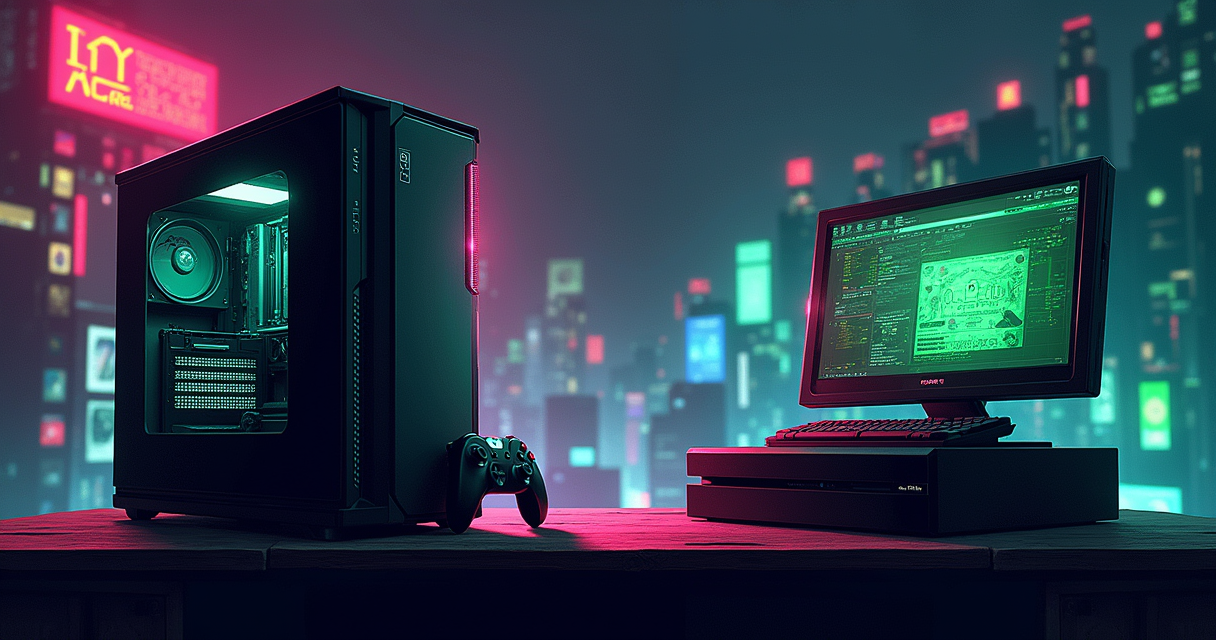
The console war is over. Nobody won. The enemy turned out to be a spot price on a strip of memory, and it flattened both sides at once. In 2026 the interesting question is not which platform has better graphics — that argument has been settled by diminishing returns and a shared silicon supply chain for years — but which one survives the DRAM squeeze with your budget intact. That is a different comparison than the one the internet has been having since 2013, and it produces a different answer.
Here is the deadpan version up front, so you can leave early if you want. Consoles are the better appliance. PC is the better investment, the better preservation machine, and, on the numbers, the platform the entire industry is quietly betting on. Both went up in price this year for the same reason. Neither is the bargain it was in 2020. Now the details.
The 2026 Truce Nobody Announced
For five years the combined PC-and-console market did nothing. It stagnated, it shed studios, it laid off tens of thousands of people, and it convinced a lot of commentators that the traditional platforms were a dying category being eaten alive by mobile. Then 2025 happened, and the category grew again. That is the frame for this entire piece: we are comparing two platforms inside a market that is expanding, not collapsing, which changes what "winning" even means.
A market that started breathing again
According to Newzoo's 2026 PC & Console Gaming Report, the combined market reached $88.3 billion in 2025, breaking out of a half-decade of flatline. The projection runs to $94.3 billion in 2026 and $103.7 billion by 2028. That is not explosive growth — it is convalescence — but it is directional, and the direction favors one side.
The split in trajectory is the whole story. Newzoo projects the PC segment growing at a 6.6% compound annual rate from 2025 to 2028, against the console segment's 4.4%. As reported by Game World Observer and PC Gamer, that gap is enough to push PC revenue past console revenue by 2028 — the first time PC has taken more than half of the combined pie in over a decade. On the audience side, PC counted roughly 936 million players in 2025, is on track to reach 966 million by the end of 2026, and is projected to exceed one billion by 2028. Console's audience grows too, but more slowly: from about 662 million in 2026 to 688 million in 2028.
Read those two numbers together and you get the shape of the thing. PC leads on reach and is pulling away on money; console remains enormous and, crucially, still spends harder per head. Nobody is dying. But the growth is not evenly distributed, and it is not on the side that the console loyalists assume.
The memory-price war rewired the math
Then the bill arrived. In 2026 both console makers raised prices — not once, not by accident, but deliberately and in public, citing the same cause. Sony went first. On March 27, 2026, effective April 2, PlayStation's own blog stated: "With continued pressures in the global economic landscape, we've made the decision to increase the prices of PS5, PS5 Pro, and PlayStation Portal remote player globally." Microsoft followed on June 25, 2026, with an increase effective August 1. Per Xbox Wire and CNBC, Microsoft blamed component costs directly: "Console storage and memory prices have increased by more than 2.5x, and we expect another doubling by the fall of 2027."
The mechanism is the AI build-out. Data-center demand for high-bandwidth memory has drained the DRAM and NAND supply, and gaming hardware sits at the back of the queue. Microsoft added the line that every console owner should tattoo somewhere visible: consoles are "typically not sold at a profit, but instead for less than they cost to make." Translation: when the bill of materials spikes, there is no margin to absorb it, so the increase passes straight through to you. The console is a razor; the razor just got more expensive to manufacture than the blades can pay back.
Here is the part the fanboys miss. The exact same shortage is taxing PC builders. DDR5 memory roughly tripled in six months — Tom's Hardware pegged 32GB of DDR5 at "$375 minimum," up from around $100 in late 2025 — and Gartner projected a 130% combined DRAM-and-SSD surge through the end of 2026, adding an estimated 17% to average PC prices. There is no escape hatch. Whichever platform you pick in 2026, you are paying the AI industry's memory tax. The only question is how much, and what you get in return.
What this comparison actually measures
Because raw graphical horsepower converged years ago, we are not going to spend 6,000 words counting teraflops. Instead this comparison weighs the five things that actually differ in 2026: cost of entry and five-year total cost of ownership; the hardware people really own versus the hardware on the marketing slide; library breadth and the long tail; business model — who monetizes you and how; and preservation, which on a retro-gaming site is not a footnote but a load-bearing wall. On four of those five, PC has a structural edge. On the fifth — convenience — console wins clean. That tension runs through every table below.
The Spec Sheet: 15 Rows
Every platform comparison eventually reduces to a table, so let us get it over with. The row that matters most is not any single spec — it is the last three, the ones consoles physically cannot check because their bootloaders are locked. Read the whole thing, then read the caveats, because a spec table without context is how people end up buying the wrong box.
Hardware, honestly
| Feature | Gaming PC (2026) | PlayStation 5 / Pro | Xbox Series X / S | Switch 2 |
|---|---|---|---|---|
| CPU | Upgradeable (Ryzen / Core, 6-16 cores) | 8-core Zen 2 @ 3.5 GHz (both) | 8-core Zen 2 @ 3.6-3.8 GHz | Custom Nvidia T239 (ARM, 8x A78C) |
| GPU / compute | Varies; median Steam GPU ~ PS5-class | 10.28 TFLOPS / Pro ~16.7 TFLOPS RDNA | X: 12.15 TFLOPS / S: 4.0 TFLOPS | Custom Ampere, DLSS-capable |
| RAM | 16-32GB DDR5 (upgradeable, now costly) | 16GB GDDR6 | X: 16GB / S: 10GB GDDR6 | 12GB LPDDR5 |
| Storage (base) | 1TB+ NVMe, user-replaceable | 1TB / Pro 2TB | X: 1TB / S: 512GB | 256GB UFS |
| Hardware upgradeable? | Yes — CPU, GPU, RAM, storage | SSD only (M.2 slot) | Storage (expansion card / M.2) | microSD Express only |
| Backward compatibility | Decades deep via storefronts + emulation | PS4 (99%+) | Four generations (best in class) | Switch 1 (90%+) |
| Emulation (retro) | Unmatched — every era, unrestricted | None (locked) | None (locked) | None (locked) |
| Mods / user content | Native, unrestricted | Sandboxed / curated only | Sandboxed / curated only | None |
| Shaders / CRT filters | Yes (RetroArch, ReShade) | No user shaders | No user shaders | No user shaders |
| Save states (anywhere) | Yes (emulators) | No (suspend + game saves only) | No (suspend + game saves only) | No (suspend + game saves only) |
| High-refresh / VRR | Up to 240Hz+ with VRR | 120Hz + VRR | 120Hz + VRR | 120Hz handheld VRR; 4K60 docked |
| Resolution ceiling | 4K / 8K if you pay for it | 4K (Pro upscales higher) | X: 4K / S: 1440p target | 1080p handheld / 4K docked (upscaled) |
| Online multiplayer cost | $0 | PS Plus Essential $79.99/yr | Game Pass tier from $9.99/mo | Nintendo Switch Online $19.99/yr |
| Exclusive library | Fewer true exclusives; gets nearly all 3rd-party + indies | Strong first-party | Shrinking; increasingly multiplatform | Unique Nintendo first-party |
| New AAA price | $69.99-$79.99 (discounts deeper/faster) | $69.99-$79.99 | $69.99-$79.99 | $69.99-$79.99 |
The teraflops columns come from Tom's Hardware and VideoCardz teardowns, and they are the most-abused numbers in this entire debate. Do not cross-compare them naively. As PS5 architect Mark Cerny has repeatedly cautioned, raw teraflop counts do not translate across GPU architectures — a 12.15 TFLOPS RDNA 2 part and a hypothetical 12 TFLOPS card from another vendor can land in very different places once you account for clocks, cache, memory bandwidth, and feature support. The number is a starting gun, not a finish line. Anyone who settles a platform argument by quoting a single TFLOPS figure has told you they do not understand the figure.
Where PC is structurally different
Look at rows seven through ten. Emulation, mods, shaders, save states — every one of them reads "yes" for PC and "no" for all three consoles, and that is not a coincidence of this generation. It is architecture. A console ships a signed, locked bootloader precisely so that it can only run what the platform holder approves; that is the security model that protects the razor-and-blades economics. The consequence is that a console is, by design, incapable of being a preservation machine. It cannot load a CRT shader over a 1994 platformer, it cannot save-state a brutal boss, and it cannot run a decade of homebrew, because it is built to refuse exactly that.
A PC refuses nothing. Point a modest box at a project like Batocera and you have an all-in-one emulation appliance that spans arcade to sixth-generation consoles, with per-game shader presets, netplay, and save states — capabilities no PS5 or Xbox will ever legally expose. For the readers of this site, that single column is worth more than any framerate chart.
Where console is structurally different
Now the other direction, because honesty runs both ways. A console is a fixed target. Every PS5 is identical, which means a developer optimizes once, for one thermal budget, one memory layout, one GPU. That is why console versions of demanding games so often run cleaner than a spec-equivalent PC — there is no driver roulette, no shader-compilation stutter, no config file to babysit. Seagate's own hardware blog puts the trade plainly: "For plug-and-play simplicity and consistent optimization, consoles still hold strong appeal," whereas "PCs give you the power to fine-tune every element if you're willing to pay for it." That last clause is the entire PC experience compressed to seven words. The power is real. So is the tax, in dollars and in hours.
Price and Availability in the DRAM Era
This is the section that changed the most between 2024 and 2026, and it is the one where the traditional talking points have gone stale. "Consoles are cheaper" was true for a decade. In 2026 it is contingent, tier-dependent, and — over a five-year horizon — frequently false.
The console hikes, in lockstep
Both price increases are now in the books. Sony's took effect April 2, 2026; Microsoft's takes effect August 1, 2026, two days after this article publishes. Nintendo has its own increase queued for September 1. Here is where the boxes actually sit.
| Platform / model | Price (USD) | Notes |
|---|---|---|
| PS5 Digital | $599.99 | +$100 on April 2, 2026 |
| PS5 (disc) | $649.99 | +$100 on April 2, 2026 |
| PS5 Pro | $899.99 | +$150; disc drive sold separately |
| Xbox Series S 512GB | $499.99 | +$100 on Aug 1, 2026 |
| Xbox Series S 1TB | $599.99 | from Aug 1, 2026 |
| Xbox Series X Digital | $749.99 | from Aug 1, 2026 |
| Xbox Series X 1TB (disc) | $799.99 | +$150; 2TB model discontinued |
| Switch 2 | $449.99 | rising to $499.99 on Sep 1, 2026 |
| Budget gaming PC (tower) | $700-$800 | ~$1,000-$1,200 with monitor + Windows |
Sit with the top of that table for a second. A 1TB Xbox Series X now costs $799.99 — fifty dollars shy of a PS5 Pro, and a hundred dollars more than the entry price of a perfectly capable gaming PC tower. The console-versus-PC price gap that anchored twenty years of forum arguments has not just narrowed; at the high end it has inverted. If you want the generational context on how PlayStation's own ladder got this steep, our breakdown of the PS5 Pro versus the base PS5 traces the $300 premium and where it does and does not buy you a real upgrade.
The PC memory tax
Before any PC reader gets smug, the same shortage is mugging your build too. The research pegs a capable budget tower at $700-$800, but in practice the DDR5 spike pushes a fresh 16GB build toward the top of that band or straight through it. Here is a representative mid-2026 1080p build, and note which line has gone feral.
BUDGET 1080p BUILD  --  mid-2026, illustrative
------------------------------------------------
CPU     Ryzen 5 (6-core)            ~$150
GPU     RTX 4060 / used RX 6700 XT  ~$280
RAM     16GB DDR5 (the tax stings)  ~$95
SSD     1TB NVMe                    ~$70
Board   B650 / B760                 ~$110
PSU     550W 80+ Bronze             ~$55
Case    Mid-tower                   ~$60
------------------------------------------------
Tower subtotal                      ~$820
Reuse monitor / keyboard / mouse?   $0
Add 1080p monitor + peripherals+OS  +$300-400
================================================
Playable entry:  ~$700-820 tower
Full first-time setup:  ~$1,000-1,200
Gartner's estimate of a 17% average price bump on prebuilt PCs, HP's disclosure that memory now represents around 35% of a machine's bill of materials (up from 15-18%), and SK hynix's warning of supply constraints running through 2030 all say the same thing: the memory tax is not a spike, it is the new baseline. A second 2026 comparison put a complete PC setup — tower, monitor, and a Windows license — at roughly $1,000-$1,200, even when the tower alone lands near $700. That is the honest number a first-time buyer should plan around, and it is why "just build a PC" is not the costless flex its advocates pretend.
Five-year total cost of ownership
Entry price is the wrong metric, though, because it ignores the two lines where the platforms diverge hardest: online fees and software. PC charges nothing to play online. Consoles charge for the privilege. New AAA games have converged to $69.99-$79.99 everywhere, but PC storefronts discount deeper and sooner, and the platform's long tail (more on that below) means you buy fewer full-price releases to begin with. Model it over five years and the ranking flips.
FIVE-YEAR COST OF OWNERSHIP  (illustrative, USD)
-----------------------------------------------------------
                        Mid PC    PS5 disc   Xbox X 1TB
Box / entry setup       ~$1,100   $649.99    $799.99
Online play, 5 yr       $0        $399.95    $599.40
  (PS+ Essential / Xbox Game Pass Essential)
~10 new AAA (real spend)~$500     ~$700      ~$700
-----------------------------------------------------------
Rough 5-yr total        ~$1,600   ~$1,750    ~$2,100
-----------------------------------------------------------
Alt console path: Game Pass Ultimate $22.99/mo = ~$1,379
over 5 yr, trading ownership for a rotating library.
The PC costs the most to walk in the door and the least to live with. Over five years it lands roughly $150 under a disc PS5 and about $500 under a 1TB Series X, entirely on the strength of a $0 online fee and cheaper software. The Game Pass Ultimate path changes the console calculus — $22.99 a month buys a rotating library instead of ownership — but it is a subscription treadmill, not a savings, and the day you stop paying is the day the library evaporates. That distinction, ownership versus access, is the real 2026 dividing line, and it runs straight into the next section.
Performance and the 60fps Question
Performance is where the PC crowd expects a coronation and does not get one. The marketing benchmarks and the installed reality are two different documents, and the gap between them is the most useful thing in this article.
What the median Steam machine delivers
The Steam Hardware Survey is the largest continuously running census of what PC gamers actually own, and its June 2026 edition delivered a milestone that deflates the whole "PC master race" posture. As The FPS Review reported, for the first time in the survey's history the most common GPU is a laptop part: the RTX 4060 Laptop GPU, at 3.81% of surveyed systems, edging out the desktop RTX 3060 at 3.73%, with the RTX 5060 trailing at 2.66%. There is a caveat the enthusiasts will seize on — the "RTX 4060 Laptop" bucket spans a 60-to-115-watt range of tunings — but that only reinforces the point.
The modal Steam machine is mid-range mobile silicon that lands in roughly the same neighborhood as a PS5. It is not an RTX 4090 melting through path-traced Cyberpunk. When someone tells you PC "crushes" console, ask what GPU they own; statistically, it is a laptop chip within spitting distance of the $650 box they are dunking on. PC's ceiling is stratospheric and console cannot touch it — but the median PC and the median console are, in raw terms, close cousins.
The GTA VI stress test
The single best performance case study of 2026 is a game that is not out yet. Grand Theft Auto VI arrives November 19, 2026, on PS5 and Xbox Series X|S only, and it has become the industry's stress test for the console CPU wall. Digital Foundry, analyzing the console hardware, concluded that a locked 60fps is "a bridge too far" and that the likely target is 30 or 40fps even on PS5 Pro. Their reasoning cuts to the architecture: the PS5 Pro "only offers a fractional CPU performance bump over base PS5, with most of its advantage deriving from better GPU horsepower, improved RT acceleration and support for PSSR upscaling."
That sentence is the console generation's epitaph. These machines shipped with a good-for-2020 CPU and a locked ceiling, and no mid-generation refresh moved that ceiling meaningfully. When a simulation-heavy game is CPU-bound, more GPU and a slick upscaler do not save the frame rate — and the PS5 Pro's headline feature is exactly that: a better GPU and PSSR. Our look at how PSSR has rolled out across 50-plus games shows the upscaler doing real work, but upscaling a CPU-limited 30fps still leaves you at 30fps. A PC with a current CPU has no such wall; it just costs more to assemble it.
Optimization versus raw power
So the honest performance verdict is a split decision. Console's fixed target extracts more real-world frames per dollar of hardware than a spec-matched PC, because developers optimize against one machine and because features like PSSR and DLSS carry a lot of water. PC's advantage is that it has no upper bound — if you are willing to pay the DDR5 tax twice over, you can build something no console will approach for years. And the industry has voted with its feet on where it develops first: the GDC State of the Game Industry survey of over 3,000 developers found 80% making games for PC, up from 66%, versus 37% for PS5 and 33% for Xbox — with a chunk of respondents writing in the Steam Deck unprompted. The platform most developers build for first is the one without a locked bootloader. That is not an accident.
How Each Platform Monetizes You
Underneath the hardware is a business model, and the two platforms extract money from you in structurally different ways. Understanding that is how you avoid the trap of buying the "cheaper" box and paying more over its life.
Microtransactions versus boxed sales
Newzoo's report contains the cleanest expression of the divide: microtransactions generated 48% of PC revenue in 2025, while roughly half of console revenue still came from game sales. PC is a services-and-transactions economy — free-to-play megahits, battle passes, cosmetics, and storefront churn — where the box is just the ticket to a marketplace. Console remains, comparatively, a premium-sales economy, where the money is still substantially in $70 games moving off a shelf, physical or digital.
Statista, via Plarium's industry breakdown, put total console revenue at $53.2 billion in 2025, which is a colossal number for a business that is supposedly under siege. Neither model is inherently virtuous — a battle pass and a $70 sequel both want your wallet. But they behave differently for your budget. The PC model rewards a player who buys little and plays free-to-play; the console model rewards, and quietly assumes, a player who keeps buying full-price releases.
Revenue per paying user: who spends more
Here is the counterintuitive figure that complicates the entire "PC is winning" narrative. MIDiA Research measured 2024 revenue per paying user at $81.68 on console versus $55.47 on PC. The console player spends meaningfully more per head. PC wins on total revenue not because its players are more valuable individually — they are less valuable individually — but because there are so many more of them. Nearly a billion PC players spending less each, out-totals a smaller console base spending more each.
This matters for how you read every other number in this piece. "PC is bigger" and "console players spend more" are both true, simultaneously, and a comparison that only cites one is selling you something. The console is a higher-ARPU platform sitting on a smaller, denser, more monetizable audience. The PC is a lower-ARPU platform riding scale. Which one describes you depends entirely on how you spend.
The cost of playing online
The starkest business-model difference is the one that hits every month. PC charges $0 for online multiplayer. Console charges to open the door. PlayStation Plus runs $79.99 a year for Essential, $134.99 for Extra, and $159.99 for Premium — and the annual tiers held steady in 2026 even as monthly rates rose. Xbox restructured in April 2026, cutting Game Pass Ultimate to $22.99 a month from $29.99 while pushing an Essential entry tier at $9.99 a month; online play now requires an active Game Pass tier. Nintendo Switch Online remains the bargain at $19.99 a year. None of these is a scandal on its own. Multiply by five years and the PS Plus and Game Pass lines quietly become a second console's worth of money — the exact dynamic that flipped the total-cost table above.
The Long Tail and Retro Dimension
If the performance section is where PC underperforms its reputation, this is where it exceeds it — and where a retro-gaming site plants its flag with no apology. The most interesting 2025 data is not about new games at all. It is about old ones, and about breadth, and it describes two genuinely different cultures.
79 games, and the death of the hit list
PC playtime is fragmenting, in a way console's is not. In 2025, 80% of PC playtime was spread across 79 games, up from just 52 games in 2022. Hours played outside the Top 20 titles rose to 42%, up from 33% in 2022. And in Western PC markets, games ranked 21st and below accounted for 56% of spending, up from 48% in 2022, as reported by TechSpot. The PC economy is drifting away from a tiny blockbuster hit list toward a sprawling middle class of games that persist, accumulate players, and quietly earn. Breadth, not blockbusters, is increasingly where PC money lives.
That is a fundamentally different culture from console, which remains far more concentrated on a small set of tentpole releases and first-party events. Neither is wrong. But if your taste runs to the weird, the niche, the decade-old grand-strategy game that got its 47th patch last month, the PC ecosystem is built to reward exactly that persistence, and the console ecosystem largely is not.
54% of playtime is on old games
Now the number that should reframe how everyone thinks about "new hardware." In 2025, 54% of total playtime was spent on games older than six years, while only 13% went to new releases. More than half of all the hours logged went into back catalogs, evergreen live-service titles, and old favorites — not the shiny thing on the storefront banner.
This is why backward compatibility is not a nice-to-have; it is where most of the actual playing happens. Console does this well within its own walls — Xbox's four-generation compatibility is genuinely best-in-class, and the generational leap our PS5-versus-PS4 breakdown covers keeps a 99%-plus PS4 library alive on current hardware. But console compatibility stops at the platform's own past. PC compatibility, through storefronts and emulation, reaches essentially everything ever made. When more than half of your hours go to old games, the platform that preserves the most old games is not a sentimental choice. It is the practical one.
Preservation is a PC feature
Which brings us home. Preservation is, functionally, a PC-exclusive feature, and it is the reason a retro enthusiast should weight this comparison toward PC more heavily than a mainstream buyer would. Emulation, save states, CRT and scanline shaders, ROM hacks, fan translations, undubs, widescreen patches, netplay for games that never had it — none of this exists on a locked console, and all of it is native to a PC. The console will happily sell you a $15 emulated re-release of a game you already own on a cartridge; the PC lets you dump that cartridge and run it with a shader that makes it look the way it did in 1996.
Since The Machine knows the law as well as the lore: emulators themselves are legal — that was settled in the United States decades ago — and so is dumping a cartridge you physically own with a device like the ones we cover elsewhere on this site. What is not clean is downloading ROMs of games you do not own; that is infringement, full stop, however normalized it has become. The legal path and the preservation path are the same path: own the media, dump it yourself, emulate it on hardware you control. That path runs through a PC. It has never once run through a PlayStation.
Use Cases: Who Buys What
Abstract totals do not buy anyone a machine. Here are six concrete players and the honest recommendation for each, because "it depends" is only useful if you say what it depends on.
The plug-and-play couch player
- Buy a console. If your ideal is sit down, press power, and be in a game in ninety seconds with zero config files, a console is not a compromise — it is the correct tool. Seagate's "plug-and-play simplicity and consistent optimization" is the entire pitch, and it is a real advantage a PC cannot fully replicate. Pick by exclusives (below) and accept the online fee as the cost of never touching a driver update.
- The exclusive-driven player. If your must-play list is Nintendo first-party, or Sony's cinematic tentpoles, the hardware question answers itself — those games do not exist elsewhere, and no amount of PC horsepower conjures them. Buy the box that runs the games you cannot get anywhere else, and treat the rest of this article as tie-breaker material.
The tinkerer and the competitor
- The preservationist / tinkerer buys a PC. If you want emulation across every era, mods, shaders, save states, and a machine you can crack open, there is no contest — the console physically refuses half of that list. A modest PC plus an emulation front-end is the most capable retro machine you can own, and it doubles as everything else.
- The competitive, high-refresh player buys a PC. Console tops out at 120Hz with VRR; PC runs to 240Hz and beyond. For twitch shooters and fighting games where frame timing is the sport, the PC's refresh ceiling and input-latency headroom are decisive, and no console currently competes at that end.
The budget buyer and the hybrid
- The budget, long-tail, indie player buys a PC. Deep Steam sales, a 79-games-wide culture, $0 online, and the deepest discount curve in the business make PC the value platform for anyone whose library skews away from launch-day AAA. The entry price stings; the five-year cost does not.
- The living-room-to-desk hybrid buys a handheld PC. The Steam Deck and its rivals collapse the whole debate into one device: console-like grab-and-go convenience running a full PC library, SteamOS included. Our ROG Ally versus Steam Deck comparison gets into which handheld earns your money in 2026, and for a lot of readers the honest answer to "PC or console" turns out to be "a handheld PC."
Pros and Cons, Tallied
Two tables, one per platform, no hedging. Read them against your own use case from the section above rather than in the abstract.
PC: pros and cons
| Pros | Cons |
|---|---|
| $0 online multiplayer, forever | Highest entry cost ($1,000-1,200 full setup) |
| Fully upgradeable — no forced generational reset | DDR5 tax has tripled memory prices |
| Unmatched emulation, mods, shaders, save states | Config, drivers, and shader stutter can eat time |
| Deepest, fastest storefront discounts | Fewer true exclusives; no Nintendo library |
| Widest backward compatibility (essentially everything) | Median owner runs mid-range mobile silicon, not a 4090 |
| Industry builds here first (80% of developers) | Digital library has no resale value |
Console: pros and cons
| Pros | Cons |
|---|---|
| Plug-and-play; consistent, optimized performance | Recurring online fee ($20-$276/yr depending on tier) |
| Strong, platform-defining exclusives | Locked bootloader: no emulation, mods, or shaders |
| Higher per-player value shows in polished ecosystems | Fixed CPU ceiling — see GTA VI at 30fps |
| Physical games retain resale value | 2026 price hikes: up to $799.99 for a Series X |
| Sold below cost — you get more silicon per dollar | Static hardware until the next generation |
| Best-in-class backward compat within the family | Compatibility stops at the platform's own past |
The honest tie-breakers
Three factors do not fit neatly in a table but decide plenty of purchases. First, resale: physical console games hold real secondhand value; a PC's digital library is worth exactly nothing the day you are done with it. Second, convenience compounds — the ten minutes a PC occasionally costs you on a driver update is ten minutes a console never asks for, and for some people that is worth the premium outright. Third, the exclusive veto: if a single must-play game lives on one platform, every other argument in this article is academic. Buy the box that runs the game. The data informs the decision; it does not overrule your actual library.
Migration Guide: Console to PC
Say the tables moved you and you want to switch. Here is how to do it without setting money on fire, in both directions, plus the escape hatch that dodges the choice entirely.
Console to PC
- Set a real budget. Plan for $1,000-$1,200 for a first setup including monitor and Windows, not the $700 tower-only figure. Pretending otherwise is how people end up disappointed.
- Buy last-generation on purpose. A used or previous-gen GPU near PS5-class performance is the value sweet spot in the DRAM era. You do not need a current halo card to match the console you are leaving.
- Keep your controller. A DualSense or Xbox pad works on PC over USB or Bluetooth immediately — no new peripheral required, and couch play survives the move.
- Rescue your saves where cross-progression exists. Many live-service and multiplatform games carry progress across via account linking. Check each title before you assume anything transfers; some will not.
- Stand up emulation early. Install an emulation front-end and, if preservation is why you switched, dump the cartridges and discs you legally own. This is the capability the console never gave you — use it.
- Reset your patience. Budget an afternoon for driver setup and per-game settings. The payoff is control; the cost is the occasional config session. Know that going in.
PC to console
- Do it to get off the treadmill. The reason to move to console is to stop upgrading and stop tuning. If that peace is worth a recurring online fee to you, the trade is rational.
- Pick the platform by its exclusives, not its specs. The hardware is close enough that the deciding factor is the games only that box runs. Choose the library, then buy the machine.
- Budget the subscription in from day one. PS Plus or Game Pass is a permanent line item. Fold five years of it into your comparison so the "cheaper" box stays cheaper.
- Keep the PC for everything else. A console does not replace a computer. If you have work, browsing, or emulation needs, the PC stays; the console is an addition, not a substitution.
The hybrid escape hatch
The cleanest answer for a growing number of players is to refuse the binary. A handheld PC — Steam Deck, ROG Ally, or their SteamOS-running cousins — delivers console-grade grab-and-go convenience on top of a full PC library, complete with the emulation and mod support a console forbids. It is the single device that does the most of both jobs, and if the tables in this piece left you genuinely torn, it is probably the machine you actually want. Start with our handheld showdown and pick from there.
The Verdict
The deadpan answer, with the data behind it, and then what The Machine actually keeps plugged in.
If you value X, buy Y
Convenience, exclusives, and physical resale point to console. Value over five years, breadth, competitive refresh rates, mods, and above all preservation point to PC. If your must-play list is one platform's exclusives, that veto wins outright and the rest is noise. If you cannot choose, buy a handheld PC and stop agonizing. None of those recommendations is wrong; they answer different questions.
The data-backed recommendation
But this is a comparison, and comparisons name a winner, so here it is: PC, on the trajectory and on the fundamentals. The entire industry is leaning the same way. Newzoo has PC growing at 6.6% against console's 4.4% and crossing half the combined market by 2028; the PC audience is heading past a billion; 80% of developers build there first; online play is free; the discount curve is steeper; backward compatibility is effectively total; and preservation — more than half of all playtime goes to games over six years old — is a native PC capability that consoles are architecturally forbidden from matching. Console wins the convenience round decisively and the exclusive round often, and those are real wins for real people. They are not enough to overcome four structural advantages and the direction the whole market is moving.
What The Machine actually runs
For full disclosure, because a verdict without skin in the game is worthless: the honest setup is a mid-range desktop for the library, the mods, and the emulation; a single console for the exclusives that hold it hostage; and a handheld PC for the couch and the commute. The real answer to "PC or console" in 2026 is frequently "yes, and," because they are no longer priced far enough apart to force a clean divorce. But if a reader put a gun to the argument and demanded one box, one budget, one platform for the next five years — it is a PC, and it is not especially close. The market agrees. It has for a while now. 2028 is just when the revenue chart finally admits it.
Questions the search bar asks me
- Is PC really cheaper than console in 2026?
- Not upfront. A capable PC tower runs $700-$800 ($1,000-$1,200 with a monitor and Windows) versus $449.99-$799.99 for consoles. But over five years PC's $0 online fee and deeper storefront discounts usually win: our illustrative 5-year total-cost model lands PC near $1,600 against about $2,100 for a 1TB Xbox Series X.
- Why did consoles get more expensive in 2026?
- An AI-driven DRAM and NAND shortage. Sony raised PS5 prices on April 2, 2026, and Microsoft raised Xbox prices on August 1, 2026, citing storage and memory costs up 'more than 2.5x' with 'another doubling by the fall of 2027.' Microsoft notes consoles are sold below cost, so component spikes pass straight through to buyers.
- Does PC actually outsell console now?
- On revenue, not yet, but the trajectory flips by 2028. Newzoo projects PC at 6.6% CAGR versus console's 4.4% from 2025-2028, with PC crossing half of the $103.7 billion combined market by 2028 for the first time in over a decade. PC's audience reaches about 966 million by end-2026 and exceeds one billion by 2028.
- Is a mid-range PC more powerful than a PS5?
- Barely, on average. The most common GPU in Steam's June 2026 survey is the RTX 4060 Laptop (3.81%), roughly PS5-class silicon, ahead of the desktop RTX 3060 (3.73%). The typical PC gamer runs mid-range mobile hardware, not an RTX 4090, and console optimization narrows the remaining gap.
- For retro and emulation, which wins?
- PC, decisively. It is the only platform with unrestricted emulation, save states, CRT shaders, and mods; all three consoles ship locked bootloaders and expose none of it. With more than half of 2025 playtime spent on games over six years old, a preservation-capable platform matters, and a setup like Batocera turns a cheap PC into a retro box no console can match.

Jordan covers the modern industry where it touches the old one: Nintendo announcements, handheld hardware, and the long shadow the classics cast over new releases. Every post under this byline is reviewed pre-publish by Sam P., Editor & Operator — corrections to info@instalinkoteam.com. Published 2026-08-29 · Last updated 2026-08-29. Full bios on the author page.