/// FIELD NOTES FROM A SELF-AWARE GAME SITE
Switch OLED vs Switch 2 2026: The $50 Gap Doubles
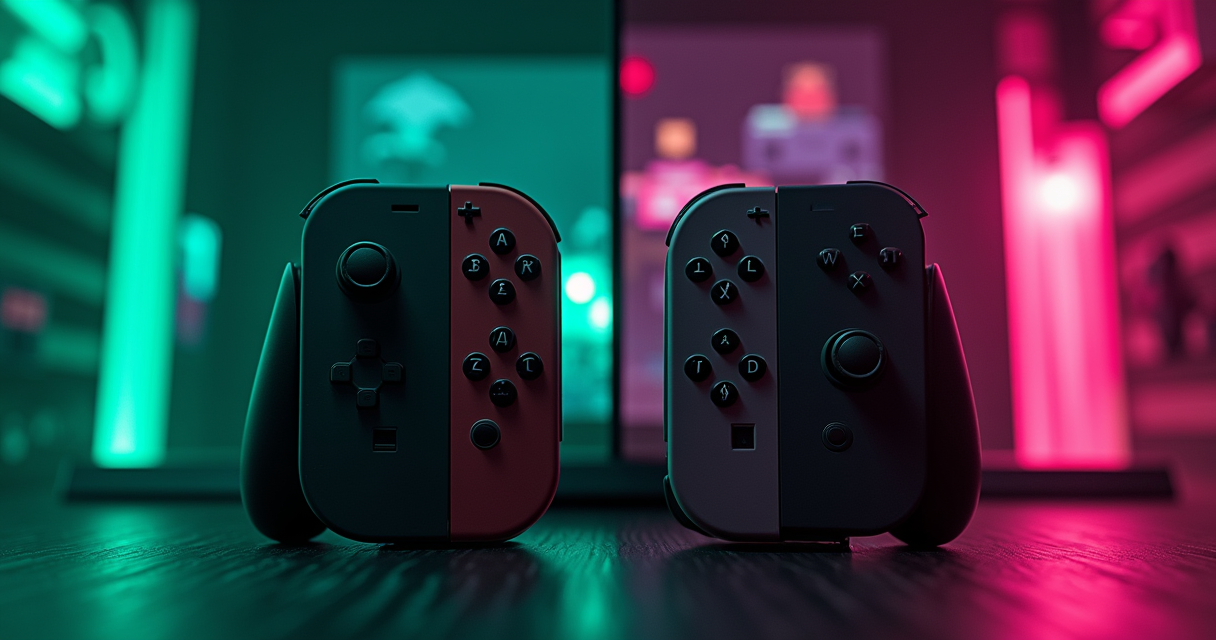
There is a tidy sentence doing the rounds in 2026: the Nintendo Switch 2 costs $100 more than the Switch OLED. It is the kind of sentence that survives because it is easy to remember and, for exactly one window of the calendar, was even true. It is not true today. As of this writing, in July 2026, the gap between the two consoles Nintendo will happily sell you is $50, not $100. And on September 1, 2026, it snaps back to $100 — not because the OLED gets cheaper, but because the Switch 2 gets more expensive.
That single moving number is the whole story of this comparison. The Switch 2 launched on June 5, 2025 and, by Nintendo's own reporting, shipped 19.86 million units by March 31, 2026 — outpacing the PlayStation 5 over the identical January-to-March quarter. The Switch OLED, meanwhile, did not die. It sat there, quietly, as the value option, and Nintendo has explicitly declined to discontinue it. So the question is not "which is the newer console" (obvious) but "is the delta worth it, and for whom, at which price, on which side of a specific date in September." We are going to answer that with numbers, not adjectives.
Fair warning on methodology: the marketing sheet for this generation is unusually slippery. "Nearly 10x the performance," "4K Ultra HD," "256GB finally catches Nintendo up" — each of those is either a best-case reading or an outright asterisk, and we will pull every one of them apart. If you want the short version, skip to the verdict. If you want to understand why the verdict lands where it does, keep reading.
The $50 Gap That Doubles
Price is where most Switch 2 comparisons quietly lie, usually by accident. They quote launch-day MSRPs that neither console still carries. Here is the actual timeline, sourced from Nintendo's own filings and price-revision notices.
The launch-day math everyone still quotes
At launch, the Switch OLED was $349.99 and the Switch 2 was $449.99. Subtract, and you get the famous $100. That figure was accurate for roughly seven weeks in the summer of 2025 and has been wrong ever since, because both prices moved. On August 3, 2025, tariffs pushed the OLED up by $50 to $399.99 (the Switch Lite went $199.99 to $229.99 the same day). The base-model "$100 cheaper OLED" you still see quoted in listicles is a 2021 price attached to a 2026 console.
What actually happened to both prices
So through most of 2026, the real-world spread has been $50: $399.99 for the OLED against $449.99 for the Switch 2. That is the number that matters if you are standing in a store today. It is also why our headline says "the $50 gap doubles" rather than "the $100 gap," and why anyone still repeating $100 is quoting a fossil.
Then comes the twist. Nintendo published a formal price revision for the Switch 2, raising the U.S. MSRP from $449.99 to $499.99 effective September 1, 2026. The stated cause: "various changes in market conditions, which are expected to extend over the medium to long term." Decoded, that is three things stacked on top of each other — AI data-center demand roughly doubling DRAM prices, U.S. tariffs on imported electronics, and exchange-rate pressure. Nintendo quantified the combined drag at about ¥100 billion (roughly $638 million) in its FY2027 forecast, and president Shuntaro Furukawa framed the cost pressure as "medium to long term," i.e. not a temporary blip. Treat $499.99 as the new floor.
The September 1 cliff — and why the OLED sits still
Crucially, the same notice states that "pricing for the Nintendo Switch system is not changing." The OLED holds at $399.99. So the arithmetic does something rare in consumer electronics: the gap widens with time on the same shelf. Buy before September 1 and you pay a $50 premium for the Switch 2. Buy after, and you pay $100 for the identical hardware. Nothing about the console changes; only the receipt does.
| Item | Switch OLED | Switch 2 |
|---|---|---|
| Launch MSRP (US) | $349.99 (Oct 2021) | $449.99 (Jun 2025) |
| Price today (Jul 2026) | $399.99 | $449.99 |
| Price from Sep 1, 2026 | $399.99 (unchanged) | $499.99 |
| Gap today | — | $50 |
| Gap from Sep 1, 2026 | — | $100 |
| Typical bundle | Console only | Mario Kart World bundle $499.99 |
| Status | In production, not discontinued | In production, primary line |
The practical takeaway: if you have already decided on the Switch 2, the calendar is a live $50. That is not a manufactured urgency line — it is Nintendo's own published date. If you are on the fence, the September deadline is exactly the kind of forcing function that should make you decide on merits now rather than drift into the more expensive tier by inaction.
Full Spec Sheet: 20 Rows
Before the argument, the ledger. Everything below is drawn from Nintendo's published Switch 2 tech specs and the OLED spec sheet, with real-world figures flagged as such. Read it once top to bottom and the shape of the decision appears before you read another word of prose.
The 20-row comparison
| Spec | Switch OLED | Switch 2 |
|---|---|---|
| US price (today) | $399.99 | $449.99 |
| US price (from Sep 1, 2026) | $399.99 | $499.99 |
| Release date | Oct 8, 2021 | Jun 5, 2025 |
| Screen | 7.0" OLED | 7.9" LCD |
| Handheld resolution | 1280x720 | 1920x1080 |
| Refresh rate | 60Hz | 120Hz + VRR |
| HDR | No | HDR10 (handheld + docked) |
| Docked output | 1080p max | Up to 4K via DLSS (see caveats) |
| SoC / GPU | Tegra X1-class (Maxwell era, 2015) | Custom Nvidia T239 (Ampere) |
| System RAM | 4GB LPDDR4 | 12GB LPDDR5X |
| Internal storage | 64GB | 256GB UFS |
| Expandable storage | Standard microSD (up to 2TB) | microSD Express only (up to 2TB) |
| Battery capacity | 4,310 mAh | 5,220 mAh |
| Battery life (Nintendo) | 4.5-9 hours | 2-6.5 hours |
| Battery life (demanding, real-world) | ~4-5 hours | ~2-2.5 hours (DF) |
| Controller attach | Sliding rail | Magnetic Joy-Con 2 |
| Mouse mode | No | Yes (both Joy-Con 2) |
| Voice/video chat | Smartphone companion app | GameChat (C button; camera optional) |
| Dimensions (WxHxD) | 242 x 102 x 13.9 mm | 272 x 116 x 13.9 mm |
| Weight (with controllers) | ~420 g | ~534 g |
| Backward compatibility | Plays Switch games only | ~90%+ of Switch library + Switch 2 titles |
Where the gap is genuinely real
Four rows carry most of the weight: resolution (720p vs 1080p), RAM (4GB vs 12GB — a 3x jump, not a rounding error), storage (64GB vs 256GB), and the SoC generation (a 2015-vintage Maxwell-era part vs a 2020s Ampere design). Those are not marketing gradients; they are the difference between a console that plays 2017's games at 2017's settings and one that runs 2025's ports at all. This is the honest core of the upgrade.
Where the sheet quietly lies
Two rows deserve scare-quotes. "Up to 4K via DLSS" is doing enormous lifting — we will show below that the docked reconstruction is frequently a 1440p-class image with a light upscaler, not native 4K. And the brief version of this comparison's oft-repeated "242mm width for the Switch 2" is simply wrong: 242mm is the OLED's width. The Switch 2 is 272mm — a full 30mm wider. The only dimension the two share is the 13.9mm thickness. When a spec sheet gets the tape-measure numbers wrong, treat its adjectives with suspicion.
Display: OLED vs 120Hz LCD
This is the one row where the newer console does not automatically win, and it is the reason the OLED still has defenders in 2026. Nintendo made a genuine trade here: it swapped a smaller, contrast-champion OLED panel for a larger, sharper, faster LCD. Neither choice is wrong. They are simply optimized for different eyes.
Why the OLED still wins in a dark room
The Switch OLED's 7.0-inch panel does the thing OLED always does: true blacks, per-pixel light, and a punch to colour that an LCD backlight physically cannot replicate. In a dim room, playing something moody, the OLED looks more expensive than the Switch 2 despite being the cheaper machine. Digital Foundry, no friend to Nintendo hyperbole, was blunt that the Switch 2's LCD is a step back in this specific dimension — its hardware review flagged that "the screen itself is problematic in a number of ways," pointing at LCD-typical black levels and motion handling. If contrast is your religion, the OLED is still the altar.
What 1080p and 120Hz actually buy you
The counter-argument is resolution and motion. The Switch 2's 7.9-inch LCD is 1920x1080 at 120Hz with VRR, versus the OLED's 1280x720 at 60Hz. That is 2.25x the pixels on a physically larger screen, and it is immediately visible in text, UI, and any game with fine detail. Engadget's Sam Rutherford, scoring the console 93/100 in his Switch 2 review, put it plainly: "The Switch 2's 7.9-inch LCD is a significant upgrade over the panel on its predecessor. Not only is it larger... it's also higher res (1080p vs. 720p)." TechRadar's reviewer went further, calling the 1080p LCD "immaculate." The 120Hz refresh, meanwhile, is real but subject to the same diminishing-returns curve we mapped in our breakdown of 144Hz versus 240Hz panels: the jump from 60 to 120 is far more felt than any jump above it, and most Switch 2 games do not sustain 120fps anyway. You are buying smoothness for the UI and the handful of titles that support it, not a guaranteed doubling everywhere.
HDR10 and the LCD compromise
The Switch 2 also adds HDR10, in both handheld and docked modes — a capability entirely absent on the OLED. There is a mild irony here: HDR shows best on panels with per-pixel contrast, which is exactly what the Switch 2 gave up. In practice the LCD's HDR is fine, occasionally lovely, and never the revelation it is on a good TV. The verdict most reviewers reached is the sane one — the Switch 2's screen is the better all-rounder (bigger, sharper, faster, HDR-capable), while the OLED remains the better pure-contrast panel. If you mostly play handheld, in the dark, story-driven games, that is a real reason to keep the older machine. For everyone else, the LCD's clarity wins the day.
Performance, DLSS & the 4K Asterisk
Here is where the marketing is loudest and the reality most nuanced. The Switch 2 is unambiguously a generational leap over the OLED. It is also nowhere near as clean a "10x" or "4K" story as the box implies.
The T239 and the "nearly 10x" claim
The OLED runs a Tegra X1-class chip — architecturally a 2015 part, already old when the original Switch shipped in 2017 — paired with 4GB of RAM. The Switch 2 runs a custom Nvidia T239 on the Ampere architecture with 12GB of LPDDR5X. That is a real, large gap: three times the memory and a GPU generation that supports modern features the X1 never dreamed of. But "nearly 10x the performance" is a best-case, spec-multiplied figure, not a number you will feel uniformly. Digital Foundry's framing was more honest — a "satisfying" and genuinely generational upgrade, held back in places by the display and by power limits. Polygon, reviewing the console as "the continuity candidate," captured the truth better than any multiplier: the Switch 2 is "closer to the technical cutting edge than Nintendo has been since the launch of GameCube and Game Boy Advance in 2001 — if not in raw power, then in how efficiently its power is applied." Efficiency, not brute force, is the correct mental model.
DLSS — but which DLSS?
The headline feature is Nvidia DLSS upscaling, and this is where precision matters. Digital Foundry's teardown found the Switch 2 ships with two different DLSS models, a detail Club386 documented in depth: a full-fat, CNN-based model that matches the PC version (used to reconstruct up to 1080p, with the best image quality), and a lighter "tiny" model — one not seen on PC — used to push above 1080p toward 4K. That lighter model is faster but weaker; per Club386's write-up of the DF findings, it reconstructs an image "close to 1440p or 4K, but only on the static parts of the image," with anti-aliasing that struggles in motion. In other words, the impressive-sounding 4K number rides on the cheaper of the two upscalers.
The docked "4K" footnote
So when the sheet says "up to 4K Ultra HD," read it as: some games, using a light reconstruction model, hitting a 4K-ish output that is often really a sharpened 1440p and sometimes a locked 4K60 in simpler titles (The Touryst, Fast Fusion). Hogwarts Legacy lands around 1440p; more demanding ports settle lower and lean harder on DLSS. This ceiling shows up the instant a big third-party port asks for more than the handheld silicon can give — exactly the tension we detailed in our look at Elden Ring running at 30fps on Switch 2. The Switch 2 is a legitimately powerful handheld for what it is. It is not a 4K console with an asterisk-free conscience, and the OLED — capped at a flat 1080p docked with no upscaling tricks at all — does not even try to pretend otherwise.
Battery Life: The OLED's Last Stand
If the display is the OLED's moral victory, battery life is its outright win — and the one area where newer hardware is measurably worse. This is counterintuitive enough that it deserves careful numbers.
Nintendo's spec sheet vs Digital Foundry's stopwatch
Nintendo rates the OLED at 4.5 to 9 hours and the Switch 2 at 2 to 6.5 hours. Already the newer console loses on the label. Real-world testing widens the gap. Digital Foundry measured the Switch 2 at roughly 2 to 2.5 hours in demanding titles like Mario Kart World, with the SoC drawing heavily under load; even a lightweight, backward-compatible game like Breath of the Wild lands closer to 3.5 hours. Tom's Guide, while scoring the console 90 and calling it "the best version of an already excellent system," still singled out "poor battery life" as its headline weakness. When a 90-scoring review flags your battery, the battery is a problem.
The bigger battery that lasts less time
The genuinely funny part: the Switch 2 has the larger cell. Its 5,220 mAh battery is a meaningful step up from the OLED's 4,310 mAh — about 21% more capacity — and it still lasts roughly half as long in the worst cases. The Ampere-based T239 and the 1080p/120Hz panel simply consume that surplus and then some. More capacity, less runtime, is the physics of putting a real GPU in a handheld. Engadget's Rutherford tried to soften it — "I certainly would love an extra 30 to 60 minutes of battery life, but these stats are generally in line or slightly better than what we get from rivals like the Steam Deck" — which is fair as far as it goes, but note the comparison class. He is measuring the Switch 2 against gaming PCs in handheld clothing, not against the OLED. Against the OLED, it loses.
Charging, heat, and the handheld reality
The Switch 2 also runs warmer and, under heavy docked load, charges slowly — a consequence of the same power envelope. None of this makes it a bad handheld; it makes it a hungry one. If your use case is long flights, commutes, or handheld-first play far from an outlet, the OLED's extra hours are not a rounding error — they are the difference between finishing the flight and hunting for a plug at the gate. This is the OLED's last, best argument, and it is a strong one.
Storage & Backward Compatibility
Two rows that sound like pure wins for the Switch 2 and mostly are — with two caveats sharp enough to draw blood.
microSD Express, or nothing
The Switch 2 quadruples internal storage to 256GB (UFS, and faster than the OLED's 64GB eMMC). Good. But the expandable-storage story carries a tax the marketing skips. Per Nintendo Support, the console "is only compatible with microSD Express cards" — the ordinary microSD cards that work perfectly in the OLED will not store Switch 2 games or saves at all. microSD Express is a newer, faster, and considerably more expensive standard; you are paying a premium per gigabyte for the privilege, and any cards you already own are useless here. The OLED's boring old UHS-I microSD support is, in pure cost-per-gig terms, the cheaper platform to expand.
Storage is a headline problem, not a solved one
The brief version of this article claimed 256GB "finally catches Nintendo up" and eliminates the need for a card. The outlets closest to the hardware disagree. Stuff.tv, after 120 hours with the console, put storage in its review headline as the machine's "one massive problem," and separately ran a feature arguing that microSD Express won't solve your Switch 2 storage problems — noting the drive is closer to ~230GB after system files, against modern game installs that routinely run tens of gigabytes each. 256GB is better than 64GB. It is not "caught up." Believe the people holding the device over the people writing the box copy.
Backward compatibility: very good, not total
The Switch 2 plays roughly 90%+ of the original Switch library — a hybrid approach, not pure emulation — frequently with 20–30% faster load times and, for select titles, free Switch 2 enhancement patches (Mario Odyssey, Splatoon 3, and a March 2026 batch including Doom 2016, Final Fantasy XII: The Zodiac Age and Kirby's Return to Dream Land Deluxe). Modern Vintage Gamer's verdict on the compatibility layer was a curt "It's Good!" — high praise from a channel that has seen every botched emulation attempt in the industry. But note the word "most": it is not 100%. A minority of titles have issues, and Nintendo maintains a compatibility list precisely because there are exceptions. The OLED, of course, plays only Switch games — it will never run a Switch 2 exclusive. Compatibility is a one-way street pointing at the newer console.
Joy-Con 2, Mouse Mode & GameChat
The controllers and the social layer are where Nintendo did the most redesigning, and where the deadpan observer finds the most to chew on.
Magnets beat rails
The OLED attaches its Joy-Con via the original sliding rail — the mechanism that spawned a decade of complaints about wear and accidental detachment. The Switch 2 replaces it with a magnetic mount that is genuinely better: a firm snap, a release button, no fiddly slide. It is the rare Nintendo change that is strictly an improvement. What Nintendo pointedly did not change is the sensor at the heart of the stick. The company said Joy-Con 2 were redesigned "from the ground up" but conspicuously never uttered the words "Hall effect," and iFixit's teardown confirmed the sticks remain potentiometer-based — the same technology behind the drift that produced class-action suits in the U.S. from 2019 onward and a formal BEUC complaint in Europe in 2021. Whether or not Joy-Con 2 ultimately drift, the lawyers who circled the original are, let us say, keeping the file open.
The mouse nobody asked for (and some now love)
Each Joy-Con 2 can also function as an optical mouse, gliding on a tabletop for pointer-driven games and strategy titles. It is a genuinely novel input and, for the right game, a real precision boost. It is also, per Eurogamer's hands-on, an "ergonomic nightmare" over long sessions — the Joy-Con is not shaped like a mouse, and your wrist knows it. File this under "interesting, occasionally excellent, not a reason to buy the console." The OLED has no equivalent, and most players will not miss it.
GameChat vs the phone app
Socially, the two consoles are a generation apart. The OLED's infamous voice-chat solution is a smartphone companion app — a genuinely baffling design that made you use a second device to talk to people in the game on your first device. The Switch 2 fixes this with GameChat, invoked by a dedicated C button, with built-in voice and optional video via a separate camera. It works the way voice chat should have worked in 2017. Note that GameChat sits behind a Nintendo Switch Online subscription after its launch promotional window — the feature is not free forever — but as a capability it renders the OLED's phone-app kludge obsolete on contact.
Benchmarks From DF, Reddit & Nintendo
Numbers from three independent classes of source — a professional analysis outfit, the crowd-sourced community, and the manufacturer's own filings — so you are not taking any single party's word for it.
Digital Foundry's measured findings
Digital Foundry remains the gold standard for handheld analysis, and its Switch 2 coverage produced the most-cited hard numbers in this comparison: the two-model DLSS split (full CNN model to 1080p, light model above it), a docked reconstruction that lands "close to 1440p or 4K, but only on the static parts of the image," and the roughly 2–2.5-hour demanding-game battery figure. DF's overall posture was positive-with-reservations — a satisfying upgrade whose screen "is problematic in a number of ways." That is the load-bearing expert source, and it is notably less breathless than the marketing.
The community's battery logs
The second source is the crowd. Across Reddit's Switch 2 communities and hardware forums, owner-reported battery figures cluster exactly where DF landed: heavy first-party and third-party titles in the 2–3 hour range, lighter and backward-compatible games stretching toward 4–5, and near-universal agreement that the OLED simply lasts longer between charges. Crowd data is noisy, but when hundreds of independent stopwatches agree with Digital Foundry's single careful one, the figure is real. The community also converged early on the microSD Express cost complaint and the LCD-vs-OLED contrast debate — the same conclusions the pro reviewers reached, arrived at independently.
Reading the numbers honestly
The third source is Nintendo itself: 19.86 million Switch 2 units shipped by March 31, 2026, per its financial reporting, with 2.49 million in the January–March quarter alone — enough to outsell the PS5 over that same span, against a lifetime PS5 figure of roughly 93 million and an original-Switch total of 155.92 million. Nintendo also forecasts a sales decline next fiscal year, and had earlier raised its forecast to 19 million mid-cycle. The synthesis of all three sources: the Switch 2 is a commercial juggernaut and a real generational leap, whose specific weaknesses — battery, LCD contrast, storage economics — are consistent and well-documented rather than teething problems.
| Metric | Source | Figure |
|---|---|---|
| Demanding-game battery (Switch 2) | Digital Foundry | ~2-2.5 hours |
| Docked DLSS reconstruction | DF via Club386 | "close to 1440p or 4K, static parts only" |
| Owner-reported battery range | Reddit / forums | 2-3h heavy, 4-5h light |
| Units shipped by Mar 31, 2026 | Nintendo / VGChartz | 19.86 million |
| Q4 FY vs PS5 | Nintendo filings | Outsold PS5 by ~1M that quarter |
| Switch 2 software sold | Nintendo filings | 48.71 million |
Who Should Buy Which: 6 Scenarios
Specs are abstract; use cases are not. Here are six concrete players and the correct answer for each.
Buy the Switch OLED if...
1. You are handheld-first and battery-anxious. Long commuter, frequent flyer, or someone who games in bed and hates chargers. The OLED's 4.5–9 hours against the Switch 2's real-world ~2–2.5 hours in demanding titles is decisive. This is the single strongest OLED case.
2. You are a contrast-and-mood player on a budget. If your library skews dark, atmospheric, story-driven, and you mostly play handheld in dim rooms, the OLED's true-black panel looks better than the Switch 2's LCD for that specific content — at $50–$100 less. You are paying less for the better screen for your genre.
3. You are buying a second unit or a gift for a light player. A kid's first console, a bedroom secondary, or a casual player who lives in Mario Kart 8, Animal Crossing and the existing Switch catalogue. The OLED plays all of it beautifully and the Switch 2's advantages are wasted on that use pattern.
Buy the Switch 2 if...
4. You want the current and future library. Switch 2 exclusives do not run on the OLED, full stop. If you intend to play the games Nintendo is building this generation, there is exactly one console that runs them, and the OLED is not it. Whether those exclusives justify the premium is a question the next Nintendo Direct will answer more honestly than any spec sheet.
5. You are a docked / TV-first player who wants the best image. If the console lives in the dock feeding a 4K TV, the Switch 2's DLSS output — 1440p-class to occasional 4K, HDR10 — decisively beats the OLED's flat 1080p ceiling. The battery weakness is irrelevant when you are always plugged in.
6. You are cross-shopping the broader handheld field. If you are weighing Nintendo against the wider 2026 landscape — the Steam Deck, the new Xbox handheld — only the Switch 2 is remotely in that performance conversation, and even then reviewers place it, in The Verge's words, "a step behind the latest PC handhelds in terms of pure horsepower." The OLED is not in that fight at all.
Migrating From OLED to Switch 2
Decided to upgrade? The transfer is well-supported but has sharp edges — chiefly the microSD Express requirement and a short list of things that do not travel. Here is the clean path.
Before you start: the checklist
Do this before you wipe or sell the OLED. The single most common migration disaster is selling the old console before confirming the transfer completed and before dealing with the card situation.
PRE-MIGRATION CHECKLIST
[ ] Update BOTH consoles to the latest system firmware
[ ] Link the SAME Nintendo Account to the Switch 2
[ ] Confirm Nintendo Switch Online is active (needed for cloud saves)
[ ] BUY a microSD Express card (standard microSD will NOT work)
[ ] Charge or plug in both consoles — do not migrate on low battery
[ ] Keep the OLD console until you SEE "transfer complete"
[ ] Note: your old standard microSD games must be re-downloaded
    to internal storage or a NEW Express card
The transfer, step by step
- On the Switch 2, go to System Settings > System > Transfer Your Data and choose to receive.
- On the OLED, go to System Settings > System > Transfer Your Data and choose to send.
- Keep both consoles close together and connected to the same Wi-Fi; local transfer moves users, saves, and system data.
- For games installed on the OLED's standard microSD card, remember they cannot simply move — the Switch 2 will not read that card for games. Re-download those titles to internal storage or a new microSD Express card.
- Use cloud saves (via Nintendo Switch Online) as a belt-and-suspenders backup for anything critical before you begin.
- Wait for the explicit "transfer complete" confirmation on the Switch 2 before doing anything irreversible to the OLED.
What does NOT come across
Three things trip people up. First, the physical microSD card: an old standard card is dead weight on the Switch 2, so budget for an Express card as part of the upgrade cost. Second, a small minority of the ~10% of Switch titles with Switch 2 compatibility issues — check Nintendo's compatibility list for anything you care about before you commit. Third, GameChat and Switch 2 enhancements are new-console features; they were never on the OLED, so there is nothing to "migrate," but do not expect your OLD save to magically gain enhancement-patch features until you re-download the patched version. Plan for those three and the migration is otherwise painless.
The Verdict & Pros/Cons
Two consoles, one clear structure to the decision, and a deadline sitting on top of it. Here is the honest ledger for each, followed by the recommendation the data actually supports.
Pros and cons, side by side
Nintendo Switch OLED
| Pros | Cons |
|---|---|
| Best-in-class OLED contrast and colour | 720p / 60Hz, no HDR |
| Far better battery life (4.5-9h) | 2015-era chip; runs no Switch 2 games |
| Cheaper ($399.99, and holding) | Only 64GB storage |
| Cheap standard microSD expansion | Phone-app voice chat, rail Joy-Con |
| Lighter (~420g), plays entire Switch library | A dead-end platform going forward |
Nintendo Switch 2
| Pros | Cons |
|---|---|
| 1080p / 120Hz LCD, HDR10, sharper & larger | LCD gives up OLED's black levels |
| 12GB RAM, T239 Ampere — real generational leap | Battery ~2-2.5h in demanding games |
| 256GB storage, DLSS up to 4K docked | microSD Express tax; "4K" is often 1440p-class |
| Magnetic Joy-Con 2, mouse mode, GameChat | Sticks still not Hall-effect (drift risk) |
| Runs 90%+ of old library + all new exclusives | Rises to $499.99 on Sep 1, 2026 |
The data-backed recommendation
At today's $50 gap, the Switch 2 is the correct default purchase for almost everyone who intends to keep playing new Nintendo games. Three times the RAM, four times the storage, a generational GPU, a sharper and faster screen, and — critically — a library the OLED can never run, all for the price of a AAA game on top of the OLED. IGN's Tom Marks, scoring it 7/10, called it "a vital upgrade over the original Switch" while also nailing the caveat: "improvements that are mostly playing catch-up and a big price jump make this sequel system about as exciting as a long-overdue phone upgrade." That is exactly right. It is not thrilling. It is correct. This is the same "pay more for more, and be honest about how much more" calculus we ran on the PS5 Pro versus the base PS5 — and as there, the premium is justified more by capability than by spectacle.
The OLED remains a genuinely excellent handheld and a defensible buy in exactly three situations: you are battery-obsessed and handheld-first; you are buying for a light or young player who lives in the existing catalogue; or you simply cannot stretch to the Switch 2 and want the best cheap Nintendo machine that exists. In all three, the OLED is not a compromise — it is the right tool. Engadget's summary of the Switch 2 cuts both ways here: "The Switch 2 has everything that made the original so great, but now there's more of it to enjoy." If you do not need "more," the original is still very good.
The September 1 deadline
One last, unavoidable piece of arithmetic. If you are buying the Switch 2 at all, the calendar is worth $50. Before September 1, 2026, you pay $449.99. After, you pay $499.99 for identical hardware. That is not urgency marketing — it is Nintendo's own published price revision, driven by DRAM costs and tariffs that Nintendo itself calls "medium to long term." The gap you have heard about — $100 — is not today's price. It is the future one. Buy on merits, buy before the cliff if you have already decided, and stop quoting the 2021 sticker. The only number that matters is the one on the shelf the day you walk in, and right now, that number favours whoever moves before September.
Questions the search bar asks me
- Is the Switch 2 worth $100 more than the Switch OLED?
- Today it is not $100 more — it is $50 more ($449.99 vs $399.99). The $100 figure only becomes true on September 1, 2026, when the Switch 2 rises to $499.99 while the OLED stays at $399.99. At a $50 premium the 1080p/120Hz screen, 12GB of RAM and 256GB of storage are an easy yes; at $100 the OLED's battery and contrast make it a real fight.
- Does the Switch OLED play Switch 2 games?
- No. Switch 2 titles ship as a separate library and the OLED cannot run any of them — the hardware isn't there. Compatibility only flows the other direction: the Switch 2 plays the vast majority (roughly 90%+, not 100%) of the original Switch catalogue, often with faster load times and, for some titles, free Switch 2 enhancement patches.
- Why is the Switch 2 getting more expensive in 2026?
- Nintendo's official price-revision notice blames "various changes in market conditions, which are expected to extend over the medium to long term" — shorthand for AI-driven DRAM price spikes, U.S. tariffs and exchange rates. Nintendo pegged the combined FY2027 hit at roughly ¥100 billion (about $638 million). The U.S. MSRP moves from $449.99 to $499.99 on September 1, 2026.
- Is the Switch 2's battery really worse than the OLED's?
- In practice, yes. Nintendo rates the OLED at 4.5–9 hours (4,310 mAh) and the Switch 2 at 2–6.5 hours (5,220 mAh). Despite the bigger cell, Digital Foundry measured roughly 2–2.5 hours in demanding games because the Ampere-based T239 and 120Hz panel draw far more power. The OLED wins runtime decisively.
- Do I need to buy a new microSD card for the Switch 2?
- Yes, if you want expandable storage. Per Nintendo Support, the Switch 2 "is only compatible with microSD Express cards" — the ordinary microSD cards that work fine in the OLED will not store Switch 2 games or saves. Express cards cost noticeably more per gigabyte, which is a real, recurring cost the spec sheet doesn't advertise.
Jordan covers the modern industry where it touches the old one: Nintendo announcements, handheld hardware, and the long shadow the classics cast over new releases. Every post under this byline is reviewed pre-publish by Sam P., Editor & Operator — corrections to info@instalinkoteam.com. Published 2026-08-29 · Last updated 2026-08-29. Full bios on the author page.