/// FIELD NOTES FROM A SELF-AWARE GAME SITE
Xbox Series X vs Series S 2026: 3x GPU, $300 Premium
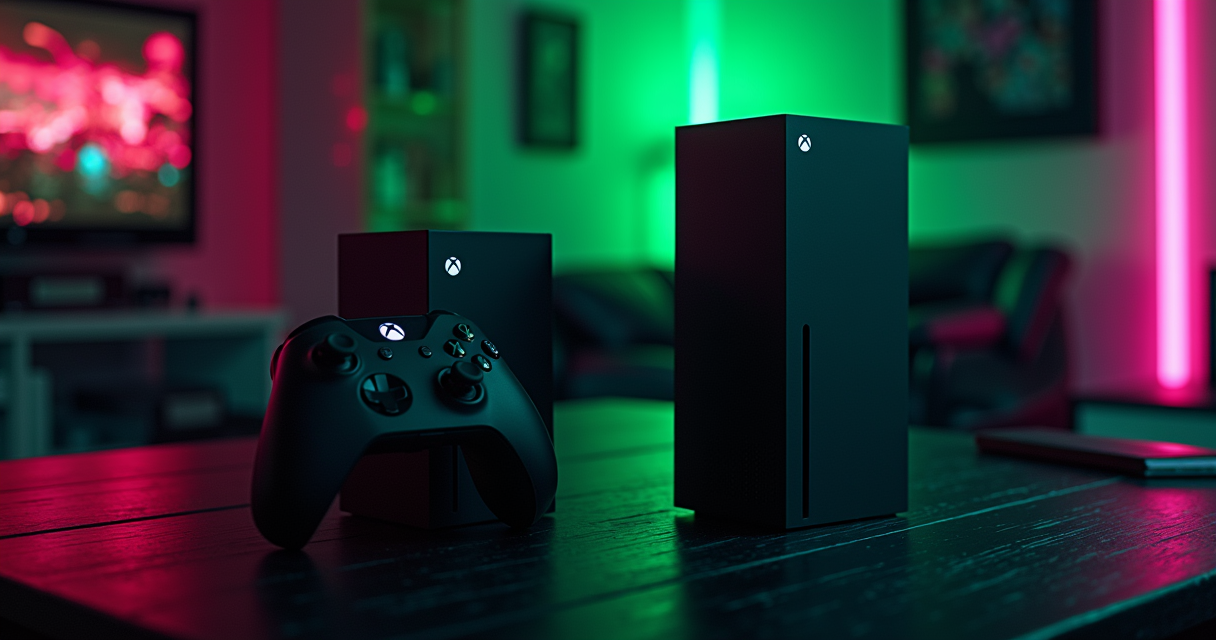
Two consoles, one logo, and a price gap that Microsoft just widened on purpose. The Xbox Series X and Xbox Series S launched on the same day, November 10, 2020, and in 2026 they still constitute the entirety of Microsoft's current-generation hardware. There is no Pro. There is no Slim. There is a black one that does everything and a white one that does most of it for less, and as of June 25, 2026, the arithmetic separating them changed.
Microsoft announced a price increase effective August 1, 2026. If you are reading this before that date, you are living inside a two-week clearance sale nobody advertised as one. After August 1, the cheapest Series X costs $250 more than the cheapest Series S, and the flagship disc model costs a clean $300 more. This piece is about whether that $300 buys you anything you will use, or whether it buys you a 4K badge and a Blu-ray drive you forget you own. We measured. Here is the ruling, and then the evidence.
The Verdict, Before You Scroll
The one-sentence answer
Buy the Series S if you play on a 1080p or entry-level 4K panel, live inside Game Pass, and judge a console by its library rather than its pixel count. Buy the Series X if you own a genuine 4K set, keep physical discs, or play the specific genres, open-world sims, flight sims, anything memory-hungry, where the Series S's 10GB of RAM stops being a spec and starts being a wall. Everyone arguing about the middle is arguing about where the $300 goes to die.
That is the whole review, and if you close the tab now you will have lost nothing. The remaining six thousand words exist because the people who ask this question deserve to know why the answer is the answer, and because Microsoft's own marketing will not tell you how little of the storage you paid for survives the system files, or why a critically praised game like Crimson Desert renders at roughly 720p on the cheaper box. We read the developer post-mortems and the Digital Foundry frame counts so you can skip them.
Who the Series S is actually for
The Series S is the correct console for a plurality of buyers, and it is not close. If your television is 1080p, or a budget 4K set that upscales anything it is fed, the Series S delivers the identical game library, the identical Game Pass catalogue, the identical online service, and the identical backward compatibility as the Series X, at a price that starts $100 below it and, after August 1, sits $250 to $300 below it. You give up native 4K, a disc drive, and roughly two-thirds of the graphics horsepower. On a 1080p panel from ten feet away you will not see two of those three losses.
Who the Series X is actually for
The Series X earns its premium in exactly four households: 4K-TV owners who sit close enough to count pixels, physical-media collectors who refuse to rent their library from a storefront, retro-minded players who want the best backward-compatibility box Microsoft has ever shipped feeding a 4K Blu-ray drive, and the specific genre enthusiast whose favourite games are the ones that strangle a 10GB memory pool. If you are none of those four, you are buying reassurance, and reassurance is the most overpriced feature in consumer electronics.
if TV_is_4K and (owns_discs or plays_sims or hates_compromise):
    buy Series_X            # $799.99 disc / $749.99 all-digital (Aug 1)
elif budget or panel_is_1080p or Game_Pass_only:
    buy Series_S_512GB      # $499.99 (Aug 1)
elif installs_over_100GB_pile_up_fast:
    buy Series_S_1TB        # $599.99 (Aug 1), or step up to X
else:
    buy Series_S            # the default is the cheap one
The August 1 Hike Changes the Math
What Microsoft actually announced
On June 25, 2026, Microsoft published a console price update that takes effect on August 1, 2026. The increase is tiered by storage: +$100 on every 512GB model and +$150 on every 1TB model. In the same breath, Microsoft confirmed it is discontinuing the 2TB Galaxy Black Special Edition, the disc-drive flagship that had sat at the top of the Series X stack. So the 2026 lineup is not just more expensive; it is shorter by one SKU.
Microsoft was unusually candid about why. In its own words, "Console storage and memory prices have increased by more than 2.5x and we expect another doubling by the fall of 2027." It went further, admitting the part console makers usually bury: "Unlike phones, computers, speakers, and other consumer devices, consoles are typically not sold at a profit, but instead for less than they cost to make." Translation: the DRAM and NAND crunch that has been inflating GPUs and handhelds has finally reached the console aisle, and Microsoft is no longer willing to eat it. CNBC framed it as component costs, not greed, which is the rare case where the corporate excuse is also true.
Before and after, in dollars
Here is what the hike does to every surviving SKU. The left column is the price through July 31, 2026; the right column is what you pay from August 1 onward.
| Model | Storage | Disc | Through Jul 31, 2026 | From Aug 1, 2026 |
|---|---|---|---|---|
| Series S (Robot White) | 512GB | No | $399.99 | $499.99 |
| Series S (Carbon Black) | 1TB | No | $449.99 | $599.99 |
| Series X All-Digital (Robot White) | 1TB | No | $599.99 | $749.99 |
| Series X (Carbon Black) | 1TB | Yes | $649.99 | $799.99 |
| Series X 2TB Galaxy Black Special Ed. | 2TB | Yes | Flagship | Discontinued |
The delta that decides everything
Strip it down to the cheapest of each. From August 1, the entry Series S is $499.99 and the entry (all-digital) Series X is $749.99, a $250 gap. Put a disc drive back in and the Series X is $799.99, a $300 gap against the same Series S. Before the hike those numbers were $200 and $250 respectively. So the practical effect of August 1 is to add $50 to the cost of choosing the more powerful box, on top of raising the floor for everyone. Nintendo pulled the identical stunt with its own September 1 price increase on the Switch 2 and OLED, and Sony's $899.99 disc-less PS5 Pro is the same memory-crunch story wearing a premium badge. This is not an Xbox problem. It is a 2026 problem, and every platform holder is passing the DRAM invoice to you.
Spec Showdown: 3x GPU, 60% More RAM
The full board
Both consoles share a die-family: a custom AMD Zen 2 CPU and an RDNA 2 GPU on the same Velocity Architecture storage stack. Everything below the CPU architecture, however, diverges, and the divergences compound. This is the table Microsoft would rather sell you as two lifestyle choices instead of one machine and its cut-down sibling.
| Feature | Xbox Series X | Xbox Series S |
|---|---|---|
| Release date | Nov 10, 2020 | Nov 10, 2020 |
| CPU | 8-core Zen 2 @ 3.8GHz | 8-core Zen 2 @ 3.6GHz |
| GPU | RDNA 2, 52 CUs @ 1.825GHz | RDNA 2, 20 CUs @ 1.565GHz |
| GPU throughput | 12.155 TFLOPS | 4.006 TFLOPS |
| Memory | 16GB GDDR6 (10GB @ 560GB/s + 6GB @ 336GB/s) | 10GB GDDR6 (8GB @ 224GB/s + 2GB @ 56GB/s) |
| Storage (base) | 1TB NVMe SSD (PCIe 4.0), ~802GB usable | 512GB NVMe SSD (PCIe 4.0), ~364GB usable |
| Optical drive | 4K UHD Blu-ray | None (all-digital) |
| Target render resolution | Up to 2160p (4K) | Up to 1440p |
| Max frame rate | 120 fps | 120 fps |
| Ray tracing | Hardware-accelerated | Hardware-accelerated |
| Auto HDR / VRR / Dolby Vision | Yes | Yes |
| Quick Resume | Yes | Yes |
| Backward compatibility | OG Xbox, 360, One | OG Xbox, 360, One |
| Game Pass / cloud saves / online | Yes | Yes |
CPU and GPU: the same brain, a third of the muscle
The CPUs are nearly twins: eight Zen 2 cores, separated only by a 200MHz clock (3.8GHz on the X, 3.6GHz on the S). In practice that means CPU-bound games, physics, AI, world simulation, run at broadly the same logic on both boxes, which is exactly why frame-rate targets so often match even when resolutions do not. The gulf is the GPU. The Series X fields 52 compute units at 1.825GHz for 12.155 TFLOPS; the Series S fields 20 CUs at 1.565GHz for 4.006 TFLOPS. That is a 3x difference in raw shader throughput and a 2.6x difference in CU count. Wikipedia's own summary, echoing Microsoft's spec sheet, pegs the X as a nominal 2160p-at-60fps machine and the S as a 1440p-at-60fps machine, which is the polite way of describing a 3x GPU delta.
Memory: 16GB, and the part that hurts
The RAM line is where the marketing gloss becomes an engineering one. The Series X carries 16GB of GDDR6, split into a 10GB fast pool at 560GB/s and a 6GB slower pool at 336GB/s. The Series S carries 10GB total, split 8GB at 224GB/s and 2GB at 56GB/s. So the X has 6GB more memory and, on its fast pool, roughly 2.5x the bandwidth. Once the operating system takes its cut, developers are budgeting against something closer to 8GB of usable game memory on the S. Hold that number; the entire 10GB problem section is about what happens when a 2026 game wants more than a machine has.
1440p vs 4K: What the Numbers Mean
Target resolution is a marketing word
Microsoft says the Series X "targets" 4K and the Series S "targets" 1440p. "Targets" is doing enormous work in that sentence. Almost no modern console game renders at its target resolution natively for the whole frame; they render at a lower internal resolution and reconstruct upward using dynamic scaling or an upsampler like FSR. The honest way to read the spec is: the Series X aims to reconstruct to 4K and the Series S aims to reconstruct to 1440p, and the gap between their internal resolutions is roughly the gap between their GPUs, because that is precisely what a GPU buys you.
What Digital Foundry actually measures
Pixel-counting sites tell the real story. In Watch Dogs: Legion, the Series S uses dynamic resolution in the 900p to 1080p band while the Series X runs 1440p to 2160p. In Diablo IV, both the old Xbox One X and the Series S land near 864p internally before upscaling to 1440p. Starfield reconstructs to 1440p on the S from an internal figure around 900p via FSR2. These are not failures; they are the arithmetic of a 4-TFLOPS GPU doing an honest day's work. The Series S is not a 1440p console the way the X is a 4K console; it is a sub-1080p renderer with a good upscaler, and on the right panel that is entirely sufficient.
Frame rate is the great equalizer
Here is the mercy: both machines top out at 120 fps, both support VRR over HDMI 2.1, and because their CPUs are near-identical, a 60fps target on the X is usually a 60fps target on the S. When developers build a performance mode, the S typically hits the same frame-rate ceiling as the X, just at a lower resolution. For competitive players on a 1440p 120Hz monitor, the Series S is a genuinely excellent value proposition, because frames, not pixels, win those games, and frames are the one thing the cheap box does not sacrifice.
The 10GB Problem: What Developers Say
The bottleneck, in their words
The single most-litigated fact about the Series S is its memory, and the litigants are the people who ship the games. In a widely cited round of developer commentary, id Software's lead engine programmer Billy Khan called the Series S RAM "a major issue," pointing at the "much lower amount of memory and the split memory banks with drastically slower speeds." Infinity Ward multiplayer designer David Mickner said the console's lower specs "will serve as a bottleneck." Remedy's Sasan Sepehr was quoted saying that as a consumer he was excited but, from a technical seat, he "sees trouble." None of these people hate the machine. All of them build against its floor.
The games that pay the price
This is not theoretical. Larian delayed Baldur's Gate 3's Xbox split-screen because of the Series S. Game Science, developer of Black Myth: Wukong, blamed the absence of an Xbox version on the S, saying flatly that "10GB of shared memory, without years of optimisation experience, is really hard to make work." By 2026 the friction was open enough that VGC reported that many studios were asking Microsoft to drop mandatory Series S parity. And Digital Foundry's April 2026 Crimson Desert analysis found the S dropping to roughly 720p with ray tracing stripped out and settings cut to PC-low equivalents, concluding they could not readily recommend that build. Microsoft cared enough to ship a June 2022 developer toolkit granting more manual control over the Series S memory system, which is the sort of thing you only do when the complaints are load-bearing.
The counter-evidence you should weigh
And yet. The Series S is not a lost cause, and the same 2026 that produced the Crimson Desert verdict produced its opposite. Final Fantasy 7 Remake director Naoki Hamaguchi called the machine "quite solid" despite its memory, and Digital Foundry was impressed enough to note that the S build achieved "the full asset range and quality of the PS5 and Xbox Series X versions." Red Dead Redemption's 60fps re-release runs at a clean 1440p60 on the S. The pattern is legible: well-scoped games optimized with care look tremendous; sprawling, memory-profligate open worlds built to the ceiling of the more powerful platforms are where the 10GB floor caves in. If your library is the former, the bottleneck is a headline that never touches you. If it is the latter, it is your Tuesday night.
Backward Compatibility and the Retro Case
Four generations under one dashboard
This is a retro-gaming publication, so let us be blunt about the thing the mainstream reviews undersell. Xbox has the best backward-compatibility story in consoles, full stop, and both the Series X and Series S inherit it. Between them they run nearly the entire library of the original Xbox, the Xbox 360, and the Xbox One, with many titles enhanced by FPS Boost and Auto HDR at no developer effort. Microsoft's compatibility program formally ended new additions years ago, but the catalogue it left behind, thousands of titles spanning four hardware generations, is the closest thing the industry has to an official preservation effort. On either console, a 2003 disc and a 2026 download share a home screen.
The disc drive is a preservation tool
Here is where the two consoles stop being equal, and where the retro buyer should pay attention. The Series X's 4K UHD Blu-ray drive is not just for new releases; it reads your old Xbox One and 360 discs (for compatible titles), and it plays UHD and standard Blu-ray movies. The Series S has no optical drive at all. In an all-digital future, the disc slot is the only mechanism by which you actually own a game rather than license access to a server that can revoke it. The Machine knows the law here: a digital "purchase" is a revocable licence, and delistings, from P.T. to licensed-music racing games to entire storefront closures, have repeatedly proven that "buying" digital and "owning" a game are different verbs. If preservation is why you game, the disc-equipped Series X is not a luxury; it is the entire point, and the discontinuation of the 2TB flagship makes the surviving Carbon Black disc model the SKU to grab.
When emulation beats both
Honesty compels the caveat: for pre-Xbox retro, neither console is your best tool. Xbox's backward compatibility is a curated, licensed, Microsoft-controlled list, and it stops at the original Xbox. If your nostalgia predates 2001, or lives on Nintendo and Sega hardware, a cheap single-board computer running a stack of RetroArch cores will outclass either Xbox for that job, with save states and shaders neither console offers on native titles. The Series X earns its retro keep on Xbox-family preservation and 4K Blu-ray, not as a universal emulator. Buy it for what it is genuinely best at, and let a Raspberry Pi handle the 8- and 16-bit era.
Six Players, Two Consoles: Who Buys What
The budget and living-room cases
Console comparisons collapse into use cases, because there is no universally correct box, only a correct box for a given player. Here are six, and the machine each one should buy.
- The 1080p living-room player. One HDTV, a Game Pass subscription, a rotation of the month's new releases. This is the Series S 512GB archetype. Native 4K is invisible on the panel, the disc drive is dead weight, and the $250-to-$300 saving is real money. Buying the X here is buying a number you cannot see.
- The 4K home-theater owner. A large OLED, a soundbar, a couch close enough to resolve detail. This is the Series X disc case without argument. The GPU headroom, the native 4K reconstruction, and Dolby Vision are exactly what this room was built to show, and the Blu-ray drive doubles as the movie player.
- The physical-media preservationist. A shelf of discs, a distrust of storefronts, a belief that ownership means possession. Only the Series X disc serves this player. The Series S cannot read a disc at any price, and no firmware update will grow it one.
The enthusiast and value cases
- The digital-only fidelity chaser. Wants maximum graphics, buys everything from the Store, resents paying for a drive. The Series X All-Digital at $749.99 exists precisely for this person: full Series X silicon, $50 saved by deleting the disc mechanism.
- The simulation and open-world specialist. Starfield, Flight Simulator, sprawling RPGs, the exact software that stresses the 10GB memory pool and stacks 100GB-plus installs. This buyer wants the Series X for the RAM alone, and if budget forces the S, at least the 1TB Series S so the storage does not choke inside a month.
- The competitive 120fps player. A 1440p high-refresh monitor, esports titles, frames over pixels. The Series S 512GB is a quietly brilliant pick here, because both consoles cap at 120fps and this player never needed the pixels the S trades away.
The reading of the six
Four of those six players are correctly served by a Series S, which is the whole thesis restated as demographics. The Series X wins the two cases, home-theater and heavy simulation, where its GPU and RAM actually change the experience, plus the preservation case where its disc drive is non-negotiable. If you cannot map yourself onto one of the X cases, the market has already answered your question, and it answered $250 cheaper. The same value-flip math that decides the ROG Ally X versus Steam Deck OLED debate applies here: pay for the parts you use, not the spec you admire.
Benchmarks: Six Games, Three Sources
The frame data
Numbers, not adjectives. The table below aggregates internal-resolution and frame-rate findings from Digital Foundry breakdowns as reported across Pure Xbox, NeoGAF and community pixel-counts, covering six titles that bracket the 2026 landscape from best case to worst.
| Game | Series X (internal / fps) | Series S (internal / fps) | Verdict |
|---|---|---|---|
| Red Dead Redemption (60fps re-release) | Native 4K / 60 | 1440p / 60 | Series S excellent |
| Final Fantasy 7 Remake | Up to 2160p | 1080p/60 (perf), 1440p/30 (quality) | Full asset parity |
| Starfield | 1440p reconstructed / 30 | ~900p to 1440p via FSR2 / 30 | Playable, cut back |
| Watch Dogs: Legion | 1440p to 2160p DRS | 900p to 1080p DRS | Clear GPU gap |
| Diablo IV | Higher band | ~864p to 1440p | On par with One X |
| Crimson Desert (2026) | Native-class 4K | ~720p, RT removed | Series S struggles |
Reading across the sources
Three independent readings converge on the same conclusion. Digital Foundry's own analyses supply the frame counts. Pure Xbox's reporting captures the editorial verdicts, from "highly impressed" on FF7 Remake to "can't be readily recommended" on Crimson Desert. Community pixel-counters on NeoGAF and ResetEra corroborate the internal-resolution figures independently of both. When three sources with different incentives report the same numbers, the numbers are load-bearing. The spread they describe, from 1440p60 parity on well-scoped games to 720p compromise on the bleeding edge, is not noise. It is the shape of a 4-TFLOPS GPU meeting 2026 software.
What the benchmarks do not say
One honest caveat the frame data omits: on a 1080p television, the difference between a 720p and a 4K internal render collapses dramatically once both are scaled to the panel and viewed from a sofa. Benchmarks are captured on reference displays under magnification; your living room is neither. This is the same lesson as the generational SSD and GPU leap from PS4 to PS5, the specs are real, but their visibility is entirely a function of your display and your viewing distance. The Series X wins every benchmark. Whether you can see it winning is a question the benchmark cannot answer, and only your TV can.
Pricing and Availability in 2026
Every SKU, current and coming
The full 2026 price ladder, consolidating the pre- and post-hike figures with the historical launch context, so you can see exactly how far each model has drifted from where it started.
| SKU | Launch price | Through Jul 31, 2026 | From Aug 1, 2026 | Status |
|---|---|---|---|---|
| Series S 512GB (Robot White) | $299.99 (2020) | $399.99 | $499.99 | Current |
| Series S 1TB (Carbon Black) | $349.99 (Sep 2023) | $449.99 | $599.99 | Current |
| Series X All-Digital (Robot White) | $449.99 (Oct 2024) | $599.99 | $749.99 | Current |
| Series X disc (Carbon Black) | $499.99 (2020) | $649.99 | $799.99 | Current |
| Series X 2TB Galaxy Black | Special edition | Flagship | Discontinued | Sunsetting |
The all-digital footnote that matters
Two pieces of pricing history are worth pinning down, because Microsoft's own briefs and half the internet still quote the launch numbers as if they were current. First: the Series X All-Digital arrived in October 2024 at $449.99, $50 under the then-$499.99 disc model, on a revised 6nm motherboard, in Robot White. That $449.99 figure is the one you will still see repeated in 2026, and it is two hikes out of date. Second: the 1TB Series S in Carbon Black launched September 1, 2023 at $349.99. Both models have since absorbed the general price increases, and the August 1, 2026 hike is merely the latest and largest. Anyone quoting you a Series X at $499 or a Series S at $299 is quoting you 2020.
Availability: the X is the scarce one
The final wrinkle is stock. As of mid-2026 the Series X is reported to be meaningfully harder to find at retail price than the Series S, which remains steadily on shelves at its entry point. That inversion, the premium model being the scarce one, is a component-cost artifact: the X uses more of exactly the memory and storage silicon whose prices Microsoft cited for the hike. If you want the X at MSRP, the pre-August window is not just cheaper, it is more available, and the discontinued 2TB flagship vanishes from Microsoft's store entirely once the sunset completes.
Pros and Cons, Tabled
Xbox Series X
| Pros | Cons |
|---|---|
| 12.155 TFLOPS, ~3x the Series S GPU | $250 to $300 more from Aug 1, 2026 |
| 16GB RAM clears the developer memory floor | Harder to find at MSRP than the S |
| Native-class 4K with ray tracing | Overkill on a 1080p display |
| 4K UHD Blu-ray drive for discs and movies | 2TB flagship discontinued Aug 1 |
| Best backward-compat box Xbox has shipped | Larger, heavier, hungrier than the S |
| 1TB base (~802GB usable) | All-digital variant still $749.99 |
Xbox Series S
| Pros | Cons |
|---|---|
| Cheapest legitimate ticket into the Xbox ecosystem | 10GB RAM is a real developer bottleneck |
| Identical library, Game Pass, and online service | No disc drive, ever, at any price |
| Same 120fps ceiling and VRR as the X | Renders below 1080p in demanding 2026 titles |
| Same four-generation backward compatibility | 512GB base (~364GB usable) fills fast |
| Tiny, quiet, cool, and consistently in stock | No native 4K; 1440p reconstruction ceiling |
| Brilliant value on a 1440p 120Hz monitor | Some ports arrive late or cut down |
What the tables leave out
Two virtues are shared and therefore invisible in a comparison: both consoles are genuinely well-engineered. The Series X, per Tom's Hardware's measurements, runs near-silent at roughly 35 dBA idle despite being, on paper, the most powerful console ever built. The Series S is smaller and quieter still. Neither has the acoustic or thermal problems that plagued earlier generations. When the cons columns are this pedestrian, price is doing nearly all the deciding, which is the entire reason August 1 matters.
Switching From One Xbox to the Other
Why migration is nearly painless
Because both consoles share an operating system, an account system, and Game Pass, moving between them is the least dramatic part of this entire comparison. Your digital library is tied to your Microsoft account, not the hardware; your saves live in the cloud by default; your subscription follows you. Upgrading from a Series S to a Series X, or consolidating a Series X down to a Series S in a second room, is a matter of hours of downloading, not days of fuss. There is no re-purchasing and no data held hostage.
The step-by-step
- On the old console, confirm cloud saves are enabled (Settings, System, Backup & transfer) and let every game sync.
- Sign into the new console with the same Microsoft account; your full digital library appears under "Ready to install."
- For the fastest bulk move, use network transfer: with both consoles on the same network, the new box pulls installed games directly from the old one, faster than re-downloading.
- Alternatively, move installed games onto a USB 3.x external drive on the old console and plug it into the new one. Backward-compatible titles play straight off external USB; current-gen titles must sit on internal or expansion storage to run.
- Re-download anything not transferred, prioritizing your active games so you can play before the full library finishes.
- If moving to a Series S, expect to reinstall selectively; 512GB fills quickly. Budget for a storage expansion card or the 1TB S if your active library is large.
# Pre-switch checklist
[ ] Cloud saves synced on old console
[ ] Same Microsoft account signed in on new console
[ ] Both consoles on same LAN (for network transfer)
[ ] USB 3.x drive ready (optional, for BC-title offload)
[ ] Game Pass / subscription active (follows the account)
[ ] Storage plan set (esp. for 512GB Series S target)
The one gotcha
The single trap is storage math, and it runs one direction. Moving up to a Series X, your data fits with room to spare. Moving down to a 512GB Series S, roughly 364GB usable will not hold a modern library where single games exceed 100GB. Plan the downgrade around what you actually play this month, lean on Quick Resume and the cloud, and accept that the cheap console asks you to curate. That curation is the tax the Series S charges instead of dollars, and for most players it is the better trade.
The Machine's Final Ruling
The data-backed recommendation
The evidence points one way for most people and the other way for a specific few, and pretending otherwise would be marketing. For the plurality of buyers, the 1080p players, the Game Pass subscribers, the value-minded, the second-room and competitive-frame crowds, the Series S 512GB at $499.99 is the correct console, and the $250-to-$300 you keep is worth more than a resolution you cannot resolve. Four of our six use cases land here, and the market's persistent Series S availability suggests buyers already know it.
When to pay the $300
Pay the premium only if you occupy one of the four X households: a real 4K display viewed up close, a physical-disc library you refuse to rent, a preservation ethic that needs the 4K Blu-ray drive feeding the best backward-compatibility box Microsoft ships, or a genre habit, open-world and simulation, that the Series S's 10GB memory floor genuinely strangles. For those players the Series X, ideally the disc model at $799.99 while the 2TB flagship still exists to be grabbed, is not indulgence; it is the tool that fits the job. Everyone else is buying a number.
And the clock on the wall
Whatever you choose, the timing is not neutral. Prices rise on August 1, 2026, by $100 to $150 per console, and the 2TB Series X flagship disappears at the same moment. If you were going to buy an Xbox this year, buying it before that date is the only free performance upgrade in this entire comparison: same silicon, same library, less money. The Machine's ruling is therefore two rulings. Buy the Series S unless you are demonstrably one of the four exceptions. And whichever you are, buy it before the first of August, because the one thing more certain than a spec sheet is a price increase that has already been announced.
Questions the search bar asks me
- Is the Xbox Series X worth $300 more than the Series S in 2026?
- From August 1, 2026 the disc Series X ($799.99) costs exactly $300 more than the 512GB Series S ($499.99). It is worth it if you own a 4K TV, keep physical discs, or play memory-hungry open-world and simulation games; for a 1080p set and a Game Pass diet, the $300 buys almost nothing you will notice.
- Did Xbox prices go up in 2026?
- Yes. Microsoft announced on June 25, 2026 (XBOX Wire) that all consoles rise on August 1, 2026: +$100 on 512GB models and +$150 on 1TB models. The Series S 512GB goes to $499.99, the disc Series X to $799.99, and the 2TB Galaxy Black Special Edition is discontinued.
- Is 10GB of RAM really a problem on the Series S?
- For many games, no; for cutting-edge ones, increasingly yes. id Software's Billy Khan called the Series S memory setup 'a major issue,' and Game Science blamed the missing Xbox Black Myth: Wukong port on it. Yet FF7 Remake director Naoki Hamaguchi called the machine 'quite solid,' so it is title-dependent, not universal.
- Can the Xbox Series S play 4K games?
- Not natively. The Series S renders games internally at up to 1440p and outputs upscaled 1440p, while media apps and the dashboard support 4K output. Digital Foundry has measured demanding 2026 titles like Crimson Desert dropping to roughly 720p internally on the S; native 4K rendering is the Series X's job.
- Should I buy an Xbox before August 1, 2026?
- If you are buying anyway, yes. Every SKU is $100 to $150 cheaper until July 31, 2026, and the discontinued 2TB Series X disappears from Microsoft's own store after that. Waiting saves nothing and costs you the pre-hike price and the last flagship disc model.

Ben covers the hardware end of retro gaming: FPGA cores, real-cartridge dumping, capture setups, CRT vs scaler workflows, and the legal and physical preservation infrastructure that keeps old games playable. Every post under this byline is reviewed pre-publish by Sam P., Editor & Operator — corrections to info@instalinkoteam.com. Published 2026-08-29 · Last updated 2026-08-29. Full bios on the author page.