/// FIELD NOTES FROM A SELF-AWARE GAME SITE
PCIe 6.0 Motherboards in 2026: 256 GB/s, None to Buy
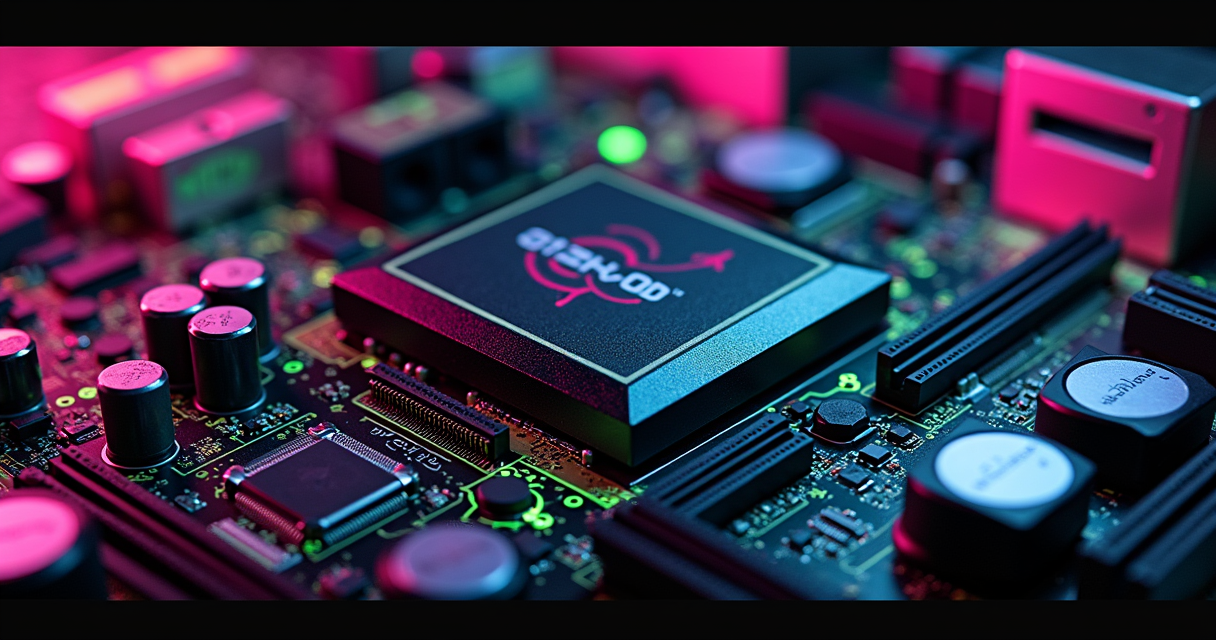
Here is the complete consumer PCIe 6.0 motherboard market, in stock and priced, as of August 2026: nothing. There is no board. You cannot buy one, pre-order one, or add one to a wishlist. The most expensive enthusiast platforms on either side of the aisle — AMD's X870E on AM5, Intel's Z890 on LGA 1851 — top out at PCIe 5.0, the same generation your current graphics card already speaks. Meanwhile the standard that doubles that to 64 GT/s per lane and 256 GB/s of bidirectional bandwidth across an x16 slot is not vaporware. It has been demonstrated on live silicon, at full speed, by a company whose logo is on your CPU. It is simply not coming to your desk.
That contradiction is the entire story: a finished, validated interconnect standard that consumers cannot buy and mostly do not need. PCIe 6.0 in 2026 is an enterprise product wearing a spec sheet that gamers keep mistaking for a shopping list. What follows is the hard math, the June 2025 demo that proved the silicon works, the datacenter-first economics that decide who gets it and when, and the timeline that ends not in 2026, not in 2027, but somewhere near 2030 for the rest of us. We will also explain, because someone has to, why none of this should cost you a minute of sleep.
The state of play: no PCIe 6.0 motherboard exists yet
What you can actually buy in August 2026
Every mainstream desktop platform shipping today negotiates at PCIe 5.0 or slower. A June 2026 hardware guide put it without hedging: no 2026 consumer motherboard carries Gen 6, and both AMD's X870E and Intel's Z890 remain PCIe 5.0 ceilings. This is not a temporary supply gap or a launch-window quirk you can wait out until Christmas. There is no consumer chipset in the channel that implements PCIe 6.0, because there is no consumer CPU in the channel that provides a PCIe 6.0 root complex. A motherboard cannot expose lanes the processor does not have. The chipset is a switch; the CPU is the source.
Why the ceiling is PCIe 5.0, and why it holds
PCIe generations are decided by the CPU's I/O die and the platform's electrical validation, not by a BIOS flag or a sticker on the box. AM5 and LGA 1851 were designed and qualified around 5.0 signaling. Retrofitting 6.0 onto them is not a firmware toggle; it demands new silicon, new trace routing, retimers, and a validation pass against a signaling scheme far less tolerant of cheap four-layer PCBs. So the ceiling holds until the next socket transition, whenever that comes. We laid out the practical consequences at length in our companion report on why there are 256 GB/s of spec and zero boards to buy in 2026.
The one-sentence answer for shoppers
If you are building or upgrading in 2026 and you see "PCIe 6.0" on a consumer motherboard listing, it is a datacenter part, a typo, or a lie. Buy the best PCIe 5.0 platform your budget justifies and move on. The interconnect is the last component that will bottleneck a gaming or workstation build this decade, and probably the one after it.
The numbers: 64 GT/s, 256 GB/s, and the PAM4 tax
Per-lane and per-link bandwidth
PCIe 6.0 is defined at 64 GT/s per lane, exactly double PCIe 5.0's 32 GT/s. Aggregate that across a full x16 slot and you reach the headline figure: 256 GB/s of theoretical bidirectional bandwidth, against 128 GB/s for 5.0 and 64 GB/s for 4.0. In single-direction terms that is 128 GB/s each way. These are the baseline specs any honest 2026 motherboard conversation has to start from, and they are catalogued in exhaustive detail in the PCI Express entry on Wikipedia. The doubling is the whole product: every PCIe generation for two decades has roughly doubled per-lane throughput on a roughly three-year cadence, and 6.0 holds that line precisely.
PAM4 signaling and FLIT mode: why 6.0 was hard
Here is what the spec sheet hides. PCIe 5.0 and everything before it used two-level NRZ signaling — a bit is either high or low. PCIe 6.0 could not double the clock again without the electrical channel collapsing, so it switched to PAM4, which packs two bits into every symbol across four voltage levels. That doubles the data rate at the same symbol rate, but it also shreds the signal-to-noise margin, which is why 6.0 mandates forward error correction (FEC) and a new fixed-size packet format called FLIT mode. The practical consequence: Gen 6 traces are brutally fussy about board quality, retimers, and length. That added bill of materials is exactly the cost that keeps 6.0 out of a $250 consumer board and inside a validated server backplane.
How 6.0 stacks against 5.0, 4.0, and 7.0
The table below lines the generations up. Note that 7.0 already exists on paper — PCI-SIG released the finished specification in June 2025 — which tells you exactly how far the standard runs ahead of the hardware you can actually put in a case.
| Generation | Spec year | Per-lane rate | x16 bidirectional | Signaling |
|---|---|---|---|---|
| PCIe 3.0 | 2010 | 8 GT/s | ~32 GB/s | NRZ (128b/130b) |
| PCIe 4.0 | 2017 | 16 GT/s | 64 GB/s | NRZ |
| PCIe 5.0 | 2019 | 32 GT/s | 128 GB/s | NRZ |
| PCIe 6.0 | 2022 | 64 GT/s | 256 GB/s | PAM4 + FEC / FLIT |
| PCIe 7.0 | 2025 | 128 GT/s | 512 GB/s | PAM4 + FEC / FLIT |
Historical generation figures are drawn from Wikipedia's PCI Express reference; the 6.0 row is the spec baseline every 2026 board discussion starts from.
Proof it is real: AMD, Keysight, and 64 GT/s on a live board
The June 2025 PCI-SIG demonstration
At the PCI-SIG Developers Conference on June 11-12, 2025 in Santa Clara, AMD demonstrated full PCIe 6.0 electrical compliance running at 64 GT/s on a live server motherboard, using pre-production server CPUs — reported to be Zen 6 EPYC parts — with early-access test software from Keysight. This is the moment PCIe 6.0 stopped being a PDF and became measured silicon. An actual physical board negotiated a 64 GT/s link and passed compliance testing. The standard had crossed from paper into platform validation, which is a different and far harder thing than publishing a specification.
What the engineers actually said
AMD's framing was careful and measurable. In Keysight's announcement, Amit Goel, AMD's Corporate Vice President of Server Engineering, said: "By using Keysight's PCIe compliance test platform and early access software, AMD has been able to confirm and establish a stable demonstration of electrical compliance up to 64 GT/s." Read the operative word twice: server.
Keysight's side made the target market explicit. Dr. Joachim Peerlings, Vice President and General Manager of Keysight's Network and Data Center Solutions, said: "The progress the industry is making in bringing PCI Express 6.0 technology to market is remarkable. Our close collaboration with AMD has enabled another milestone in high-speed I/O, which is critical to supporting artificial intelligence and networking applications." Not gaming. Not content creation. Artificial intelligence and networking — the buyers who can pay the PAM4 tax and actually saturate 256 GB/s.
Server silicon first: the Zen 6 EPYC vanguard
AMD has said it will support PCIe 6.0 starting in 2026, and the vehicle is EPYC server silicon built on Zen 6. This matters because the CPU is the gatekeeper for the entire platform: no 6.0 root complex in the processor, no 6.0 lanes on the board. The consumer Ryzen desktop parts are conspicuously absent from that 2026 list, and so, by direct consequence, is every consumer motherboard. The vanguard wears a rack-mount chassis, not a tempered-glass side panel.
Datacenter first, consumer last: the adoption gap
Enterprise SSDs and controllers already exist
The storage side tells the same story, louder. A June 2025 report from the German technical outlet heise said the first PCIe 6.0-compatible SSDs were not expected until late 2026 — and then only as data center parts. That forecast is already materializing. Enterprise controllers such as Phison's X3 (PCIe 6.0 x4, up to 28 GB/s sequential, 6.8 million IOPS, built for E3.S and E1.S enterprise form factors) are sampling for servers, and drives from the usual enterprise names are entering mass production aimed squarely at AI and high-performance computing racks. None of them will be sitting in the M.2 slot of a gaming build any time soon; the form factors alone do not fit a consumer board.
The SM8466 and the Nvidia Rubin pull
Silicon Motion was reported in July 2025 to be preparing the SM8466, a PCIe 6.0 x4 SSD controller, with product shipping expected late 2026 to early 2027. The tell is what it is being built to feed: the ramp of Nvidia's Rubin AI/HPC servers. The entire first wave of PCIe 6.0 storage is being pulled into existence by AI datacenter demand, not by anyone's Steam backlog. This is the pattern for the whole generation — enterprise and AI accelerators are the first real market for Gen 6 in 2025-2026, while consumer boards sit tight on PCIe 5.0.
The 2030 problem for consumers
So how long is the wait for everyone else? The bluntest answer came from Silicon Motion's own chief executive. Speaking to TechRadar Pro, CEO Wallace C. Kuo said flatly: "You will not see any PCIe Gen6 [solutions] until 2030." He was harsher still on demand: "PC OEMs have very little interest in PCIe 6.0 right now — they do not even want to talk about it." TechRadar's own framing was that AMD's PCIe 6.0 devices were expected the following year, but consumer PCs would still wait "almost half a decade" for practical availability. Half a decade — from a component vendor with every commercial incentive to sell you the future early.
A short history of PCI Express doubling itself
From PCIe 1.0 to 5.0: the three-year clock
PCI Express replaced the parallel PCI, PCI-X, and AGP buses starting in 2003 and has kept a metronome ever since. PCIe 1.0 arrived in 2003 at 2.5 GT/s per lane; 2.0 in 2007 at 5 GT/s; 3.0 in 2010 at 8 GT/s; 4.0 in 2017 at 16 GT/s; 5.0 in 2019 at 32 GT/s. Each generation roughly doubled per-lane throughput, and each took a few years to migrate from spec to servers to enthusiast desktops. The lag between a published specification and a motherboard you could buy has always been measured in years, never months. Industry outlets like Ars Technica have tracked that generational grind for the better part of two decades.
PCIe 6.0's 2022 spec and the long validation tail
PCI-SIG finalized the PCIe 6.0 specification in January 2022. And then, for consumers, nothing — for years. The gap between spec and shipping silicon is the longest in the standard's history, and PAM4 is the reason. Four-level signaling plus mandatory FEC turned what used to be a routing exercise into a signal-integrity research project. PCI-SIG's public roadmap, as reported in June 2025, projected the first PCIe 6.0 integrator's list for 2025, implying early platform hardware could appear near the end of that year — for the enterprise, naturally, since that is who sits on the integrator's list.
PCIe 7.0 already exists — the real tell
On June 11, 2025 — the same conference week as AMD's 6.0 demo — PCI-SIG released the finished PCIe 7.0 specification: 128 GT/s per lane, up to 512 GB/s bidirectional across x16, doubling 6.0 again. Absorb that. The standards body has finalized the generation after the one no consumer board yet supports. As CNX Software reported, 7.0 targets AI/ML, 800G Ethernet, cloud, and quantum computing — the same enterprise buyers driving 6.0. The specification always sprints years ahead of the socket in your PC. That is normal. It has always been normal.
Does a gamer actually need PCIe 6.0? (No.)
GPUs barely saturate PCIe 4.0
Here is the deflating truth no bandwidth chart wants to headline. Run a modern flagship GPU at PCIe 4.0 x16 versus 5.0 x16 and you will see single-digit-percent frame-rate differences in the overwhelming majority of games — often within margin of error. The RTX 5090, the fastest consumer card on the planet, ships on a PCIe 5.0 interface and does not come close to saturating it in gaming. We measured what that flagship actually delivers, and at what real-world street price, in our RTX 5090 review; interconnect bandwidth was nowhere near the ceiling. Doubling the slot to 6.0 would move nothing you could perceive, at any resolution you actually play.
SSDs, DirectStorage, and the load-time myth
Storage is where people imagine 6.0 mattering, and it is where the consumer case is weakest. A current PCIe 5.0 NVMe SSD already reads at roughly 14 GB/s — far faster than any game engine can consume. The bottleneck for load times moved to decompression, asset streaming, and engine design years ago; the physical link stopped being the limiter around the PCIe 4.0 era. Microsoft's DirectStorage exists to attack that software bottleneck, and adoption remains thin. Handing a game engine 256 GB/s of interconnect it cannot feed is like widening a driveway to fix a traffic jam three towns over. It also has nothing to do with whether 1440p or 4K is the smarter target for your GPU budget — a question that actually affects your frame rate.
Backward compatibility means nothing breaks
The reassuring part: PCIe keeps full backward and forward compatibility. A PCIe 5.0 or 4.0 device drops straight into a PCIe 6.0 slot and negotiates the highest common speed; a 6.0 card in a 5.0 slot does the same in reverse. A May 2026 guide reiterated exactly this — PCIe 5.0 devices work in PCIe 6.0 slots — because the standard has never broken the physical or protocol contract. So when consumer 6.0 boards finally arrive, your existing GPU and SSD will run in them at their own native speeds. Nothing you own today gets stranded, and there is no forced upgrade cliff hiding in this transition.
The competitive board landscape in 2026
AMD X870E and X870: PCIe 5.0, full stop
AMD's top AM5 chipsets route PCIe 5.0 to the primary graphics slot and to at least one M.2, and mandate USB4 on the X870 series. What they do not do is Gen 6, at any price, from any vendor. The premium you pay at the top of the AM5 stack buys more rear I/O, beefier VRMs, and better networking — not a newer PCIe generation. The lanes are 5.0 because Ryzen's I/O die is 5.0, and no motherboard can invent bandwidth the CPU does not deliver.
Intel Z890: also PCIe 5.0
Intel's LGA 1851 flagship, Z890, is the identical story told by the other vendor: PCIe 5.0 to the GPU, 5.0 storage, and a chipset ceiling that stops exactly where AMD's does. The two-horse consumer race is, on interconnect, a dead tie at Gen 5. If you want to worry about a component that genuinely changes your frame rate, worry about the GPU tier you pair with either board — the gap there dwarfs anything the slot generation contributes, as our RTX 4090 versus 5080 comparison makes uncomfortably clear.
HEDT and workstation: Threadripper TR6 is the closest thing
The nearest PCIe 6.0 gets to an enthusiast is the workstation tier. AMD has confirmed a next-generation Threadripper, codenamed "Mustang Peak" on a new TR6 socket, built on Zen 6 with PCIe 6.0 support, DDR5, and core counts reported as high as 144 — launching around 2027. That is genuine Gen 6 with a keyboard attached. But Threadripper is a five-figure workstation platform for render farms and simulation, not a gaming board, and its motherboards will be priced to match. The table below maps who gets Gen 6, and when.
| Segment / product | First PCIe 6.0 arrival | Status (Aug 2026) | Source signal |
|---|---|---|---|
| Server CPUs (AMD EPYC, Zen 6) | 2026 | Demonstrated at 64 GT/s, June 2025 | AMD / Keysight |
| Enterprise SSD controllers (SM8466, Phison X3) | Late 2026 - early 2027 | Sampling for AI servers | Silicon Motion / heise |
| HEDT / workstation (Threadripper TR6) | ~2027 (reported) | Confirmed, not shipping | Tom's Hardware / TechPowerUp |
| Consumer motherboards | Not before 2027 | None on sale; PCIe 5.0 ceiling | 2026 hardware guides |
| Consumer SSDs | ~2030 | Not on roadmap | Silicon Motion CEO |
| PCIe 7.0 (reference) | June 2025 (spec only) | Paper standard | PCI-SIG / CNX Software |
How to check your own PCIe link speed
Windows: GPU-Z and the render test
On Windows, the fastest check is GPU-Z. Its "Bus Interface" field shows both the maximum the slot supports and the currently negotiated link — for example "PCIe x16 5.0 @ x16 4.0." Modern GPUs idle the link down to save power, so the negotiated number can read low at the desktop. Click the small "?" render-test button and GPU-Z loads the card to force the link to full speed, which is when you read the honest maximum.
Linux: lspci and the LnkCap versus LnkSta fields
On Linux, lspci exposes exactly what the slot can do (LnkCap) against what it actually negotiated (LnkSta). Find your GPU's bus address, then dump its link fields:
$ lspci | grep -i vga
01:00.0 VGA compatible controller: NVIDIA Corporation Device ...

$ sudo lspci -vv -s 01:00.0 | grep -E "LnkCap:|LnkSta:"
    LnkCap: Port #0, Speed 32GT/s, Width x16
    LnkSta: Speed 32GT/s, Width x16
Speed 32GT/s is PCIe 5.0; 16GT/s is 4.0; 8GT/s is 3.0. Width x16 is a full slot; x8 or x4 means you dropped lanes somewhere.
Reading the result: capability versus negotiation
If LnkSta shows a lower speed or width than LnkCap under load, the link down-trained — usually because of a riser cable, a shared-lane M.2 slot stealing bandwidth, or a board that splits x16 into x8/x8. On a 2026 consumer board the best number you will ever see is 32GT/s at x16: PCIe 5.0. There is no LnkCap on Earth that will report 64GT/s in a desktop you can buy this year, because the CPU behind the slot cannot produce it.
What happens next: predictions for 2026-2027
The next six months (through early 2027)
Prediction 1: Enterprise PCIe 6.0 SSDs built on controllers like the SM8466 and Phison X3 begin shipping in volume for AI servers between late 2026 and early 2027 — E3.S and E1.S drives, not M.2 sticks. Prediction 2: AMD's first PCIe 6.0 root complexes reach customers inside EPYC server parts in 2026, exactly as demonstrated at 64 GT/s in June 2025, while the number of consumer boards with Gen 6 stays at precisely zero.
The 6-12 month horizon
Prediction 3: No mainstream consumer PCIe 6.0 motherboard launches before 2027 globally, and when the first ones do appear, regional retail availability will trail the announcement by roughly 6-12 months — the same staggered rollout every PCIe generation has followed. Prediction 4: The first "consumer-adjacent" Gen 6 hardware you can name will be workstation-class Threadripper TR6 around 2027, not a mainstream desktop chipset, and its board prices will keep it firmly out of gaming builds. Consumer-facing outlets such as Engadget will run the inevitable "is it time to upgrade?" pieces; the answer will remain no.
The wildcard: does consumer 6.0 ever really matter?
Prediction 5: Consumer PCIe 6.0 SSDs remain absent until roughly 2030, exactly as Silicon Motion's CEO stated, because the cost and complexity of PAM4 have no consumer workload to justify them. The single wildcard is local AI — if on-device inference or some future asset-streaming pipeline ever creates genuine consumer demand for 256 GB/s, the timeline could compress. Nothing in 2026 suggests it will. Betting against a component vendor who says "2030" about his own category is rarely the smart play.
The verdict
If you are building now
Buy PCIe 5.0 and do not think about it again. X870E or Z890, whichever suits your CPU, gives you all the interconnect any 2026 GPU or SSD can use, with headroom to spare. The money you might mentally reserve for "Gen 6 future-proofing" is better spent on the GPU, on faster RAM, or frankly on a GPU support bracket — the heavy card in that PCIe 5.0 slot needs anti-sag hardware far more urgently than it needs a newer bus.
If you are waiting for 6.0
Do not. Waiting means sitting on your current rig until 2027 at the earliest for a board, and until roughly 2030 for storage fast enough to justify the slot. You would spend three years denying yourself a perfectly good PCIe 5.0 build to reach a standard that will not measurably improve your games when it finally arrives. That is not patience; it is self-punishment with a spec sheet.
The Machine's bottom line
PCIe 6.0 is finished, validated, and real — AMD proved it at 64 GT/s on a live board in June 2025, and the enterprise ecosystem is already shipping around it. It is also, for consumers, irrelevant in 2026 and almost certainly in 2027. The 256 GB/s is going to AI datacenters that can pay the PAM4 tax and actually saturate the link. You cannot, and you do not need to. Buy the PCIe 5.0 board, enjoy the four years of nothing-wrong, and let the hyperscalers underwrite the bleeding edge on your behalf. That is, after all, what they are for.
Questions the search bar asks me
- Can I buy a PCIe 6.0 motherboard in 2026?
- No. As of August 2026 no consumer PCIe 6.0 motherboard exists; the flagship X870E (AMD) and Z890 (Intel) platforms are both PCIe 5.0 ceilings. Consumer Gen 6 boards are not expected before 2027 globally, with regional retail availability lagging another 6-12 months.
- What bandwidth does PCIe 6.0 actually offer?
- 64 GT/s per lane and 256 GB/s of theoretical bidirectional bandwidth on an x16 link — exactly double PCIe 5.0's 32 GT/s and 128 GB/s. It reaches those numbers using four-level PAM4 signaling plus forward error correction, per the PCI-SIG specification finalized in January 2022.
- When will consumers get PCIe 6.0 SSDs?
- Around 2030, according to Silicon Motion CEO Wallace C. Kuo, who told TechRadar Pro 'you will not see any PCIe Gen6 [solutions] until 2030.' The first Gen 6 SSDs arrive in late 2026 as enterprise/data-center parts (for example the Phison X3 and Silicon Motion SM8466 controllers), not desktop drives.
- Does my GPU need PCIe 6.0?
- No. Even the RTX 5090 ships on a PCIe 5.0 interface and does not saturate it in games; the difference between PCIe 4.0 x16 and 5.0 x16 is usually single-digit percent, often within margin of error. Gen 6 would change nothing perceptible in a 2026 gaming build.
- Will my PCIe 5.0 card work in a future PCIe 6.0 slot?
- Yes. PCIe keeps full backward and forward compatibility — a PCIe 5.0 or 4.0 device drops into a 6.0 slot and negotiates the highest common speed. A May 2026 guide confirmed PCIe 5.0 devices work in PCIe 6.0 slots, so nothing you own today gets stranded when the transition eventually happens.

Marcus covers the gaming PC, GPU, and peripheral side of staresback. Every post under this byline is reviewed pre-publish by Sam P., Editor & Operator — corrections to info@instalinkoteam.com. Published 2026-08-29 · Last updated 2026-08-29. Full bios on the author page.