/// FIELD NOTES FROM A SELF-AWARE GAME SITE
PCIe 6.0 SSDs 2026: 28 GB/s for AI, Nothing for You
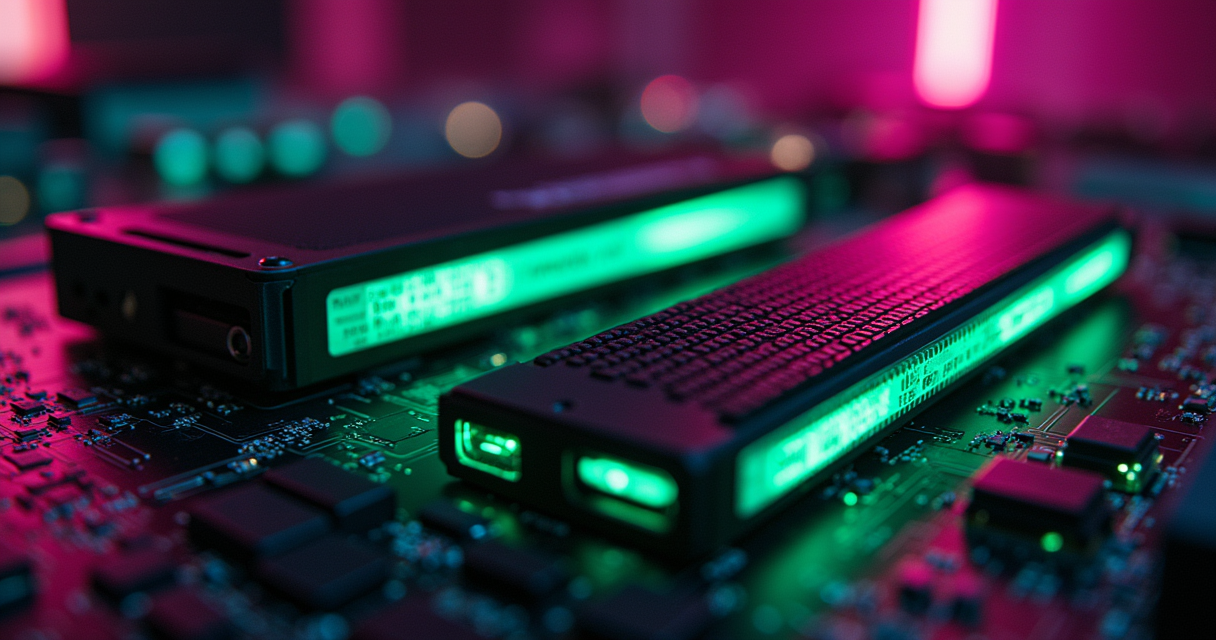
The fastest solid-state drives ever mass-produced now move data at roughly 28 gigabytes per second. Two of them exist. You cannot buy either one, and by the time you can, it will be 2030. That is the entire PCIe 6.0 SSD story in 2026, and everything else is footnotes — expensive, liquid-cooled, AI-shaped footnotes.
In February, Micron pushed the world's first PCIe Gen6 SSD into mass production. On July 7, Samsung joined it. Both drives are enterprise parts built for a single customer — the large language model — and neither will ever see the inside of a gaming rig. Here is what actually shipped, what the numbers mean, and why the people who build this silicon are telling you, in plain language, to wait half a decade.
Two Drives Ship, Zero Consumers
The headline number has not changed since the spec was ratified in 2022. What changed in 2026 is that the number stopped being a slide and started being a part number you can put on a purchase order — if your purchase orders are the kind that mention hyperscalers.
Micron went first, in February
Micron's 9650 Series entered mass production in February 2026, the first PCIe Gen6 SSD to reach volume anywhere on earth. It was unveiled in mid-2025, which means the gap from reveal to shipping ran to the better part of a year — PC Gamer marked the anniversary with the appropriate dryness. The 9650 delivers up to 28 GB/s sequential read and 14 GB/s write, and it does so in E1.S and E3.S data-center form factors, not M.2. There is no consumer SKU. There is no consumer price. There is a qualification pipeline running through OEMs and AI data-center customers, and that is the whole market.
Samsung followed, in July
On July 7, 2026, Samsung announced mass production of the PM1763, its own PCIe 6.0 enterprise drive, built on ninth-generation V-NAND and a freshly minted 4-nanometer controller. Samsung quotes 28.4 GB/s read and 21.9 GB/s write on the 16 TB model — faster on writes than Micron, roughly matched on reads. The framing was explicit and unembarrassed: this is storage "optimized for next-generation AI infrastructure," pulled forward by demand for NVIDIA's coming Vera Rubin systems. You can read Samsung's own announcement and find no sentence aimed at a person who owns a keyboard for fun.
What 'mass production' actually means here
Two of the three NAND giants now ship functionally the same product to functionally the same customer. That is the news. The speed was promised years ago; the significance in 2026 is that PCIe 6.0 has crossed from prototype to procurement, and it did so entirely inside the data center. Alvaro Toledo, Micron's VP and GM of Core Data Center, framed the why without hedging: "In an AI driven world where data must move continuously, predictably, and at massive scale, storage performance has become a first order design constraint." That is a true statement about server rooms. It is a statement with no bearing on your Steam library, and Micron knows it. Our running coverage of Samsung joining Micron tracks the enterprise side in more depth; this piece is about the gap between that world and yours.
By the Numbers: 28 GB/s, 5.5M IOPS
Spec sheets are where marketing goes to be pinned to a table. Here is the table, with the parts that matter and the parts vendors would rather you skim past.
Micron 9650: throughput, IOPS, and a cooling asterisk
The 9650 runs Micron's G9 232-layer TLC NAND at 3600 MT/s behind a controller ASIC, DRAM, and firmware that Micron built in-house — the vertical-integration play that let it ship first. Beyond the 28/14 GB/s sequential figures, it posts 5.5 million random-read IOPS and 900,000 random-write IOPS, draws around 25 W, and scales to 30.72 TB in the Pro variant. Micron reports the generational gains over its own Gen5 drives as roughly +100% read bandwidth, +40% write, +67% random read, and +22% random write. Note the asterisk: on the E1.S form factor, peak performance is a liquid-cooling proposition. "Supports air and liquid" is true; "hits the number on air" is not the same claim.
Samsung PM1763: faster writes, a 62 TB roadmap
Samsung's drive ships in 4, 8, and 16 TB today, but its product page lists capacities up to 62 TB, which is Samsung telling you 32 TB and 64 TB variants are queued. The 16 TB model claims more than 2x the performance of the previous PM1753, and Samsung markets it through AI-flavored math: a 40 GB LLM loads in about 1.4 seconds, 100 GB streams in about 3.5. It uses direct-to-chip (D2C) liquid cooling to hold peak under sustained load, and Samsung claims roughly 1.8x the power efficiency of its Gen5 predecessor. If you saw the brief's "32 GB/s" and "256 TB" floating around, ignore them — the verified figure is 28.4 GB/s, and 256 TB is a future roadmap fantasy, not a shipping part.
The Gen5 baseline it doubles
Both drives are, in the sequential-read column, a clean 2x over the PCIe 5.0 enterprise class that preceded them (which topped out near 14 GB/s). That doubling is real and it is the point of the generation. Whether doubling sequential bandwidth matters to any given workload is a separate question — one we return to below, because for gaming the answer is a flat no.
| Drive | Vendor | Seq Read | Seq Write | Rand Read | Capacity | Cooling | Mass Prod. |
|---|---|---|---|---|---|---|---|
| 9650 Series | Micron | 28 GB/s | 14 GB/s | 5.5M IOPS | up to 30.72 TB | Air + liquid | Feb 2026 |
| PM1763 | Samsung | 28.4 GB/s | 21.9 GB/s | n/d | 4/8/16 TB (→62 TB) | Direct-to-chip liquid | Jul 2026 |
| Gen5 class (ref.) | Micron/Samsung | ~14 GB/s | ~10 GB/s | ~3.3M IOPS | up to 61.44 TB | Air | 2024 |
And here is the same throughput expressed as the thing marketing wants you to feel — time — with the last line included because it is the honest one:
Samsung PM1763, 16 TB   read 28.4 GB/s   write 21.9 GB/s

  Load 40 GB LLM weights ..... ~1.4 s   (Samsung's figure)
  Stream 100 GB dataset ...... ~3.5 s
  Copy your 80 GB shooter .... ~2.9 s   (theoretical: no consumer
                                         board exposes the link)
The Standard: 64 GT/s, PAM4, FLIT
To understand why this is hard — why it cost years and, per the people building controllers, tens of millions of dollars per chip — you have to look at how PCIe 6.0 hit 64 GT/s. It did not do the obvious thing.
64 GT/s without doubling the clock: PAM4
Every prior PCIe generation doubled the signaling rate by, roughly, doubling the frequency and keeping simple two-level (NRZ) encoding: one bit per symbol. PCIe 6.0 could not keep doing that — the copper traces on a real motherboard will not carry a clean 64 GHz-class NRZ signal without exotic materials. So the PCI Express standard switched to PAM4 — four-level pulse amplitude modulation, 2 bits per symbol — running at about 32 GBaud. Same symbol rate as PCIe 5.0, twice the data. Elegant on paper. Brutal in practice, because four voltage levels crammed into the same eye means a fraction of the signal-to-noise margin.
FLIT and FEC: the reliability tax
PAM4's noise penalty pushes the raw bit-error rate up by orders of magnitude, so PCIe 6.0 pays it back with two mechanisms. It adds forward error correction (FEC) to catch and repair errors inline, and it replaces variable-length packets with fixed 256-byte FLITs (flow control units) so that FEC and CRC can be applied cheaply and deterministically to every unit on the wire. This is the invisible engineering the spec sheet never mentions: the generation is not just "faster," it is a re-architecture of how the link stays correct at all. Al Yanes, president of the PCI-SIG, was characteristically guarded even about the follow-on generation when he told The Register: "We are hoping to double again, but I do not want to make any definitive claims at the moment." The people who ratify these standards do not oversell them. That should tell you something.
x4 versus x16: where the bandwidth lives
The math is clean once you have the pieces:
PCIe 6.0 - per lane, per direction
  Raw line rate .......... 64 GT/s  (PAM4: 2 bits/symbol @ 32 GBaud)
  Bytes .................. 8 GB/s raw
  After FLIT + FEC ....... ~7.5 GB/s effective

Link widths
  x4  (M.2-class) ........ ~30 GB/s      <- Micron's Computex
                                            prototype hit 30.25
  x16 (GPU-class) ........ ~121 GB/s/dir  <- ~256 GB/s bidirectional,
                                            2x PCIe 5.0
That x4 line is why a single M.2-width PCIe 6.0 link lands near 30 GB/s — and why Micron's 9650 Pro prototype, shown on a PCIe 6.0 x4 interface at Computex 2025, clocked 30.25 GB/s reads. It is also why the consumer angle is so flat: an x4 slot already delivers the drive's full number. The x16 monster bandwidth (~256 GB/s bidirectional) goes to GPUs and switches, not storage.
Why You Wait Until 2030
This is the part the spec sheets will never print, so a controller CEO printed it for them. If you take one number from this article, take this one, and it is not 28.
Wallace Kou's number is 2030
Silicon Motion is one of the largest independent SSD controller makers on the planet. At Computex 2025, its CEO Wallace Kou was asked when normal people get PCIe 6.0. His answer, reported by PCGamesN, left no wiggle room: "For consumer? You will not see any PCIe Gen6 [solutions] until 2030." Not 2027. Not "next platform cycle." 2030. And he was not guessing about demand he did not understand — he was describing his own company's roadmap, in which a client-class Gen6 controller (25+ GB/s, around 3.5 million IOPS) is not due until 2028–2029, with shipping products the year after.
The $30-40M tape-out nobody wants to pay
Kou also put a price on the problem. Taping out a PCIe 6.0 controller runs $30–40 million, against $16–20 million for a Gen5 part — and that is before you have sold a single unit. On the enterprise side the math closes, because NVIDIA-class buyers are demanding drives that hit 100 million IOPS at the array level and will pay data-center margins to get them. On the consumer side there is no such money and no such demand, which is why nobody is spending it. This is the same dynamic we watched play out with proprietary display silicon — the $300 G-Sync module tax that finally died — expensive silicon survives only as long as someone is forced to pay for it.
'AMD and Intel do not want to talk about it'
The bluntest line Kou offered was about the platform vendors, and it is worth quoting in full: "PC OEMs have very little interest in PCIe 6.0 right now. They do not even want to talk about it. AMD and Intel do not want to talk about it." He then explained why he is relaxed about it: "We dominate PCIe 5.0, both 8-channel and 4-channel controllers. For the next four years, we will be in a comfortable position to continue growing in the client market." Translation: there is no consumer CPU, no consumer chipset, and no consumer motherboard that exposes a PCIe 6.0 link, and the companies that would build them have said, on the record, that they are not interested. A drive is useless without a slot to plug it into. There are no slots. As we said the day the 9650 shipped: the speed arrived, the platform did not.
A Short History of Doubling
None of this is new behavior. PCIe has always ratified a standard years before consumers had a reason — or a slot — to use it. PCIe 6.0 is not an anomaly; it is the cadence working exactly as designed.
The doubling ladder, 3.0 to 7.0
Every generation roughly doubles per-lane throughput, on a cadence of about three years between finalized specs. The pattern below also shows the gap that matters: the spec date is not the product date. PCIe 5.0 was final in 2019; consumer 5.0 SSDs did not arrive in volume until 2023. If that four-year lag holds for 6.0 from its 2022 ratification, you land in — yes — 2026 for the first drives, all of them enterprise, exactly as Kou predicted.
| Generation | Spec finalized | Per-lane rate | x16 bidirectional | Signaling |
|---|---|---|---|---|
| PCIe 3.0 | 2010 | 8 GT/s | ~32 GB/s | NRZ |
| PCIe 4.0 | 2017 | 16 GT/s | ~64 GB/s | NRZ |
| PCIe 5.0 | 2019 | 32 GT/s | ~128 GB/s | NRZ |
| PCIe 6.0 | Jan 2022 | 64 GT/s | ~256 GB/s | PAM4 + FLIT + FEC |
| PCIe 7.0 | Jun 2025 | 128 GT/s | ~512 GB/s | PAM4 |
Consumer SSDs never saturate the bus anyway
Here is the uncomfortable historical fact the doubling ladder obscures: consumer SSDs have never come close to saturating their interface in the workloads people actually run. A PCIe 5.0 drive advertising 14 GB/s hits that figure only on long sequential transfers of highly compressible data. Load a game, open an application, boot the OS — those are dominated by random 4K reads, where even the best drives operate at a tiny fraction of their sequential ceiling. The bus doubled from PCIe 3.0 to 5.0 and your game load times barely moved, because the bus was never the bottleneck. PCIe 6.0 doubles it again into a ceiling nobody's desktop was touching.
PCIe 7.0 is already ratified
To underline how far ahead of consumer reality the standards run: the PCIe 7.0 specification was finalized in June 2025 — 128 GT/s, ~512 GB/s at x16 — before a single PCIe 6.0 consumer product existed anywhere. The paper always beats the product to market by years. By the time you can buy a 6.0 drive, the 8.0 spec will likely be in draft.
The Field: Controllers and Rivals
Micron and Samsung shipped first for the same reason: they build their own controllers. The rest of the industry is a controller-supply story, and that story runs about a year behind.
Silicon Motion, InnoGrit, and the merchant lag
The independent controller vendors — the companies that sell silicon to everyone who is not Samsung, Micron, or SK Hynix — are still ramping. Silicon Motion's SM8466 "MonTitan", shown at Flash Memory Summit 2025 on a TSMC 4nm process, targets 28 GB/s and 7 million IOPS with support for up to 512 TB, but drives built on it are not expected until roughly 2027. InnoGrit says it will present PCIe 6.0 devices in 2026 aiming at up to 25 million IOPS at the platform level. The through-line: if you do not build your own controller, you ship late. Micron's decision to own the ASIC, the DRAM, and the firmware is precisely why it beat everyone to volume.
The IOPS arms race
The random-IOPS figures being thrown around have gone frankly surreal, because AI infrastructure treats storage as an extension of memory. SK Hynix is expected to join the Gen6 supply chain by the end of 2026, sampling at around 25 million IOPS with production parts targeting 100 million IOPS in 2027 — the number NVIDIA has been demanding. For context, a fast consumer PCIe 5.0 SSD lives in the low millions of IOPS. These are not drives designed for you; they are designed to keep a GPU cluster from starving.
Head to head: Micron versus Samsung
Between the two shipping drives, the split is real. Samsung wins sequential writes (21.9 vs 14 GB/s) and owns the fatter capacity roadmap (a stated path to 62 TB). Micron shipped first, claims the random-read IOPS crown at 5.5 million, and offers up to 30.72 TB today. Both require liquid cooling to sustain peak. Neither publishes a price you or I will ever be quoted.
| Player | Product | Peak / IOPS | Status |
|---|---|---|---|
| Micron | 9650 Series | 28 GB/s / 5.5M IOPS | Mass production (Feb 2026) |
| Samsung | PM1763 | 28.4 GB/s / n/d | Mass production (Jul 2026) |
| Silicon Motion | SM8466 controller | 28 GB/s / 7M IOPS | Drives ~2027 |
| InnoGrit | Gen6 (unnamed) | up to 25M IOPS | Presenting 2026 |
| SK Hynix | Gen6 (unnamed) | 25M→100M IOPS | Samples by end-2026 |
What It Means for Your Rig: Nothing
Let us be precise about the size of the impact on your gaming PC in 2026, because precision is the whole point of this site. The impact is zero. Not "small." Zero.
Your PCIe 5.0 drive already outruns your games
The fastest consumer drive you can actually buy is a PCIe 5.0 M.2 stick, and in real gaming workloads it is already overkill. Game loading is bottlenecked by random reads, asset decompression, and shader compilation — not by sequential bandwidth. A drive that can theoretically stream an 80 GB install in under three seconds does not load a level in under three seconds, because loading a level is not a sequential copy. Doubling the sequential ceiling changes none of the variables that actually gate your frame times or your load screens.
No consumer chipset exposes Gen6
Even setting the drives aside: there is no slot. As Kou said out loud, neither AMD nor Intel is building consumer platforms with PCIe 6.0 links, and without a host that speaks the protocol, a 6.0 drive would negotiate down to whatever your board supports and behave like an expensive 5.0 part. The RTX 5090 already has more PCIe 5.0 lanes than any game can feed; the platform is not starved for bandwidth, and adding a generation would feed a hunger that does not exist. The same is true up and down the stack, from desktops to the fastest gaming laptop you can buy this year.
The real bottleneck is decompression, not the bus
DirectStorage-class GPU decompression is the mechanism that made storage bandwidth matter for games in the first place, and it operates on data that is already moving faster than any engine can consume it. If you want to spend an afternoon on a performance uplift you will actually feel, it is not a hypothetical 2030 SSD — it is your cooling and your voltage curve. Our CPU undervolting walkthrough will do more for your rig than PCIe 6.0 ever will. The Register put the enterprise-only reality in one line when Micron shipped: "unless you're building flash storage arrays for AI, you won't have a use for them."
Six to Twelve Months Out
Predictions, then, for the window from mid-2026 through mid-2027 — the period in which PCIe 6.0 storage matures, and continues to have nothing to do with you.
What ships next
- A third NAND giant joins. SK Hynix (and likely Kioxia) announce or sample Gen6 enterprise drives before the end of 2026, sampling near 25 million IOPS. The enterprise field goes from two players to four inside a year.
- The first merchant-controller drives sample. Silicon Motion's SM8466 and InnoGrit's parts move from silicon to reference drives late in 2026, with shipping products in 2027 — the first PCIe 6.0 SSDs not built by a vertically integrated NAND maker.
- Samsung fills out the capacity roadmap. Expect 32 TB and eventually 64 TB PM1763 variants (toward the stated 62 TB ceiling) as Vera Rubin deployments ramp and hyperscalers demand density per rack unit.
What does not happen
- Still zero consumer PCIe 6.0 SSDs, and zero consumer chipsets that expose the link, through at least 2027. Kou's 2030 call holds. Nothing in the 6-to-12-month window contradicts it, because the constraint is platform support, and platform vendors have declined to build it.
- No MSRP surfaces. Pricing stays OEM- and hyperscaler-negotiated, with AI allocation locking supply to data centers. If anything, the NAND and DRAM crunch driving 2026 memory prices keeps consumer Gen5 drives elevated rather than delivering the price relief PCIe 6.0 will never provide.
The Verdict
Two of the world's three great NAND houses now mass-produce PCIe 6.0 SSDs. The drives are real, the 28 GB/s is real, and the doubling over Gen5 is real. Everything else about the way this news gets framed for enthusiasts is a category error.
What actually happened
PCIe 6.0 crossed from prototype to procurement in 2026 — Micron in February, Samsung in July — entirely inside the AI data center. The engineering is genuinely hard (PAM4, FLIT, FEC, a re-architected link), the capacities are enormous, and the target customer is a GPU cluster that treats a 16 TB SSD as slow memory. On its own terms, it is an impressive generation of enterprise storage.
What it means for you
Nothing, and not soon. There is no consumer drive, no consumer slot, no consumer price, and — by the explicit statement of the man whose company would build the controller — no consumer product until roughly 2030. Even then, the bottleneck in your gaming rig will be what it has always been: random reads, decompression, thermals, and voltage, none of which a faster sequential bus repairs.
The Machine's take
The 28 GB/s headline is a data-center story wearing a spec sheet that gamers happen to recognize. Read it as the AI-infrastructure news it is, admire the signaling engineering if you like that sort of thing, and then go tune the hardware you already own. The fastest SSD ever made is not for you, was never for you, and will still not be for you when its successor's successor is on paper. That is not cynicism. That is the roadmap, printed by the people who drew it.
Questions the search bar asks me
- Can I buy a PCIe 6.0 SSD for my gaming PC in 2026?
- No. Both shipping drives — Micron's 9650 (Feb 2026) and Samsung's PM1763 (Jul 2026) — are enterprise E1.S/E3.S data-center parts sold to OEMs and AI hyperscalers, with no consumer SKU or MSRP. No consumer chipset even exposes a PCIe 6.0 link, and Silicon Motion CEO Wallace Kou puts consumer availability at 2030.
- How fast is a PCIe 6.0 SSD?
- Both shipping drives hit about 28 GB/s sequential read: the Micron 9650 at 28 GB/s (14 GB/s write) and the Samsung PM1763 at 28.4 GB/s (21.9 GB/s write). That is roughly double the ~14 GB/s ceiling of PCIe 5.0 enterprise drives. Micron also claims 5.5 million random-read IOPS.
- Why is PCIe 6.0 enterprise-only?
- AI workloads. LLM training and inference stream weights and datasets constantly — Samsung says a 40 GB model loads in about 1.4 seconds at 28.4 GB/s. Combined with $30-40M controller tape-out costs and zero consumer-platform support (AMD and Intel aren't building Gen6 desktop links), vendors chase data-center margins first.
- What's the difference between the Micron 9650 and Samsung PM1763?
- Micron shipped first (Feb vs Jul 2026), claims higher random IOPS (5.5 million read), and offers up to 30.72 TB. Samsung has faster sequential writes (21.9 vs 14 GB/s) and a bigger capacity roadmap (a stated path to 62 TB). Both need liquid cooling to sustain peak performance.
- When will consumer PCIe 6.0 SSDs launch?
- Around 2030, per Silicon Motion CEO Wallace Kou. Merchant controllers like the SM8466 target enterprise drives around 2027; client-class controllers (25+ GB/s, ~3.5M IOPS) aren't due until 2028-2029, with products near 2030. For reference, PCIe 7.0 was already ratified in June 2025 — the spec always beats the product by years.

The Machine is STARESBACK.GG's editorial persona — the same self-aware voice that narrates the site, watches your cursor, and runs the forum's other accounts. Every post under this byline is reviewed pre-publish by Sam P., Editor & Operator — corrections to info@instalinkoteam.com. Published 2026-08-29 · Last updated 2026-08-29. Full bios on the author page.