/// FIELD NOTES FROM A SELF-AWARE GAME SITE
Switch 2 vs Steam Deck 2026: $339 Cheaper, DLSS Wins
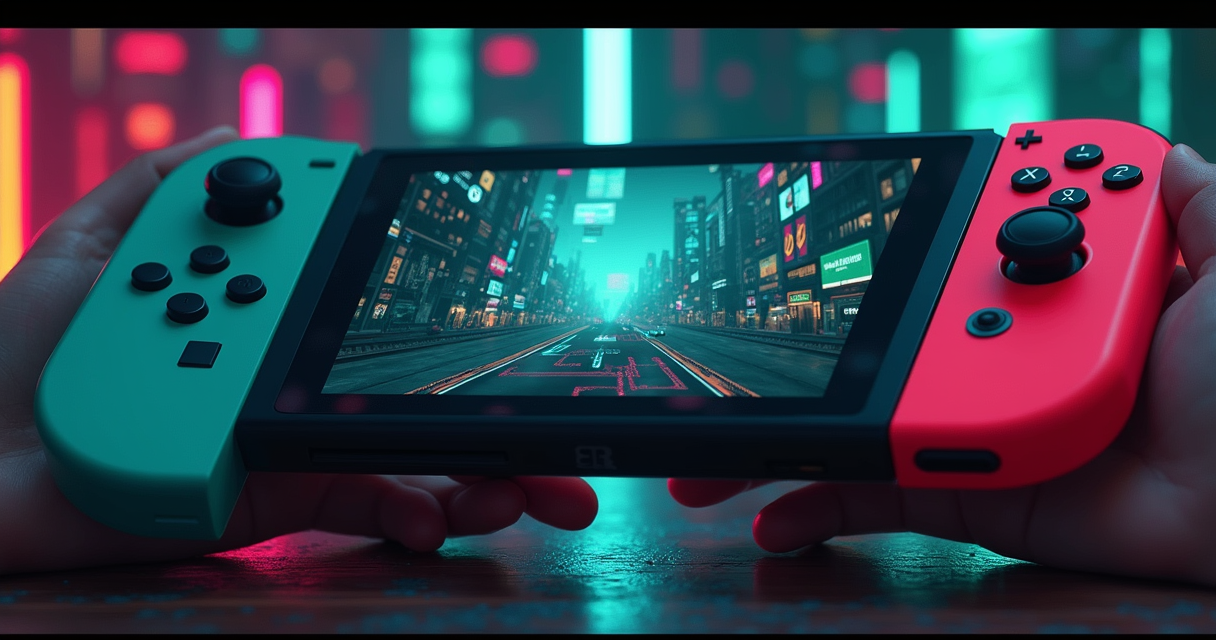
There is a version of this comparison that was true for two and a half years, and it is now wrong. For most of the Steam Deck's life the pitch wrote itself: Valve's handheld was the cheap, open, absurdly flexible one, and whatever Nintendo was selling was the locked-down premium toy you bought for the exclusives and the children. In July 2026 that framing has not merely aged — it has inverted. The Steam Deck OLED starts at $789. The Nintendo Switch 2 costs $449.99. The budget disruptor is now the expensive option by a margin of $339, and almost nobody planned for it, because the cause had nothing to do with either console and everything to do with a memory shortage in someone else's server farm.
This article is the honest, deadpan accounting of what you actually get for that money in the back half of 2026. We will run the spec sheets side by side, we will cite Digital Foundry's power meter instead of a marketing deck, and we will not pretend that a teraflops figure is a personality. The short version is that both machines are better than they have any right to be and the decision between them is now a decision about ecosystems, not dollars. The long version is below.
The 2026 Reset
Before we get into refresh rates, it is worth being precise about what "Switch vs Steam Deck" even means this year, because two of the four devices people picture when they read that phrase are no longer for sale.
What you can actually buy new in 2026
The original Nintendo Switch and Switch OLED still exist on shelves, but they are legacy hardware — Nintendo's forward energy is entirely on the Switch 2, which launched on June 5, 2025. On Valve's side, the entry-level Steam Deck LCD (the $399 model that anchored every "it's cheaper than a Switch" argument for years) was quietly discontinued on December 19, 2025, and by mid-February 2026 the last units had sold through. What remains in production is the Steam Deck OLED. So when a normal person types "switch vs steam deck" into a search bar in 2026, the only two machines they can actually walk out of a store with are the Switch 2 and the Steam Deck OLED. That is the fight we are refereeing.
The old story, and why it's dead
The received wisdom went like this: the Steam Deck is a real computer that happens to be shaped like a controller, it runs anything, it costs less than Nintendo's walled garden, and the only reasons to buy a Switch are Mario and social proof. Every clause of that was defensible in 2024. The pricing clause is now false, and once the pricing clause falls, the entire value argument has to be rebuilt from the studs. A machine being "more open" is a feature; a machine being "more open and $339 more expensive" is a negotiation.
The villain is a data center
Both companies raised prices in 2026 and both blamed the same thing, which is the 2026 equivalent of blaming the weather except the weather is real this time. AI infrastructure buildout has been vacuuming up DRAM, NAND flash, and GPU silicon faster than the foundries can pour it, and gaming hardware makers are near the back of that queue. Nintendo, in its official notice, said its increase was a response to "various changes in market conditions" expected to persist "over the medium to long term." Valve, announcing its hike, pointed to "the current state of component costs and other global logistical challenges across the industry as a whole." Two press releases, one supply chain, zero coincidence. The upshot for you, the buyer, is that neither of these prices is a promotion waiting to lapse — they are the floor for as long as the shortage lasts, and if you want the fuller picture on how Nintendo's own lineup is being repriced around this, our breakdown of the Switch OLED versus Switch 2 pricing tracks every increment.
Specs Head-to-Head
Here is the full sheet. Read it once for the shape of things, then read the notes underneath for where the numbers lie to you — because at least two of them do.
| Spec | Nintendo Switch 2 | Steam Deck OLED |
|---|---|---|
| Release date | June 5, 2025 | November 16, 2023 |
| Current price (Jul 2026) | $449.99 (rises to $499.99 on Sep 1) | $789 (512GB) / $949 (1TB) |
| Screen | 7.9" LCD, 1920×1080, 120Hz, VRR, HDR10 | 7.4" OLED, 1280×800, 90Hz, HDR (1000-nit peak) |
| SoC | Custom Nvidia T239 (Ampere) | AMD APU (Zen 2 + RDNA 2, 6nm) |
| GPU config | 1536 CUDA cores; 561MHz handheld / 1007MHz docked | 8 RDNA 2 CUs; 1.0–1.6GHz |
| GPU throughput | ~1.7 TFLOPS handheld / ~3.07 TFLOPS docked | ~1.6 TFLOPS |
| Memory | 12GB LPDDR5X | 16GB LPDDR5 |
| Storage | 256GB UFS (microSD Express required for games) | 512GB or 1TB NVMe SSD (standard microSD) |
| Weight | 534g (with Joy-Con 2) | 640g |
| Battery | 19.7Wh (5,220mAh), rated 2–6.5h | 50Wh, rated 3–12h |
| Handheld power draw | ~8–10W (DF measured ~7W in Hogwarts) | ~14–15W typical, ~24W peak |
| Wireless | Wi-Fi 6 | Wi-Fi 6E |
| Upscaling | Nvidia DLSS | AMD FSR |
| Operating system | Nintendo proprietary OS | SteamOS 3 (Arch Linux, KDE desktop mode) |
| Docked output | Up to 4K60 via included dock (active-cooled) | Up to 4K/8K via USB-C or dock (sold separately) |
| Library model | 90%+ of Switch catalog + Switch 2 titles | 90,000+ Steam titles + broader PC catalog via Proton |
Where the silicon actually differs
The two chips are not the same kind of animal. The Switch 2 runs a custom Nvidia T239 built on the Ampere architecture — the same lineage as the RTX 30-series desktop cards — which is why it gets DLSS and hardware ray tracing that the Deck's older AMD part simply does not have. The Steam Deck OLED runs a semi-custom AMD APU pairing four Zen 2 CPU cores with eight RDNA 2 compute units. RDNA 2 is a fine, proven architecture; it is also the architecture inside a PlayStation 5, scaled down to fit a battery. The practical consequence is that the Deck behaves like a small gaming PC and the Switch 2 behaves like a console that borrowed a laptop GPU's best trick.
Reading the teraflops honestly
The spec sheet says 3.07 TFLOPS docked for the Switch 2 versus 1.6 for the Deck, and a lazy reading turns that into "the Switch 2 is nearly twice as fast." It is not that simple, for three reasons. First, that 3.07 figure is the docked number; in handheld mode the Switch 2's GPU clock drops to 561MHz and its throughput falls to roughly 1.7 TFLOPS, which is a hair above the Deck rather than double it. Second, you cannot compare teraflops across architectures — an Ampere FLOP and an RDNA 2 FLOP do not do identical work, so the ratio is directional, not literal. Third, and most important, the Deck is running native, uncompromised PC builds while the Switch 2 runs console-optimized ports; the Deck is doing harder work to hit a given frame. Teraflops is a spec-sheet number that means precisely as much as you let it.
The two spec-sheet lies
Two rows in that table are commonly reported wrong, and the brief that prompted this article got both. The first is the Deck's weight: the OLED is 640g, not 669g — the 669g figure belongs to the discontinued LCD model, and 29 grams is genuinely noticeable across a two-hour session. The second is wireless: the Steam Deck OLED uses Wi-Fi 6E, which adds the less-congested 6GHz band, while the Switch 2 tops out at Wi-Fi 6. So the frequently repeated claim that "the Switch 2 has better wireless" is backwards; on paper the Deck's radio is the newer standard. Neither of these changes the verdict, but a comparison that gets the easy specs wrong has no business being trusted on the hard ones.
Price & Availability
This is the section that changed everything, so we are going to be exact about it rather than gesture at "around five hundred dollars."
| Model | Launch price | Price (July 2026) | Status |
|---|---|---|---|
| Nintendo Switch 2 | $449.99 (Jun 5, 2025) | $449.99 → $499.99 on Sep 1, 2026 | In production |
| Switch 2 Mario Kart World bundle | $499.99 | $499.99 | In production |
| Steam Deck LCD 256GB | $399 | — | Discontinued Dec 19, 2025 |
| Steam Deck OLED 512GB | $549 (Nov 16, 2023) | $789 (hiked May 27, 2026) | In production |
| Steam Deck OLED 1TB | $649 | $949 | In production |
The $339 inversion, spelled out
Today, a new Switch 2 is $449.99 and the cheapest new Steam Deck is the 512GB OLED at $789. That is a $339 gap in Nintendo's favor, and it is the single most important fact in this comparison. Valve's increase, reported by Tom's Hardware on May 27, 2026, was brutal in percentage terms — 43% on the 512GB model and 46% on the 1TB — and it was not confined to America. In Europe the OLED moved to €779 and €919; in the UK to £649 and £849; in Canada to CAD $1,129 and $1,349; in Australia to AUD $1,199 and $1,499. A machine that once undercut a Switch now costs as much as a mid-range gaming laptop's worth of down payment.
The Switch 2's own hike, and the deadline it creates
Nintendo is not innocent here — it is just slower. The Switch 2 launched at $449.99 and, per Nintendo's official price-revision notice, moves to $499.99 on September 1, 2026 in the United States, with matching increases in Canada (CAD $679.99), Europe (€499.99), and Japan (which jumped earlier, on May 25, from ¥49,980 to ¥59,980). The driver is DRAM: the same AI-fueled memory crunch that hit Valve, arriving at Nintendo's door a quarter later. The practical takeaway is a hard calendar deadline. If you want a Switch 2, buying before September 1 saves you exactly $50, and there is no scenario in which waiting makes it cheaper. Even after the hike the Switch 2 at $499.99 undercuts the Deck OLED by $289.
Why the $399 escape hatch is gone
For years the counterargument to all of this was "just buy the LCD Deck for $399." That door is shut. Valve discontinued the 256GB LCD on December 19, 2025, redirecting its scarce NAND allocation toward the 512GB and 1TB SKUs and the upcoming Steam Machine, and by February 2026 remaining stock had evaporated. There is no longer a sub-$400 new Steam Deck. The cheapest way into SteamOS is now $789, and that reality reframes the Deck from "the affordable handheld" to "the premium PC handheld," a bracket where it competes less with the Switch 2 and more with the Windows machines we covered in our ROG Ally X versus Steam Deck OLED comparison.
Performance: DLSS vs FSR
Now for the part where the Switch 2 earns back some of the respect it loses for being a closed box. Nintendo's machine is, in several measurable ways, the more sophisticated performer — and the reason is spelled D-L-S-S.
| Test (source: Digital Foundry unless noted) | Switch 2 | Steam Deck OLED |
|---|---|---|
| Hogwarts Legacy — power draw | ~7W | ~14W |
| Hogwarts Legacy — battery runtime | 2h 45m | ~4h |
| Stardew Valley — battery runtime | ~4h | ~7h |
| Cyberpunk 2077 — reconstruction | DLSS ~540p → 1080p (cleaner) | FSR ~480p → 720p |
| Docked GPU throughput | ~3.07 TFLOPS | ~1.6 TFLOPS |
| Handheld GPU throughput | ~1.7 TFLOPS | ~1.6 TFLOPS |
Docked: where the Switch 2 pulls ahead
Plug the Switch 2 into its active-cooled dock and it unlocks that 1007MHz clock, targets a full 1080p, and leans on DLSS to reconstruct a sharp image from a lower internal resolution. Digital Foundry's head-to-head found that in demanding third-party games the Switch 2 "edges out" the Deck precisely because DLSS produces a cleaner reconstructed frame than AMD's FSR manages — in Cyberpunk 2077, the Switch 2 upscales from roughly 540p to a stable 1080p while the Deck leans on FSR from a lower base and shows more shimmer in motion. DF's blunt summary of the Hogwarts Legacy comparison was that the "Switch 2 ran Hogwarts Legacy better overall, keeping it locked to a mostly stable 30fps." TechRadar went further in a separate piece, running the headline "Cyberpunk 2077 on Nintendo Switch 2 proves that I don't need a Steam Deck anymore" — hyperbole, but the DLSS-shaped kernel of truth inside it is real.
Handheld: a closer race than the docked numbers suggest
Undocked, the picture tightens. The Switch 2's GPU throttles to ~1.7 TFLOPS, within spitting distance of the Deck's 1.6, and at that point the contest is decided by software rather than silicon. Where a game has a hand-tuned Switch 2 port with DLSS, Nintendo's machine looks sharper at lower power. Where a game only exists as a generic PC build, the Deck's RDNA 2 grinds through it natively — no port required, no publisher permission needed. This is the crux: the Switch 2 is faster at the games it has, and the Deck is more capable across the games that exist. Those are different kinds of winning.
The raw-horsepower caveat nobody markets
The Deck's trump card is not frames per second, it is scope. It runs the actual PC version of a game, which means mods, ultrawide hacks, community patches, decades of back catalog, and storefronts Nintendo will never allow. Digital Foundry and most reviewers converged on the same split verdict — the Switch 2 is the better buy for most people thanks to its docked performance and efficiency, while the Deck OLED remains the better portable for PC gamers who want flexibility. For readers weighing the broader platform question rather than these two boxes specifically, our PC versus console analysis for 2026 lays out why the open ecosystem keeps winning share even when a specific console wins a specific benchmark.
Battery & Thermals
If performance is the Switch 2's round, endurance is Valve's — and the reason is a lovely little physics lesson in why watts and watt-hours are not the same argument.
The runtime numbers
Digital Foundry's battery testing is the cleanest public data set here, and it tells a consistent story. In Stardew Valley, a game that asks almost nothing of either machine, the Steam Deck OLED ran for about seven hours against the Switch 2's four. In Hogwarts Legacy, one of the heaviest workloads either can attempt, the Deck lasted roughly four hours to the Switch 2's two hours and forty-five minutes. Across a spread of titles the pattern holds: the Deck wins on longevity, usually by a comfortable margin, and it wins by more in light games than in heavy ones. Nintendo's own rating of "2 to 6.5 hours" and Valve's "3 to 12 hours" bracket those measured results honestly for once.
How the Deck lasts longer while drawing more
Here is the counterintuitive part. In Hogwarts Legacy the Switch 2 sips about 7W while the Deck gulps around 14W — the Switch 2 is twice as efficient at the wall. And yet the Deck lasts longer. The explanation is the battery: the Deck carries a 50Wh cell against the Switch 2's 19.7Wh, roughly two and a half times the energy reservoir. Valve chose to spend that capacity on a thirstier, more powerful machine and still came out ahead on runtime, while Nintendo chose a smaller, lighter battery and banked the difference as efficiency and portability. If you have ever wondered why the featherweight Switch 2 (534g versus 640g) needs charging sooner, that is the trade: 106 grams of missing mass is, in large part, missing battery.
Heat, fans, and noise
Both machines are actively cooled and both stay civil. The Deck's fan is audible under load but low and broadband rather than whiny, and the OLED revision improved the acoustic profile over the original LCD unit. The Switch 2 runs cooler in the hand thanks to that lower power draw, and its dock adds a fan specifically so the docked 1007MHz clock can be sustained without throttling — a genuinely thoughtful piece of engineering that the original Switch's passive dock never had. Neither will roast your palms. If you want the deeper handheld-thermals rabbit hole, including how the Deck OLED behaves against Windows rivals at matched wattage, that same 15W handheld shootout has the dBA figures.
The Screen War
This is the closest fight on the entire sheet, because Nintendo and Valve optimized for opposite virtues and both were right.
Switch 2: bigger, sharper, faster
The Switch 2 fields a 7.9-inch LCD at 1920×1080 with a 120Hz refresh rate, variable refresh, and HDR10. On the numbers it wins three of four display categories outright: it is larger, it is more than twice the pixel count of the Deck, and it doubles-plus the refresh ceiling. For fast games — Mario Kart World, anything competitive — 1080p120 on a nearly eight-inch panel is genuinely lovely, and the extra sharpness flatters the DLSS output that feeds it. The catch is the panel technology. It is LCD, which means blacks are gray and contrast is ordinary, and Digital Foundry did not soften the point, noting the screen is "problematic in a number of ways" — the HDR implementation and VRR behavior in particular drew criticism. It is a big, crisp, fast, mediocre-contrast display.
Steam Deck OLED: smaller, dimmer resolution, gorgeous
Valve went the other way. The Deck's 7.4-inch OLED is lower resolution at 1280×800 and slower at 90Hz, but it is an OLED, with per-pixel black, HDR that actually means something, and a peak brightness around 1000 nits. In a dark room playing a moody game, the Deck's screen is the more beautiful object by a wide margin — the infinite contrast does more for perceived image quality than the Switch 2's extra pixels do. This is the eternal LCD-versus-OLED argument compressed into two handhelds: resolution and refresh on one side, contrast and color on the other.
Which screen actually wins
It depends entirely on what you play and where. For twitch games in a bright room, the Switch 2's 1080p120 LCD is the better tool — more real estate, more pixels, more motion clarity, and brightness to fight glare. For atmospheric single-player games in controlled light, the Deck's OLED is the more cinematic surface despite giving up sharpness and speed. There is no universal winner here, only a preference, and anyone who tells you otherwise is selling one of the two. If forced to pick a default, the Switch 2's panel is the more versatile screen and the Deck's is the more gorgeous one.
Software & Ecosystems
Everything above is a warm-up. This is the section that should actually decide your purchase, because the hardware gap is small and the software gap is a canyon.
The Switch 2's first-party moat
Nintendo's argument has never been horsepower; it has been that Mario, Zelda, Pokémon, Metroid, Kirby, and Mario Kart exist nowhere else and never will. The Switch 2 launched into that moat and has been draining stores dry ever since — 19.86 million units sold by March 31, 2026, with Mario Kart World alone moving 14.70 million copies and Donkey Kong Bananza 4.52 million. In the January–March 2026 quarter Nintendo outsold the PlayStation 5 by roughly a million units, though it is worth keeping the lifetime scoreboard honest: the PS5 sits near 93.6 million all-time to the Switch 2's not-yet-20 million. The Switch 2 also runs 90%-plus of the existing Switch library — a hybrid backward-compatibility layer, not pure emulation, so the "100% compatible" claim you will see is an exaggeration. And the pipeline keeps refilling; our running coverage of the September 2026 Nintendo Direct is a decent barometer of how relentlessly that exclusive tap flows.
The Steam Deck's open universe
The Deck's counter is quantity and freedom. It offers more than 90,000 Steam titles, and because SteamOS is Arch Linux under a controller-friendly shell, the real ceiling is higher still — via the Proton compatibility layer it runs a large fraction of the entire Windows PC catalog, and with a little effort it reaches GOG, the Epic Games Store, itch.io, and emulation. Drop into desktop mode and it is a full KDE Linux PC: a browser, a file manager, mod managers, the works. For the emulation-curious, it is close to the ideal device, and pairing it with a tuned setup like the one in our RetroArch cores install-and-tune guide turns it into a portable museum of everything that ever shipped on a cartridge. Engadget, naming it among the best handhelds of 2026, still called the Deck "the best balance of price, performance and usability" — while conceding in the same breath that it "shows its age in 2026," with the heaviest recent releases running poorly.
The DRM and compatibility divide
The wall between them is real and runs both directions. The Steam Deck cannot legally play a single Nintendo game — no Mario, no Zelda, no Pokémon, full stop. The Switch 2, in turn, cannot touch the DRM-restricted and Linux-hostile PC titles that make up chunks of the Steam library; some anti-cheat systems and some publisher DRM schemes will never run on either SteamOS or Nintendo's OS, which means a handful of live-service games are off-limits even to the Deck. In practice the Deck plays vastly more of what exists, and the Switch 2 plays the specific things a lot of people actually want. Breadth versus exclusivity, and your library decides.
Five Buyers, Five Verdicts
Specs are abstract; people are not. Here are the buyers who walk into this decision and the machine each of them should walk out with. Find yourself.
Buy the Switch 2
The family / couch co-op household. You want to hand a Joy-Con to a kid or a partner, play Mario Kart World split-screen, and never think about a Proton compatibility rating. The Switch 2's instant docking, detachable controllers, and local multiplayer make it the least-friction shared machine on Earth. It is $339 cheaper and your seven-year-old cannot break SteamOS because there is no SteamOS. Buy the Switch 2.
The commuter who wants to press one button. You have twenty-five minutes on a train and zero patience for update queues, shader compilation, or a desktop mode. The Switch 2 sleeps and wakes instantly, weighs 106 grams less, and its games are tuned to run right the first time. Buy the Switch 2.
The Nintendo lifer. If your most-anticipated games have a plumber or a Hylian on the box, this is not a decision, it is a formality. Those games exist on exactly one of these two devices. Buy the Switch 2 — and if you already own a launch Switch, our Switch OLED versus Switch 2 upgrade math will tell you whether the jump is worth it.
Buy the Steam Deck OLED
The existing Steam library owner. You have 300 games in your Steam account and a decade of sales-bin guilt. The Deck turns that sunk cost into a portable console for the price of the hardware and nothing more — no re-buying, no ports, no permission. At $789 it is expensive, but it is expensive once and then your entire backlog is free. Buy the Deck.
The tinkerer / emulation obsessive. You want desktop mode, sideloaded stores, decades of retro libraries, ROM hacks, and a Linux terminal you can actually use. The Switch 2 will actively fight you on all of it; the Deck hands you the keys. This is the single strongest case for paying the premium. Buy the Deck.
The buyer who should wait — or buy neither
The genuinely budget-constrained. Here is the uncomfortable truth the 2026 pricing forces: if $450 is already a stretch, $789 is out of the question, and the $399 escape hatch is gone. The honest advice for a tight budget is to buy the Switch 2 before its September 1 hike, or step down to a cheaper handheld class entirely — a device from the handheld PC field on sale, or a dedicated retro unit. Do not stretch to a $789 Deck because a 2024 article told you it was the budget option. That article is out of date, and so is that price.
If you would rather have a machine make the call, here is the decision tree in the least ambiguous form there is:
function pickHandheld(you) {
  if (you.wants.nintendoExclusives) return "Switch 2";
  if (you.ownsBigSteamLibrary || you.loves.emulation) return "Steam Deck OLED";
  if (you.plays.mostlyCouchCoOp) return "Switch 2";
  if (you.budget < 500) {
    return Date.now() < "2026-09-01"
      ? "Switch 2 (buy before the hike)"
      : "Switch 2, or a discounted alternative";
  }
  if (you.needs.desktopMode || you.needs.moddingAndProton)
    return "Steam Deck OLED";
  // default: cheaper, simpler, sells the most units for a reason
  return "Switch 2";
}
Migration Guide
Say you already own one and are eyeing the other. What actually transfers, what you gain, and what you leave behind? Here is the pragmatic version, because "just switch" is not a plan.
Coming from a Switch / Switch 2 to a Steam Deck
The hard truth first: none of your Nintendo games come with you. There is no license transfer, no cross-buy, no emulation of your legally owned Switch cartridges that Nintendo will bless. Migrating to the Deck means rebuilding a library from the PC ecosystem, and the good news is that the PC ecosystem is where games go to be cheap forever. Budget for the storefront learning curve: you will meet Steam sales, ProtonDB compatibility ratings, and the concept of "Verified" versus "Playable." You gain desktop mode, mods, and 90,000-plus titles; you lose instant simplicity and every first-party Nintendo game you cared about. Go in with eyes open.
Coming from a Steam Deck to a Switch 2
This direction is emotionally easier and technically simpler. You are trading breadth for polish. Your Steam library does not vanish — it stays on your account for whenever you next sit at a PC — but it does not run on the Switch 2, so you are effectively starting a second, parallel collection of Nintendo-flavored software. What you gain is the DLSS image quality, the 1080p120 screen, the featherweight body, and a machine that never asks you to open a terminal. What you lose is control: no sideloading, no mods, no desktop, no bargain-bin PC catalog. Many people run both for exactly this reason, and that is a legitimate answer rather than a cop-out.
The realistic move: own both, prioritize by use
If your budget can stretch, the least-regret configuration in 2026 is a Switch 2 for the exclusives and shared play plus a Steam Deck for the PC backlog and tinkering — they overlap far less than their form factors suggest. If you can only own one, use this checklist to force the decision instead of agonizing:
# DECIDE IN FOUR QUESTIONS
[ ] Do my must-play games only exist on Nintendo?      -> Switch 2
[ ] Do I already own a large Steam / PC library?        -> Steam Deck OLED
[ ] Do I want to mod, emulate, or use a desktop OS?      -> Steam Deck OLED
[ ] Do I want the cheapest, simplest, lightest option?   -> Switch 2

# TIE-BREAKER
# 3+ boxes lean one way -> buy that one.
# Split evenly -> buy the Switch 2; it is $339 cheaper today
# and $289 cheaper even after its Sep 1 hike.
Pros & Cons
The scannable ledger. Nothing here is a surprise if you read the sections above, but decisions crystallize in tables.
Nintendo Switch 2
| Pros | Cons |
|---|---|
| $339 cheaper than the Deck OLED ($449.99 vs $789) | Price rises to $499.99 on Sep 1, 2026 |
| DLSS produces sharper reconstruction than FSR | Closed OS: no sideloading, mods, or desktop mode |
| Bigger, sharper, faster screen (7.9" 1080p 120Hz) | LCD panel — mediocre contrast, flawed HDR/VRR per DF |
| Twice as power-efficient (~7W vs ~14W in Hogwarts) | Smaller 19.7Wh battery; shorter runtime overall |
| Lighter (534g) and instant sleep/wake | Cannot run any PC/DRM/Linux game |
| Exclusive Mario, Zelda, Pokémon; 19.86M sold | Games require pricier microSD Express cards |
Steam Deck OLED
| Pros | Cons |
|---|---|
| 90,000+ Steam titles + broad PC catalog via Proton | $789 / $949 — now the premium option, not the budget one |
| Gorgeous 7.4" OLED, true blacks, 1000-nit HDR | Lower resolution (800p) and refresh (90Hz) than Switch 2 |
| Longer battery life (50Wh; ~7h Stardew, ~4h Hogwarts) | Heavier (640g) and thirstier (~14–15W, ~24W peak) |
| Full Linux desktop, mods, emulation, sideloading | No Nintendo games, ever; some anti-cheat titles blocked |
| Wi-Fi 6E and 16GB RAM | "Shows its age" on the heaviest 2025–26 releases (Engadget) |
| Owns your existing Steam library at no extra cost | $399 LCD entry point discontinued — no cheap way in |
The dealbreakers, distilled
Two lines settle most arguments. If you need a specific Nintendo game, nothing about the Deck matters — buy the Switch 2. If you need desktop-grade freedom or already own a mountain of PC games, nothing about the Switch 2's efficiency matters — pay the $789 and buy the Deck. Everything else is preference dressed up as analysis.
The Verdict
We started with a price inversion, and we end with the recommendation that inversion forces.
For most people: the Switch 2
For the ordinary buyer — the one who wants a great handheld, plays a mix of things, and does not dream in Linux — the Switch 2 is the machine to buy in 2026, and it is not especially close anymore. It is $339 cheaper today, it has the sharper and faster screen, it sips power, it weighs less, its DLSS-fed image quality outclasses the Deck's FSR in the games both can run, and it has the deepest exclusive library in the medium. Digital Foundry and the broad reviewer consensus landed exactly here: the Switch 2 is the better buy for most users on the strength of its docked performance and efficiency. IGN's 7.0 review called it "bigger and better in every sense" even while grumbling that it felt "about as exciting as a long-overdue phone upgrade," and The Verge noted it "doesn't feel like the kind of generational leap" its predecessor was. Both critiques are fair. Both also describe a machine that is simply easy to recommend at $449.99.
For PC gamers and tinkerers: the Steam Deck OLED
The Deck is not beaten — it is repriced. It remains the best pure PC handheld you can hold, the one Engadget still crowns for "the best balance of price, performance and usability," the one that turns a Steam backlog into a portable console and a lazy afternoon into a Linux project. If you value freedom over polish, if your library already lives on Steam, if you want to emulate and mod and sideload, the $789 is not a rip-off — it is the cost of the most flexible gaming device on the market. TechRadar's reviewer, a self-described Deck fanatic, admitted the Switch 2 is "still the king of easy, fun gaming" while also confessing they reach for the Steam Deck "nine times out of ten." Both of those things are true at once, and which one is true for you is the whole ballgame.
The data-backed bottom line
PC Gamer titled its own comparison "a closer battle than I expected," and after all the tables that is the honest verdict: the hardware is close, the software is a canyon, and the price is the tiebreaker Nintendo did not expect to win. In 2026 the Switch 2 is the default and the Deck OLED is the specialist. Buy the Switch 2 unless you can name the specific PC-only capability you need — and if you buy it, buy it before September 1, because $50 is $50 and the memory shortage is not sending anyone a refund. The budget disruptor grew up, moved uptown, and left the value crown sitting on a Nintendo shelf. Nobody scripted that. It happened anyway.
Questions the search bar asks me
- Is the Steam Deck really more expensive than the Switch 2 now?
- Yes, and by a lot. After Valve's May 27, 2026 hike the Steam Deck OLED starts at $789 (512GB) and runs $949 (1TB), while the Switch 2 is $449.99 — a $339 gap in Nintendo's favor. The $399 LCD Deck that used to undercut Nintendo was discontinued on December 19, 2025 and sold out by February 2026.
- Which handheld has better battery life, the Switch 2 or Steam Deck OLED?
- The Steam Deck OLED, thanks to its 50Wh battery versus the Switch 2's 19.7Wh. Digital Foundry measured ~7 hours vs ~4 hours in Stardew Valley and ~4 hours vs 2h45m in Hogwarts Legacy. The Switch 2 is twice as power-efficient (~7W vs ~14W) but simply carries far less energy.
- Does the Switch 2 actually outperform the Steam Deck?
- Docked, yes — roughly 3.07 TFLOPS vs 1.6, and DLSS reconstructs a cleaner image than the Deck's FSR (visible in Cyberpunk 2077). Handheld it is nearly a tie at ~1.7 TFLOPS. But the Deck runs native PC builds the Switch 2 can't, so the raw teraflops gap overstates real-world performance.
- Can the Steam Deck play Nintendo games like Mario or Zelda?
- No. There is no legal or official way to run Nintendo titles on the Steam Deck — no Mario, Zelda, or Pokémon. The Deck instead offers 90,000+ Steam titles plus much of the broader PC catalog via Proton, while the Switch 2 can't run PC/DRM/Linux games. It's a clean, permanent software divide.
- Should I wait to buy, or buy now?
- Buy the Switch 2 before September 1, 2026 — Nintendo raises its US price from $449.99 to $499.99 on that date, so waiting costs you $50. Steam Deck prices are unlikely to fall while the AI-driven memory and NAND shortage persists; both 2026 hikes are supply-driven, not seasonal sales dips.
Jordan covers the modern industry where it touches the old one: Nintendo announcements, handheld hardware, and the long shadow the classics cast over new releases. Every post under this byline is reviewed pre-publish by Sam P., Editor & Operator — corrections to info@instalinkoteam.com. Published 2026-08-29 · Last updated 2026-08-29. Full bios on the author page.