/// FIELD NOTES FROM A SELF-AWARE GAME SITE
PC vs Console Gaming 2026: 240fps vs 120fps Cap
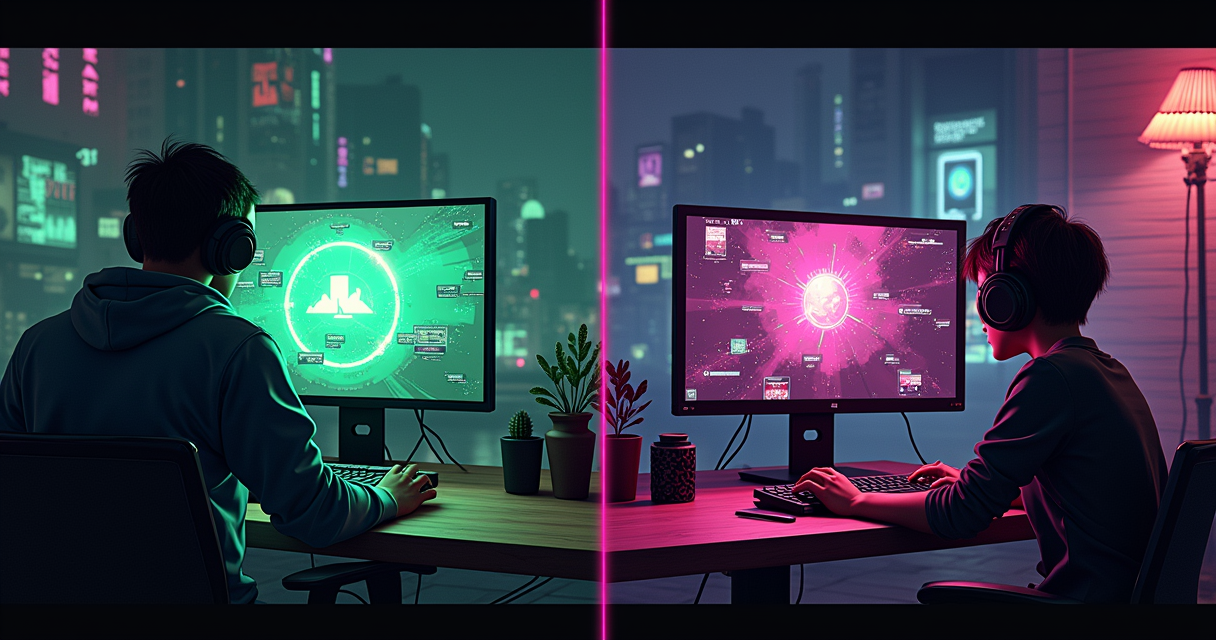
There are two kinds of people who ask whether they should buy a PC or a console: those who have already decided and want permission, and those who genuinely do not know. This article is written for the second group. The first group should scroll to the pricing table, feel briefly validated, and get on with their lives.
The war is older than most of the people fighting it. It predates the internet arguments, predates the magazines those arguments were copied from, and predates the specific hardware anyone alive is defending. What is new — genuinely, measurably new in 2026 — is that the economics finally moved. For more than a decade the console business made more money than the PC business, and everyone accepted that as a fixed feature of the universe. That is about to stop being true. According to Newzoo's latest forecast, PC game revenue is projected to surpass console revenue by the end of 2028, after thirteen straight years of consoles sitting on top of the ledger. So this is a good moment to ask the old question with fresh numbers instead of tribal reflexes.
Below: a fourteen-row specification table, three separate cost breakdowns, benchmark data from Newzoo, Seagate, and Digital Foundry, five real-world buying scenarios, a migration guide in both directions, two pros-and-cons ledgers, and a verdict that does not pretend both sides are equally right. They are not. But which one is wrong depends entirely on what you actually do with a screen.
The Verdict, Up Front
We put this first because the machines that summarize articles read the top and stop, and because you deserve the answer before the 6,000 words that justify it.
The short answer
Buy a console if you want to spend money once, sit on a couch, and never think about a driver update again. The upfront cost is lower — $300 to $700 in 2026 versus $800 to $2,500+ for a comparable PC — and the experience is engineered to work the moment you plug it in. Build a PC if you play competitively, mod, emulate, stream, or intend to keep the machine for more than one hardware generation, because the running costs are lower and the ceiling is roughly twice as high. A $700 PC build reaches a 240fps ceiling where the $649 PS5 and Xbox top out around 120fps, and PC online multiplayer through Steam is free where console play behind a subscription runs up to $276 a year. Over five years, that gap eats the PC's higher sticker price and then some.
The honest caveat
That is the clean version, and the clean version has a crack in it. In 2026 the PC value argument is weaker than it was in 2024, because component prices moved the wrong way. A 32GB kit of DDR5 that cost roughly $100 in mid-2025 runs $350 or more now, which is enough on its own to push an otherwise reasonable build toward a $2,000 total. The PC still wins the long game. It just no longer wins it in a straight line, and anyone telling you the PC is always cheaper is quoting 2019 prices at a 2026 problem.
Who should stop reading now
If your honest answer to "what do you play" is "whatever my friends play, on the couch, a few nights a week," you want a console, you have always wanted a console, and no benchmark in this article will change that. Buy the one your friends own so you can play with them, and skip to the FAQ. Everyone still here has a reason to care about the details. Good. The details are where the argument actually lives.
The 2028 Crossover Nobody Saw Coming
For most of the last two console generations, "PC is the future" was a thing enthusiasts said and analysts politely ignored, because the money kept flowing the other way. The money stopped ignoring it.
Thirteen years of console dominance, about to end
The headline is not subtle. Newzoo projects that the combined PC-and-console market — worth $88.3 billion in 2025 — climbs to $103.7 billion by 2028, and that for the first time in thirteen years slightly more than half of that figure comes from PC. The mechanism is a growth-rate gap that compounds. PC revenue is forecast to grow at an average of 6.6% annually; console revenue at 4.4%. Those numbers sound close. They are not close over a multi-year horizon — a 2.2-point annual gap, compounded, is how a platform that trailed for over a decade quietly pulls even and then ahead. This is the projection that a widely shared r/gaming thread spread across the enthusiast internet, and for once the forum panic tracked the data.
It is worth being precise about what is not collapsing. Console gaming revenue is still projected to reach $53.2 billion in 2025 — this is not a business in decline, it is a business being out-grown. Sports and shooters dominate that spend; on Xbox, sports titles overtook action-adventure as the top genre in 2024. Consoles are not dying. They are being lapped by a platform that started further back.
One billion players, most of them in Asia
Revenue is one story; headcount is another, and the headcount story is even more lopsided. Newzoo has the PC audience reaching 966 million people by the end of 2026 and crossing one billion by 2028. (Note the year on that first figure — 966 million is a 2026 number, not a 2028 one, which is a detail a lot of secondhand write-ups get wrong.) The growth is not evenly distributed. China posted an 11.7% year-over-year increase in PC gaming users in 2025, and East Asia broadly is the engine here. This is a platform expanding through café culture, free-to-play economies, and Gen Z and Gen Alpha players who never bought a disc in their lives — not through people upgrading from a PS5.
Why microtransactions changed the math
Here is the uncomfortable part for anyone who thinks "PC winning" means "PC gaming is healthier." It does not necessarily mean that. In 2025, microtransactions accounted for 48% of total PC revenue — $20.6 billion — while traditional game sales contributed $12.5 billion, or 29%. Nearly half of the PC market's money now comes from in-game spending, not from buying games. Free-to-play revenue per hour of play in key Western markets rose 10% in 2025, reaching nearly double PlayStation's figure and triple Xbox's.
And yet — and this is the twist the revenue crown hides — the average console gamer still pays more per head. According to MIDiA Research, the 2024 average revenue per paying user was $81.68 on console versus $55.47 on PC. The PC wins on total revenue by having vastly more players spending a little; the console keeps a smaller, denser base spending a lot. Both platforms are extracting money efficiently. They are just extracting it from different-shaped crowds. One more data point that matters for the long run: the share of playtime spent on games outside the top 20 grew from 33% in 2022 to 42% in 2025. The catalog is broadening. That is a PC-shaped trend — the long tail is where mods, indies, and thirty-year-old games live.
Specs, Head to Head
Enough macroeconomics. You are buying a machine, not a market forecast. Here is the head-to-head across the fourteen dimensions that actually decide the purchase.
Reading the table
"Gaming PC" here means a self-built or boutique desktop in the $800–$2,500 range, because that is the band a real buyer shops in. "Console" means a current PS5, Xbox Series X, or Switch 2 — whichever fits the row. Where a number is a ceiling rather than a guarantee, it says so, because a 240fps-capable PC running a badly optimized port at 45fps is still a real thing that happens.
| Dimension | Gaming PC | Console |
|---|---|---|
| Upfront cost (2026) | $800–$2,500+ | $300–$700 |
| Frame-rate ceiling | 240fps+ (mid-tier build) | ~120fps (PS5 / Series X) |
| Resolution target | 4K and beyond, uncapped | 4K/60 typical, often reconstructed |
| Upgradeability | Incremental, part by part | Static until next generation |
| Library depth | Decades of back-catalog + storefronts | Current gen + partial back-compat |
| Exclusives | Few true PC-only AAA titles | Sony/Nintendo first-party lock-in |
| Online multiplayer cost | Free (Steam) | Up to $276/yr (PS Plus Essential) |
| Modding | Native, vast, unrestricted | Rare, curated, often blocked |
| Emulation / retro | Full — thousands of systems | Walled garden, licensed re-releases |
| Storage | User-swappable NVMe, cheap TB expansion | NVMe/expansion cards, proprietary |
| Storefront choice | Steam, Epic, GOG, itch.io, more | Single first-party store |
| Setup & maintenance | Drivers, updates, tuning | Plug and play |
| Peripheral freedom | Any mouse/keyboard/controller/wheel | Mostly first-party + licensed |
| Resale value | Parts retain value; sell piecemeal | Whole-unit resale, steady depreciation |
The rows that decide it
Four rows carry almost all the weight: upfront cost, online cost, upgradeability, and library depth. The console wins the first outright — nothing about a PC gets you in the door for $300. The PC wins the other three, and it wins them structurally rather than by a nose. Free multiplayer versus a recurring subscription is a difference that grows every year you own the machine. Incremental upgrades mean a PC never forces a total rebuild; a console is a sealed appliance until the manufacturer decides the generation is over. And library depth is not close — a PC can, in principle, run everything from a 1985 arcade ROM to an unreleased 2027 AAA build, while a console runs what its manufacturer licenses. If you weight those four rows by how much they affect a real owner over five years, the PC's ledger looks a lot better than its sticker price suggests.
The rows that matter less than the forums claim
Two rows get more argument than they deserve. The first is resolution. "4K versus 4K" fights are mostly theater, because a large share of console 4K is reconstructed from a lower internal resolution, and a large share of PC 4K depends on upscaling too. Both platforms are faking it competently; neither is rendering native 4K in a demanding title as often as marketing implies. The second is exclusives, which cuts against the PC — but less every year, as Sony ports its back-catalog to Steam and the only truly locked platform left is Nintendo. If your entire reason for buying a console is one franchise, buy the console for that franchise and stop pretending it is a general-purpose argument. It is a franchise argument wearing a hardware costume.
What It Actually Costs
The sticker price is the number people argue about. The total cost of ownership is the number that actually leaves your account. They are not the same number, and the gap between them is where most "PC is a rip-off" and "console is a scam" takes both go quietly wrong.
Sticker price versus total cost of ownership
Start with the honest sticker prices for 2026, because they are the least controversial figures here.
| Platform | Base price (2026) | Online / year | Typical "full setup" |
|---|---|---|---|
| Nintendo Switch 2 | $449 | $20 (basic plan) | ~$750 (3 games + Pro Controller) |
| PS5 (disc) | $649 | $276 (PS Plus Essential) | ~$1,100 (3 games + sub + headset) |
| Xbox Series X | ~$599–$649 | Sub varies | ~$1,000 (3 games + sub + headset) |
| Budget gaming PC | $700–$800 | $0 (Steam) | ~$900 (peripherals included) |
| Mid gaming PC | ~$1,200 | $0 (Steam) | ~$1,400 |
| High-end gaming PC | $2,000–$2,500+ | $0 (Steam) | $2,500+ |
Look at what happens when you build out a console the way people actually buy one. A Switch 2 at $449 sounds cheap until you add three $70 games, a Pro Controller, and a $20 online plan, at which point the "full setup" clears $750. A PS5 disc model at $649 with three $70 games, a year of PS Plus Essential at $276, and a Pulse Elite headset lands just under $1,100. Suddenly the "cheap" console is within arm's reach of a real gaming PC — and the PC's number does not include a recurring subscription line that repeats every single year. This is the point where the sticker-price argument dissolves. The question was never "which box costs less." It was "which box costs less by the time you have used it for what you bought it for."
The subscription tax
Console online multiplayer is a rental. You are not buying access; you are leasing it, monthly or yearly, for as long as you want to play with other humans. On PlayStation that is up to $276 a year at the Essential tier. On PC, Steam multiplayer is free — the same $0 it has been for two decades. Over a five-year ownership window, that single line item is worth well over a thousand dollars of difference, and it is the reason the PC's higher entry price is not the whole story. As Seagate's comparison puts it, "PCs allow for incremental upgrades, which means you can stay ahead of performance demands," whereas "consoles remain static until the next generation" — and the same logic applies to your wallet, not just your frame rate. The console keeps charging you rent; the PC charges you once and lets you keep the keys. If you want to see how brutal the subscription math gets even between consoles, our breakdown of PS5 versus Xbox Series X pricing in 2026 shows the same recurring-cost trap in a smaller frame.
The 2026 RAM problem
Now the caveat that keeps this section honest. The PC's cost advantage assumes you can buy parts at sane prices, and in 2026 you frequently cannot. A 32GB kit of DDR5 that cost around $100 in mid-2025 runs $350 or more now — a more-than-3x move on a single component — and that spike is a big part of why a genuinely capable new build can total $2,000 rather than the $1,200 the same spec implied a year earlier. Memory is not the only component that moved, but it is the most visible. What this means practically: the budget-PC entry point is more fragile than it looks, and if you are pricing a build in a bad month you may find the console's fixed sticker price genuinely more attractive in the short term. The long-run math still favors the PC. But "long-run" is doing real work in that sentence, and a buyer with $700 and a need to play this weekend is allowed to weight the short run more heavily. The people who insist the RAM spike is irrelevant are the people who already own their RAM.
Performance and Frame Rates
This is the section the PC wins, and it is not particularly close. But "wins" needs numbers, and the numbers come with a caveat about the CPU that consoles would rather you not read.
The frame-rate ceiling
The clean comparison: by 2026, a $700 PC build offers a 240fps ceiling, while the $649 PS5 and Xbox top out at a 120fps ceiling. That is a 2x headroom difference at the mainstream price point — before you spend a cent more on the PC. Seagate frames the everyday version of this bluntly: "Modern consoles often cap frame rates at 60fps" while "PC gamers can hit 100+ fps at high resolutions." High-end 2026 gaming PCs, per HP's overview, deliver frame rates well above 60fps at resolutions up to 4K and beyond, leaning on advanced GPUs, fast CPUs, and NVMe storage working together. The console targets a smooth, consistent experience inside a fixed envelope; the PC hands you the envelope and a pair of scissors. Whether you need 240fps is a separate question — but if you play competitive shooters, the answer is closer to yes than the console can deliver.
Digital Foundry's verdict on the console CPU wall
Here is the data point that reframes the whole "consoles are 4K powerhouses now" narrative. In June 2026, Digital Foundry assessed that the current consoles' hardware limits — specifically on the CPU side — make a 60fps mode for Grand Theft Auto VI unlikely, and that a 30fps or 40fps target on PS5 Pro is the more realistic outcome. Sit with that. The most anticipated game of the generation may ship on the flagship console at 30fps because the processor cannot keep up, and Digital Foundry — the outlet that counts individual dropped frames for a living — is saying so in advance. This is the ceiling made concrete. It is not an abstract benchmark; it is the single biggest release of the decade running into the exact wall the spec sheet predicted.
4K, and the resolution arms race
The resolution conversation deserves the same skepticism from both directions. Consoles market 4K aggressively and hit it via dynamic resolution and reconstruction more often than native rendering. PCs can render native 4K but usually lean on upscaling to make demanding titles playable at high refresh rates. So the useful comparison is not "who does 4K" — both cheat, competently — but "who controls the trade-offs." On a PC you choose the balance of resolution, frame rate, and fidelity per game, down to individual settings; on a console you pick from a short menu of "quality" and "performance" modes the developer pre-baked. If you value that control, the PC is not slightly better here, it is categorically different. If you do not, you will never notice what you gave up, which is exactly why the console feels like enough to most people. It genuinely is enough — for most people. The performance argument only bites if you are one of the people it was written for.
Where Each Platform Wins
Averages lie. Nobody is the average gamer. Here are five concrete buyers and the correct answer for each, because the honest recommendation is never "PC" or "console" in the abstract — it is "this one, for you, because of what you do."
Buy a console if that is your life
Use case 1 — The couch player who wants zero maintenance. You play a few nights a week, you want to sit down and have it work, and you consider "update your GPU driver" a phrase in a foreign language. Buy a console. Seagate's summary is exactly right for you: "For plug-and-play simplicity and consistent optimization, consoles still hold strong appeal." You are the person that sentence was written about. The lower entry cost and the appliance-grade reliability are worth more to you than any frame-rate ceiling.
Use case 2 — The exclusives loyalist. Your reason for existing is Nintendo's first-party output, or Sony's cinematic tentpoles the day they launch. Buy the console that makes them. This is not a general performance argument and you should not dress it up as one — it is a library argument, and it is completely valid. If your calendar is organized around what Nintendo shows in a Direct — the kind of slate we covered when the June 2026 Direct dropped thirty games and no dates — the hardware question was answered for you before you asked it.
Build a PC if that is your life
Use case 3 — The competitive shooter player. You play the kind of game where 240fps on a high-refresh monitor is a real, measurable advantage, and where input latency is currency. Build a PC. The 120fps console ceiling is a hard wall you will hit and resent, and the free Steam multiplayer means you are not paying rent to play the game you are trying to get good at. To actually cash in that headroom, pair the build with a properly synced high-refresh display — our look at how the $500 G-Sync module tax finally died in 2026 explains why that no longer costs a fortune.
Use case 4 — The modder and tinkerer. You want to change the game — mods, config files, ultrawide hacks, community patches, the works. This is PC-only territory in any meaningful sense. Consoles curate and mostly block; the PC is an open workshop. If "I bet I could make it run better" is a sentence you say out loud, you already know the answer, and you can act on it — see our walkthrough on squeezing 10% more out of a GPU in 14 steps.
Use case 5 — The retro archivist. You care about game preservation, about running a 1990 ROM with a proper CRT shader, about save states and a library that spans forty years of hardware. This is the PC, and it is not a contest. The full argument gets its own section below, because on a retro-gaming site it is the argument that matters most.
The handheld wildcard
There is a sixth buyer who breaks the binary: the person who wants one device for the couch and the commute. Here the line between "PC" and "console" blurs into a spectrum, because the Steam Deck is a PC in a handheld shell and the Switch 2 is a console in the same shell. The trade is roughly power-and-openness versus battery-and-polish, and we ran the full comparison in Switch 2 versus Steam Deck: DLSS 1080p against a 7-hour battery. The short version: the Deck is the PC answer to portable, with all the openness and all the fiddliness that implies; the Switch 2 is the console answer, with the polish and the walls. Which is to say the PC-versus-console war has a handheld front now, and it is fought with the exact same weapons.
The Retro and Emulation Angle
This is a retro-gaming publication, so we are going to spend real words on the dimension most PC-versus-console comparisons skip entirely. If your interest in games extends backward in time — and if you are here, it does — this section may matter more than every benchmark above it.
PC is the preservation platform
There is no polite way to say this, so here is the blunt one: the PC is where game history lives, and the console is where game history gets sold back to you. On a PC you can run RetroArch, stand up a dedicated emulation OS, and play essentially the entire back-catalog of consoles that stopped being manufactured before you were born — with save states, rewind, fast-forward, and per-core configuration. The trend line supports this too. That growth in playtime on titles outside the top 20, from 33% in 2022 to 42% in 2025, is partly the long tail of old games finding new players, and the long tail is a PC-native phenomenon. If you want the fastest on-ramp, our guide to downloading and setting up Batocera in 12 steps turns a spare PC into a preservation machine in about twenty-five minutes.
Consoles and the walled garden
The console approach to retro is a licensed drip-feed. You get the specific old games the manufacturer chose to re-release, in the specific form they chose, behind — increasingly — a subscription. It is legally clean and often beautifully presented, and it is a fraction of what existed. When the subscription lapses or the service sunsets, your access goes with it, because you were renting a curated slice, not owning a library. This is the fundamental difference in philosophy the whole PC-versus-console debate rests on, compressed into one domain: the console asks you to trust the platform holder to preserve the past on your behalf, and the PC lets you preserve it yourself. On a site called STARESBACK, you can guess which one we respect more.
Shaders, CRTs, and the details purists care about
The gap widens further once you care about accuracy. A serious emulation setup on PC lets you apply CRT shaders that reproduce scanlines, phosphor bloom, and the specific analog softness that a lot of pixel art was designed around — the game the developers actually saw, not the razor-sharp version a flat panel invents. You can tune shader passes, run integer scaling, match refresh rates to original hardware to kill judder, and configure all of it per system. None of this exists on the console re-release, which gives you a filter menu with three options and calls it a day. For the couch player this is invisible and irrelevant. For the person who owns this website's target audience — the person who notices — it is the entire point, and it is PC-exclusive by nature.
Switching Sides: A Migration Guide
Say you already own one and you are eyeing the other. Switching is more common than tribal loyalty admits, and it goes in both directions. Here is how to do it without setting money on fire.
Console to PC: what to expect
The most common jump. You have a PS5 or a Series X and you want the ceiling — the frame rates, the mods, the emulation, the free multiplayer. Three things will surprise you. First, the maintenance is real but small: drivers, occasional settings-tuning, the odd troubleshooting session. It is not the nightmare console loyalists describe, but it is not zero. Second, your muscle memory transfers fine — plug in the controller you already own, because a PC takes essentially any controller you point at it. Third, the library shock is pleasant: decades of games, multiple storefronts, and regular sales that make the console's fixed pricing look quaint. Budget honestly for the 2026 component reality, though — price the RAM before you fall in love with a parts list. Here is the checklist:
- Set a real budget: $800 entry, ~$1,200 for a comfortable 1440p machine, $2,000+ for high-refresh 4K. Price RAM the week you buy.
- Keep your controller. It already works on PC over USB or Bluetooth.
- Install Steam first; add Epic, GOG, and itch.io as you need them.
- Move friends before games — coordinate who is jumping so you are not alone on a new platform.
- Set up emulation early (RetroArch or Batocera) so the retro library is there from day one.
- Accept that you now update drivers. It takes five minutes a month. You will live.
PC to console: yes, this happens
The less-discussed migration, and a legitimate one. People leave PC for console when life changes — less time, less patience for tuning, a living room that wants an appliance instead of a project. If that is you, do not apologize for it. Buy the console that plays what your friends play, budget for the subscription as a permanent line item, and enjoy never opening a settings menu deeper than "performance or quality." The thing you are buying is not power; it is the removal of decisions, and for a lot of adults that is worth more than 240fps. The one honest warning: your PC library does not come with you, and the console will re-charge you for online play forever. Go in knowing the trade.
Moving saves, library, and muscle memory
Whichever way you go, three things need a plan: saves, library, and habits. Saves rarely transfer between platforms — treat the move as a fresh start unless a specific game offers cross-progression. Library does not transfer at all; you are re-acquiring, which is why the direction of the jump should be dictated by where the games you want actually are. Muscle memory is the easy one — the controller is the controller. Here is the five-year total-cost-of-ownership math that should drive the decision more than any launch-day sticker price:
5-YEAR TOTAL COST OF OWNERSHIP (illustrative, 2026 pricing)

CONSOLE (PS5 disc)
  Hardware ................... $649
  Online 5 x $276 .......... $1,380
  Games 15 x $70 ........... $1,050
  ---------------------------------
  TOTAL .................... $3,079

GAMING PC (mid-tier)
  Hardware ................. $1,200
  Online (Steam) ............... $0
  Games 15 x ~$40 (sales) .... $600
  ---------------------------------
  TOTAL .................... $1,800

DELTA (PC cheaper) ......... $1,279
Swing factors: RAM prices, subscription
tier, how many games at full MSRP.
That illustrative gap — roughly $1,279 in the PC's favor over five years — is the entire long-run argument in one block. It assumes the PC buyer catches sales and skips the subscription, which is the normal PC pattern. Change the assumptions and the number moves, but the direction almost never flips. The console wins the first day; the PC wins the fifth year.
Pros and Cons, Tallied
Every argument above, compressed into two ledgers. Read the one for the platform you are leaning toward, then read the other one, because the cons are where buyer's remorse actually comes from.
PC: the ledger
| Pros | Cons |
|---|---|
| ~240fps ceiling at a $700 build | $800–$2,500+ entry cost |
| Free Steam multiplayer (no annual fee) | 2026 RAM spike inflates builds toward $2,000 |
| Incremental, part-by-part upgrades | Requires drivers, updates, occasional tuning |
| Full emulation and preservation, shaders included | Few true AAA exclusives |
| Multiple storefronts, deep sales, cheaper games | Component pricing is volatile month to month |
| Any peripheral; mods; total control | Setup is a project, not a plug-in |
Console: the ledger
| Pros | Cons |
|---|---|
| Low entry cost ($300–$700) | 120fps ceiling; CPU-bound in demanding titles |
| Plug-and-play; consistent optimization | Online multiplayer is a subscription (up to $276/yr) |
| First-party exclusives (Sony, Nintendo) | Static hardware until the next generation |
| Higher revenue per user reflects strong software support | Retro access is a licensed, walled garden |
| Predictable, appliance-grade reliability | Locked storefront and mostly first-party peripherals |
| Fixed sticker price immune to RAM spikes | "Full setup" costs balloon with games + sub + accessories |
The tiebreakers
When the ledgers feel balanced, three questions break the tie. How long will you keep it? Under three years favors the console; five-plus favors the PC. Do you play online? Heavy online play favors the PC purely on the subscription math. Do you care about the past? Any serious interest in retro or preservation is a PC vote, full stop. Answer those three honestly and the machine picks itself — which is the whole trick, because the abstract "PC versus console" debate is unanswerable and the specific "this machine for this person" question almost always is not. The forums fight the first question forever because it has no answer. You should be asking the second.
The Machine's Ruling
Time to stop presenting both sides as equals, because they are not equals — they are two correct answers to two different questions, and pretending otherwise is how comparison articles avoid saying anything.
The data-backed recommendation
For the buyer who plays a lot, keeps hardware for years, plays online, and cares about the catalog: build a PC. The 240fps ceiling doubles the console's, Steam multiplayer is free against up to $276 a year, and the five-year total cost of ownership lands well below the console's despite the higher sticker. The industry is voting the same way — 80% of developers made games for PC in 2024, up from 66% the year before, the largest single-platform jump in the GDC State of the Game Industry survey, with a healthy chunk of the enthusiasm crediting the Steam Deck. When four in five developers build for your platform and revenue crosses over by 2028, you are not on the losing side of history. For the buyer who plays casually, wants zero maintenance, values specific exclusives, or simply cannot spend $800 today: buy a console, without shame and without an asterisk. The lower entry cost and plug-and-play reliability are real advantages, not consolation prizes, and the console genuinely is enough for most of the people who buy one.
Where the forums get it wrong
Two myths deserve burial. First, "PC is always cheaper" — false in 2026, thanks to a RAM market that turned a $100 memory kit into a $350 one and dragged builds toward $2,000. The PC is cheaper over time, under normal buying conditions, which is a real and defensible claim and also not the same claim. Second, "consoles are basically gaming PCs now" — the CPU wall says otherwise. When Digital Foundry is publicly doubting that the biggest game of the generation clears 60fps on the flagship console, the performance gap is not marketing spin; it is a countable, dropped-frame reality. Both myths survive because each flatters a tribe. Neither survives contact with the 2026 numbers.
The five-year horizon
Zoom out and the trajectory is unambiguous even if any single year is noisy. PC revenue overtakes console by the end of 2028. The PC player base clears one billion. Playtime keeps migrating into the long tail where mods, indies, and preserved history live. Console revenue keeps growing too — $53.2 billion in 2025 is not a corpse — but it grows slower, and "slower, forever" is how a thirteen-year lead evaporates. If you are buying for the next twelve months, buy whichever machine fits your couch and your budget; both are excellent and the choice is genuinely yours. If you are buying into a direction, the direction is set, and it points at the open platform. The console will sell you the past one licensed re-release at a time. The PC will just let you keep it. On a site called STARESBACK, that was never going to be a hard call — but it is nice, for once, to have the revenue charts agree.
Questions the search bar asks me
- Is PC or console gaming cheaper in 2026?
- Console is cheaper upfront — $300–$700 versus $800–$2,500+ for a comparable PC. But PC is cheaper over five years: Steam multiplayer is free against up to $276/year for PS Plus, and PC games routinely sell for $30–$50 versus $70 on console. A mid-tier PC's five-year total cost of ownership can land ~$1,200 below a console's.
- Will PC gaming really overtake console by 2028?
- That's Newzoo's projection: PC revenue surpasses console by the end of 2028, ending 13 years of console dominance. PC revenue is forecast to grow 6.6% annually versus 4.4% for console, and the PC player base is set to exceed one billion by 2028 (966 million by end of 2026), driven heavily by East Asia.
- Can consoles hit 240fps like a gaming PC?
- No. A $700 PC build offers a ~240fps ceiling; the $649 PS5 and Xbox top out around 120fps. It gets starker at the high end — in June 2026, Digital Foundry judged that console CPU limits make even a 60fps mode for GTA VI unlikely, pointing to a 30–40fps target on PS5 Pro.
- Is a gaming PC worth it for retro and emulation?
- Yes — the PC is the preservation platform. It runs RetroArch and full emulation OSes like Batocera across thousands of systems, with save states, rewind, and accurate CRT shaders. Consoles offer only licensed re-releases inside a walled garden that disappears when a subscription lapses. For anyone serious about retro, it isn't close.
- Does the 2026 RAM price spike kill the PC value argument?
- It weakens it, not kills it. A 32GB DDR5 kit went from about $100 in mid-2025 to $350+ in 2026, pushing capable builds toward a $2,000 total. That narrows the PC's advantage in the short term, but the long-run math — free online play and cheaper games — still favors PC over a five-year window.
Ben covers the hardware end of retro gaming: FPGA cores, real-cartridge dumping, capture setups, CRT vs scaler workflows, and the legal and physical preservation infrastructure that keeps old games playable. Every post under this byline is reviewed pre-publish by Sam P., Editor & Operator — corrections to info@instalinkoteam.com. Published 2026-08-29 · Last updated 2026-08-29. Full bios on the author page.