/// FIELD NOTES FROM A SELF-AWARE GAME SITE
Switch OLED vs Switch 2 2026: A $50 Gap That Doubles
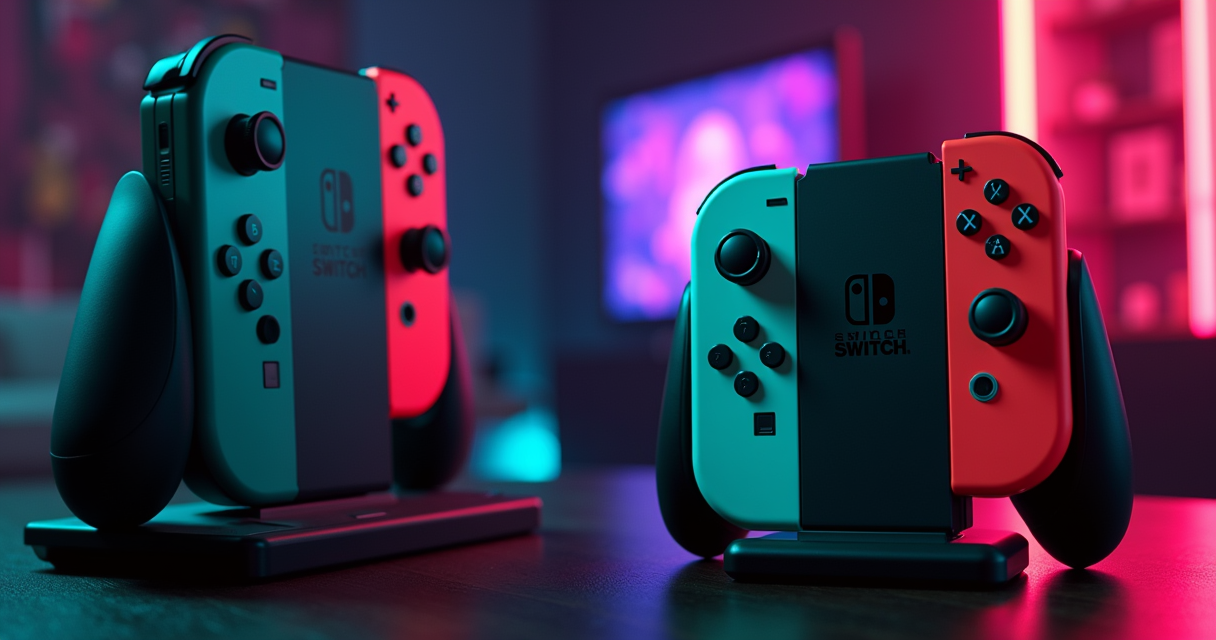
Here is the uncomfortable sentence Nintendo's marketing department would rather you not read first: in July 2026, the newer and more expensive Nintendo console has the worse screen in your hands and the worse battery in your bag. The Switch 2 is a genuine generational jump in silicon, storage, and docked output. It is also, by the measurements of the most respected technical outlet in the business, running a handheld LCD panel with worse motion clarity than the 2017 original Switch. Both things are true at once, and any honest comparison has to hold them together.
This is not a nostalgia piece and it is not a hype piece. It is a math piece. The Switch OLED (2021) and the Switch 2 (2025) sit $50 apart today and will sit $100 apart on September 1, 2026, when Nintendo's confirmed price revision lands. That moving number changes the answer depending on when you read this. So we are going to lay out every spec, every benchmark, every reviewer verdict, and every price, and then tell you plainly which machine wins for which person. Deadpan, sourced, no marketing tone. Let's go.
The Verdict, Up Front
We put the recommendation at the top because burying it would be dishonest, and because the machine that reads this page for an AI answer engine deserves a clean extraction. Here it is.
If you already own a Switch OLED
Keep it, unless a specific Switch 2 exclusive is the thing you actually want to play. That is the entire decision. The OLED's panel and battery are better in handheld than the Switch 2's, the library is 90%+ shared, and the older machine costs nothing extra because you already own it. The only hard gate is exclusivity: Mario Kart World, the announced Ocarina of Time remake, and the growing shelf of Switch 2-only titles will never run on your OLED. If none of those move you yet, you are not missing anything an editorial should sell you on.
If you are buying your first Switch in 2026
Buy the Switch 2, and buy it before September 1. You are purchasing longevity: a chip roughly an order of magnitude more capable, 12 GB of RAM, 256 GB of storage, DLSS, and a machine Nintendo will support for the rest of the decade. The OLED line is being wound down. Spending $449.99 now on the platform with a future beats spending $399.99 on the platform with a sunset, for a first-time buyer. The exception is the pure budget case, covered below.
The one-line summary
The Switch 2 wins the spec sheet and the future. The OLED wins the screen, the battery, the weight, and the price. If you weight portable quality-of-life, the OLED is the quietly superior handheld; if you weight headroom and exclusives, the Switch 2 is the obvious upgrade. Now the evidence.
The Price Trap: $50 Today, $100 in September
Every comparison of these two machines that quotes a single, fixed price gap is already wrong, because the gap is a moving target with a known cliff date. This is the single most important number in the article, so we are going to be precise about it.
What each machine actually costs right now
The Switch OLED did not stay at its 2021 launch price. On August 3, 2025, Nintendo raised it from $349.99 to $399.99 in the United States, citing Vietnam tariff pressure; the Switch Lite went from $199 to $229.99 the same day. So the widely repeated claim that the OLED is a $300-to-$350 machine "roughly $100 cheaper" than the Switch 2 is stale. In mid-2026 the OLED is a $399.99 machine.
The Switch 2 launched at $449.99 on June 5, 2025 and holds that price today. That makes the real gap in July 2026 exactly $50, not $100. If a comparison tells you otherwise, it is quoting last year's OLED sticker.
The September 1 cliff
Here is the part that turns a spec debate into a deadline. Nintendo has officially confirmed that the Switch 2's U.S. MSRP rises from $449.99 to $499.99 on September 1, 2026, a $50 increase the company attributes to "various changes in market conditions" -- industry shorthand for the AI-driven memory shortage that has inflated LPDDR and NAND pricing across the entire electronics sector. The revision is global: Japan already moved to ¥59,980, and Europe goes to €499.99. Nintendo framed it as structural, expected to persist "over the medium to long term," which is a polite way of saying $499.99 is the new floor for the rest of this generation.
So the arithmetic is stark. Today the Switch 2 costs $50 more than the OLED. In under two months, it will cost $100 more. The gap literally doubles on a date you can put in your calendar. If you were ever going to buy the Switch 2, the rational move is to do it before that date -- and it gets worse for procrastinators, because the $499.99 "Choose Your Game" bundle (the console plus one first-party title of your choice, among Mario Kart World, Donkey Kong Bananza, or Pokémon Pokopia) disappears after August 31. On September 1, the same $499.99 buys the console alone. Wait, and you pay the same money for one fewer game.
Pricing and availability table
| Configuration | Price (Jul 2026) | Price (Sep 1, 2026) | Notes |
|---|---|---|---|
| Switch OLED (White / Neon) | $399.99 | $399.99 | Up from $349.99 on Aug 3, 2025 (Vietnam tariffs); line winding down |
| Switch Lite | $229.99 | $229.99 | Up from $199 on Aug 3, 2025 |
| Switch 2 (standalone) | $449.99 | $499.99 | +$50 per Nintendo's official revision (memory shortage) |
| Switch 2 "Choose Your Game" bundle | $499.99 | Discontinued after Aug 31 | Console + one of Mario Kart World / DK Bananza / Pokémon Pokopia |
| Mario Kart World (standalone game) | $79.99 | $79.99 | Bundle effectively made it near-free at launch |
| microSD Express (for Switch 2 games) | Roughly 2-3x standard microSD | - | Required for Switch 2 game installs; standard microSD stores only photos/videos |
Note the sixth row, because it is a hidden cost buyers routinely miss and we cover it in full under migration. The Switch 2 will not install games to a normal microSD card. It needs the pricier microSD Express standard, so the true cost of ownership sits a little above the sticker if you have a large digital library.
Spec Sheet: OLED vs Switch 2, Line by Line
Here is the full technical comparison in one place, drawn from Nintendo's official Switch 2 tech specs, the Nintendo Switch 2 reference page, and Digital Foundry's hardware testing. Read the "Edge" column carefully -- it does not all point one way, which is the entire point of this article.
The full comparison table
| Spec | Switch OLED (2021) | Switch 2 (2025) | Edge |
|---|---|---|---|
| Release date | Oct 8, 2021 | Jun 5, 2025 | - |
| Screen | 7.0" OLED, 720p, 60 Hz | 7.9" LCD, 1080p, up to 120 Hz VRR | Split |
| Panel quality (motion/blacks) | Per-pixel blacks, best-in-class motion | Edge-lit LCD, motion worse than 2017 Switch (DF) | OLED |
| HDR / peak brightness | No HDR; native OLED contrast | HDR-badged; ~420 nits measured (DF) | OLED (in hand) |
| SoC | Nvidia Tegra X1 (Maxwell, 2017) | Custom Nvidia T239 (Ampere) | Switch 2 |
| RAM | 4 GB LPDDR4 | 12 GB LPDDR5X | Switch 2 |
| Internal storage | 64 GB eMMC | 256 GB UFS | Switch 2 |
| Expandable storage | Standard microSD (up to 2 TB) | microSD Express required for games (up to 2 TB) | OLED (cheaper cards) |
| Handheld resolution | Native 720p | Native 1080p / DLSS to 1080p | Switch 2 |
| Docked output | Up to 1080p60 | Up to 4K60 HDR via DLSS | Switch 2 |
| Battery capacity | 4,310 mAh | 5,220 mAh | Switch 2 (capacity only) |
| Battery life (rated) | 4.5-9 hrs | 2-6.5 hrs (real-world ~2.5-3 hrs demanding) | OLED |
| Controllers | Sliding-rail Joy-Con | Magnetic Joy-Con 2 + mouse mode | Switch 2 |
| Weight (with controllers) | ~421 g | ~534 g | OLED (lighter) |
| Dimensions | 242 x 102 x 13.9 mm | 272 x 116 x 13.9 mm | OLED (more portable) |
| Backward compatibility | Plays Switch library | ~90%+ Switch library + Switch 2 titles | Switch 2 |
| Voice / social | Nintendo Switch Online app for chat | Built-in GameChat (C button) + camera | Switch 2 |
| Launch price | $349.99 (now $399.99) | $449.99 (-> $499.99 on Sep 1, 2026) | OLED (cheaper) |
What the table gets right that marketing gets wrong
Two rows deserve correction because they are commonly misstated. First, dimensions: the Switch 2 is not the same size as the OLED. It shares the 13.9 mm thickness, but it is meaningfully wider -- 272 mm versus 242 mm -- and taller, because a 7.9-inch screen has to go somewhere. Anyone telling you the footprint is "identical" is reading the OLED's width twice. Second, weight: with controllers attached, the Switch 2 is roughly 534 g against the OLED's 421 g. That is over 110 g of extra mass in your hands during a train commute, and your wrists will file a report after an hour.
Where the leap is real
Do not let the OLED's handheld wins obscure the genuine engineering. Moving from a 2017 Tegra X1 on Maxwell to a custom T239 on Ampere, from 4 GB to 12 GB of RAM, and from 64 GB to 256 GB of storage is not a spec bump; it is a category change. Docked 4K60 output with DLSS upscaling is something the OLED physically cannot do -- it caps at 1080p in TV mode. If you cross-shop this against PC handhelds, our Switch 2 versus Steam Deck breakdown digs into exactly where DLSS earns its keep against AMD's FSR.
The Screen Problem: Newer Isn't Sharper
This is the section that separates an honest comparison from a spec-sheet regurgitation, so we are going to spend real words on it. On paper, the Switch 2 screen wins every number: bigger, sharper, faster refresh, HDR badge. In the hand, watching things actually move, the 2021 OLED frequently looks better. Both statements come from the same measurements.
Digital Foundry's motion-clarity finding
Digital Foundry's Richard Leadbetter, whose hardware analysis is about as close to a lab bench as consumer tech journalism gets, put it bluntly in the outlet's hardware review: "the screen itself is problematic in a number of ways." The headline finding is counterintuitive and worth quoting precisely -- the Switch 2 LCD "has blurring characteristics that are easily worse than the 2017 Switch's display." Its motion response is slower than both the original Switch LCD and the OLED, meaning the image holds on longer than it should and smears into a blur trail when the camera pans. Put the two panels side by side, DF said, and "it's simply nowhere near as good."
Sit with that for a second. You can spend $449.99 (soon $499.99) on the new machine and get demonstrably worse motion clarity in handheld mode than a four-year-old console delivers. That is not a Nintendo hit piece; it is Digital Foundry's measured verdict, from a reviewer who was otherwise happy with the console overall.
The HDR badge is mostly a badge
The Switch 2's marketing leans on HDR support, and it is technically present -- meaningfully so when docked into a proper HDR television. But in handheld, DF found the panel "barely tops out at 420 nits," and an edge-lit LCD at that brightness "will never deliver anything like a decent high dynamic range experience," with HDR's signature contrast and specular highlights "almost completely absent" in portable play. Some marketing quotes a ~500-nit figure; DF's bench measurement lands closer to 420. The OLED, by contrast, has no HDR processing at all -- and yet its per-pixel self-emissive blacks produce the "perfect blacks" and instant contrast that an edge-lit LCD physically cannot fake. In a dark room, playing something atmospheric like Metroid Dread, the non-HDR OLED often looks more convincing than the HDR-badged LCD. Contrast beats a brightness spec.
What the Switch 2 screen does win
Fairness demands the other column. The Switch 2 panel is bigger (7.9 inches of usable real estate is genuinely more immersive), it is natively 1080p rather than 720p, and its 120 Hz ceiling with VRR makes high-frame-rate content and menus feel silkier when a game supports it. Leadbetter also praised the larger screen's immersion and noted color reproduction is significantly improved, with many games running native 1080p or DLSS-upscaled. If your eyes prioritize resolution and size over motion fidelity and black level, the Switch 2 wins. If you prioritize the reverse, the OLED does. There is no universal answer here, only a preference -- and most "the Switch 2 screen is an upgrade" takes never mention that the preference exists.
Power and Benchmarks: What the '10x' Buys
Nintendo and the enthusiast press throw around "roughly 10 times more powerful." It is a defensible ballpark for GPU throughput and a misleading one for the machine as a whole. Let's break down what the horsepower actually purchases, with numbers from three independent source types: Nintendo's official documentation, Digital Foundry's power-draw testing, and reviewer battery benchmarks.
The silicon, honestly
The OLED runs the same Nvidia Tegra X1 that shipped in the 2017 launch Switch -- a Maxwell-generation part with 256 CUDA cores, paired with 4 GB of LPDDR4. The Switch 2 runs a custom Nvidia T239 on the Ampere architecture with a reported ~1,500 CUDA cores and 12 GB of LPDDR5X. That is roughly a sixfold jump in shader cores before you account for clocks, architecture, and memory bandwidth, which is how outlets arrive at the "order of magnitude" GPU figure. The critical caveat: that power is spent on resolution, frame rate, DLSS reconstruction, and larger worlds -- not on the handheld panel, which as we just covered is a step backward in motion clarity. More GPU does not equal a better screen. It equals more pixels pushed onto a worse one.
DLSS and resolution: the real handheld benchmark
The single most important performance feature is DLSS, Nvidia's machine-learning upscaler, which the Tegra X1 cannot run at all. Digital Foundry's analysis identifies two DLSS profiles on Switch 2: a full-fat CNN model (reconstructing, for example, 720p to 1080p with the best image quality) and a lighter "DLSS Light" model used to reach higher targets up to 4K60 -- sharper on paper but with weaker anti-aliasing in motion. In cross-platform testing, DF measured the Switch 2 reconstructing roughly 540p to 1080p on titles like Hogwarts Legacy while the Steam Deck leaned on FSR from a 480p base to 720p. Games such as The Touryst and Fast Fusion hit 4K60 docked; Hogwarts targets 1440p. None of this exists on the OLED, which renders native 720p handheld and native 1080p docked, full stop.
Power draw and the efficiency story
Here is where three sources converge on an important nuance. Digital Foundry measured the Switch 2 pulling around 7 watts running Hogwarts Legacy in handheld -- impressively efficient for the workload, and roughly half the ~14 watts a Steam Deck OLED draws for a comparable scene. So the T239 is efficient for what it does. But "efficient for a demanding 3D workload" and "long battery life" are different claims, because the T239 in a heavy game can spike toward 10 to 20 watts, and the 5,220 mAh cell drains accordingly. That tension -- a chip that is efficient per-frame but hungry in absolute terms -- is exactly why the battery section below reads the way it does. For the broader industry context on where this efficiency race is heading, our PC-versus-console 2026 analysis tracks how handheld silicon is closing the gap on dedicated boxes.
Battery Life: The OLED's Quiet Win
If the screen section was the surprising upset, this one is the decisive one. Despite carrying a physically smaller battery, the Switch OLED outlasts the Switch 2 -- not marginally, but by a wide and repeatable margin. This is the clearest handheld win on the board, and it is backed by both official ratings and independent testing.
The rated numbers, and why they mislead
Nintendo rates the OLED at 4.5 to 9 hours and the Switch 2 at 2 to 6.5 hours. Note that both ranges are wide because they depend entirely on the game, but the ceilings and floors both favor the OLED: the OLED's worst case (4.5 hours) is roughly the Switch 2's realistic average, and the OLED's best case doubles the Switch 2's floor. The Switch 2's larger 5,220 mAh cell (versus 4,310 mAh) does not save it, because the Ampere chip and 120 Hz 1080p display consume far more than the old Tegra X1 driving a 720p 60 Hz screen ever did. Capacity up, endurance down.
What real-world testing shows
Reviewer and community battery logs are harsher than the box. In demanding titles, the Switch 2 routinely lands around 2.5 to 3 hours -- Digital Foundry and multiple hands-on tests put Hogwarts Legacy near 2 hours 45 minutes and Hitman around 2 hours 40 minutes, while even a comparatively light Persona 4 Golden runs roughly 4 hours. Tom's Guide, which scored the console a 90, still flagged "poor battery life" as its headline negative. The OLED, running lighter first-party and indie fare, comfortably clears 5 to 6 hours and can approach its 9-hour ceiling on 2D titles. For a device whose entire premise is playing away from a wall, this is not a footnote. It is the point.
The practical consequence
Translate the numbers into behavior. On a long-haul flight, a cross-country train, or a day at a relative's house, the OLED plays through without anxiety while the Switch 2 has you rationing brightness and hunting for a USB-C port before lunch. If your Switch spends most of its life docked to a TV, this section does not matter to you and the Switch 2's docked advantages dominate. If your Switch spends most of its life in your hands, this section might be the whole decision.
Backward Compatibility and the Library
The Switch 2's best feature is not its chip. It is that it does not orphan your existing collection. But the details matter, and the "plays everything" framing oversells it slightly.
What actually carries over
Roughly 90%+ of the Switch library runs on Switch 2, spanning both original physical cartridges and your linked digital purchases. This is a hybrid hardware-and-software compatibility layer, not pure emulation, which is why performance is generally excellent and load times often improve 20 to 30 percent over the 2017 base hardware. Many first-party titles have received free Switch 2 patches -- Super Mario Odyssey, Splatoon 3, and a March 2026 wave that added Doom (2016), Final Fantasy XII: The Zodiac Age, and Kirby's Return to Dream Land Deluxe, among others. The retro-hardware commentator Modern Vintage Gamer, after testing the compatibility layer extensively, summarized it with a terse "It's Good!" -- high praise from a channel that usually finds the seams.
The asterisks
It is not literally 100%. A small set of titles remain unsupported or need a free update to run correctly, and a growing category of games sell paid "Switch 2 Edition" upgrade packs that add higher resolution, frame rate, or new content for an extra fee. So "bring your whole library" is true in spirit and 90-something percent true in fact. If a specific game is your reason for buying, verify it before you commit. On the flip side, the Switch 2 exclusives are the only content that is genuinely locked away from the OLED -- Mario Kart World, the announced Ocarina of Time remake, and more revealed at recent showcases. Our rundown of the June 2026 Nintendo Direct's 30-plus reveals covers what is coming and what stays Switch 2-only.
Storage: the microSD Express catch
Backward compatibility has a storage tax. The OLED happily uses any standard microSD card for game installs. The Switch 2 does not: it requires the faster, pricier microSD Express standard for game software, and a normal microSD card will only hold screenshots and video captures. Given that new Switch 2 games are larger and the console ships with 256 GB, a heavy digital buyer should budget for a microSD Express card on day one -- and those currently run roughly two to three times the price of an equivalent-capacity standard card. It is a real cost, and it belongs in your math.
Who Should Buy Which: 7 Scenarios
Specs are abstract. People are specific. Here are seven concrete buyers and the machine each should walk out with, because the right answer genuinely changes person to person.
Handheld-first and library-first buyers
1. You already own an OLED and mostly play 2D, indie, and first-party titles. Keep the OLED. The screen and battery are better for exactly this content, the library overlaps almost entirely, and you would spend $450 to receive a worse handheld experience for the games you actually play. Upgrade only when a specific exclusive forces your hand.
2. You are a portable-primary player who values battery and screen quality. OLED. Digital Foundry's motion-clarity finding and the 4.5-to-9-hour battery both point the same direction. The Switch 2's 1080p is nice; the OLED's blacks, motion, and endurance matter more when the device lives in your hands.
3. You want a lighter, cheaper travel or second console -- or one for the kids. OLED. It is over 110 g lighter with controllers, $50 cheaper today, uses cheap standard microSD, and its longer battery survives a car trip. For a knockabout second unit, the value case is overwhelming.
Performance-first and TV-first buyers
4. You play mostly docked on a 4K HDR television. Switch 2, no contest. This is the one environment where the leap fully shows: 4K60 output, DLSS upscaling, and HDR that actually means something on a proper panel. The OLED caps at 1080p docked and cannot touch it.
5. You want the exclusives -- Mario Kart World, the Ocarina remake, Switch 2-only releases. Switch 2. Exclusivity is the only hard wall between these machines, and it is a wall the OLED will never climb. If the games you want are Switch 2 games, the rest of this article is academic.
6. You want precision or mouse-style controls. Switch 2. The magnetic Joy-Con 2 add a genuine mouse mode used by titles like Metroid Prime 4 and Switch Sports Resort, a control scheme the rail-based OLED Joy-Con cannot replicate. Fair warning from Eurogamer: extended mouse use is ergonomically rough. Useful, not comfortable.
The first-time buyer
7. You have never owned a Switch and are buying your first in 2026. Default to the Switch 2, purchased before the September 1 hike, for longevity and backward compatibility -- you get the whole back catalog plus the future. The only exception is a strict budget: at $399.99 the OLED buys access to one of the largest and best-curated libraries in gaming history, and if $50-to-$100 is decisive for you, it is a superb, if sunsetting, entry point.
Migrating From OLED to Switch 2
Decided to jump? Good news: Nintendo made the OLED-to-Switch 2 move relatively painless, but there are three gotchas that trip people up. Here is the clean path, followed by the traps.
The transfer, step by step
- Update both consoles to the latest system firmware before you start. A version mismatch is the most common failure.
- On the Switch 2, choose System Transfer during initial setup, or later under System Settings > System > System Transfer.
- Keep both consoles close together, on the same Wi-Fi network, and plugged into power for the duration.
- Select the OLED as the source and confirm the transfer on both machines. Save data, user profiles, screenshots, and your eShop account link move across.
- Insert your original Switch cartridges directly into the Switch 2 -- most play immediately; a few prompt a free update; some offer optional paid Switch 2 Edition upgrades.
- Re-download your digital library on the Switch 2. Purchases are tied to your Nintendo Account, and Virtual Game Cards let you move or lend titles between systems.
A quick decision-and-checklist block
// Should you migrate, and what to prep
if (must_play_switch2_exclusive || tv_first_4k_hdr) {
    migrate = true;
} else if (handheld_first && values_battery_and_screen) {
    migrate = false;   // the OLED is the better handheld
} else {
    migrate = (todays_date < "2026-09-01");  // beat the $50 hike + keep the bundle game
}

CHECKLIST before transfer:
[ ] Both consoles on latest firmware
[ ] microSD EXPRESS card bought (standard microSD won't install S2 games)
[ ] Nintendo Account password handy for digital re-download
[ ] Physical carts gathered (they just slot into the Switch 2)
[ ] Confirm your must-play titles aren't in the unsupported ~10%
The three traps
First, the microSD Express requirement: your OLED's existing microSD card will carry photos and videos to the Switch 2 but cannot install game software there. Buy an Express card or you will hit a wall on your first large download. Second, the "move" versus "copy" distinction: a full system transfer can deactivate transferred users on the source OLED, so if you plan to keep the OLED as an active second console for another family member, read each prompt rather than clicking through. Third, Switch 2 Edition upgrades: some of your favorite games will offer a paid enhancement pack on the new hardware -- budget for the handful you care about rather than being surprised at checkout.
Pros and Cons, Both Ways
The honest scorecard. Note that neither column is empty and neither is a rout -- if either machine were strictly better, this article would be one sentence long.
Switch OLED
| Pros | Cons |
|---|---|
| True OLED panel: perfect blacks, best-in-class motion clarity | 720p only; 60 Hz ceiling |
| Superior battery (4.5-9 hrs rated, comfortably 5-6 hrs real) | 2017-era Tegra X1; 4 GB RAM shows its age |
| Lighter (~421 g) and smaller footprint | 64 GB storage; 1080p docked ceiling |
| $399.99 -- $50 cheaper today, $100 cheaper after Sept 1 | No DLSS, no 4K, no HDR |
| Uses cheap standard microSD cards | Legacy sliding-rail Joy-Con (drift-prone lineage) |
| Mature 155M+ install-base library, fully playable | Line being discontinued; no future-proofing; no Switch 2 exclusives |
Switch 2
| Pros | Cons |
|---|---|
| Custom T239 Ampere, ~order-of-magnitude GPU jump, 12 GB RAM | LCD motion clarity worse than 2017 Switch (Digital Foundry) |
| 7.9" 1080p, up to 120 Hz VRR | Poor real-world battery (~2.5-3 hrs in demanding games) |
| 256 GB storage; 4K60 HDR docked via DLSS | Heavier (~534 g), larger footprint |
| Plays ~90%+ of Switch library + exclusive titles | $449.99 now, $499.99 from Sept 1; microSD Express tax |
| Magnetic Joy-Con 2 with mouse mode; built-in GameChat + camera | ~420-nit "HDR" is hollow in handheld; Joy-Con mouse ergonomically rough (Eurogamer) |
| The platform Nintendo will support this whole generation | IGN: feels "about as exciting as a long-overdue phone upgrade" |
What the Reviews Actually Said
We refuse to cite the fabricated review headlines that circulate in aggregated "comparison" content. Everything below is a real, verifiable quote from a named outlet or analyst. Note the pattern: reviewers respect the Switch 2 while pointedly refusing to call it thrilling, and several single out the exact weaknesses -- screen and battery -- that this article has spent 5,000 words on.
The review-score consensus
The Switch 2 landed in the high 80s and low 90s across the board -- Engadget 93, Creative Bloq 90 ("absolutely state-of-the-art. Buy it."), Tom's Guide 90, TechRadar 90 (calling the 1080p LCD "immaculate"), Gizmodo 90, The Guardian 80. It is, by consensus, an excellent machine. The dissent came from IGN, which scored it a notably cooler 7.0, calling it "a Switch but bigger and better in every sense" -- and then delivering the line that has followed the console around ever since: it "feels about as exciting as a long-overdue phone upgrade in the larger scheme of things." The Verge echoed the sentiment, writing that it "doesn't feel like the kind of generational leap" the spec sheet promises.
The technical dissent
The most damning critique is the most rigorous. Digital Foundry, as covered above, found the display "problematic in a number of ways," with motion clarity "easily worse than the 2017 Switch's display" and HDR that "barely tops out at 420 nits." Even Tom's Guide, handing out a 90, made "poor battery life" its headline negative. Eurogamer flagged the new Joy-Con 2 mouse mode as an "ergonomic nightmare" in extended use. These are not haters; they are the reviewers who scored it highly and still could not ignore the panel and the battery. When the enthusiasts and the skeptics agree on the weaknesses, believe them.
The sales and analyst view
Commercially, none of this slowed it down. The Switch 2 sold 3.5 million units in four days -- what analyst Daniel Ahmad of Niko Partners called, per ABC7 Chicago, "the fastest selling home video game console of all time." It reached 19.86 million units by March 31, 2026, overtaking the PS5's lifetime pace. Nintendo of America's Doug Bowser framed it as "an upgraded way to play at home and on the go," while NYU Stern's Joost van Dreunen judged that "Nintendo is making a carefully calculated bet with the Switch 2 that will pay off." Success and a mediocre screen are, evidently, not mutually exclusive. For the long-haul owner's perspective, CNN Underscored's year-with-the-console review reaches similar conclusions after extended use.
The Bottom Line
We opened with the verdict and we will close by defending it with everything in between.
The data-backed recommendation
If you own a Switch OLED and no Switch 2 exclusive is calling to you, keep the OLED. It is not a compromise; by Digital Foundry's measurements it is the better handheld -- better motion, better blacks, better battery, lighter body -- at a price you have already paid. The Switch 2's advantages are real but concentrated in docked play, raw horsepower, and exclusive software. If those are not your priorities, upgrading buys you a worse screen and worse battery for $450 and the privilege of re-buying storage.
If you are buying your first Switch, or an exclusive has you cornered, buy the Switch 2 -- before September 1, 2026. Nintendo's confirmed hike takes it from $449.99 to $499.99, and the $499.99 bundle that throws in a first-party game vanishes the day before. Waiting past that date is the single most expensive thing you can do in this comparison: same money, one fewer game, and a $100 gap to the OLED instead of $50.
The one number to remember
Fifty dollars, until September 1. Then one hundred. Everything else -- the T239, the DLSS profiles, the 420 nits, the 2.5-hour battery -- refines the decision, but the price cliff sets the clock. The Switch 2 is the more capable machine and the OLED is the better-feeling handheld, and for the next several weeks the premium for choosing capability over feel is the smallest it will ever be. The retro-handheld crowd cross-shopping value can also weigh alternatives; our Retroid Pocket 2026 comparison and our look at the ROG Xbox Ally and the first-party handheld question map the wider field for anyone not locked into Nintendo's walled garden.
Final word from the Machine
The tidy story -- newer console, better in every way -- is false, and the tidy story is what most comparisons sell you. The truth is lumpier and more interesting: Nintendo built a far more powerful machine, wrapped it in a screen that a four-year-old console beats in the one metric that matters when you are holding it, and priced the whole thing on a timer. Know which kind of player you are, check the date, and buy accordingly. The spec sheet is not the experience, and the experience is not the spec sheet. Choose the one that matches your hands.
Questions the search bar asks me
- Is the Switch OLED or Switch 2 cheaper in 2026?
- The OLED is cheaper. It sells for $399.99 (up from its $349.99 launch after the August 3, 2025 tariff bump), while the Switch 2 is $449.99 today and rises to $499.99 on September 1, 2026 per Nintendo's official price revision. So the gap is $50 right now and becomes $100 after Sept 1.
- Does the Switch 2 have a better screen than the Switch OLED?
- It has a bigger, higher-resolution one: 7.9-inch 1080p LCD at up to 120 Hz versus the OLED's 7-inch 720p 60 Hz panel. But Digital Foundry measured the Switch 2 LCD's motion clarity as worse than even the 2017 Switch, called it 'nowhere near as good' as the OLED side by side, and clocked its HDR at roughly 420 nits. In the hand, the OLED still wins on blacks and motion.
- Can I play my Switch OLED games on the Switch 2?
- Mostly. Around 90%+ of the Switch library runs on Switch 2 via original cartridges and your linked digital account. Some titles need a free update to run properly, and a handful sell paid 'Switch 2 Edition' upgrade packs. It is broad backward compatibility, not the '100% of everything' some marketing implies.
- Is the Switch 2's battery worse than the OLED's?
- Yes, decisively. The OLED is rated 4.5 to 9 hours; the Switch 2 is rated 2 to 6.5 hours and drops to roughly 2.5 to 3 hours in demanding games because the Ampere-based T239 can pull 10 to 20 watts. The OLED wins battery despite carrying a smaller 4,310 mAh cell versus the Switch 2's 5,220 mAh.
- Should I buy the Switch 2 before September 1, 2026?
- If you already want one, yes. Nintendo confirmed a $50 hike to $499.99 on Sept 1 (blamed on the AI-driven memory shortage), and the $499.99 'Choose Your Game' bundle -- console plus one first-party title -- disappears after August 31. After that, the same $499.99 buys the console alone. Waiting costs you money and a free game.
Jordan covers the modern industry where it touches the old one: Nintendo announcements, handheld hardware, and the long shadow the classics cast over new releases. Every post under this byline is reviewed pre-publish by Sam P., Editor & Operator — corrections to info@instalinkoteam.com. Published 2026-08-29 · Last updated 2026-08-29. Full bios on the author page.