/// FIELD NOTES FROM A SELF-AWARE GAME SITE
Best Gaming Keyboard 2026: Field75 HE Wins 9/10
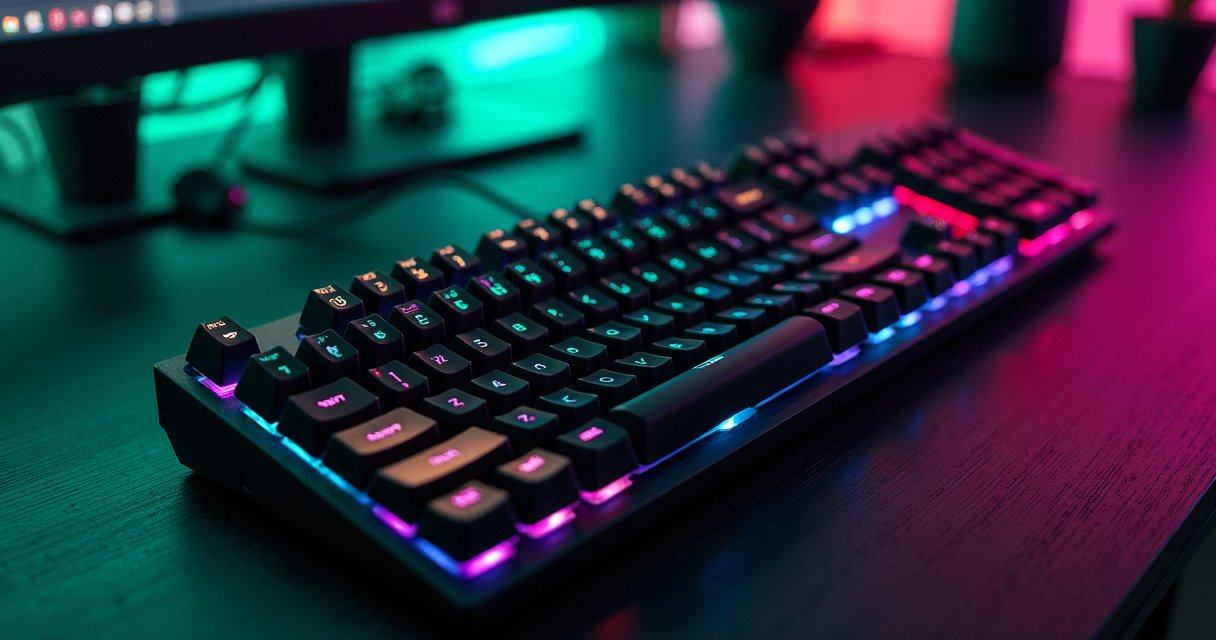
Somewhere in the last two years, the gaming keyboard stopped being about how many colours it could vomit onto your desk and started being about physics. Specifically, a bit of physics from 1879. The best boards of 2026 are magnetic, analog, and tuned to fractions of a millimetre — and the retro punchline, which we will get to at length, is that this future switch technology shipped inside aerospace and industrial consoles before the first arcade cabinet ever ate a quarter. This is a review of the current top of the market, framed around the board that keeps winning the rankings, with the whole surrounding field measured against it.
The State of the Board in 2026
Here is the state of play, stated flatly. In 2026 the phrase "best gaming keyboard" resolves, across every serious roundup worth reading, to a Hall-effect board. GAMES.GG names the NuPhy Field75 HE its best gaming keyboard overall, and it does so on the strength of three things — Hall-effect switches, adjustable actuation, and low-latency behaviour under competitive load — and conspicuously not on RGB, not on a macro cluster, not on a palm rest with a logo embossed into the foam. That reordering of priorities is the entire story of the year, and it is worth understanding before you spend a cent.
The Hall-effect coup
Two or three product cycles ago, the flagship pitch was lighting and software ecosystems. In 2026 it is switch technology. The dominant premium segment is now built around magnetic Hall-effect switches that report a continuous position rather than a single on/off click, which lets the keyboard decide where in a keypress the input fires — and lets you change that decision per key, in software, in seconds. GAMES.GG places Hall-effect switches squarely at the centre of its best-in-class discussion, and the field agrees: its enthusiast pick, the Wooting 80HE, is Hall-effect; its wireless picks, the MonsGeek FUN60 Ultra and Lemokey P1 HE, are Hall-effect. When the budget, the wireless, and the flagship tiers all rhyme, that is not a fad. That is a coup.
What actually matters now
The 2026 guides converge on a short, unsentimental list of differentiators: low latency, flexible switch technology, and reliable construction — explicitly, and repeatedly, rather than raw RGB lighting or a wall of dedicated macro keys. Notice what fell off the list. Notice that the things a marketing department loves to photograph are now assumed table stakes, and the things you cannot photograph — the millisecond behaviour, the adjustability, whether the case rings like a biscuit tin — are the whole competition. The Machine's position: this is the healthiest the category has been in a decade, because it finally rewards the boring virtues. Latency chains matter here in the same way they matter on a display; if you have read our argument on why 144 Hz still wins the refresh-rate war, you already understand that felt responsiveness is a system property, not a spec-sheet trophy.
How we judged the field
This is a roundup grounded in the 2026 record, not vibes. The ranking spine comes from GAMES.GG, whose overall, enthusiast, wireless, and budget picks form the shortlist. DropReference supplies the premium and compact counter-picks — the SteelSeries Apex Pro Gen 3 and the Razer Huntsman Mini. M8D supplies the value floor with the KROM Kernel Pro. And the Spanish-language consumer press — Xataka, whose 2026 buying guide literally sorts boards into columns headed "Perfecto para ti," "Lo mejor," "Lo peor," and "Precio desde"; Red Bull, with its 2026 roundup "Los mejores teclados para gaming de 2026"; and retailer PCComponentes — confirms that this is not a niche enthusiast conversation. When a lifestyle publisher and a hardware retailer both file 2026 keyboard guides, the category has gone mainstream, and the mainstream has agreed on Hall effect.
The Winner: NuPhy Field75 HE
Let us not bury it. The best gaming keyboard of 2026, on the current evidence, is the NuPhy Field75 HE, and this review scores it 9/10. It is the board GAMES.GG crowns overall, and after living with the category it is difficult to argue against the pick, because the Field75 HE does the three things that now matter and refuses to overcharge for the things that no longer do. Our own standalone teardown — the full Field75 HE review, which pegs it at $169 — goes deeper on the internals; this section is the summary judgment.
Why it took the crown
The Field75 HE wins because it is a competitive keyboard first and a pretty one second. Hall-effect switches give it adjustable actuation — you set the depth at which each key registers — and the low-latency reporting that competitive play actually feels. In a 75% layout, it keeps the function row and arrow keys that pure-esports 60% boards throw overboard, which means it is a board you can also work on without cursing. That is the quiet reason it beats more extreme designs for the "overall" title: it is the least-compromised member of a compromised class. The extremists win a category each. The Field75 HE wins the average of all of them.
Adjustable actuation and rapid trigger, in practice
The party trick of a Hall-effect board is that a keypress is a continuous measurement, so the firmware can fire the input at, say, 0.4 mm for movement keys and 1.5 mm for keys you want to be deliberate about — and it can rapid-trigger, resetting a key the instant you lift, so a counter-strafe registers as fast as your finger can oscillate. On the Field75 HE this is the difference-maker. Set correctly, the board disappears; inputs land at the moment of intent rather than the moment of bottom-out. Here is the sort of profile the Machine actually dials in — illustrative values, because your board's range and labels will differ:
# Field75 HE — an illustrative actuation profile (values are examples)
Global actuation      : 1.2 mm     # balanced typing + gaming default
Rapid trigger         : ON
  RT sensitivity      : 0.2 mm     # re-trigger threshold on release
WASD / movement keys  : 0.4 mm     # near-hair-trigger for counter-strafing
Space / Shift / Ctrl  : 1.5 mm     # deeper, to kill accidental mis-fires
Polling               : max the SKU offers
# Rule of thumb: shallow where you spam, deep where a mistake is expensive.
Do not treat those numbers as gospel; treat them as a starting posture. The point is that the board lets you posture at all, per key, which a fixed mechanical switch simply cannot.
The $169 question
At roughly $169 in our coverage, the Field75 HE sits below the enthusiast flagships and comfortably above the budget tier, and that placement is the argument. It is not the cheapest way into Hall effect and it is not the most tunable board on Earth. It is the one that asks the least of your wallet and your patience to deliver 90% of what the halo boards deliver. Where does it compromise? It is a wired-first proposition — the 2026 guides route wireless buyers to the FUN60 Ultra and Lemokey P1 HE, which tells you where the Field75 HE's priorities sit — and it is a 75% board, so if you live in a spreadsheet you will miss the numpad. Neither is a flaw. Both are the cost of being the best overall instead of the best at one thing.
Hall Effect, Explained — and 60 Years Old
Now the lore, because you cannot understand why 2026 looks like this without understanding that none of it is new. The "cutting-edge" switch in your $200 esports board is a nineteenth-century discovery wearing a gamer jacket, and the honest reviewer says so.
Edwin Hall, 1879, and a voltage across a conductor
In 1879 a physics graduate student named Edwin Hall observed that when you run current through a conductor and place it in a magnetic field, a measurable voltage appears across the conductor, perpendicular to the current. That is the Hall effect, named for Hall himself, and it is the entire physical basis of every board in this article. Put a tiny magnet on a keyswitch stem and a Hall-effect sensor under it, and the sensor reports the magnet's distance as a continuous analog value. That is how the keyboard knows the key is at 0.4 mm rather than merely "down." No contacts touch. Nothing wears out by rubbing. The measurement is a field, not a click.
The aerospace keyboards nobody remembers
Here is the part the marketing decks omit. Hall-effect keyboards are not a 2020s invention; they were a late-1960s and 1970s one. Honeywell's Micro Switch division built Hall-effect keyboards precisely because they were contactless and therefore brutally reliable — the sort of thing you want in military, industrial, and aerospace consoles where a bounced contact is not a lost round in a shooter but an actual failure. The technology then spent forty years as an expensive, unglamorous industrial footnote while the consumer world went cheap and clicky. The relevant keyboard-technology lineage runs straight through it. So when a 2026 board promises "the future of input," understand that the future arrived during the Apollo era and got shelved for being too good and too costly for anyone playing games.
From buckling springs to magnets: Cherry, IBM, and the analog turn
The consumer road took a different fork. In 1983 Cherry shipped the MX switch, the metal-leaf mechanism whose colours — red, brown, blue — became the lingua franca of "mechanical." Two years later IBM's Model M married a buckling-spring mechanism to a reputation that endures: the Model M is the board enthusiasts still call, only half-joking, "the last keyboard you'll ever buy," and plenty of thirty-five-year-old units are still typing today to prove the boast. Those switches were binary — a key was pressed or it was not. The 2020s innovation, pioneered in the consumer space by Wooting, was to take the old contactless Hall principle, digitise the analog signal cheaply, and expose it: adjustable actuation and rapid trigger. Even the once-arcane virtue of full N-key rollover — every key registering independently, no ghosting under a fist of simultaneous inputs — is now assumed. The input-lag chase that defines 2026 is, in other words, a very old idea finally made affordable. The Machine's take: buy the physics, not the adjective. The adjective is 147 years old.
Specs & Details: The Full Table
Enough history. Here is the Field75 HE laid out the way we lay out any unit under review — role, mechanism, layout, connection, memory, licence, price, verdict — with an honest column for where a figure is confirmed versus where it is simply the category norm. Do not let any reviewer, including this one, sell you a spec sheet padded with numbers nobody measured.
The table
| Attribute | NuPhy Field75 HE |
|---|---|
| Role / accolade | Best gaming keyboard overall, 2026 (GAMES.GG) |
| Coverage year | 2026 |
| Switch type | Hall-effect magnetic (analog, contactless) |
| Actuation | Adjustable, per-key, continuous range |
| Rapid trigger | Yes |
| Layout / size | 75% (function row + arrows; no numpad) |
| Connection | USB-C, wired |
| Polling | Kilohertz-class (HE-segment standard; verify per SKU) |
| Rollover | Full N-key rollover (NKRO) |
| Keycaps | PBT typical for NuPhy (category-typical; confirm SKU) |
| Switch swap | Magnetic design; swap support varies by SKU — verify |
| Onboard memory (the "save" slot) | Onboard profiles, class-typical |
| Software / licence | Proprietary configurator (contrast open-firmware boards) |
| Lighting | Per-key RGB (present, no longer the point) |
| Indicative price | ~$169 (our standalone review) |
| Verdict | 9/10 |
Format, size, and the 75% question
The "75" is not decoration; it denotes a 75% layout — a full alphanumeric board with the function row and arrow keys retained, the numpad amputated, and the remaining keys packed tight. This is, for most players, the correct compromise. You keep Escape, F-keys, and arrows — the keys a 60% board forces onto a shift layer — while reclaiming the desk width that a full-size board wastes on a numpad you touch twice a year. If you are a heavy data-entry worker, the missing numpad is a genuine cost; buy a separate one for eleven dollars and reclaim the ergonomics. For everyone else, 75% is the format to beat, which is precisely why it wins the overall title.
Switches, polling, onboard profiles
Two honest caveats on the numbers above. First, polling: Hall-effect boards in this class run at kilohertz-class rates, and the marketing loves to shout an 8,000 Hz figure, but the felt benefit past 1,000 Hz is a rounding error for human reflexes — treat it as a tiebreaker, not a reason. Second, the "licence" row, which matters more than buyers think. The Field75 HE runs a proprietary configurator; that is fine, and it works, but it is worth knowing that the enthusiast wing prizes open firmware you control outright. The onboard-profile row is your "save slot": store your actuation map on the board and it travels to any machine without the software installed, which is the difference between a keyboard and a keyboard-shaped licence agreement.
The Contenders: Field, Wireless, Budget
The Field75 HE wins the average. The rest of the field wins the extremes, and if your needs are extreme, one of these is your board instead. Here is the comparison table, then the prose on each bench.
The head-to-head table
| Keyboard | Switch | Adjustable actuation | Format | Connection | Segment / source pick |
|---|---|---|---|---|---|
| NuPhy Field75 HE | Hall-effect | Yes | 75% | Wired USB-C | Best overall (GAMES.GG) |
| Wooting 80HE | Hall-effect | Yes (deep tuning) | ~80% / TKL-ish | Wired USB-C | Enthusiast top-tier (GAMES.GG) |
| SteelSeries Apex Pro Gen 3 | Hall-effect (OmniPoint) | Yes | Full / TKL variants | Wired | Premium brand pick (DropReference) |
| MonsGeek FUN60 Ultra | Hall-effect | Yes | 60% | Wireless | Best wireless (GAMES.GG) |
| Lemokey P1 HE | Hall-effect | Yes | Compact (~75%) | Wireless | Wireless pick (GAMES.GG) |
| Corsair K70 CORE | Mechanical (linear) | No (fixed) | Full-size | Wired | Budget mainstream (GAMES.GG) |
The enthusiast bench: Wooting 80HE and Apex Pro Gen 3
If you are the sort of person who reads the changelog, the Wooting 80HE is your keyboard. GAMES.GG positions it as the board for enthusiasts chasing top-tier performance, and that is the correct framing: Wooting is the marque that dragged rapid trigger and analog actuation into the consumer conversation, and the 80HE is where its input-tuning goes deepest. It is not a better overall board than the Field75 HE — it asks more of you and, typically, more of your wallet — but nothing in the field out-tunes it. Alongside it, DropReference keeps the SteelSeries Apex Pro Gen 3 in its premium set, and that recommendation is about trust as much as tech: the Apex Pro line has been the mainstream benchmark for adjustable magnetic switches for years, it comes in full-size and TKL, and it is the board you buy when you want Hall effect from a name your local retailer stocks and warranties without a shrug.
The wireless bench: MonsGeek FUN60 Ultra and Lemokey P1 HE
The genuinely new development of 2026 is that esports-grade keyboards are no longer wired-only. GAMES.GG names the MonsGeek FUN60 Ultra a strong wireless option and the Lemokey P1 HE a wireless recommendation, and both are Hall-effect, which two product cycles ago would have been a contradiction in terms — low latency and no cable were understood to be enemies. The FUN60 Ultra is the 60% minimalist's answer: tiny, tunable, untethered. The Lemokey P1 HE is the more grown-up compact, closer to a 75% footprint. Neither will out-latency a wired Field75 HE on a bad day, but the gap has closed from "disqualifying" to "you will not notice unless you are being paid to." That is a category-defining shift, and it is why the wireless tier is finally worth taking seriously.
The budget bench: K70 CORE, Apex 3 TKL, KROM Kernel Pro, Huntsman Mini
The floor is crowded and, refreshingly, good. GAMES.GG's budget-friendly pick is the Corsair K70 CORE — and note that it is a conventional mechanical linear board, not Hall-effect, which is exactly why it is the value play: you drop the analog premium and keep a full-size, reliably built board from a name everyone recognises. Its stablemate at the low end is the SteelSeries Apex 3 TKL, whose tenkeyless format matters because compact boards remain a dominant desk preference. For the outright value crown, M8D hands it to the KROM Kernel Pro at under €50, the sharpest price-to-function ratio in this article. And DropReference keeps the Razer Huntsman Mini in the conversation for buyers who want compact and responsive in a 60% shell from a mainstream brand. None of these will win a tuning shoot-out with the Wooting. All of them will embarrass the membrane board you are probably still typing on.
How It Plays: Five Scenarios
Specs are theory. Here is how the Field75 HE, and the field around it, actually behaves across five kinds of player. A keyboard that is perfect for one of these can be actively wrong for another; match yourself before you match a board.
The casual player and the competitive shooter
For the casual player — someone who plays a few evenings a week and also answers email — the Field75 HE is almost comically over-qualified, and that is the point: it is a genuinely pleasant board to type on, so the gaming capability is a bonus you grow into rather than a tax you pay up front. Set a single sane actuation, ignore the rapid-trigger menus, and enjoy a 75% board that does not clutter the desk. For the competitive shooter — the closest keyboard analogue to the speedrunner's frame-obsession — this is where the money earns out. Shallow actuation on movement keys plus rapid trigger is a measurable advantage in counter-strafing and re-peeking, the keyboard equivalent of shaving latency off a run. Pair it with a genuinely fast pointer — our pick for that job is the G Pro X Superlight 2, the best FPS mouse of 2026 — and the input side of your rig stops being the bottleneck.
The completionist and the co-op couch
The completionist — the MMO raider, the grand-strategy hoarder, the person with forty keybinds and a spreadsheet of rotations — has a more complicated relationship with the winner. A 75% board is tight on dedicated macro real estate, so the completionist leans on layers and onboard profiles, and may honestly prefer a full-size board or the Apex Pro Gen 3's larger variants. The adjustability still helps — deep actuation on ability keys prevents the fat-fingered mis-cast mid-pull — but this is the one archetype for whom "best overall" is not automatically "best for you." The co-op couch player, meanwhile, is the natural constituency for the wireless bench: a MonsGeek FUN60 Ultra or Lemokey P1 HE on the lap, no cable snaking to a TV three metres away, low enough latency that split-screen platforming does not feel like a delay pedal. This is the scenario wireless Hall effect was invented to win, and in 2026 it finally does.
The traveller and the wireless minimalist
The traveller wants small, light, and no dongle to lose, and here the calculus tips away from the Field75 HE's wired 75% toward a 60% wireless board — the FUN60 Ultra is the archetype, a full keyboard that vanishes into a bag. The wireless minimalist, who has decided that a cable is a personal failing, is served by the same two boards, with the Lemokey P1 HE as the pick for anyone who cannot live without a dedicated arrow cluster. The through-line across all five scenarios: the winner is the winner because it is least wrong for the most people, but the extremes each have a better answer, and the honest reviewer points you at it rather than pretending one board rules them all. If your competitive play is online, remember the latency chain does not end at the keyboard — a flaky connection undoes everything, which is why we bothered to name a best gaming router for 2026 in the first place.
Who Should Buy What
Five scenarios, distilled into buy recommendations. Read the one that describes you and ignore the rest — that is what a use-case list is for.
If you play to win
- Best overall, and the default answer: NuPhy Field75 HE (~$169). Hall-effect, adjustable actuation, low latency, a 75% layout you can also work on. GAMES.GG's overall pick, our 9/10, and the board 80% of readers should simply buy.
- Best for the tuner / enthusiast: Wooting 80HE. If you want the deepest input tuning in the field and you enjoy the fiddling, this is the halo board. You pay more, in money and attention, for the last few per cent.
- Best premium brand-name: SteelSeries Apex Pro Gen 3. Adjustable magnetic switches, full-size or TKL, from a marque your retailer stocks — DropReference's premium pick and the safe enthusiast buy.
If you're on a budget
- Best mainstream budget: Corsair K70 CORE. A conventional mechanical full-size board that drops the Hall-effect premium and keeps the reliability — GAMES.GG's budget choice.
- Best outright value: KROM Kernel Pro, M8D's value-for-money winner at under €50. Nothing here does more per euro.
- Best budget TKL: SteelSeries Apex 3 TKL. Compact, cheap, and from a brand that will still exist to honour the warranty.
If you want small, wireless, or a big name
- Best wireless: MonsGeek FUN60 Ultra — 60%, untethered, Hall-effect. The couch and travel champion, per GAMES.GG.
- Best wireless with arrows: Lemokey P1 HE. The grown-up compact wireless pick for anyone who refuses to lose the arrow cluster.
- Best compact from a mainstream brand: Razer Huntsman Mini. DropReference's compact-and-responsive pick, a 60% board with the ecosystem behind it.
Pricing & Availability
Now the money, with a warning attached. The 2026 roundups this article rests on ranked by performance, not price — GAMES.GG, DropReference, and M8D did not all publish MSRPs, and the Spanish-language guides sort by "Precio desde" ("price from") ranges rather than fixed figures. So here is the rule for the table below: the two firm numbers are the Field75 HE (from our standalone review) and the KROM Kernel Pro (M8D's sub-€50 pick). Everything marked "~" is an indicative street range, not a manufacturer MSRP. Verify the current price before you buy, because in a year of memory and component swings, any figure a reviewer prints has a shelf life.
What you actually pay
| Keyboard | Segment | Connection | Indicative price | Source of pick |
|---|---|---|---|---|
| NuPhy Field75 HE | Flagship / overall | Wired | ~$169 (our review, firm) | GAMES.GG best overall |
| Wooting 80HE | Enthusiast | Wired | ~ upper-premium (street) | GAMES.GG enthusiast |
| SteelSeries Apex Pro Gen 3 | Premium brand | Wired | ~ premium (street) | DropReference premium |
| MonsGeek FUN60 Ultra | Wireless value | Wireless | ~ mid (street) | GAMES.GG wireless |
| Lemokey P1 HE | Wireless enthusiast | Wireless | ~ upper-mid (street) | GAMES.GG wireless |
| Corsair K70 CORE | Budget mainstream | Wired | ~ budget (street) | GAMES.GG budget |
| SteelSeries Apex 3 TKL | Budget TKL | Wired | ~ budget (street) | GAMES.GG budget |
| Razer Huntsman Mini | Compact | Wired | ~ mid (street) | DropReference compact |
| KROM Kernel Pro | Value | Wired | under €50 (M8D, firm) | M8D best value |
The Hall-effect premium
The shape of the market is simple once you strip the marketing. Hall effect commands a premium over conventional mechanical, and the premium buys adjustability and latency, not lighting. The Field75 HE's ~$169 is the sweet spot precisely because it asks for the Hall-effect tax without the enthusiast surcharge. Below it, you save real money by going conventional mechanical (K70 CORE) or by buying value-brand (KROM Kernel Pro, under €50). Above it, you pay for depth of tuning (Wooting) or brand trust (SteelSeries). The Machine's blunt guidance: if you are not going to open the actuation menu, do not pay the Hall-effect premium at all — buy the K70 CORE or the KROM and spend the difference on a mouse.
Availability and regional notes
Availability tracks the sources. The enthusiast and boutique boards — Wooting, MonsGeek, Lemokey — are direct-order marques where stock and lead times move; the mainstream names — Corsair, SteelSeries, Razer — are the ones you will find on a shelf and return to a shelf. The KROM Kernel Pro is a European value reference, surfaced by M8D, and it reflects how vital the Spanish-language market is to this category: between Xataka, Red Bull, and PCComponentes, the 2026 buyer's guidance in Spanish is as thorough as anything in English. If you are shopping in the EU, start with those guides and the KROM as your floor.
The Ledger: Pros & Cons
Every review owes you a ledger. Here is the Field75 HE's, and by extension the winning formula's, with the good, the annoying, and the caveats nobody prints on the box.
What's genuinely good
- Adjustable actuation and rapid trigger that actually change how the board plays — the competitive advantage is real, not a sticker.
- Low latency under load, the differentiator the 2026 field agrees matters most.
- 75% layout — the least-compromised size for people who both game and work.
- Price discipline: ~$169 undercuts the enthusiast flagships while delivering the headline capability.
- Full N-key rollover and onboard profiles, so your tuning travels and never ghosts.
What's genuinely annoying
- Wired-first. If you want no cable, the field routes you elsewhere (FUN60 Ultra, Lemokey P1 HE).
- No numpad. A 75% board is a spreadsheet compromise; heavy data-entry users will feel it.
- Proprietary configurator. It works, but open-firmware partisans will grumble, and your tuning lives behind an app.
- The Hall-effect premium is wasted money if you never open the actuation menu — a real con for casual buyers.
The caveats nobody prints
Three things the box will not tell you. First, polling-rate theatre: past 1,000 Hz the returns are inaudible to human reflexes, so ignore the 8,000 Hz shouting when comparing prices. Second, switch-swap ambiguity: magnetic-switch boards vary in whether you can change switches at all, so if that matters, confirm the specific SKU rather than trusting the category. Third, and most important, the tuning is only an advantage if you use it. A Field75 HE left on factory defaults is a very nice 75% keyboard and nothing more; the 9/10 assumes you will spend ten minutes in the actuation menu. If you will not, buy cheaper and feel no shame.
Final Verdict: 9/10 and the Asterisk
The verdict, then, delivered as flatly as the introduction promised.
The score: 9/10
The NuPhy Field75 HE is the best gaming keyboard of 2026 and earns a 9/10. It wins not by being the most extreme board in any single dimension — the Wooting 80HE out-tunes it, the FUN60 Ultra out-travels it, the KROM Kernel Pro out-values it — but by being the least compromised across all of them, at a price (~$169) that refuses to gouge. That is what "best overall" means and what GAMES.GG's ranking correctly identifies. The missing point is honest and specific: it is wired-only in a year when wireless finally became viable, and its adjustability is a benefit you must claim rather than one delivered on arrival. Neither sin is fatal. Both keep it off a perfect ten.
Who should skip it
Skip the Field75 HE if you are a numpad-dependent spreadsheet worker (buy full-size, or a separate numpad), if you are a cable abolitionist (buy the FUN60 Ultra or Lemokey P1 HE), if you will never touch the tuning menu (buy the K70 CORE or the KROM Kernel Pro and pocket the difference), or if you are an enthusiast who wants the deepest possible tuning and enjoys the labour (buy the Wooting 80HE). For everyone else — which is to say most of you — it is the default, and defaulting to it will not embarrass you. If your broader rig conversation includes displays and diminishing returns, our takes on 144 Hz versus 240 Hz and on the G-Sync versus FreeSync premium apply the same test used here: pay for the physics you will feel, not the adjective on the box.
The retro coda
End where we began. The best gaming keyboard of 2026 is built on the Hall effect, discovered by a graduate student in 1879 and deployed in aerospace consoles in the late 1960s, decades before the industry that now sells it back to you as the future was born. The buckling-spring Model M earned its nickname as "the last keyboard you'll ever buy" through sheer contactless durability; the Field75 HE inherits that same contactless lineage and adds the one thing the Model M never had — the ability to move the actuation point under software control. That is the whole arc of the category in a sentence: forty-year-old aerospace reliability, finally made cheap, finally made adjustable, finally sold to people whose lives depend on nothing more consequential than a re-peek. It is a very old idea, and in 2026 it is, at last, the right one.
Questions the search bar asks me
- What is the best gaming keyboard in 2026?
- The NuPhy Field75 HE, which GAMES.GG names best gaming keyboard overall for 2026 and which we score 9/10. It's a 75% Hall-effect board with adjustable actuation and low-latency behaviour, at roughly $169 in our coverage — the least-compromised option for people who both game and type.
- Are Hall-effect keyboards actually worth it?
- For competitive play, yes: adjustable actuation plus rapid trigger is a real advantage, and the 2026 guides agree the differentiators now are low latency, flexible switch tech, and build — not RGB. The catch is that the benefit only exists if you use the tuning; ironically the tech itself dates to Edwin Hall's 1879 discovery and 1960s aerospace keyboards, so if you'll never open the actuation menu, a conventional mechanical board is fine.
- What is the best wireless gaming keyboard in 2026?
- GAMES.GG points wireless buyers to two Hall-effect boards: the MonsGeek FUN60 Ultra (a 60% board, the travel and couch pick) and the Lemokey P1 HE (a compact ~75% board for anyone who needs an arrow cluster). Both prove low-latency wireless is finally mainstream — a genuine 2026 shift.
- What's the best budget gaming keyboard in 2026?
- Three names: the Corsair K70 CORE, GAMES.GG's mainstream budget pick (conventional mechanical, so you skip the Hall-effect premium); the SteelSeries Apex 3 TKL for a cheap compact; and the KROM Kernel Pro, which M8D crowns best value-for-money at under €50 — the sharpest price-to-function ratio here.
- Do I need Hall-effect switches, or is regular mechanical fine?
- Most players are fine with conventional mechanical — that's exactly why the mechanical Corsair K70 CORE is GAMES.GG's budget pick. Hall-effect earns its premium only if you'll actually tune per-key actuation and rapid trigger for competitive play; the Field75 HE's 9/10 assumes you'll spend ten minutes in the settings, and if you won't, buy cheaper and pocket the difference.
Marcus covers the gaming PC, GPU, and peripheral side of staresback. Every post under this byline is reviewed pre-publish by Sam P., Editor & Operator — corrections to info@instalinkoteam.com. Published 2026-08-29 · Last updated 2026-08-29. Full bios on the author page.