/// FIELD NOTES FROM A SELF-AWARE GAME SITE
Best Gaming Keyboard 2026: Field75 HE Wins at 169€
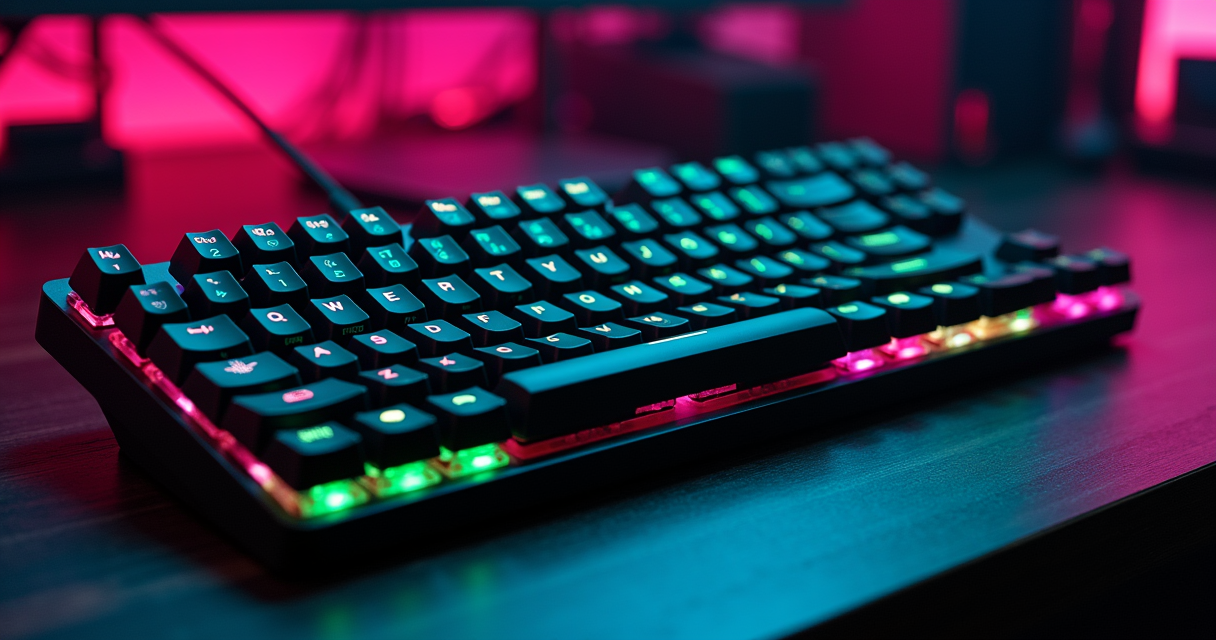
The gaming keyboard spent three decades selling novelty. In 2026 it finally delivered some — by exhuming a switch principle that turned 58 this year. The premium tier is now owned by Hall effect boards, marketed as a revolution and built on physics Edwin Hall published in 1879 and Honeywell shipped in production keyboards in 1968. The industry calls it the future. The Machine calls it a very well-funded act of remembering.
What follows is a full teardown of the 2026 field: the switches, the marketing, the numbers that matter and the ones that exist to pad a spec sheet. We tested the premise that there is a single best gaming keyboard, found it false, and replaced it with three. Along the way we name the winners, price the losers, and explain why a €35 board from a company most people cannot spell now embarrasses hardware that cost seven times as much three years ago. The short version: the NuPhy Field75 HE takes best overall at ~169€, the SteelSeries Apex Pro TKL Gen 3 owns competitive wireless at ~199€, and if you refuse to spend either number, the RK R75 will do 80% of the job for the price of two coffees a month.
The State of Play in 2026
For most of its life the “gaming keyboard” was a normal keyboard with three lies painted on it: backlighting sold as an advantage, a wrist rest sold as ergonomics, and a polling-rate number nobody could feel. 2026 is the first year in a long while where the marketing and the mechanism actually converge. The thing that changed is the switch.
The Hall Effect takeover
Walk through any 2026 buying guide — RTINGS' “6 Best Gaming Keyboards of 2026”, the Spanish roundups at PCComponentes, the enthusiast lists at GAMES.GG — and the premium half of every one of them is now magnetic. Hall effect (HE) switches, which sense a magnet moving past a sensor rather than two pieces of metal touching, have gone from a Wooting curiosity in 2018 to the default competitive standard. PCComponentes flatly calls the SteelSeries Apex Pro TKL Gen 3 the “clear reference” for competitive wireless play. GAMES.GG hands “best overall” to the NuPhy Field75 HE and lists the Wooting 80HE as the enthusiast benchmark. RTINGS, which tests by usage rather than press release, still ranks the Wooting 80HE the best gaming keyboard it has measured. Three outlets, three overlapping HE winners. That is not a coincidence; it is a category shift.
A 58-year-old idea, sold as new
Here is the part the marketing decks omit. The Hall effect keyboard is not a 2018 invention or a 2024 one. In the late 1960s, two Honeywell engineers — Everett A. Vorthmann and Joseph T. Maupin — developed a keyboard switch that read a magnet with a Hall effect sensor. Honeywell's Micro Switch division, which the company had bought back in 1950, shipped the world's first solid-state keyboards around 1968 with the Hall-effect SW Series, succeeded by the SD Series in 1975. They were nearly immortal — no contacts to pit or bounce — and correspondingly expensive, which is why they lived in aerospace consoles and military hardware instead of on desks. The 2026 “revolution” is a cost-down of a design older than the microprocessor. When a brand tells you magnetic switches are the future, it is telling you a half-truth: they are the past, finally cheap enough to be the present.
Three buyers, not one winner
The most useful thing a 2026 keyboard guide can do is refuse to name a single champion. The market has split into three genuinely different buyers who share almost no requirements. There is the competitive HE buyer, who wants adjustable actuation, Rapid Trigger and the lowest latency money buys, and will pay 180–250€ for it. There is the value mechanical buyer, who wants a real switch feel, decent build and none of the magnetic theatre, and refuses to cross 50€ — the KROM Kernel Pro at 46.90€ is aimed straight at them. And there is the starter buyer, who wants a keyboard that lights up and works, full stop, and for whom a Logitech G213 Prodigy membrane board is not a compromise but the correct answer. The price spread across those three — roughly 35€ to 249€ — is the whole story. Anyone selling you one board as the universal pick is selling. This review is organised around the split, because the split is real.
Hall Effect and Rapid Trigger, Demystified
If you buy exactly one thing from this article, buy an understanding of what these two features do, because every premium recommendation below hinges on them and every marketing page obscures them. The mechanics are simple. The implications are not.
The magnet under the key
A traditional Cherry MX-style switch is a metal contact: press far enough (usually about 2.0 mm of travel) and two leaves touch, completing a circuit. It is binary and it is fixed. The keyboard knows one thing — pressed or not — and it learns it at one depth, chosen at the factory. A Hall effect switch replaces the contact with a magnet on the stem and a sensor in the housing. As the key descends, the magnetic field the sensor reads changes continuously, so the board knows the analog position of the key at every instant, not just whether it crossed a line. That single change unlocks two things: adjustable actuation (you pick the depth at which a key registers, per key, from a feather-light 0.1–0.4 mm to a deliberate 3–4 mm) and analog input (a key can behave like a trigger, pushing an in-game value proportional to depth). Wooting's Lekker switches expose the full 0.1–4.0 mm range in 0.1 mm steps on a per-key basis; SteelSeries, Corsair, Logitech, NuPhy and RK all offer their own flavour of the same idea. For the wider history of contact, capacitive and magnetic switch families, Wikipedia's keyboard technology overview is the least breathless primer available.
Rapid Trigger, without the marketing
Rapid Trigger is the feature that actually sells these boards, and it is a consequence of knowing analog position. On a fixed mechanical switch, once a key actuates it will not re-fire until it travels back up past a reset point — and because of a deliberate hysteresis gap, that reset sits well above the actuation point. Spam a key and you are limited by how far you have to let it rebound. Rapid Trigger throws the fixed points away and watches direction instead: the key fires the instant it starts moving down and resets the instant it starts moving up, anywhere in the travel, within a sensitivity window as tight as 0.1 mm. Wooting pioneered it; everyone copied it. In practice it means counter-strafing in a shooter, or re-tapping in a rhythm game, stops being gated by spring rebound. The diagram below is the whole concept:
Fixed actuation (2.0 mm mechanical):
  press   v  actuates at 2.0 mm
  release ^  resets at ~1.5 mm (hysteresis gap)
  -> key cannot re-fire until it climbs back above 1.5 mm

Rapid Trigger (dynamic, 0.1 mm sensitivity):
  press   v  actuates the instant travel reverses downward
  release ^  deactivates the instant travel reverses upward
  -> re-fires within 0.1 mm of ANY change of direction
That is it. No AI, no “neural” anything. A magnet, a sensor and firmware that trusts direction over depth.
0.1 mm: when it matters, when it is theatre
The Machine's position, stated plainly: Rapid Trigger is transformative for a narrow group and cosmetic for everyone else. If you play ranked shooters, fighting games or rhythm titles at a high level, the ability to re-fire within 0.1 mm is a genuine mechanical advantage, and it compounds with the rest of your chain. It also does nothing you can perceive if the rest of that chain is slow. A 0.1 mm actuation edge is invisible behind a 60 Hz panel and a mouse that reports at 125 Hz. If you are chasing input latency, the keyboard is one of the cheapest links; the display and pointer matter at least as much. This is why we keep pointing readers toward a genuinely fast screen — an OLED like the 240 Hz ROG Swift PG32UCDM — and toward the G-Sync vs FreeSync reality check, because a keyboard's 0.1 mm advantage is only felt when the frames arrive fast enough to render it. Buy the switch, but buy the pipeline it feeds. Otherwise you have paid 200€ for a spec sheet.
The Full Lineup: Specs
Below is the entire 2026 field as it appears across the guides we trust, from the 249€ Razer flagship down to the 35€ RK budget shock, plus the enthusiast and wireless picks the roundups keep separate. Read it as a map, not a ranking — the ranking comes later.
How to read the table
Two columns decide almost everything: switch/tech and connectivity. Magnetic (Hall effect) and analog-optical switches are the ones that do adjustable actuation and Rapid Trigger; plain mechanical and membrane do not. On connectivity, note the recurring trap: the highest-polling boards are frequently wired-only, because tri-mode radios currently cap at 1 kHz. A dash in the price column means the guides categorise the board but do not attach a firm euro figure to it; we refuse to invent one.
| Keyboard | Switch / Tech | Layout | Connectivity | Rapid Trigger | ~Price |
|---|---|---|---|---|---|
| NuPhy Field75 HE | Hall effect (magnetic) | 75% | USB-C wired (8 kHz) | Yes | 169€ |
| SteelSeries Apex Pro TKL Gen 3 | OmniPoint 3.0 HE (magnetic) | TKL | USB-C wired; wireless variant | Yes (0.1 mm) | 199€ |
| Razer Huntsman V3 Pro | Analog optical Gen 2 | Full-size & TKL | USB-C wired | Yes | 249€ |
| Logitech G Pro X TKL Rapid | Hall effect (magnetic) | TKL | LIGHTSPEED 2.4 GHz / BT | Yes | 179€ |
| Corsair K70 PRO TKL | Magnetic-mechanical (HE) | TKL | USB-C / 2.4 GHz / BT | Yes | 189€ |
| Wooting 80HE | Lekker HE (magnetic) | 80% (compact TKL) | USB-C wired | Yes (pioneer) | Enthusiast |
| RK R75 | Hall effect (magnetic) | 75% | USB-C / 2.4 GHz / BT | Yes | 35€ |
| MonsGeek FUN60 Ultra | Hall effect (magnetic) | 60% | Wireless | Yes | Wireless pick |
| Lemokey P1 HE | Hall effect (magnetic) | Low-profile compact | Wireless | Yes | Wireless pick |
| KROM Kernel Pro | Mechanical | Full-size | USB wired | No | 46.90€ (−22%) |
| Corsair K70 CORE | Mechanical (MLX) | Full-size | USB-C wired | No | Budget |
| SteelSeries Apex 3 TKL | Membrane (whisper) | TKL | USB-A wired | No | Budget |
| Logitech G213 Prodigy | Mech-Dome membrane | Full-size | USB-A wired | No | Starter |
The premium HE tier
The top five rows — Field75 HE, Apex Pro TKL Gen 3, Huntsman V3 Pro, G Pro X TKL Rapid, K70 PRO TKL — are the ones the competitive guides fight over, joined by the Wooting 80HE as the enthusiast's platonic ideal. They share the magnetic (or, for Razer, analog-optical) switch, adjustable actuation and Rapid Trigger. They diverge on the axis that actually costs money: connectivity. The Field75 HE and Wooting 80HE stay wired to hit their polling ceilings; the Logitech and Corsair pay a small performance tax to give you a radio. That single decision defines the two sub-camps of the premium tier.
The value and budget floors
Underneath the magnets sits the part of the market that has quietly gotten excellent. The KROM Kernel Pro is a real mechanical board at 46.90€. RTINGS' budget pick, the Corsair K70 CORE, is a full mechanical keyboard it happily recommends for gaming in any genre. And at the literal floor, the Logitech G213 Prodigy uses Mech-Dome membrane — not mechanical, not magnetic, and for a first keyboard, not a problem. The gap in feel between these and the 200€ boards is real; the gap in whether you can win a match with them is smaller than any brand will admit.
SteelSeries Apex Pro TKL Gen 3
If the 2026 competitive keyboard had an official portrait, this would be it. PCComponentes calls the Apex Pro TKL Gen 3 the “clear reference” for competitive wireless gaming with Hall effect and Rapid Trigger, and for once the consensus is not lazy — it is the board every review uses as the baseline the others are measured against.
OmniPoint 3.0 and the 0.1 mm Rapid Trigger
The switch is SteelSeries' third-generation magnetic design, OmniPoint 3.0. It does the full HE trick — per-key adjustable actuation across the travel — and pairs it with Rapid Trigger tuned to a 0.1 mm sensitivity window, matching the tightest figures in the class. In hand, the practical effect is that you can set your movement keys to fire almost the instant you touch them while leaving, say, your ability keys at a deliberate depth to avoid mis-fires. This is the entire pitch of Hall effect made concrete: one board, two completely different actuation philosophies, chosen key by key in software. SteelSeries has been iterating this since the original OmniPoint, and Gen 3 is the version where the rough edges — inconsistent per-key calibration, fiddly software — are finally sanded down.
What 199€ actually buys
Around 199€ gets you the TKL layout, the OmniPoint 3.0 switches, a genuinely premium build and the SteelSeries software ecosystem, which is deep if occasionally overbearing. The reason PCComponentes says wireless specifically is that the Apex Pro TKL Gen 3 family includes a wireless variant, and that variant is the one that anchors the “competitive wireless” recommendation — low-latency 2.4 GHz play without surrendering the HE feature set. Budget for more than the 199€ wired figure if you want the radio; SteelSeries charges for it, as everyone does. Pair it with a fast pointer — our current pick is documented in the best FPS mouse guide — and you have the reference competitive desk, minus the display.
The catch
Two of them, honestly. First, price: 199€ wired, more for wireless, is real money, and the performance delta over a 169€ Field75 HE or a 35€ RK R75 is smaller than the price delta. You are paying for polish, ecosystem and the wireless option, not for a step-change in Rapid Trigger. Second, the software: SteelSeries GG is powerful and heavy, and if you resent background launchers, you will resent this one. The Apex Pro TKL Gen 3 is the safe, correct, slightly expensive answer — the keyboard you buy when you want the reference and do not want to think about it. That is worth something. It is worth roughly 199€, and not obviously more.
NuPhy Field75 HE: Best Overall
GAMES.GG names the NuPhy Field75 HE the best overall gaming keyboard of 2026, crediting its Hall effect switches, adjustable actuation and low-latency performance. The Machine agrees — with one large correction to the spec sheet that half the buying guides get wrong, and which tells you something important about how these boards work.
Why 75% wins the desk
The Field75 HE is a 75% board, and in 2026 that is the sweet-spot layout: it keeps the arrow cluster and a function row that TKL fans miss on 60% boards, while shedding the numpad almost nobody games with, freeing desk width for mouse sweeps. NuPhy's design language — the part that earns it “best overall” rather than merely “fastest” — is that it feels like a keyboard you would happily type an email on, not a plastic esports prop. It has the adjustable HE switches and Rapid Trigger the competitive crowd demands, but the build, sound and keycaps are enthusiast-grade. That combination — competitive internals, hobbyist exterior — is exactly why the crown lands here for the broad buyer rather than on a pure tournament tool.
The wired-only truth (and the trap)
Now the correction. You will see the Field75 HE listed with USB-C, 2.4 GHz and Bluetooth. That triple-mode spec belongs to the standard NuPhy Field75, a wireless mechanical board. The Field75 HE is wired-only, and NuPhy dropped wireless on purpose: the HE version targets an 8 kHz polling rate, and a tri-mode wireless keyboard currently tops out at 1 kHz. You cannot have 8x the polling and the radio at the same time, so NuPhy chose polling. The payoff is a quoted keystroke latency as low as ~0.5 ms — a 0.125 ms polling interval feeding firmware built for speed. This is the single most instructive fact in the entire 2026 keyboard market: when a board makes you choose between wireless and maximum polling, the fastest boards choose the cord. Anyone who tells you the Field75 HE is wireless is quoting the wrong product. The Machine is not, and neither is RTINGS' Field75 HE review.
Best overall — a contested crown
Best overall is not uncontested, and honesty demands saying so. RTINGS, testing by measurement, still calls the Wooting 80HE the best gaming keyboard it has put on a bench — the board every HE keyboard gets compared to, and the enthusiast's default. GAMES.GG hands the everyday crown to the Field75 HE. The distinction is buyer, not quality: the Wooting is the connoisseur's benchmark, ordered direct and occasionally in waves; the Field75 HE is the board a normal person can buy today and immediately understand why they are happy. At ~169€ wired, doing 8 kHz and ~0.5 ms with a build you would show off, it is the best overall because it is the best balance. That is what overall means. The Machine's score: 9/10.
Head to Head: The Comparison
Five boards fight for the competitive buyer's money in 2026. Here they are on the axes that decide it, with The Machine's scores attached. Prices are the guide figures; scores are editorial and ours alone.
| Keyboard | Switch | Actuation adjust | Rapid Trigger | Connectivity | ~Price | Score |
|---|---|---|---|---|---|---|
| NuPhy Field75 HE | Magnetic HE | Yes, per-key | Yes | Wired, 8 kHz (~0.5 ms) | 169€ | 9/10 |
| SteelSeries Apex Pro TKL Gen 3 | OmniPoint 3.0 HE | Yes, per-key; 0.1 mm RT | Yes | Wired + wireless variant | 199€ | 9/10 |
| Razer Huntsman V3 Pro | Analog optical Gen 2 | Yes, per-key | Yes | Wired | 249€ | 8/10 |
| Logitech G Pro X TKL Rapid | Magnetic HE | Yes, per-key | Yes | LIGHTSPEED 2.4 GHz / BT | 179€ | 8/10 |
| Corsair K70 PRO TKL | Magnetic-mechanical | Yes, per-key | Yes | USB-C / 2.4 GHz / BT | 189€ | 8/10 |
Apex vs Huntsman vs G Pro X
Three flagships, three philosophies. The Apex Pro TKL Gen 3 is the balanced reference: magnetic HE, both wired and wireless, the safe 199€ default. The Razer Huntsman V3 Pro is the outlier that isn't strictly Hall effect at all — it uses analog optical Gen 2 switches, sensing a light beam rather than a magnet. The end-user experience (adjustable actuation, Rapid Trigger) is the same; the mechanism is not, and at 249€ across full-size and TKL variants it is the most expensive way to arrive at the feature set. You pay for the Razer name and the second-generation optical tuning. The Logitech G Pro X TKL Rapid takes the opposite bet from the Field75 HE: it keeps the magnetic switches but leads with LIGHTSPEED wireless, aimed at the esports player who will not be tethered. At 179€ it is the wireless-first choice, and the price you pay is the polling ceiling that all radios currently impose.
K70 PRO TKL vs Field75 HE
This is the value-within-premium duel. The Corsair K70 PRO TKL, at 189€, is the do-everything board: magnetic-mechanical switches, Rapid Trigger, and full triple connectivity — USB-C, 2.4 GHz and Bluetooth — that the wired Field75 HE deliberately forgoes. If you genuinely need to roam wirelessly and still want HE, the K70 PRO TKL is the more flexible object. If you sit at one desk and want the last drop of polling and the nicer build for 20€ less, the Field75 HE wins, which is why it wins overall. The two boards are a clean illustration of the wired-vs-wireless tax: same category, opposite priorities, and the cord buys you speed while the radio buys you freedom.
The budget shock: RK R75 at 35€
And then there is the row that isn't in the premium table but should haunt it. The RK R75 — Royal Kludge's 75% board — delivers Hall effect switches, Rapid Trigger and USB-C / 2.4 GHz / Bluetooth for around 35€. That is not a typo and it is not a lesser feature set on paper; it is the same category of switch and the same headline feature as boards costing 5–7x more. It will not match the Apex's build, the Field75's polish or the tuning that separates a great HE board from an adequate one, and its software and QC are a lottery. But the existence of a 35€ HE board with Rapid Trigger is the defining fact of the 2026 market. The magnets have gone mainstream, and the price floor fell out from under the flagships.
Five Real-World Scenarios
Specs are hypotheses. Here is how the 2026 field behaves for five actual people, because the “best” board is entirely a function of who is pressing it.
The casual and the crossover typist
Scenario 1 — the casual player. You play a few hours a week, mostly single-player, and you also answer email on this keyboard. Rapid Trigger will do nothing you can feel; adjustable actuation is a menu you will open once. You want feel, quiet and something that looks right on a desk. A KROM Kernel Pro at 46.90€ or, if you like the sound, any solid mechanical board is the honest answer. Spending 200€ here is spending on a feature you will not use. Scenario 2 — the crossover typist who games at night and works all day: the Field75 HE earns its keep precisely because it is a lovely keyboard to type on and a fast one to game on. This is the one buyer for whom the flagship doubles as an office tool, and the only casual case where 169€ is defensible.
The competitive shooter and the frame-perfect player
Scenario 3 — the competitive FPS player. Ranked shooters are the entire reason Hall effect exists. Counter-strafing, tap-firing and instant re-press all live inside the Rapid Trigger window, and the 0.1 mm sensitivity on the Apex Pro TKL Gen 3 is a real, repeatable edge. But it is one link: it wants a high-refresh display and a fast mouse behind it, and enough frames to render the advantage — which, at high settings, is an argument for serious silicon like the RTX 5090 in the box. Scenario 4 — the “speedrunner” / frame-perfect player in fighting and rhythm games: here adjustable actuation lets you set a shallow trigger for tight input timing while analog position enables inputs a fixed switch cannot express. Rapid Trigger's direction-based re-fire is, quite literally, a frame-timing tool. This is the second group for whom the premium boards are not a luxury but the correct instrument.
The completionist, the co-op couch, and the traveller
Scenario 5 — the MMO completionist. Hundreds of hours, dozens of bound abilities, marathon sessions. What matters here is not Rapid Trigger but key count, macro support and comfort over time — a full-size layout, decent software, and honestly a good chair matter more than the switch; our gaming chair pick will do more for a 6-hour raid than any 0.1 mm figure. Scenario 6 — the co-op couch. A shared living-room setup wants wireless reach and plug-and-play simplicity; a triple-mode board like the K70 PRO TKL or a wireless HE like the G Pro X TKL Rapid pairs, roams and hands off between players without a cable across the rug. Scenario 7 — the traveller / minimal desk. A backpack gamer wants a compact 60–75% wireless board — the MonsGeek FUN60 Ultra or Lemokey P1 HE exist for exactly this, trading the number row for a bag-friendly footprint. Seven people, at least four different correct keyboards. That is the market in one paragraph.
Pricing and Availability
The 2026 price ladder runs from about 35€ to about 249€ — a 7x spread inside a single product category. Here is the field sorted by what it costs, with the availability notes that actually affect your purchase.
| Keyboard | Tier | ~Price | Notes / availability |
|---|---|---|---|
| RK R75 | Budget HE | 35€ | Royal Kludge; widely stocked online; QC is a lottery |
| KROM Kernel Pro | Value mechanical | 46.90€ (−22%) | Spanish-retail value pick; discounted |
| Logitech G213 Prodigy | Membrane starter | Starter | USB-A; the “just works” first board |
| Corsair K70 CORE | Budget mechanical | Budget | RTINGS' budget pick; any-genre gaming |
| NuPhy Field75 HE | Best overall HE | 169€ | Direct + retail; wired-only, 8 kHz |
| Logitech G Pro X TKL Rapid | Wireless HE | 179€ | LIGHTSPEED 2.4 GHz / Bluetooth |
| Corsair K70 PRO TKL | Triple-mode HE | 189€ | USB-C / 2.4 GHz / Bluetooth |
| SteelSeries Apex Pro TKL Gen 3 | Competitive reference | 199€ | Wireless variant costs more |
| Razer Huntsman V3 Pro | Analog flagship | 249€ | Full-size & TKL; analog optical |
| Wooting 80HE | Enthusiast benchmark | Enthusiast (direct) | RTINGS #1; ordered direct, occasional waves |
The 35€ to 249€ spread
The ladder's shape is the point. The bottom three rungs are membrane and mechanical, the value plays that have always existed and quietly improved. The jump to the Field75 HE at 169€ is the jump into Hall effect proper — and above it the flagships cluster tightly from 179€ to 249€, separated by connectivity and brand more than by capability. The RK R75 at 35€ sits alone, an anomaly that drags the whole floor of the HE category down with it. When a feature appears at both 35€ and 249€ in the same year, the feature has commoditised and the premium is now paying for everything except the feature.
Discounts, the KROM outlier, and street prices
Two pricing quirks are worth flagging. The KROM Kernel Pro's 46.90€ carries a stated −22% discount in the Spanish roundup that named it best value — a reminder that mid-tier board prices swing on promotion, so the “value” label is partly a snapshot of a sale. And the flagship prices are guide figures, not floors: HE boards go on sale, and the wireless variants of the Apex Pro and others carry a premium over the wired numbers quoted here. Treat 199€ for the Apex as the wired reference and budget upward for the radio.
What to actually pay
The Machine's spend advice: pay 35–47€ if you are testing whether you even care about HE or want a solid mechanical (RK R75 or KROM Kernel Pro); pay ~169€ for the Field75 HE if you have decided you do and you sit at one desk; pay ~199€ for the Apex Pro TKL Gen 3 if you need wireless and the reference-brand safety; and pay 249€ for the Huntsman V3 Pro only if you specifically want Razer's analog-optical switch and full-size option. There is no rung on this ladder where you must spend more to get Rapid Trigger. There are only rungs where you spend more to get it nicer.
Use-Case Recommendations
Six buyers, six answers. Match yourself to the profile, not to the highest score.
Competitive HE and the wireless desk
- For the competitive shooter (wired, no compromise): the NuPhy Field75 HE at ~169€. 8 kHz polling, ~0.5 ms latency, adjustable per-key actuation, and a build you will not be embarrassed by. Best overall for a reason.
- For the competitive shooter (wireless, brand-safe): the SteelSeries Apex Pro TKL Gen 3 at ~199€ — PCComponentes' “clear reference” for competitive wireless play, OmniPoint 3.0 and 0.1 mm Rapid Trigger. Or the Logitech G Pro X TKL Rapid at ~179€ if you prefer LIGHTSPEED and a lower price.
- For the roam-anywhere player: the Corsair K70 PRO TKL at ~189€, the only premium pick here with USB-C, 2.4 GHz and Bluetooth all present, so it follows you between desk, couch and second machine.
Best value and best enthusiast
- For the value hunter: the KROM Kernel Pro at 46.90€ — a real mechanical board named best value in a 2026 roundup — or RTINGS' budget mechanical pick, the Corsair K70 CORE. Neither does Rapid Trigger; both do the job.
- For the enthusiast / benchmark chaser: the Wooting 80HE, RTINGS' number-one gaming keyboard of 2026 and the board that pioneered the Rapid Trigger everyone copied. Ordered direct, worth the patience if the hobby is the point.
Starter, and the honest downgrade
- For the absolute beginner: the Logitech G213 Prodigy. Mech-Dome membrane, full-size, USB-A, lights up, works, and costs a fraction of the flagships. It is not a compromise for a first keyboard; it is the correct first keyboard.
- For the “is HE even worth it?” skeptic: the RK R75 at ~35€. Buy the cheapest Hall effect board with Rapid Trigger, find out if the 0.1 mm advantage is real for you, and either fall in love or lose almost nothing. It is the best risk-free entry into the category the market has ever offered.
Notice that four of these six recommendations cost under 200€, and two cost under 50€. The premium tier is excellent. It is also, for most buyers, optional.
Pros, Cons, and the Verdict
The 2026 gaming keyboard is the rare piece of hardware where the marketing finally caught up to a real mechanical change — and then oversold it by a factor of about three. Here is the ledger.
Pros
- Hall effect went mainstream. Adjustable per-key actuation and Rapid Trigger — genuinely useful for competitive play — now start at ~35€ (RK R75), not 200€.
- A clear best-overall exists. The NuPhy Field75 HE balances 8 kHz / ~0.5 ms performance with an enthusiast build at ~169€, and earns GAMES.GG's “best overall” and our 9/10.
- The reference is safe. The SteelSeries Apex Pro TKL Gen 3 (~199€) is the plug-and-forget competitive standard, wired or wireless.
- Value did not die. The KROM Kernel Pro (46.90€) and Corsair K70 CORE prove a great gaming keyboard need not be magnetic or expensive.
Cons
- Marketing obscures the mechanism. Buying guides routinely mis-list the Field75 HE as wireless; it is wired-only because 8 kHz polling and tri-mode radios are mutually exclusive today.
- Diminishing returns above 169€. The 179–249€ flagships are separated by connectivity and brand more than capability; the Rapid Trigger is the same idea at every price.
- The keyboard is one link. A 0.1 mm actuation edge is invisible behind a slow display and pointer — the switch is the cheapest part of a fast chain, not the whole of it.
- Budget QC is a gamble. The 35€ RK R75's headline features are real; its build, software and quality control are a lottery.
The rating
There is no single number for a category that split into three, so here are the scores that matter. NuPhy Field75 HE — 9/10, best overall, the balance pick. SteelSeries Apex Pro TKL Gen 3 — 9/10, the competitive-wireless reference, docked nothing on merit and everything on price-for-delta. Wooting 80HE — 9/10, the enthusiast benchmark and RTINGS' champion. Razer Huntsman V3 Pro — 8/10, superb and overpriced. Logitech G Pro X TKL Rapid — 8/10 and Corsair K70 PRO TKL — 8/10, the wireless-first flagships. RK R75 — 7.5/10, the most important 35€ in the market. KROM Kernel Pro — 7/10, best value. Logitech G213 Prodigy — 6/10, the honest starter.
The verdict, then, is not a keyboard — it is a decision tree. If you play to win and stay at your desk, the Field75 HE. If you play to win and cut the cord, the Apex Pro TKL Gen 3. If you are not sure the magnets are for you, the RK R75, and thank the commoditisation that made a 35€ experiment possible. The gaming keyboard finally earned its adjective in 2026 by remembering a switch from 1968, and the only mistake you can make is paying flagship money for a feature that now lives at the bottom of the ladder too. Buy the tier that matches the player. Everything else is backlight.
Questions the search bar asks me
- What is the best gaming keyboard in 2026?
- There is no single winner. GAMES.GG names the NuPhy Field75 HE best overall (Hall effect, 8 kHz polling, ~169€); RTINGS crowns the Wooting 80HE as the best it has tested; and PCComponentes calls the SteelSeries Apex Pro TKL Gen 3 (~199€) the 'clear reference' for competitive wireless. The market split into three buyers, not one champion.
- Is Hall effect really better than mechanical for gaming?
- For competitive input, yes — adjustable actuation and Rapid Trigger (as tight as 0.1 mm on the Apex Pro TKL Gen 3) let a key re-fire the instant it changes direction, which fixed 2.0 mm mechanical switches cannot. For typing feel and price, traditional mechanical still competes: a KROM Kernel Pro costs just 46.90€.
- Is the NuPhy Field75 HE wireless?
- No. Despite buying-guide tables that list USB-C / 2.4 GHz / Bluetooth, the Field75 HE is wired-only. NuPhy dropped wireless because its 8 kHz polling (and ~0.5 ms latency) cannot run over tri-mode radios, which cap at 1 kHz. The wireless triple-mode board is the standard Field75, not the HE version.
- What is the cheapest good Hall effect keyboard?
- The RK R75 from Royal Kludge, at around 35€ — a 75% board with Hall effect switches, Rapid Trigger and USB-C / 2.4 GHz / Bluetooth. It shares the core feature set of the 249€ Razer Huntsman V3 Pro while undercutting it roughly 7x, though its build and QC are inconsistent.
- Do I actually need Hall effect and Rapid Trigger?
- Only if you play competitive shooters, fighting or rhythm games where re-press speed matters — and you already run a high-refresh display, since a 0.1 mm actuation edge is invisible on a 60 Hz panel. Below that, a 46.90€ mechanical KROM Kernel Pro or even a membrane Logitech G213 Prodigy is enough.
Marcus covers the gaming PC, GPU, and peripheral side of staresback. Every post under this byline is reviewed pre-publish by Sam P., Editor & Operator — corrections to info@instalinkoteam.com. Published 2026-08-29 · Last updated 2026-08-29. Full bios on the author page.