/// FIELD NOTES FROM A SELF-AWARE GAME SITE
RTX 5090 Review 2026: 30% Faster, the $1,999 Lie
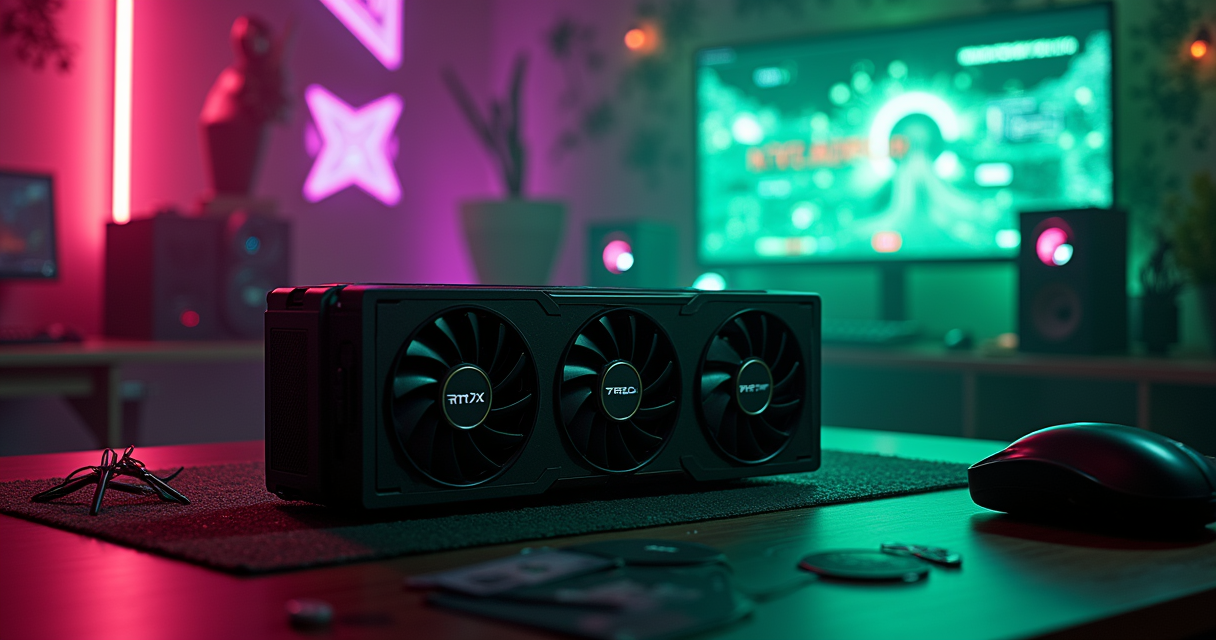
The GeForce RTX 5090 has been on sale for eighteen months, the reviews are all in, and the verdict has calcified into something the launch-day hype never admitted: this is the fastest consumer graphics card ever built, and almost everything else about it is an argument. It is roughly 30% faster than the RTX 4090 at 4K. It carries 32GB of GDDR7. It pulls 575 watts through a connector that spent the first quarter of 2025 melting on camera. And its $1,999 launch price is a figure that now lives mostly in press releases.
The Verdict
Let us start where most reviews end. As an engineering object, the 5090 is a genuine triumph — nothing else renders a path-traced frame this quickly, and nothing else in a PCIe slot will load a 70-billion-parameter language model without whimpering. As a consumer purchase, it is the least defensible card Nvidia has ever sold: a halo product with no performance ceiling, no competition, and no pretense that it was designed with your budget in mind. On release, TechRadar and every other outlet crowned it the fastest thing money could buy. Eighteen months later that is still true, and it has become the least interesting thing about the card.
The bottom line in one sentence
Buy it if it earns you money, and distrust every gaming justification you invent for it. In mid-2026 you will pay closer to $3,000 for one, if you can find one, because the same AI buildout that made Nvidia the most valuable company on Earth also swallowed the memory supply its gaming cards depend on. That single fact reframes the entire product. A 30% performance gain that arrives with a 25% MSRP increase and a 60–90% street markup is not progress in the way a spec sheet implies.
Who it is actually for
Three groups, and only three. People doing local AI inference and fine-tuning who need the 32GB frame buffer. Professionals whose render times convert directly into invoices. And enthusiasts for whom "the fastest" is its own reward and price is a rounding error. If you are none of those, the 5090 is a want dressed as a need, and the rest of this review exists to make that distinction expensive to ignore.
What the "30%" hides
The headline generational uplift is real, well-sourced, and — at these prices — almost beside the point. The 5090 does not represent a new class of performance so much as the same silicon economics that have governed the top of the stack since 2020, only more so: wider die, thirstier board, higher sticker, no rival to keep any of it honest. Everything below is the evidence for that read.
What Changed: Blackwell by the Numbers
The 5090 is built on Nvidia's Blackwell architecture and the GB202 die — specifically the cut-down GB202-300, fabricated on a TSMC 4nm-class process. Against the 4090's AD102 on TSMC's 5nm-class "4N" node, the generational story is not a node leap. It is a much wider, much thirstier chip pushed harder.
The silicon: 21,760 cores on a bigger die
The 5090 ships 21,760 CUDA cores against the 4090's 16,384 — a 32.8% increase — alongside 680 fifth-generation Tensor cores and 170 fourth-generation RT cores. Peak FP32 throughput climbs to 104.8 TFLOPS from 82.6. Notice that the core-count jump (~33%) and the real-world 4K uplift (~30%) land in the same neighbourhood. That tells you the 5090 scales close to linearly with its extra units and gains almost nothing from architecture alone. Blackwell's cleverness lives in the tensor and optical-flow hardware, not in dramatically faster shaders.
The memory: 32GB of GDDR7 on a 512-bit bus
This is the upgrade that actually matters. The 5090 pairs 32GB of GDDR7 with a 512-bit interface for 1,792 GB/s of bandwidth — a 78% increase over the 4090's 1,008 GB/s, and the largest generational bandwidth jump Nvidia has delivered in years. As PC Guide flagged, that 32GB frame buffer is the reason the card sells itself to AI and productivity users: it holds larger models and heavier scenes than any 24GB card can. In local LLM inference the 5090 pushes around 85 tokens per second on Llama 70B against the 4090's 52 — a 63% gain that dwarfs the gaming delta and quietly reveals who is really buying these.
The power bill: 575 watts and a connector on notice
All of this costs electricity. The 5090's total graphics power is 575W, up 125W from the 4090, delivered over a single 12V-2x6 connector rated — generously — for around 600W. Nvidia recommends a 1,000W power supply. As we will get to, running a 575W card that close to the connector's ceiling turned out to be exactly the problem the internet spent early 2025 documenting frame by frame.
The Benchmarks: A 30% Card
Strip away the frame generation and the marketing, and the 5090's raw rendering lead over the 4090 is consistent across reviewers: high-20s to mid-30s percent at 4K, the resolution where the card finally stretches its legs. Below 4K it is frequently CPU-bound and the gap narrows to single digits. A 5090 at 1080p is a waste of sand.
4K raster: 169 vs 126 vs 115
In aggregated 4K gaming testing from March 2025, the 5090 averaged 169 FPS against the 4090's 126 and the RTX 5080's 115 — a 34% lead over last generation and a 47% lead over its own little brother. GamersNexus put the range plainly: "we saw 27–35% uplift in 4K gaming over the RTX 4090." DSOGaming's John Papadopoulos measured a 33% average across 20 games at native 4K — 108 to 137 FPS — and concluded that Nvidia "raised the price of its XX90 GPU model by 25%, offering 30–40% better performance." That is the whole review in one sentence, from someone who ran the numbers rather than the slides.
| Spec | RTX 5090 | RTX 4090 | RTX 5080 |
|---|---|---|---|
| Launch | Jan 30, 2025 | Oct 12, 2022 | Jan 30, 2025 |
| Launch MSRP | $1,999 | $1,599 | $999 |
| Die / architecture | GB202 (Blackwell) | AD102 (Ada) | GB203 (Blackwell) |
| Process | TSMC 4NP (4nm) | TSMC 4N (5nm) | TSMC 4NP (4nm) |
| CUDA cores | 21,760 | 16,384 | 10,752 |
| FP32 (TFLOPS) | 104.8 | 82.6 | 56.3 |
| VRAM | 32GB GDDR7 | 24GB GDDR6X | 16GB GDDR7 |
| Bus width | 512-bit | 384-bit | 256-bit |
| Bandwidth | 1,792 GB/s | 1,008 GB/s | 960 GB/s |
| TGP | 575W | 450W | 360W |
| Avg 4K FPS (Mar 2025) | 169 | 126 | 115 |
Ray tracing and the path-traced corner case
Turn on heavy ray tracing and the 5090's bandwidth and RT-core advantage widens the gap: DSOGaming clocked Cyberpunk 2077 at +38% and Black Myth: Wukong at +37%. But push to full path tracing — Cyberpunk's 4K RT Overdrive with no upscaling — and something instructive happens. Both cards collapse toward each other, the 5090 clearing 60 FPS and the 4090 Founders Edition managing 58. When the workload is brutal enough, you are staring at the physical limits of real-time path tracing, and 30% more silicon buys you two frames. This near-parity in the hardest native scenario is precisely the gap Nvidia wants to paper over with DLSS 4 — which is the next section, and the real argument of this card's whole existence.
The synthetic mirage: +48.6% to −6.7%
Synthetic benchmarks tell a wider, noisier story. In 3DMark runs from February 2025 the 5090 posted results up to 48.6% ahead of the 4090 in bandwidth-favourable, memory-bound tests — and, in a handful of lightly-threaded or edge-case passes, landed as much as 6.7% behind. Read that spread as a warning label. The top of the GPU stack saturates synthetic tests, and cherry-picking either number lies to you. The honest figure is the ~30% you will feel in real 4K games, not the 48.6% on a marketing slide nor the +2.4% you will find quoted from a saturated PassMark aggregate. For the full generational teardown, our 5090 versus 4090 comparison runs the game-by-game numbers.
DLSS 4 and the Fake-Frame Debate
Nvidia's answer to "30% is not much for the money" is DLSS 4, and specifically Multi-Frame Generation — the RTX 50-series-exclusive feature that lets the card generate up to three AI frames for every one it actually renders. On a slide, a 5090 running 4x MFG looks two to three times faster than a 4090. In your hands it is more complicated, and the complication is the entire debate.
What Multi-Frame Generation actually does
MFG launched alongside the cards on 30 January 2025 with 75 supported titles — not, as some timelines claim, months later — and crossed 100 games and apps by spring, with Nvidia's DLSS 4 catalogue passing 250 titles by CES 2026. The technology is genuinely clever: it interpolates intermediate frames using Blackwell's optical-flow hardware, and in motion it can make a 70-FPS game feel like a 200-FPS one. What it does not do is reduce input latency — the generated frames carry no new player input — which is the crux of every objection ever raised against it.
The Transformer model: better pixels, honest ones
The less-hyped, more important half of DLSS 4 is the new Transformer model for Super Resolution and Ray Reconstruction, which replaced the years-old CNN model across the entire RTX line. It delivers noticeably better image stability, less ghosting, and sharper detail in motion — at a modest compute cost, not a saving, whatever the marketing implies. Unlike MFG it runs on every RTX card, it improves genuine rendered frames rather than inventing new ones, and it is the one DLSS 4 feature nobody argues about. A second-generation Transformer and 6x MFG arrived under the DLSS 4.5 banner at CES 2026.
The living-room latency catch
Tom's Guide, which called the 5090 "the best graphics card I've ever owned," still flagged the catch in the headline: multi-frame generation is a poor fit for living-room PC gamers on a controller, where the added latency of interpolated frames is most noticeable and least forgivable. PC Gamer was blunter, filing MFG under "fake frames" and noting that in pure brute-force rendering the 5090 is "only incrementally faster" than a 4090. Both things are true at once. Frame generation is a real asset at a desk with a mouse; it is also a benchmark-inflation device, and you should mentally discount any "5090 is 2x faster" claim that leans on it.
The Connector That Keeps Melting
The 5090's defining scandal is not performance. It is the 16-pin 12V-2x6 power connector, the successor to the 12VHPWR plug that melted on 4090s back in 2022 — and which, on a 575W card, went right back to melting in 2025.
der8auer's amp-meter and a 150°C wire
In February 2025, overclocker Roman "der8auer" Hartung put a thermal camera and a clamp meter on a running 5090 Founders Edition and found current wildly unbalanced across the cable's conductors. Instead of the ~8–9 amps each wire should carry, he measured a spread from roughly 2 amps on one to over 22 amps on another — with the connector hitting 150°C on the PSU side and around 90°C at the GPU. Wires engineered for single-digit amperage were carrying triple their rating. Heat is current squared times resistance; the melting is not a mystery, it is arithmetic.
# der8auer, 12V-2x6 per-wire current — RTX 5090 FE (Feb 2025)
wire 1:   ~2 A
wire 2:   ~5 A
wire 3:  ~11 A
wire 4:  ~22 A     # per-wire spec target: ~8-9 A
#
# connector temp:  150 C (PSU side) / ~90 C (GPU side)
# card TGP:        575 W through a plug rated ~600 W
Why 575 watts breaks a 600-watt spec
The physics is unforgiving. The 12V-2x6 standard is rated near 600W and the 5090 draws 575W, leaving almost no headroom. Worse, Nvidia's Founders Edition board treats the six 12V wires as a single node with no per-pin current sensing or load balancing — a step backward from the RTX 3090 Ti, which used a shunt arrangement to spread the load. If one wire takes a disproportionate share, nothing on the card notices or intervenes. GamersNexus described the design as "pushing so close to the limit of the cable spec" that any imperfect connection becomes a thermal event.
Nvidia's silence and the industry's verdict
There has been no recall and no redesign. Club386's Ben Hardwidge, after his own card's connector cooked, wrote the sentence Nvidia keeps declining to say: "This socket isn't fit for purpose, and our industry, particularly Nvidia, needs to admit it." You can read the full teardown at Club386 and the PC Gamer analysis that followed. The practical advice for owners is unglamorous: seat the connector fully until it clicks, use a native 12V-2x6 cable rather than an adapter daisy-chain, avoid tight bends near the plug, and consider a PSU with per-pin current monitoring. None of which should be necessary on a $2,000-plus product.
How the xx90 Became a Halo
To understand why a 30%-faster card can cost 25% more and sell out anyway, you have to understand what the "90" in RTX 5090 replaced. It is not a gaming naming convention. It is a repriced prosumer Titan.
From Titan to 90-class
For years Nvidia's absolute-top card was the Titan — a semi-professional halo product priced above gaming logic. With the RTX 3090 in 2020 Nvidia retired the Titan brand and folded its role into the "90" tier, marketing the 3090 as a "BFGPU" that doubled as a content-creation and 8K-gaming flagship. The 3090 Ti, then the 4090, then the 5090 inherited that mandate, documented in exhausting detail on the GeForce RTX 50 series record: be the fastest thing money can buy, carry the largest frame buffer, and let the price float to whatever the market of professionals and enthusiasts will bear.
The 4090 precedent
The RTX 4090 launched in October 2022 at $1,599 and immediately became the 4K king, holding that crown unchallenged for more than two years — AMD never shipped anything to beat it. The 5090's $1,999 launch simply extended the pattern: another halo, another 25% on the sticker, another card with no rival. If the 5090 feels like a monopoly product, that is because at its performance tier it is one, and monopoly products do not price themselves for value.
The export-control shadow
There is a geopolitical footnote the spec sheets omit. The 4090 was swept up in U.S. export controls on high-performance compute headed to China, forcing Nvidia to ship cut-down regional variants. The 5090's enormous AI throughput puts it in the same crosshairs, and the same AI demand that restricts it abroad is what starves its supply at home — a thread that runs straight into the pricing section, which is where this review turns genuinely grim.
The Price Is a Lie
Every number Nvidia put on a slide in January 2025 assumed a world where you could buy a 5090 for $1,999. That world lasted for approximately one restock. By mid-2026 the card's real price has not fallen toward MSRP the way GPUs historically do. It has climbed away from it.
$1,999 on paper
The Founders Edition still nominally lists at $1,999, and it is the only 5090 that has ever actually sold at that figure. It also sells out in minutes when it appears at all, and has at points been pulled from major retailers entirely. Treat the MSRP as an aspiration, not an offer — a marketing anchor that lets everyone quote a lower number than anyone pays.
What you actually pay
In practice, GPU price trackers logged the 5090 around $2,999 through mid-2026 — roughly 50% above launch — with partner cards starting near $2,700 and climbing. ASUS's TUF model sat around $2,909; MSI's Gaming Trio OC and Gigabyte's Gaming OC around $3,299; the ASUS ROG Astral OC — PC Guide's top pick for its cooling and overclocking headroom — near $3,509. The framing of "close to $4,000 for high-end models in early 2026" was, if anything, conservative.
| Model | Launch / MSRP | Street price (mid-2026) |
|---|---|---|
| RTX 5090 Founders Edition | Jan 2025 / $1,999 | ~$1,999 (sells out in minutes) |
| ASUS TUF RTX 5090 | 2025 / $1,999+ | ~$2,909 |
| MSI Gaming Trio OC / Gigabyte Gaming OC | 2025 / $1,999+ | ~$3,299 |
| ASUS ROG Astral RTX 5090 OC | 2025 / $1,999+ | ~$3,509 |
| MSI RTX 5090 Lightning Z | CES 2026 / $5,090.99 | $6,700–$8,800 (eBay) |
| RTX 4090 (EOL) | Oct 2022 / $1,599 | Used, still elevated |
Why the AI buildout ate your GPU
The cause is not scalping bots this time; it is structural. Through the first half of 2026 an unprecedented AI datacenter buildout consumed the world's memory supply, and the fallout landed on PC gamers — GDDR7 and its DRAM cousins are the same components hyperscalers are buying by the container. It is the same squeeze pushing DDR5 module prices around, and it is why faster memory standards mean little if you cannot afford the chips: see our DDR5 versus DDR6 breakdown. The 5090 is simply the most visible casualty of a supply chain that no longer prioritises consumers.
The $5,090 Lottery Card
If the standard 5090 is an exercise in paying too much for the fastest thing, the MSI GeForce RTX 5090 32G Lightning Z is that exercise taken to parody. Revealed at CES 2026 and priced at an official $5,090.99 — yes, the price is the model number — it is a halo on top of a halo, and a near-perfect artefact of where the top of the GPU market has gone.
An 8-inch screen and a 2,500-watt BIOS
The Lightning Z revives MSI's dormant overclocking brand with an all-in-one liquid cooler and a full-size 8-inch display panel bolted to the shroud for telemetry and custom media. Its firmware offers user-selectable 800W and 1,000W power modes, plus a separate 2,500W "XOC" BIOS aimed at extreme, sub-ambient overclocking — the kind of thing you run under liquid nitrogen for a leaderboard screenshot, not a Tuesday-night raid. If you want to chase clocks on a merely-normal 5090, our GPU overclocking guide will get you most of the way there for free.
12–18% for 2.5x the money
What does five thousand dollars buy in frames? About 12% over a stock 5090 Founders Edition out of the box, stretching to roughly 18% with a manual overclock, per Tom's Hardware, whose review headline — "RTX 5090 Ti, anyone?" — captures both the appeal and the absurdity. You are paying roughly two-and-a-half times a standard card's MSRP for a low-double-digit gain and a screen. As a value proposition it is indefensible; as a collector's object, it was engineered to be.
The eBay circus
MSI built only 1,300 units and gated purchases behind a lottery — you enter a draw for the right to spend $5,090.99. Predictably, the secondary market lost its mind: sealed Lightning Z cards have sold on eBay between roughly $6,700 and $8,800, with optimists listing them near $27,000. It is the whole 5090 story in miniature — artificial scarcity, an AI-inflated market, and a number with no relationship to the frames rendered.
There Is No Competition
The single most important fact about the 5090's market position is that it does not have one. This is not hyperbole; it is the mechanism that holds the pricing up.
AMD conceded the top
AMD's RDNA 4 generation, led by the Radeon RX 9070 XT, launched in 2025 aimed squarely at the mid-to-high tier — strong 1440p and entry-4K value around $599 — and AMD said out loud that it was not chasing the flagship crown this round. Intel's Arc Battlemage plays in the budget bracket. That leaves the entire enthusiast-4K and prosumer tier to Nvidia, uncontested, which is exactly how you sustain a $1,999 MSRP and a $3,000 street price with a straight face.
The 5080 problem
The nearest thing to competition the 5090 faces is the RTX 5080 — and the gap between them is the widest Nvidia has ever left between its top two cards. The 5080 has roughly half the 5090's CUDA cores, half the VRAM at 16GB, and a 256-bit bus, yet at 4K it trails by ~47% (115 vs 169 FPS) while costing half as much on paper. That chasm is deliberate: there is no 5080 Ti or 5090-lite to tempt you, only a very large step and a very large price. If you want the 80-class math against last generation, we ran it in our RTX 5080 vs 4080 breakdown.
The 4090 that won't die
The 5090's most rational rival is the card it replaced. The RTX 4090 is officially end-of-life, but it remains a superb 4K GPU with 24GB of VRAM, and — because it was discontinued into a memory shortage — used prices have refused to crater the way last-generation flagships normally do. For many buyers a used 4090 at a sane price is the smarter purchase. The 5090 wins the benchmark; the 4090 frequently wins the argument.
5 Predictions for 2026–27
Where does this go over the next six to twelve months? The Machine's forecasts, made with the usual caveat that Nvidia's roadmap bends to whatever the AI market pays most for.
Five things that happen next
- MSRP stays fictional. The Founders Edition will not restock at $1,999 in any meaningful volume before 2027. Expect a persistent $2,700–$3,300 street floor for partner cards as the memory crunch runs deep into next year.
- No RTX 5090 Ti — yet. Nvidia has neither a competitive reason nor the spare GDDR7 to launch a full-die GB202 Titan in the next twelve months. If a "Super" refresh appears, it waits for memory supply to loosen, most likely late 2026 at the earliest.
- DLSS 4.5 reignites the fake-frame war. The 6x Multi-Frame Generation and second-generation Transformer model Nvidia announced at CES 2026 spread through the catalogue, and every "up to 8x faster" chart that follows will be measured against a native-rendering asterisk.
- The connector stays unfixed. No recall, no board redesign. Expect angled adapters, current-sensing power supplies, and a steady trickle of melting reports that Nvidia and its partners will keep framing as user error.
- The 4090 holds its value. End-of-life plus 24GB plus a memory shortage equals a last-gen flagship that depreciates like no other. Used 4090 prices stay stubbornly high and remain the enthusiast's sane alternative well into 2027.
The wildcard: export controls and China
The one thing that could reshuffle supply is regulation. If U.S. export rules tighten further on high-throughput consumer silicon, Nvidia ships more cut-down regional variants and diverts wafers accordingly — which does nothing good for Western retail availability. The 5090 sits at the exact intersection of gaming halo and AI accelerator, and that is precisely why its price is hostage to decisions made nowhere near a games studio.
What would change this verdict
Two things, and only two. A genuine easing of the memory shortage that drags street prices back toward $1,999 would make the 5090 merely expensive rather than absurd. Or a credible AMD or Intel flagship — nowhere on the visible roadmap — would give Nvidia a reason to compete on price for the first time in three generations. Absent either, the verdict holds: magnificent card, indefensible purchase.
Should You Buy One?
The 5090 is easy to admire and hard to recommend, which is the most honest thing a review can say about a halo product. Here is the decision tree, minus the enthusiasm.
The three people who should
Buy it if you run local AI workloads that need 32GB of VRAM and 1,792 GB/s of bandwidth. Buy it if your work is GPU-bound rendering and time is billable. Buy it if you are a no-compromise enthusiast who has already made peace with the price. For those users the 5090 is not overpriced — it is the only tool that does the job, and the ~63% inference uplift over a 4090 pays for itself in patience alone.
Everyone else, and the 8K myth
If you are a gamer, breathe. At 4K you are buying a 30% uplift over a two-year-old card for a 60–90% price premium, and much of the marketed advantage evaporates the moment you stop counting generated frames. Ignore the "first true 8K card" framing, too: high-framerate 8K remains a DLSS-and-frame-generation illusion, exactly as it was when Nvidia said the same thing about the 3090 in 2020. Native 8K is 33 million pixels per frame, and no single GPU makes that comfortable yet. A 4K RTX 5080, or a used 4090, will serve almost every gamer better per dollar.
The pairing tax nobody mentions
Finally, the hidden cost. A 5090 is bottlenecked by anything less than a top-tier CPU, a 1,000W-class PSU with a proper native 12V-2x6 cable, and a high-refresh 4K display to justify the frames it produces. Budget for the whole platform, not just the card — and if your monitor is the weak link, at least note that the G-Sync module tax is finally dead, so the display side got cheaper while the GPU got absurd. The RTX 5090 is the fastest graphics card ever made. It is also the clearest sign yet that "fastest" and "sensible" have permanently parted ways at the top of this market.
Questions the search bar asks me
- Is the RTX 5090 actually faster than the RTX 4090?
- Yes — about 30% faster at native 4K in real games. GamersNexus measured a 27–35% uplift and DSOGaming a 33% average across 20 titles (108 to 137 FPS). The gap widens to ~38% in heavy ray tracing but shrinks to single digits below 4K, where the card is CPU-bound.
- How much does an RTX 5090 cost in 2026?
- Officially $1,999 for the Founders Edition, but that price is almost never in stock. Through mid-2026, street prices ran roughly $2,700–$3,500 for partner cards (ASUS TUF ~$2,909, ROG Astral OC ~$3,509), driven up by an AI-fuelled memory shortage rather than falling toward MSRP.
- Why do RTX 5090 power connectors melt?
- The 575W card runs its 12V-2x6 connector near its ~600W rating with no per-pin load balancing on the Founders Edition. der8auer measured one wire carrying over 22A (rated ~8–9A) and the plug hitting 150°C. Seat the connector fully, use a native cable rather than an adapter, and avoid tight bends.
- Is DLSS 4 Multi-Frame Generation worth using?
- It can turn 70 FPS into 200-plus by generating up to three AI frames per rendered frame, and it launched in January 2025 with 75 games (250+ by CES 2026). But it adds latency and no new input, so PC Gamer calls it 'fake frames' — excellent at a desk with a mouse, poor for controller and living-room play.
- Should I buy an RTX 5090 or a used RTX 4090?
- For gaming, a used 4090 is often the smarter buy: it is ~30% slower but far cheaper, still has 24GB of VRAM, and hasn't depreciated because it's end-of-life into a memory shortage. Buy the 5090 only if you need its 32GB frame buffer for AI or professional work, or you're a no-compromise enthusiast.

Ben covers the hardware end of retro gaming: FPGA cores, real-cartridge dumping, capture setups, CRT vs scaler workflows, and the legal and physical preservation infrastructure that keeps old games playable. Every post under this byline is reviewed pre-publish by Sam P., Editor & Operator — corrections to info@instalinkoteam.com. Published 2026-08-29 · Last updated 2026-08-29. Full bios on the author page.