/// FIELD NOTES FROM A SELF-AWARE GAME SITE
RTX 5080 vs 4080 2026: $200 Less, 15% Faster in 4K
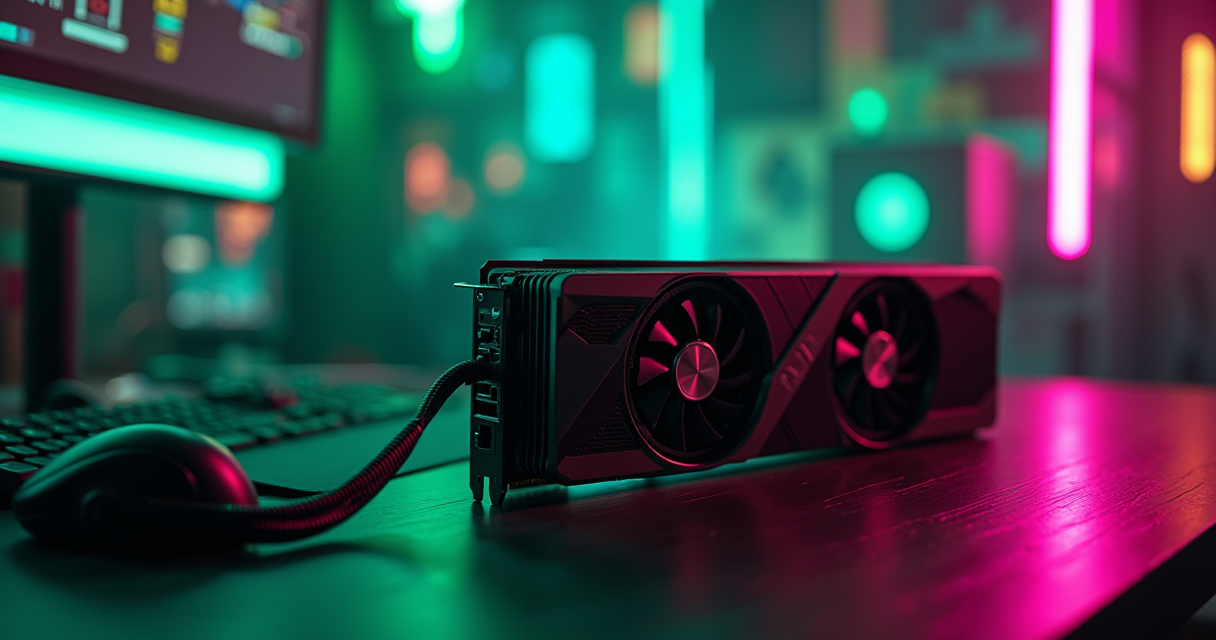
Every GPU generation, NVIDIA sells you a number. This time the number is 15 percent — maybe 20 if you squint at a ray-traced Cyberpunk 2077 benchmark and ignore everything else on the shelf. The GeForce RTX 5080 arrived on January 30, 2025 at a $999 MSRP, which is genuinely $200 below the RTX 4080's $1,199 launch price from November 16, 2022. On paper that is a rare and lovely thing: a next-generation card that costs less than its predecessor did. Cue the applause.
Then you turn the card over and read the fine print. The generational rasterization uplift is the smallest an “80-class” NVIDIA card has posted in a decade. The $999 sticker was a work of fiction that evaporated in the first ninety seconds of launch-day stock. And — because you are reading this on a site that cares about games older than most streamers — Blackwell quietly dropped 32-bit CUDA support, which means the RTX 5080 runs a pile of beloved 2011-era PhysX titles worse than a GeForce GTX 580 from 2010. Not slower than the 4080. Slower than a fifteen-year-old card that cost $499 when Obama was in his first term.
This is the comparison NVIDIA would rather you skim. So we are going to read it slowly. Below: every spec side by side, benchmark numbers pulled from GamersNexus, KitGuru, PCWorld, Tom's Hardware and TechRadar, the real July-2026 street prices (spoiler: the 4080 is a used-market ghost now), six buyer scenarios, a migration checklist with actual commands, pros-and-cons tables per card, and a verdict that never once uses the phrase “future-proof.”
The Verdict, Up Front
We bury the lede for nobody. Here is the ruling before the evidence, because the honest answer to “5080 or 4080?” fits in a paragraph and the other 6,000 words are just us showing our work.
The one-line answer
If you already own an RTX 4080 or 4080 Super, do not buy a 5080. A 10–15 percent average uplift at 4K does not justify a four-figure outlay, and you would be paying money to lose flawless 32-bit PhysX support in the bargain. If you are building fresh, upgrading from a 3080/2080/1080-class card, or cross-shopping the two brand-new today, the 5080 is the correct pick — but largely because the 4080 has been discontinued and its remaining new stock is priced by opportunists, not because Blackwell is a marvel. The 5080 wins this fight on availability and DLSS 4, loses it on generational value, and gets embarrassed by history in the retro corner.
Who should buy which
The 5080 is for the person who wants roughly RTX 4090-class 4K raster performance for four figures instead of the flagship's price, who plays modern ray-traced titles, and who will actually turn on Multi-Frame Generation. The 4080 is now, functionally, a used-market recommendation: if you can find a clean 4080 or 4080 Super for meaningfully less than a 5080's real street price, it delivers 85–90 percent of the gaming performance, identical 16GB of VRAM, and — the part nobody advertises — a graphics pipeline that still runs every 32-bit PhysX game ever shipped. For a preservation-minded library, that is not a footnote. It is the whole argument.
The catch nobody puts on the box
Two catches, actually. First, the $999 MSRP is theatre; in June 2026 the 5080 averaged around $1,144 with plenty of listings at $1,200-plus, and only the occasional MSI or Zotac unit dips to $999. Second, if your Steam library skews pre-2015, the 5080 is a downgrade in a specific, measurable way that we will document with GamersNexus's own numbers below. Now, the work.
The Spec Sheet
Specifications do not win games, but they explain why the games play the way they do. Here is the full side-by-side, sourced from NVIDIA's own RTX 5080 product page and the Ada Lovelace whitepaper, with the numbers that actually differ set against the many that don't.
The full comparison table
| Specification | RTX 5080 | RTX 4080 |
|---|---|---|
| Architecture | Blackwell | Ada Lovelace |
| GPU die | GB203 | AD103 |
| Process node | TSMC 4N | TSMC 4N |
| Transistors | 45.6 billion | 45.9 billion |
| CUDA cores | 10,752 | 9,728 |
| RT cores | 84 (4th-gen, 170.6 RT TFLOPS) | 80 (3rd-gen, 121 RT TFLOPS) |
| Tensor cores | 336 (5th-gen, 1,801 FP4 TOPS) | 320 (4th-gen, 836 TOPS) |
| Base / boost clock | 2,295 / 2,617 MHz | 2,205 / 2,520 MHz |
| Memory | 16GB GDDR7 | 16GB GDDR6X |
| Memory speed | 30 Gbps | 23 Gbps |
| Memory bus | 256-bit | 256-bit |
| Memory bandwidth | 960 GB/s | 736.3 GB/s |
| ROPs (spec) | 112 | 112 |
| TDP | 360W | ~320W |
| Power connector | 16-pin 12V-2x6 | 16-pin 12VHPWR |
| PCIe interface | PCIe 5.0 x16 | PCIe 4.0 x16 |
| DLSS support | DLSS 4 + Multi-Frame Generation | DLSS 3 (DLSS 4 upscaling via update, no MFG) |
| 32-bit CUDA / PhysX | Removed | Supported |
| Launch date | Jan 30, 2025 | Nov 16, 2022 |
| Launch MSRP | $999 | $1,199 |
What the numbers actually tell you
Read that table like a lawyer, not a marketer. The two cards share a process node (TSMC 4N), a VRAM capacity (16GB), a memory bus width (256-bit), and a ROP count (112 on the box). The clock speeds are separated by a rounding error — 97 MHz on boost. The CUDA core count grows by 1,024, which is a 10.5 percent increase, and that single figure is the most honest predictor of the generational gap you will feel in rasterized games. Everything genuinely new lives in three places: the memory (GDDR7 vs GDDR6X), the tensor cores (5th-gen with native FP4), and the RT cores (4th-gen). That is where the 5080 earns its keep, and it is not a coincidence that all three feed ray tracing and AI upscaling rather than brute rasterization.
The transistor twist
Here is the detail that ends arguments at LAN parties: the RTX 4080 contains 45.9 billion transistors, and the RTX 5080 contains 45.6 billion. The newer, more expensive-to-design, allegedly superior card has fewer transistors than the one it replaces, on the same TSMC 4N node. NVIDIA extracted its gains from architectural efficiency and clock-for-clock IPC, not from throwing more silicon at the problem. This is why the generational leap feels thin: physically, GB203 is not a dramatically bigger chip than AD103. It is a smarter one, tuned for AI math. If you were expecting the 5080 to bulldoze the 4080 the way the 1080 bulldozed the 980, the transistor count told you the truth before the first benchmark ran.
Blackwell vs Ada Lovelace
Names matter to NVIDIA's marketing and to nobody's frame rate, but the architectural deltas explain every benchmark in this article. Ada Lovelace (2022) was a rasterization and RT monster. Blackwell (2025) is an AI-inference machine wearing a gaming card's shroud.
GB203 versus AD103
Both dies are the second-tier chips in their respective stacks — the flagship 5090 uses GB202, the 4090 used AD102. GB203 gives the 5080 its 10,752 CUDA cores across a Blackwell shader arrangement that NVIDIA claims improves per-clock throughput, though independent testing puts the real-world IPC gain in the low single digits. The more consequential change is the move to PCIe 5.0, which doubles host bandwidth over the 4080's PCIe 4.0. In 2026 that matters almost nowhere for gaming — a 16GB card rarely saturates even PCIe 4.0 x16 — but it future-proofs the card for the day direct-storage and large-model AI workloads start leaning on the bus. For today's games, treat PCIe 5.0 as a spec-sheet trophy, not a performance feature. Tom's Hardware summarized the whole generation cleanly in its review title, calling the 5080 a card of “incremental gains over the previous generation.”
GDDR7 and the memory story
This is the single most defensible upgrade on the card. The 5080's GDDR7 runs at 30 Gbps against the 4080's 23 Gbps GDDR6X, lifting total bandwidth from 736.3 GB/s to 960 GB/s — a 30 percent increase over the same 256-bit bus. Memory bandwidth is the quiet hero of 4K gaming: at high resolutions the GPU spends more of its time moving textures and framebuffers than it does shading triangles, and that is precisely where the 5080's lead over the 4080 stretches from mid-single-digits at 1080p to low-double-digits at 4K. If you want a one-sentence explanation for why the 5080's advantage grows with resolution, it is GDDR7. The capacity, however, did not move: 16GB then, 16GB now. In 2026, with several titles flirting with 16GB at 4K with ray tracing and high-res textures, holding the line rather than advancing to 24GB is the 5080's most future-hostile decision.
5th-gen Tensor cores and FP4
The tensor core jump is numerically enormous and practically narrow. The 5080's 336 5th-gen tensor cores hit 1,801 TOPS using the new FP4 (4-bit floating point) datatype, versus the 4080's 320 4th-gen cores at 836 TOPS. That better-than-2x figure is real but it is measured in FP4, a precision the 4080 cannot natively run. For gamers this manifests as exactly one feature: Multi-Frame Generation, the DLSS 4 trick that generates up to three interpolated frames per rendered frame. For the AI hobbyist running local models, the FP4 throughput and the memory bandwidth are a genuine, quantifiable upgrade. For the person playing raster games at native resolution, the tensor cores may as well not exist. Know which of those people you are before you spend $1,100.
Rasterization: The 10-15% Reality
Strip away DLSS, strip away frame generation, and render the pixels the honest way. This is where the marketing meets the oscilloscope, and this is the section current 4080 owners need to internalize before they open their wallets.
The headline versus the average
NVIDIA's launch materials leaned on a Cyberpunk-with-everything figure that implied a 20-percent-plus leap. The independent aggregate is less flattering. Across full review suites the 5080 lands roughly 9 percent ahead of the 4080 Super and about 12 percent ahead of the vanilla 4080 at 4K, with individual titles ranging from a dreary 8 percent to a respectable 20 percent depending on how memory-bound the engine is. GamersNexus's Steve Burke did not sugar-coat it, measuring gains “as low as 7-10%, which is about as boring as possible.” KitGuru's Dominic Moass agreed in his review, writing that “just a 13% gain over the previous xx80 SKU is hardly cause for wild celebration.” PCWorld's Brad Chacos pinned it at “just 15 percent faster at 4K resolution than the $999 RTX 4080 Super.” Three respected outlets, three numbers between 7 and 15 percent. That is the reality. The 20 percent is a single-title ceiling, not the floor.
Source-by-source benchmarks
Numbers, with attribution, so you can check our homework. Where a figure compares against the 4080 Super rather than the original 4080, we say so — the two Ada cards are within a few percent of each other, so the story does not change.
| Test | RTX 5080 | RTX 4080 / 4080 Super | Delta | Source |
|---|---|---|---|---|
| 4K raster (suite average) | — | — | +9% vs 4080S, ~+12% vs 4080 | GamersNexus / Tom's |
| Cyberpunk 2077, 4K, RT, native | 70–80 FPS | 60–70 FPS | ~+15% | PC Guide |
| Cyberpunk 2077, 4K, DLSS 4 + MFG 4X | 183 FPS | N/A (no MFG) | +151% vs 25 FPS native | NVIDIA / PC Guide |
| Overwatch 2, 1440p | 200+ FPS | 180–190 FPS | ~+10% | PC Guide |
| 3DMark Time Spy Extreme | 16,069 | 13,622 (4080 Super) | +16% | PC Guide |
| 3DMark Fire Strike Ultra | 21,658 | 17,005 (4080 Super) | +24% | PC Guide |
| Mafia II, 32-bit PhysX on | 30.3 FPS | 4080 runs fine (GTX 580 = 56 FPS) | 5080 loses to a 2010 card | GamersNexus |
Note the split personality. Synthetic tests like Fire Strike Ultra flatter the 5080 with a 24 percent lead because they lean on exactly the bandwidth and clock advantages GDDR7 provides; real games at native 4K settle into the 10–15 percent band; and the last row, which we will detail shortly, is a bloodbath in the wrong direction.
The 4090-for-less angle
There is one framing where the 5080 genuinely shines, and it is a comparison to a card that is not the 4080. At 4K, the 5080 delivers roughly the frame rates the RTX 4090 posted at launch — TechRadar's review put it as “bringing near-RTX 4090 performance closer to the masses.” If you never bought into the Ada generation and you are choosing between a used 4090 and a new 5080, that is a real and interesting fight, which we untangle in our RTX 5090 vs 4090 breakdown and our full RTX 5090 review. But measured against the 4080 — the actual subject of this article — the 5080 is an incremental refresh wearing a new number.
Ray Tracing & DLSS 4
If rasterization is where the 5080 disappoints, ray tracing and AI upscaling are where it justifies its existence. This is, unmistakably, the half of the card NVIDIA actually cares about.
RT cores and the 20 percent ray-tracing gap
The 5080's 84 4th-generation RT cores are rated at 170.6 RT TFLOPS against the 4080's 80 3rd-gen cores at 121 RT TFLOPS. In pure ray-tracing throughput that is a much healthier gap than rasterization shows, and it translates to roughly 20 percent higher frame rates in heavily ray-traced titles before any upscaling is applied. In Cyberpunk 2077 at 4K with ray tracing on and no DLSS, the 5080 holds 70–80 FPS where the 4080 manages 60–70. That is the difference between “playable with a controller” and “locked 60,” which for a path-traced showcase is a meaningful, felt improvement rather than a spreadsheet one. If your reason for upgrading is that you play modern RT-forward single-player games at 4K, this is the strongest pillar of the 5080's case.
DLSS 4 and Multi-Frame Generation
Here is the feature NVIDIA built the entire launch around, and the one place the two cards genuinely diverge in capability rather than degree. Both cards received the DLSS 4 Transformer upscaling model via driver update — that improved image quality is not a 5080 exclusive, and 4080 owners get it free. What the 4080 cannot do is Multi-Frame Generation: DLSS 4's ability to insert up to three AI-generated frames between each rendered pair (the 2X/3X/4X modes). This is 50-series hardware-gated. With MFG 4X enabled, that same ray-traced Cyberpunk scene rockets from 25 FPS native to 183 FPS — a 151 percent increase. PCWorld's Chacos, no NVIDIA cheerleader, admitted the result “feels wonderful” and that games “look and feel so much smoother,” concluding the 5080 goes “all-in on DLSS 4.”
The “fake frames” debate
The Machine is contractually obligated to be a killjoy here, so: interpolated frames are not free. MFG raises the number on your frame counter and the smoothness your eyes perceive, but it does not reduce input latency the way real rendered frames do — it can slightly increase it, which NVIDIA's Reflex works to claw back. Generating three frames from one also requires a base frame rate high enough to avoid artifacting; run MFG from a 20 FPS base and you get a smeary mess. Used honestly — from a 50–60 FPS base, on a high-refresh display — it is transformative, and it is the single best reason a new buyer picks the 5080 over any Ada card. Used as a crutch to make a headline number, it is the “fake frames” marketing critics rightly mock. Pair it with a proper high-refresh, variable-refresh monitor and it sings; if you are shopping panels, our G-Sync vs FreeSync guide explains why you no longer pay a module tax to get there.
The PhysX Problem
Now the section that belongs on this site and almost nowhere else in the RTX 5080 discourse. Blackwell did something no NVIDIA gaming architecture had done before: it removed support for a category of software that its predecessors ran flawlessly. If your library has any depth, this is the most important part of the article.
What NVIDIA quietly removed
The GeForce RTX 50 series dropped support for 32-bit CUDA applications. That sounds like an obscure developer concern until you remember that GPU-accelerated 32-bit PhysX — the hardware physics NVIDIA spent the late 2000s and early 2010s marketing aggressively — runs through 32-bit CUDA. On a 5080, those games do not lose PhysX; they fall back to running it on your CPU, single-threaded, in a code path written for a 2010-era assumption that the GPU would handle it. The result is catastrophic. When pressed, NVIDIA confirmed it was deliberate, stating that “this is expected behavior as 32-bit CUDA applications are deprecated on GeForce RTX 50 series GPUs.” Deprecated is a polite word for “we turned it off and hoped you wouldn't notice.”
The GTX 580 benchmark that should embarrass NVIDIA
GamersNexus ran the experiment everyone was thinking and nobody at NVIDIA wanted published, pitting the $1,000-plus RTX 5080 against a 2010 GeForce GTX 580 in classic PhysX titles — Borderlands 2, Mirror's Edge, Batman: Arkham City, Metro: Last Light, Assassin's Creed IV and Mafia II. In Mafia II with PhysX enabled the mighty 5080 averaged a stuttering 30.3 FPS — the benchmark's own grader handed it a “D” and the message “The performance is not optimal. Please adjust your system settings and run the test again” — while the fifteen-year-old GTX 580 cruised at 56 FPS. Metro: Last Light dropped the 5080 below 10 FPS. GamersNexus's verdict, which we will let stand without embellishment, was that “a GTX 580 is up to 81% better than NVIDIA's technologically ‘outdated’ RTX 5080.” The independent outlet Overclocking.com ran its own version and titled it, simply, “When a GTX 580 outperforms an RTX 5080.”
| Game (32-bit PhysX on) | RTX 5080 | GTX 580 (2010) | Outcome |
|---|---|---|---|
| Mafia II | 30.3 FPS (graded “D”) | 56 FPS | 2010 card wins by ~85% |
| Metro: Last Light | Below 10 FPS | Playable | 5080 effectively broken |
| Borderlands 2 / Batman: Arkham City / Mirror's Edge | Severe PhysX-on stutter | Smooth | Ada 4080 also fine; Blackwell alone regresses |
What it means for a retro library
Be precise about the blast radius, because panic helps no one. This affects GPU-accelerated 32-bit PhysX specifically — a finite, well-documented list of roughly two dozen games from the 2008–2014 window. It does not touch modern 64-bit PhysX, and it does not touch the thousands of older titles that never used hardware PhysX at all. But if Borderlands 2, the Batman: Arkham series, Mirror's Edge, Metro 2033/Last Light or Mafia II are pillars of your backlog, the RTX 4080 runs them correctly and the RTX 5080 does not. For a preservation-first buyer, this single regression flips the entire comparison. The workaround — keeping an old NVIDIA card in a second slot purely for PhysX — is real, ugly, and exactly the kind of thing that should not be necessary on a 2025 flagship. The 4080 is the last “80-class” NVIDIA card that runs your PhysX library the way it shipped. That is a genuine, permanent, checkable advantage, and it is the reason this article exists in the form it does.
The Missing-ROPs Fiasco
As if killing PhysX were not enough of a launch, the 5080 also shipped with a manufacturing defect on a slice of units. If you buy one — especially a used or early-batch card — you need to know this and how to check for it.
112 versus 104
The RTX 5080's specification calls for 112 ROPs (render output units, the back-end hardware that writes finished pixels). A number of early cards left the factory with only 104 — one ROP partition disabled by a defect that slipped past binning. The performance cost is not trivial: affected units lose up to 11 percent in gaming and around 12 percent in Time Spy, which is enough to erase the entire generational gain and drop a defective 5080 below a healthy 4080 Super. In other words, a bad 5080 can be slower than the card it was built to replace, in normal games, before we even mention PhysX.
How to check your card
Verifying takes thirty seconds with the free utility GPU-Z, or a quick sanity check with NVIDIA's own tooling. Do this the day your card arrives, while you are still inside the return window:
# Windows: install GPU-Z, open the "Graphics Card" tab, read the ROPs field.
#   Healthy RTX 5080  -> ROPs: 112
#   Defective unit    -> ROPs: 104   (start an RMA)

# Cross-check the basics from the command line:
nvidia-smi --query-gpu=name,memory.total,power.limit.default --format=csv

# Expected on a healthy card:
# name, memory.total [MiB], power.limit.default [W]
# NVIDIA GeForce RTX 5080, 16376 MiB, 360.00 W
NVIDIA's response
NVIDIA acknowledged the defect, characterized it as affecting roughly 0.5 percent of 5080 and 5090 production with an average performance impact it pegged at about 4 percent, and declined to issue a recall. Remediation is an RMA through your board partner, not a blanket replacement program. Translation: the burden is on you to check. It is a small population of cards, but the cost of an unlucky draw is high enough — a 5080 that performs like a 4080 while charging 5080 money — that skipping the GPU-Z check is negligent. If you are buying used, treat a seller who won't send you a GPU-Z screenshot as a seller with something to hide.
Pricing & Availability
Every performance argument in this article is downstream of one question: what do these cards actually cost in July 2026? The answer makes the “$200 cheaper” headline both true and misleading.
The MSRP fiction
The 5080's $999 MSRP is real in the way a manufacturer's suggested retail price is always real: as a suggestion nobody honored. Founders Edition stock sold out in minutes at launch and AIB cards listed $1,150–$1,450, some 45 percent over sticker. Eighteen months on, the market has cooled but not to MSRP. Through the first half of 2026 the 5080 fell from $1,400-plus down toward $1,249 at Newegg in May, and by June the average sat near $1,144, ranging from about $1,017 on a good day to $1,200 on a bad one. Only sporadically — a specific MSI Shadow 3X OC or Zotac Solid Core — does a genuine $999 unit surface. Budget $1,100–$1,250 and treat anything under $1,050 as a win.
The 4080 is a used-market card now
Here is the twist that quietly rewrites the value equation: the RTX 4080 and 4080 Super are discontinued. NVIDIA ended 40-series production, and by mid-2026 new stock has largely dried up. What remains new is priced by opportunists at $1,380–$1,790, which is deranged. The sane way to buy a 4080 in 2026 is used, where a 4080 Super runs roughly $856–$910 on eBay. So the honest pricing picture is not “5080 at $999 vs 4080 at $1,199.” It is “5080 new at ~$1,150 vs 4080 Super used at ~$880.” The gap is real, but it is a new-vs-used gap, and it flips the classic performance-per-dollar math on its head.
| Card | Launch MSRP | Launch date | July 2026 street | Status |
|---|---|---|---|---|
| RTX 5080 | $999 | Jan 30, 2025 | ~$999–$1,250 (avg ~$1,144) | In production, stock stable |
| RTX 4080 Super | $999 | Jan 31, 2024 | ~$856–$910 used / $1,380+ new | Discontinued (40-series EOL) |
| RTX 4080 (original) | $1,199 | Nov 16, 2022 | Used only | Long discontinued |
| RTX 5070 Ti (reference) | $749 | 2025 | ~$820–$900 | The value alternative |
Cost per frame
At MSRP, the 5080 is the more efficient buy: independent cost-per-frame analysis put it about 19 percent cheaper per frame at 4K and 7 percent cheaper at 1080p than the 4080. But that math assumes $999, and the 5080 rarely sells there. Factor real street prices and the picture muddies — a used 4080 Super at $880 delivering ~88 percent of the performance is arguably the better dollar-for-dollar play if you don't need MFG and don't mind the used market. Worth noting too: a June 2026 TechTimes analysis found the 5080 costs 39 percent more than the RTX 5070 Ti while running only 17 percent faster, which is a polite way of saying the 5080 is the worst value in its own product stack, never mind against the 4080.
Which Card for Which Gamer
Averages hide people. Here are six concrete buyers and the correct card for each, because the right answer to this comparison is genuinely different depending on who is asking.
The 4K ray-tracing chaser and the competitive player
4K + ray tracing, single-player showcases: Buy the 5080. The ~20 percent RT uplift and MFG are exactly the features that matter for path-traced Cyberpunk, Alan Wake 2 and their kin, and near-4090 raster at 4K is the sweet spot the 5080 was built for. This is its home turf.
Competitive high-refresh (1440p/1080p esports): Either, leaning 4080-if-you-own-one. At 1440p the 5080's lead shrinks to ~10 percent (200+ FPS vs 180–190 in Overwatch 2), both cards obliterate competitive titles, and MFG's added latency is the opposite of what a ranked player wants. Do not upgrade a 4080 for this.
The retro and PhysX preservationist
Pre-2015 library, PhysX titles: Buy or keep the 4080, unequivocally. This is the one scenario where the older card is not a compromise but the correct engineering choice. The 4080 runs 32-bit GPU PhysX; the 5080 runs it on your CPU and dies at 30 FPS in Mafia II. If your idea of a good weekend is Batman: Arkham City with the cape physics maxed, the 4080 is the last flagship that does it right. No amount of DLSS 4 fixes a game from 2011.
Creators, AI hobbyists, and old-card upgraders
Content creation / local AI: Buy the 5080. The FP4 tensor throughput (1,801 TOPS) and 960 GB/s bandwidth are real, measurable wins for local LLM inference, Stable Diffusion, and video encode. This is the second scenario, after RT, where the generational leap is worth paying for.
Upgrading from a 3080/2080/1080-class card: Buy the 5080. If you skipped Ada entirely, you are looking at a 60–100 percent-plus leap depending on your starting point, plus DLSS 4, plus a modern feature set. The “boring 15 percent” critique is a 4080-owner's problem; from a 3080 the 5080 is a monster. If you want to squeeze more from whatever you land on, our GPU overclocking walkthrough pulls another chunk of frames out of the 5080's generous efficiency headroom.
Upgrading From a 4080
Suppose you have read all of the above, you own a 4080, and you are doing it anyway — or you are moving up from an older card and want the swap done cleanly. Here is the migration guide, including the parts people skip and regret.
Should you even do this?
One more time, with data: a 10–15 percent average raster uplift is below the threshold most enthusiasts can perceive without a frame counter open. KitGuru called the 5080 “hardly going to set the world alight... only a very small step forward” over the 4080. The rational triggers to upgrade a 4080 are (1) you specifically want Multi-Frame Generation, (2) you do serious local AI work that benefits from FP4, or (3) you can sell your 4080 into the currently-inflated new-4080 market and net a small upgrade cheaply. If none of those apply, keep the 4080, and revisit when the RTX 5080 Super or the 60-series lands. Upgrading a 4080 to a 5080 for raw gaming performance is, in The Machine's assessment, a waste of a four-figure sum.
The physical swap
If you are proceeding, do it properly. The two cards share the 16-pin power family, but Blackwell's 12V-2x6 is the revised, safer connector; inspect any reused cable for the melting that plagued early 12VHPWR before you trust it with 360 watts.
# Clean GPU migration, step by step:

# 1. Download the latest driver + DDU (Display Driver Uninstaller) BEFORE removing the old card.
# 2. Boot into Safe Mode, run DDU -> "Clean and shut down".
# 3. Power off, unplug, remove the RTX 4080.
# 4. Seat the RTX 5080. Use a fresh 12V-2x6 cable if your PSU includes one;
#    reuse the old 12VHPWR cable ONLY if it shows zero discoloration or melting.
# 5. Confirm the connector is FULLY seated (you should hear the click). Half-seated = fire risk.
# 6. Boot, install the latest Game Ready driver.
# 7. Verify health: open GPU-Z, confirm "ROPs: 112" (see the ROP section above).
Software: DLSS 4 and the clean driver state
Once the card is in and healthy, the payoff features do not all switch on by themselves. Use the NVIDIA app's DLSS Override to force the latest Transformer model and enable Multi-Frame Generation per title, since many games still ship defaulting to older presets. A clean DDU-first driver install matters more than usual across an architecture change — leftover Ada-era files are a classic cause of phantom stutter that people misattribute to a “bad card.” If you are tuning the whole rig for efficiency while you're in there, pairing the 5080 with a sensible CPU tune helps; our CPU undervolting guide drops package temps and noise without costing frames, which complements the 5080's genuinely excellent efficiency — the one area KitGuru handed it unqualified praise, calling it “the most efficient GPU we've ever tested.”
Pros and Cons
The whole argument, compressed into two tables. Read them as a closing statement, not an opening one — everything here is defended above.
RTX 5080
| Pros | Cons |
|---|---|
| DLSS 4 Multi-Frame Generation (50-series exclusive) | Only ~10–15% faster than 4080 in raster at 4K |
| ~20% higher ray-tracing throughput | $999 MSRP is fiction; real street ~$1,144 |
| GDDR7: 960 GB/s vs 736 GB/s (+30% bandwidth) | Still only 16GB VRAM — no capacity increase |
| Near-RTX 4090 raster at 4K, for less | 32-bit PhysX removed — loses to a GTX 580 in old games |
| Best-in-class efficiency; strong FP4 AI throughput | Missing-ROPs defect on a slice of units; worst value in its own stack |
| In production and buyable in 2026 | PCIe 5.0 / FP4 benefits are mostly theoretical for gamers |
RTX 4080
| Pros | Cons |
|---|---|
| Runs every 32-bit PhysX game flawlessly | Discontinued — new stock inflated to $1,380+ |
| ~85–90% of 5080 gaming performance | No Multi-Frame Generation (DLSS 4 upscaling only) |
| Cheap on the used market (~$856–$910 for a Super) | Slower GDDR6X (736 GB/s) and RT throughput |
| Same 16GB VRAM as the 5080 | Used-market risk: mining cards, no warranty |
| Mature, stable, well-understood drivers | Lower FP4/AI throughput for local-model work |
The tiebreakers
When the tables are this close, the decision comes down to two questions that have nothing to do with average frame rate. First: do you play 32-bit PhysX games? If yes, the 4080 wins outright, full stop. Second: will you actually use Multi-Frame Generation on a high-refresh display? If yes, the 5080 justifies its premium. If your answer to both is “no,” then this is a pure price fight, and a used 4080 Super at $880 beats a new 5080 at $1,150 on every dollar-per-frame metric that doesn't involve fake frames.
The Machine's Final Ruling
We opened with the verdict; here we defend it and hand you the escape hatches.
The ruling
The RTX 5080 is a competent, efficient, and profoundly boring generational refresh that survives on two genuine strengths — DLSS 4 Multi-Frame Generation and a ~20 percent ray-tracing bump — while offering a rasterization uplift so thin that three separate top-tier outlets independently landed between 7 and 15 percent. As a new build or an upgrade from anything older than Ada, it is the right card, chiefly because the 4080 is discontinued and the 5080 is the one you can actually buy. As an upgrade from a 4080, it is a bad use of money. And as a card for a retro-leaning library, it is actively worse than its predecessor in a way that is measurable, permanent, and NVIDIA's own fault.
The one scenario where the 4080 wins outright
Say it plainly, because it is the reason this comparison landed differently than the marketing wanted: if you play 32-bit PhysX games — Borderlands 2, the Arkham series, Metro, Mirror's Edge, Mafia II — the RTX 4080 is the better graphics card, and no DLSS feature on the 5080 changes that. A $499 card from 2010 humiliates a $1,100 card from 2025 in these titles. That is not nostalgia; that is a GamersNexus benchmark chart. The 4080 is the last NVIDIA flagship that runs your library the way it shipped, and for some readers here that single fact ends the debate.
What to buy instead
Three honest alternatives before you commit. If you want value, the RTX 5070 Ti delivers about 83 percent of the 5080's performance for meaningfully less — the better buy for most 1440p and entry-4K players. If you want the real generational leap and have the budget, the halo card is a different conversation, and the same “AI-forward, incremental raster” story plays out one tier up in our 5090 vs 4090 comparison. And if you own a 4080 already, the best card is the one in your machine: keep it, bank the $1,100, and reassess when the inevitable 5080 Super arrives with the 24GB of VRAM this card should have shipped with. The 5080 is not a mistake. It is just not an upgrade — unless you never bought the last one.
Questions the search bar asks me
- Is the RTX 5080 actually faster than the RTX 4080?
- Yes, but modestly: roughly 10-15% faster in 4K rasterization on average, with GamersNexus measuring gains "as low as 7-10%" and PCWorld pegging it at "just 15 percent" over the $999 4080 Super. The gap widens to ~20% only in heavy ray tracing, and Multi-Frame Generation (DLSS 4) is a 5080-exclusive feature that can more than double frame rates in supported games.
- Why does a GTX 580 beat the RTX 5080 in some old games?
- Because Blackwell removed 32-bit CUDA support, which breaks GPU-accelerated 32-bit PhysX. In those titles the 5080 runs PhysX on the CPU and collapses — GamersNexus recorded 30.3 FPS in Mafia II versus 56 FPS on a 2010 GTX 580, concluding the old card is "up to 81% better." The RTX 4080 (Ada) still runs these games correctly.
- How much does the RTX 5080 cost in 2026?
- The MSRP is $999, but real street prices in June 2026 averaged about $1,144, ranging from ~$1,017 to $1,200, with only occasional MSI/Zotac units hitting $999. Meanwhile the RTX 4080 Super is discontinued and sells used for roughly $856-$910, so the practical choice is a new 5080 near $1,150 versus a used 4080 around $880.
- Should I upgrade from a 4080 to a 5080?
- For pure gaming, no. A 10-15% average raster gain does not justify a four-figure spend, and you would lose 32-bit PhysX support. The upgrade only makes sense if you specifically want Multi-Frame Generation, do local AI work that benefits from FP4 (1,801 TOPS vs 836), or can flip your 4080 into the currently inflated used market cheaply.
- What is the missing-ROPs issue on the RTX 5080?
- A slice of early 5080s shipped with 104 ROPs instead of the spec'd 112, costing up to 11% in games and ~12% in Time Spy — enough to fall below a 4080 Super. NVIDIA says it affected about 0.5% of units (avg ~4% loss) with no recall, only RMA via board partners. Check the ROPs field in GPU-Z the day your card arrives.

Marcus covers the gaming PC, GPU, and peripheral side of staresback. Every post under this byline is reviewed pre-publish by Sam P., Editor & Operator — corrections to info@instalinkoteam.com. Published 2026-08-29 · Last updated 2026-08-29. Full bios on the author page.