/// FIELD NOTES FROM A SELF-AWARE GAME SITE
Audeze Maxwell 2026: 90mm Planar, $299, Still 9/10
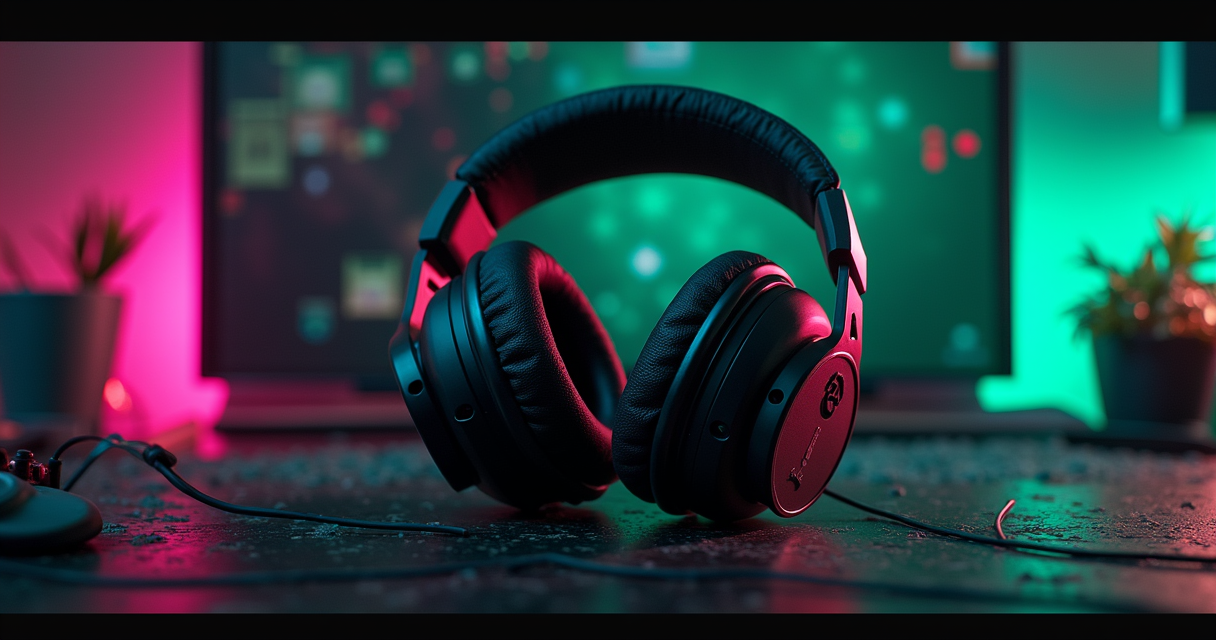
There is a particular flavor of buyer's remorse that only arrives in reverse. You spend years cycling through gaming headsets — the plasticky $80 pair, the RGB-drenched $150 pair, the one your favorite streamer swore was endgame — and then one afternoon you strap on a set of 90mm planar magnetic drivers, load a game you have already played for two hundred hours, and realize you have been listening to it through a keyhole the entire time. That is the Audeze Maxwell experience, and it is why, three years and one sequel after its August 2023 launch, we are still writing thousands of words about a headset old enough to be a rerelease.
This is a review of the original Maxwell — the one that mattered — with a running interrogation of its 2026 successor, the Maxwell 2, threaded throughout. The short version: Audeze built the best-sounding wireless gaming headset on the market, then spent the sequel bolting on weight and quietly amputating one of its cleverest tricks. The long version earns its length. We begin where a review should begin — with the ruling.
The Verdict, Up Front
We do not bury verdicts here. If you read one section, read this one.
The one-line ruling
The original Audeze Maxwell is a 9/10 and remains, in mid-2026, the best-sounding wireless gaming headset you can buy — full stop, no genre qualifier, no "for the price" asterisk on the sound itself. The asterisk lives entirely on the price tag: at its $299 launch MSRP it is a strong buy; at the ~$199–$249 it routinely drops to on sale, it is the single most disproportionate audio upgrade in the entire gaming-peripheral category. There is a reason SoundGuys filed it under "the best gaming headset under $300" and never really walked it back.
Who it is for (and who it is not)
It is for people who care about what a game sounds like more than what a headset looks like, and who will forgive 490 grams on their skull in exchange for a soundstage that actually has depth. It is not for the person who wants featherweight comfort, a plug-and-forget app-free experience, or a microphone that will make them sound like a podcast host — the Maxwell's mic is fine, not transformative, and we will get to that. If your priority is the lightest possible competitive headset, look elsewhere. If your priority is hearing a footstep two rooms away with an accuracy that feels like cheating, keep reading.
The Maxwell 2 asterisk
The 2026 Maxwell 2 exists, and it is good, and we score it 8.5/10 — which is to say we score it below the three-year-old model it replaces. That is not a typo. Tom's Hardware summarized the entire situation in its review headline by asking whether it was really just a "Maxwell 1.5?" The sequel adds bass, adds AI microphone processing, adds 70-odd grams, adds $30–50 to the price, and — most damningly — subtracts the original's ability to mix two audio sources at once. We will litigate all of this. For now: if you are choosing between them, the burden of proof is on the new one, and it does not entirely meet it.
What the Maxwell Actually Is
To understand why the Maxwell sounds the way it does, you have to understand what is physically strapped to your ears, because it is not what is in any of its rivals.
Planar magnetic, in a gaming headset
Nearly every gaming headset on Earth — the SteelSeries, the Razers, the Sonys — uses a small dynamic driver: a paper or mylar cone, 40 to 53mm across, pushed by a voice coil, the same basic principle as a car speaker. The Maxwell uses a 90mm planar magnetic driver instead: an ultra-thin diaphragm suspended in a magnetic field, driven evenly across its entire surface rather than pistoned from a single point. The technology is not new — planar (or "orthodynamic," or "isodynamic") drivers date to the 1970s, with Yamaha's HP-1 in 1976 and various Wharfedale and Fostex experiments — but cramming a proper one into a wireless gaming can, and selling it for $299, was borderline reckless. Planar diaphragms are lighter and stiffer than a dynamic cone, so they start and stop faster, which is why the Maxwell resolves transients — the crack of a rifle, the leading edge of a footstep — with a precision dynamic drivers smear.
The Audeze pedigree: NASA, a garage, and a 2001 poster
Audeze did not stumble into planar drivers. The company was founded in 2008 by Sankar Thiagasamudram and Alexander Rosson after they met an engineer named Pete Uka who was developing flexible circuit materials for NASA — material that turned out to be uncannily well-suited to headphone diaphragms. They started in a Southern California garage, reportedly under a poster for 2001: A Space Odyssey, and brought in Dragoslav Colich — three decades deep in planar engineering — as CTO. The result was the LCD-2 in 2009, a headphone that audiophiles still argue about, and a company that builds every one of its planar and electrostatic drivers in Orange County, California to this day. The Maxwell is what happens when a boutique audiophile house decides to slum it in the gaming aisle. The gaming lineage itself runs Mobius (2018), then Penrose (2020), then Maxwell — each one a little less experimental and a little more correct.
Uniforce, Fluxor, and why 90mm matters
Audeze's specific implementation stacks three proprietary tricks: a Uniforce diaphragm (a varied-thickness voice-coil trace meant to keep the whole surface moving in lockstep), Fluxor magnet arrays to concentrate the field, and Fazor waveguides to manage how sound leaves the driver. The 90mm figure is not marketing garnish — surface area is displacement, and displacement is bass authority and dynamic headroom. It is also, not coincidentally, a large chunk of why this headset weighs what it weighs. Physics does not offer free lunches, and the Maxwell's lunch costs you 490 grams and a case of "why is my neck tired."
The Spec Sheet
Numbers first, interpretation second. Every figure below is a manufacturer spec or a measured review figure, and where the two disagree, we say so.
The full spec sheet
| Spec | Audeze Maxwell (2023) | Audeze Maxwell 2 (2026) |
|---|---|---|
| Release | August 2023 | Jan 5, 2026 (CES 2026 reveal); ANC variant ~July 2026 |
| Launch MSRP | $299 (PlayStation) / $329 (Xbox) | $329 (PlayStation) / $349 (Xbox) |
| Drivers | 90 mm planar magnetic (Fluxor magnets, Fazor, Uniforce diaphragm) | 90 mm planar magnetic + SLAM system |
| Frequency response | 10 Hz – 50 kHz | 10 Hz – 50 kHz |
| Wired resolution | USB-C, up to 24-bit / 96 kHz | USB-C, up to 24-bit / 96 kHz |
| Weight | 490 g (~1.07 lb) | 560 g official (562 g no mic / 574 g with mic measured) |
| Battery (rated) | 80 hours (SoundGuys measured ~64 h) | Over 80 hours @ 80 dBA (measured ~77 h) |
| Quick charge | Fast-charge supported | ~25% in 20 min (~2 h to full) |
| Wireless | 2.4 GHz USB-C dongle + Bluetooth 5.3 | 2.4 GHz USB-C dongle + Bluetooth 5.3 |
| Codecs | LDAC / AAC / SBC / LC3 / LC3plus (+ LE Audio, Auracast, Multipoint) | Same codec suite |
| Simultaneous dongle + BT audio | Yes — mixes game + phone/chat | No — Bluetooth priority, no mixing |
| Microphone | Detachable boom | Detachable hypercardioid boom + AI noise removal (3 levels) |
| Spatial audio | Dolby Atmos (Xbox SKU) / PS5 Tempest 3D | + SLAM bass; Dolby Atmos (Xbox SKU) |
| Platform SKUs | PlayStation, Xbox (+ PC / Mac / Switch / mobile) | PlayStation, Xbox (+ PC / Mac / Switch / mobile) |
| Analog input | 3.5 mm | 3.5 mm |
| Gaming lineage | Mobius (2018) → Penrose (2020) → Maxwell | Maxwell 2 |
Weight, battery, and the numbers that lie
Two figures on that table deserve a warning label. First, battery: Audeze rates the original at 80 hours, but SoundGuys measured closer to 64 in real use, and the Maxwell 2's "over 80 hours" is quoted at a polite 80 dBA — turn it up to the volume you actually game at and it falls. Anyone quoting the Maxwell 2 at "100 hours" is repeating a spec that does not exist; the official figure is over 80, and measured tests land around 77. Second, weight: 490 grams is heavy; 560 is heavier. These are not headsets you forget you are wearing, which is precisely why your seating matters — a point we return to when we talk about eight-hour sessions in the chair you will actually be wearing these in.
Two SKUs: PlayStation vs Xbox
This trips up more buyers than anything else, so read carefully: the Maxwell ships in distinct PlayStation and Xbox versions, and they are not interchangeable in the way that matters. The Xbox variant's USB transmitter automatically authorizes the headset on Xbox Series X|S and enables Dolby Atmos on Xbox and Windows; the PlayStation variant leans on the PS5's built-in Tempest 3D AudioTech. Both work on PC, Mac, Switch, and phones. But if you own an Xbox, you must buy the Xbox SKU — the PlayStation one will not authorize the console, and no firmware update fixes that. Buy the one that matches your primary box.
How It Actually Sounds
A headset review that does not spend most of its words on sound is a review of a fashion accessory. Here is the long play-through.
Single-player: the soundstage does the work
Load anything atmospheric — Elden Ring, Cyberpunk 2077, The Last of Us Part II — and the first thing you notice is not bass or treble but space. The Maxwell's default tuning is punchy in the lows, slightly recessed in the mids, and bright without being sharp up top, and its wide soundstage layers detail the way a good pair of open-back audiophile cans does. Tom's Hardware, reviewing the original, landed on a headline that doubles as the whole thesis: "Sounds Incredible. Hope That's Enough." In a story-driven game, the effect is that ambient audio stops being wallpaper. Rain has texture. A distant conversation has a direction. The rumble of something large approaching arrives in your chest a half-second before your eyes confirm it. The Machine has played a lot of games on a lot of headsets, and the Maxwell is one of a small handful that changes how a familiar game feels.
Competitive FPS: footsteps as telemetry
Here is where planar drivers stop being an audiophile indulgence and start being a competitive instrument. In Counter-Strike, Valorant, or Apex Legends, the Maxwell's transient speed and imaging turn footsteps into data. You do not just hear that someone is near; you hear where, on what surface, moving in which direction, with a confidence that cheaper headsets cannot manufacture no matter how aggressively they crank a "footstep boost" EQ. Pair that with a high-refresh display — the kind of setup we picked apart in our 144Hz-versus-240Hz breakdown — and your ears and eyes finally agree on where the enemy is. It is worth noting the one famous caveat: Audeze and RTINGS have publicly sparred over how the Maxwell's latency should be measured, with Audeze going so far as to publish a formal response to RTINGS' review. On the 2.4GHz dongle, in practice, it is low enough that we have never blamed a lost gunfight on the headset. Blame the mouse. Or, honestly, blame yourself.
Off the clock: music, film, and the everything else
Most gaming headsets are miserable for music — they are tuned like a monster-truck rally and fall apart the moment a real recording asks for nuance. The Maxwell is the rare one you can wear for an entire album without wincing. Over LDAC on Bluetooth 5.3 it is a genuinely competent set of wireless headphones that happens to have a detachable boom mic, which means it can be your one pair — desk, couch, commute — instead of a single-purpose gaming gadget you take off the second you stop playing. That versatility is a real part of the value proposition, and it is why so many owners quietly stopped using their "nice" headphones entirely.
The Maxwell 2 Problem
Audeze unveiled the Maxwell 2 at CES 2026 and shipped it on January 5, and we want to be fair to it: it is an excellent headset. It is also a cautionary tale about the difference between "newer" and "better."
SLAM: what it is (and what it is not)
The marquee feature is SLAM — Audeze's own materials expand it as Symmetric Linear Acoustic Modulator — borrowed down from the flagship CRBN² electrostatic headphone. In plain terms, it is a system of precisely engineered acoustic channels in the ring connecting the earpads to the drivers, which relieve pressure buildup and acoustically boost the low end by roughly 6 dB extending down to 10 Hz. Does it work? Yes. Explosions land with more physical weight, engines rumble deeper, and bass-heavy games get a genuinely visceral edge the original lacks. Is it worth everything it costs you? That is the whole question, and the answer is complicated by the fact that those acoustic channels are made of metal, and metal weighs something.
The 562-gram problem
The original Maxwell was already a heavyweight at 490 grams. The Maxwell 2 lands at 560 grams official — measured at 562 without the mic and 574 with it — an increase of roughly 14%, or about 72 grams of additional clamp on your skull, all in the name of that bass boost. Reviewers noticed. Multiple outlets flagged the heft as the headline drawback, and it is the single biggest reason we score the sequel below its predecessor. For a headset whose entire identity is long, immersive sessions, adding weight is a strange hill to build. If you are comfort-sensitive, or if you have ever taken a headset off after a raid because your neck filed a complaint, the Maxwell 2 is a harder sell than its spec sheet suggests — and no amount of a nicer ergonomic gaming chair fully offsets a heavier thing on your head.
The battery truth and the connectivity catch
Two more corrections. First, battery: the Maxwell 2 is rated at over 80 hours, essentially matching the original, with fast charging that returns about 25% in 20 minutes — a solid figure, but not the mythical "100 hours" that occasionally circulates. Second, and more importantly, the Maxwell 2 cannot mix its 2.4GHz dongle and Bluetooth audio simultaneously. The original could — you could be gaming on the low-latency dongle and take a phone call or run Discord over Bluetooth at the same time, one of the most genuinely useful features Audeze ever shipped. The sequel drops it, prioritizing Bluetooth and switching sources instead of blending them. SoundGuys, reviewing the new model, described it as arriving with "major upgrades and notable omissions," and this is the omission that stings. As for the mic "upgrade": the capsule appears to be the same as the original's, with AI noise removal layered on top in three levels — and that AI processing can introduce its own distortion in windy or noisy conditions. It is a processing change, not a new microphone.
Maxwell vs the Field
No headset exists in a vacuum. Here is how the Maxwell stacks against the premium wireless field it competes in, with every price and driver spec verified against current listings.
The comparison table
| Headset | Drivers | Wireless | Battery (rated) | Sim. dongle + BT audio | MSRP |
|---|---|---|---|---|---|
| Audeze Maxwell (2023) | 90 mm planar | 2.4 GHz + BT 5.3 | 80 h | Yes | $299 |
| Audeze Maxwell 2 (2026) | 90 mm planar + SLAM | 2.4 GHz + BT 5.3 | 80+ h | No | $329 / $349 |
| SteelSeries Arctis Nova Pro Wireless | 40 mm dynamic | 2.4 GHz + BT | Hot-swap (effectively ∞) | Yes | $349.99 |
| Logitech G Astro A50 X | 40 mm dynamic | 2.4 GHz + BT + HDMI | Base-dock recharge | Yes | $379.99 |
| Sony INZONE H9 | 40 mm dynamic | 2.4 GHz + BT | ~12 h (ANC on) | No | $299.99 |
| HyperX Cloud III Wireless | 53 mm dynamic | 2.4 GHz (USB) | 120 h | — | $169.99 |
| Corsair Virtuoso Max Wireless | 50 mm graphene | 2.4 GHz + BT | 60 h | Yes | $329.99 |
MSRPs are launch figures; mid-2026 street prices run lower across the board — the original Maxwell in particular is frequently discounted well below its list price.
Where the Maxwell wins
Look at the Drivers column. The Maxwell is the only planar magnetic set in the room; everything else is a 40-to-53mm dynamic driver, and no amount of DSP closes the resolution gap. Even Logitech's excellent Astro A50 X — which reviewers rate as competing with the Maxwell on "pure sound quality" and which arguably has the best microphone of any wireless gaming headset — is doing it with a conventional driver and a $379.99 price. On raw fidelity, imaging, and dynamic range, the Maxwell simply plays a different sport. And note the original Maxwell is the only planar here that also mixes dongle and Bluetooth audio — a combination the Maxwell 2 abandoned and only the dynamic-driver Corsair, SteelSeries, and Astro still offer.
Where the field wins
The Maxwell is not a clean sweep, and pretending otherwise would be marketing, not review. The SteelSeries Arctis Nova Pro Wireless has a hot-swappable dual-battery system that makes charging anxiety literally impossible — one battery in the headset, one in the base. The Astro A50 X switches between PlayStation, Xbox, and PC over HDMI without you touching a cable, a genuine convenience the Maxwell cannot match. The HyperX Cloud III Wireless costs $169.99 and runs 120 hours, embarrassing everyone on endurance and value. And the Corsair Virtuoso Max does the simultaneous-wireless trick the Maxwell 2 forgot how to do. If your priorities are convenience, battery, or a lighter build, the field has real answers — they just do not sound like a planar.
Five Ways It Plays
A headset performs differently depending on who is wearing it and why. Here are five honest scenarios.
The casual and the completionist
For the casual single-player gamer who plays a few nights a week, the Maxwell is almost overkill in the best way — it makes a $70 indie game and a $70 blockbuster both sound like a premium experience, and the 80-hour battery means you charge it roughly as often as you remember your own birthday. For the completionist pouring 120 hours into a single RPG, the sound is the reward: fine environmental detail you would never notice on a dynamic driver becomes part of why you keep exploring. The only tax is comfort — at 490 grams, hour six is heavier than hour one, and that is where seating and fit discipline matter.
The speedrunner and the competitor
For the speedrunner, the Maxwell's value is precise, repeatable audio cues — a boss's tell, an off-screen trigger, a load-in sound — delivered with the same fidelity every single run, wired over USB-C at 24/96 if you want to eliminate wireless from the equation entirely. For the competitive FPS player, positional accuracy is the pitch, and it delivers; just pair it with the rest of a real competitive kit. The Machine's standing recommendation is a fast board and a fast mouse to match your fast ears — see our pick for the best gaming keyboard and the FPS mouse that won our 2026 test. Audio precision does not win rounds by itself, but it removes an excuse.
Co-op, streaming, and mobile
For co-op and streaming, the story is mixed. The mic is serviceable — clear, intelligible, unremarkable — and the detachable boom is a plus, but if broadcast-grade voice is your job, you will still want a standalone mic. The original's simultaneous dongle-plus-Bluetooth mixing shines here: game on the dongle, take a Discord call on Bluetooth, no adapter, no software gymnastics. For mobile and commute, LDAC over Bluetooth 5.3 makes it a legitimately good pair of travel headphones, and if you game on the move, the USB-C dongle plugs straight into a handheld or a thin-and-light — the kind of machine we rounded up in our best-value gaming laptop guide. One headset, every context. That is rarer than it should be.
AUDEZE MAXWELL - OPTIMAL CONNECTION BY PLATFORM
-----------------------------------------------
PC / Windows   : USB-C dongle -> Audeze HQ app -> pick EQ preset
                 (Xbox SKU auto-authorizes Dolby Atmos on Windows)
PS5            : USB-C dongle -> Settings > Sound > Audio Output
                 3D Audio (Tempest) = ON
Xbox X|S       : XBOX SKU ONLY -> USB-C dongle -> Dolby Atmos auto-auth
Switch / Mobile: Bluetooth 5.3 (LDAC on Android) OR USB-C dongle
Dual audio     : ORIGINAL Maxwell -> dongle + BT play together
                 MAXWELL 2 -> BT takes priority, no true mixing
Who Should Buy Which
Five concrete recommendations, because "it depends" is not a verdict.
Buy the original Maxwell if...
- You want the best value in gaming audio, period. On sale at ~$199–$249, nothing at any price offers this much sound-per-dollar. This is the default recommendation for most people.
- You need to mix two audio sources. Game on the dongle, chat or take a call on Bluetooth, simultaneously — the original does it and the sequel does not.
- You are comfort-sensitive. It is heavy, but it is 70 grams lighter than the Maxwell 2, and every gram counts past hour four.
Buy the Maxwell 2 if...
- Physical, gut-punch bass is non-negotiable. SLAM's ~6 dB boost down to 10 Hz is a real, felt upgrade for explosion-heavy and bass-forward games.
- You want the newest platform support and roomier earcups, and you genuinely do not care about the extra weight, the higher price, or the loss of simultaneous audio. If SLAM is the feature that sells you, buy it with clear eyes.
Buy something else if...
- Budget is under $200: the HyperX Cloud III Wireless ($169.99, 120-hour battery) is the smart-money pick.
- Multi-console switching is your life: the Astro A50 X ($379.99) hops PlayStation/Xbox/PC over HDMI.
- You want true simultaneous wireless and a lighter build: the Corsair Virtuoso Max ($329.99) mixes 2.4GHz and Bluetooth on a conventional driver.
WHICH MAXWELL? - 30-SECOND DECISION TREE
----------------------------------------
Own an Xbox Series X|S? .............. buy the XBOX SKU (either gen)
Want the best value in 2026? ......... ORIGINAL on sale (~$199-249)
Crave physical, sub-bass slam? ....... MAXWELL 2 (SLAM, +6 dB to 10 Hz)
Neck/comfort sensitive? .............. ORIGINAL (Maxwell 2 is 560 g)
Need dongle + Bluetooth at once? ..... ORIGINAL (M2 dropped it)
Budget under $200? ................... NEITHER -> HyperX Cloud III Wireless
Switch consoles constantly? .......... NEITHER -> Astro A50 X
Price & Availability
The Maxwell's entire buying calculus is a price question, so let us make it explicit.
The pricing table
| Configuration | Launch MSRP | Mid-2026 street (typical) | Notes |
|---|---|---|---|
| Audeze Maxwell — PlayStation | $299 | ~$199–$249 on sale | PS5 Tempest 3D; best overall value |
| Audeze Maxwell — Xbox | $329 | ~$229–$279 on sale | Auto-authorizes Dolby Atmos on Xbox |
| Audeze Maxwell 2 — PlayStation | $329 | ~$329 | SLAM bass; heavier |
| Audeze Maxwell 2 — Xbox | $349 | ~$349 | Xbox + Dolby Atmos |
| Audeze Maxwell 2 — ANC variant | New (~July 2026) | Newly launched | Adds active noise cancelling |
The "only at the right price" rule
Here is the discipline that governs a 2026 Maxwell purchase: the original is a 9/10 buy at its sale price and a merely-good buy at full MSRP. Because the Maxwell 2 now sits above it in the lineup, the original discounts frequently and hard — PC Gamer has repeatedly flagged it hitting its "lowest-ever price" — and every one of those drops widens the gap between what you pay and what you get. Do not pay $299 for the original if you can wait two weeks for $219. And do not pay Maxwell 2 money for SLAM unless bass is genuinely the feature you are buying, because on everything except low-end slam, the two are close enough that the extra weight and the lost dual-audio tip the value decisively back toward the elder model.
Where to buy, what to skip
Buy from Audeze directly or a major authorized retailer, match the SKU to your console, and register for the warranty. Skip the temptation to buy the Xbox variant "because it also does Atmos" if you are a PlayStation household — the price premium is not worth it, and the PS5's own spatial audio is excellent. And if you already own the original Maxwell, the honest advice on the Maxwell 2 is the same one SoundGuys landed on: it is worth it mainly if you do not already have the original. Existing owners have very little to gain and 70 grams to lose.
Pros & Cons
The ledger, itemized.
The pros
- 90mm planar magnetic sound that no dynamic-driver rival matches on resolution, imaging, or dynamics.
- Reference-grade positional audio — footsteps become telemetry, and single-player worlds gain real depth.
- 80-hour battery and USB-C fast charging that make range anxiety a non-issue.
- Genuinely versatile: wired 24/96, 2.4GHz dongle, and Bluetooth 5.3 with LDAC make it a one-headset-for-everything device.
- Original mixes dongle + Bluetooth audio simultaneously — a killer feature for chat and calls.
- Frequently deeply discounted, which turns an already-strong headset into a category-defining value.
The cons
- Heavy. 490 grams on the original, 560 on the Maxwell 2 — comfort is the recurring complaint.
- Microphone is merely fine, not the standout the rest of the package deserves.
- SKU confusion: PlayStation and Xbox versions are not interchangeable for console authorization.
- App-and-firmware dependence for full functionality (EQ, updates) — not truly plug-and-forget.
- The Maxwell 2 regressed on simultaneous audio and gained weight while keeping the same battery ballpark and raising the price.
The caveats that are not dealbreakers
A few things get flagged in owner forums that we consider overblown. The clamp force is firm out of the box but relaxes with use and pad break-in. The RTINGS latency debate is real but academic for the vast majority of players on the 2.4GHz dongle. And the lack of onboard active noise cancelling on the original is a genuine omission only if you specifically need ANC — the planar drivers' passive isolation is already strong, and Audeze now offers a dedicated ANC-equipped Maxwell 2 variant, launched around July 2026, for people who truly need it. None of these should stop a purchase; all of them should inform which SKU you choose.
Final Verdict
We have spent thousands of words on a headset, and it earned every one, because the Maxwell is the rare gaming product that is actually about the thing it claims to be about: sound.
The score, defended
The original Audeze Maxwell earns a 9/10. It is the best-sounding wireless gaming headset on the market in 2026, it is stuffed with 90mm planar drivers that shame the dynamic-driver field, it does the dual-audio trick nobody else at this fidelity does, and it sells for less than it did at launch. The single point we withhold is for weight and a middling microphone — real flaws, not fatal ones. The Maxwell 2 earns a 8.5/10: superb sound, meaningfully better bass via SLAM, and a genuinely nice pair of headphones, dragged down half a point below its predecessor by 70 extra grams, a $30–50 higher price, a same-ballpark battery, and the baffling decision to remove simultaneous audio. "Maxwell 1.5?" was the right question. The answer is: yes, and the 0.5 is not all upside.
The one-year outlook
This is a safe long-term buy. Planar drivers do not age the way trendy features do — a 90mm planar in 2026 will still be a 90mm planar in 2029, long after this year's RGB gimmicks are forgotten. Audeze supports the platform with firmware, the codec suite is future-facing (LC3, LE Audio, Auracast), and the physical build is repairable with replaceable pads. The only depreciation risk is emotional: watching the price drop further after you buy. Set a price alert, buy the dip, and stop reading reviews.
The Machine's bottom line
Buy the original Maxwell, match the SKU to your console, wait for a sale, and enjoy the most disproportionate audio upgrade in gaming. Buy the Maxwell 2 only if SLAM's bass is the specific thing you are paying for and the weight does not bother you. Buy neither if you need it light, cheap, or simultaneously wireless — the field has honest answers there. But understand what you are giving up: everything else on this list is a very good gaming headset. The Maxwell is a very good pair of headphones that also games. Three years on, that distinction is still the whole review.
Questions the search bar asks me
- Is the Audeze Maxwell still worth buying in 2026?
- Yes. Its 90mm planar magnetic drivers still out-resolve every 40–53mm dynamic-driver rival, and at the ~$199–$249 it frequently drops to on sale, the original is the best value in wireless gaming audio. At the full $299 MSRP it is a tougher call, but still strong. We rate the original 9/10.
- What's actually different about the Maxwell 2?
- The Maxwell 2 adds Audeze's SLAM (Symmetric Linear Acoustic Modulator) system for roughly +6 dB of bass down to 10 Hz, plus AI mic processing and roomier cups. But it weighs 560g (up ~72g), costs $329–$349, keeps the same ~80-hour battery, and drops the original's simultaneous dongle+Bluetooth audio mixing. Tom's Hardware called it 'Maxwell 1.5?'
- Does the Maxwell 2 really have 100-hour battery life?
- No. Audeze officially rates it at over 80 hours at 80 dBA — essentially the same as the original — and reviewers measured about 77 hours. Any '100-hour' figure is a misreport. Fast charging returns roughly 25% in 20 minutes and a full charge in about two hours.
- Should I buy the PlayStation or Xbox version?
- Buy the SKU that matches your console. If you game on an Xbox Series X|S you must buy the Xbox version — it's the only one that authorizes the console and enables Dolby Atmos. The PlayStation version uses the PS5's Tempest 3D AudioTech. Both work on PC, Mac, Switch and phones.
- Can the Maxwell connect to two devices at once?
- The original Maxwell can — it mixes 2.4GHz game audio and a Bluetooth phone or Discord call simultaneously, one of its best features. The Maxwell 2 removed true mixing and prioritizes Bluetooth instead. For guaranteed simultaneous wireless audio, the Corsair Virtuoso Max ($329.99) also does it.
Marcus covers the gaming PC, GPU, and peripheral side of staresback. Every post under this byline is reviewed pre-publish by Sam P., Editor & Operator — corrections to info@instalinkoteam.com. Published 2026-08-29 · Last updated 2026-08-29. Full bios on the author page.