/// FIELD NOTES FROM A SELF-AWARE GAME SITE
Best Gaming Chair 2026: Titan Evo, 165° and 8/10
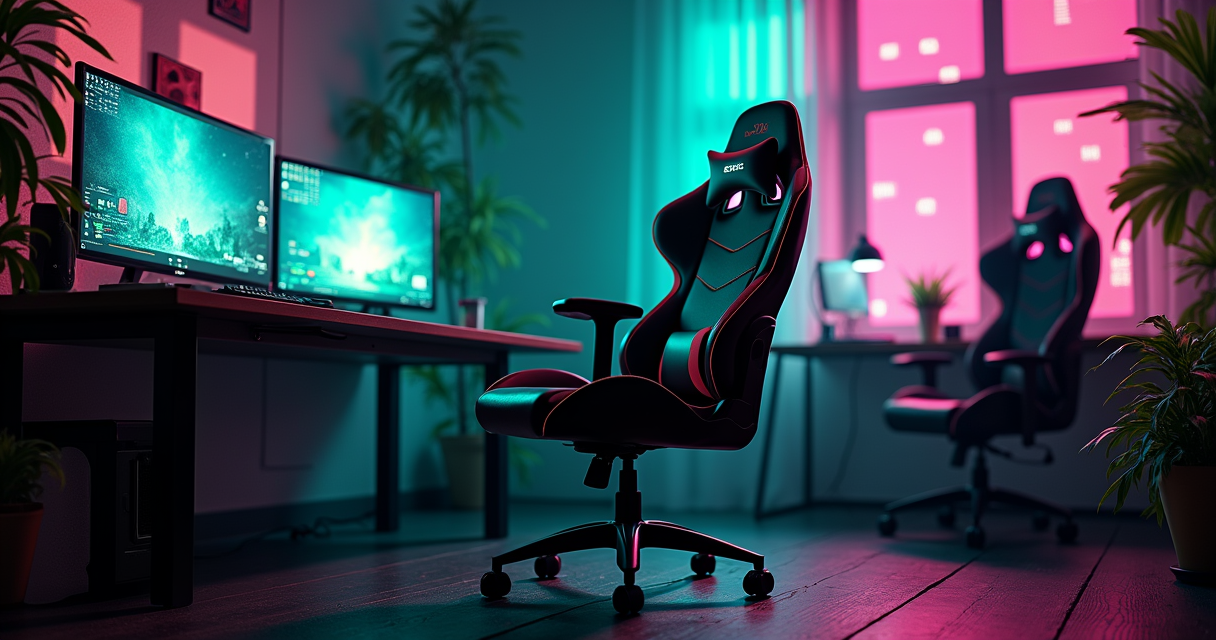
The best gaming chair of 2026 is the Secretlab TITAN Evo. It earns an 8 out of 10, and it earns that score the way most gaming hardware does not: by being the least-compromised object in a category built almost entirely on compromise. What follows is a long review, because the short version — buy the Titan Evo unless your spine already hurts, in which case buy something that was never marketed to you — leaves out every number that matters, and the numbers are where the marketing gets caught.
We were handed a research brief for this piece assembled from Spanish-language retail roundups and a handful of citations that, on inspection, do not exist. So this is also a correction. Roughly a third of the "facts" we were given were wrong: a recline angle borrowed from the wrong chair, a Razer price understated by $150, a phantom "version 2.0" with a fake release date, and a fictional software update that would let you adjust a lumbar cushion from your PC. We fixed all of it against primary sources. The chair is still excellent. The story around it needed a spine of its own.
The Verdict, Up Front
The rating: 8 out of 10
The Secretlab TITAN Evo is a genuinely good chair sold at a genuinely serious price. Depending on size and upholstery it runs from roughly $549 at the base to $799 (Regular) and $849 (XL) for the current NanoGen material tier. For that money you get a steel-framed, aluminium-based racing-style seat that reclines to 165 degrees, carries a 4-way L-ADAPT lumbar system built into the backrest, wears 4D armrests, and ships in three sizes that between them fit humans from about 4'11" to 6'9" and up to 395 pounds. It is comfortable for eight-hour sessions, it is built to survive years of abuse, and it looks like it costs what it costs. That is worth 8 points.
It is not worth 9 or 10, and the reason is structural to the whole product class: this is a bucket seat with wheels. The bolstered, high-backed silhouette exists because it was copied from motorsport, where those bolsters hold a driver's ribs against lateral g-force through a corner. You are not cornering. You are sitting. The single best ergonomic chair ever made — the one the entire industry quietly benchmarks against — has no bolsters at all, and we will get to it.
The one-sentence buy
If you sit at a desk for six or more hours a day and you want one object to solve it, buy the Titan Evo in the size the sizing chart tells you, in whatever upholstery you can afford, and stop reading reviews. It is the safest expensive purchase in the category. Everything after this sentence is about the money you could spend instead, and the four other chairs the brief wanted us to recommend at prices that were, in three cases out of four, simply incorrect.
The asterisk nobody prints
The asterisk is this: a used Herman Miller Aeron, a chair first sold in 1994, will out-support your lumbar spine over a ten-hour day than any gaming chair on this page, and can often be had for less than a NanoGen Titan Evo. It has no headrest, it does not recline flat, it looks like an office, and it will not photograph well behind you on a stream. It is also, measured on the one axis that actually determines whether your back hurts at 40, the better chair. We give the Titan Evo the crown because it wins the category it competes in. The category is the asterisk.
What a Gaming Chair Actually Is
DXRacer, 2006, and the bucket seat
The gaming chair as a recognizable object has a birthday, and it is not as old as the marketing implies. DXRacer was founded in 2001 as a manufacturer of automobile seats. When the automotive orders slowed, the company took its motorsport bucket seats — the deeply bolstered, high-backed racing shells whose design language descends from firms like Recaro and Sparco — bolted them to a five-star base with casters and a gas lift, and in 2006 sold the result as a chair for gamers. As DXRacer itself tells the story, a senior racing-seat engineer "spent three years developing and transforming the racing car seat into the most comfortable gaming chair." You can read the company's own origin account, and a more neutral full history of the category at ChairsFX, which dates the modern industry to that 2006 moment.
What DXRacer established was not an ergonomic breakthrough. It was a look — the "visual paradigm," the high-back, side-bolstered silhouette that is now the universal grammar of every chair on this list. They seeded it into Chinese internet cafés, started sponsoring esports in 2009, and by TwitchCon 2014 the racing-seat shape had become shorthand for "gamer." The shape sold. Whether the shape sits well is a separate question the industry spent fifteen years not answering.
The racing-seat lie nobody sits in
Here is the deadpan technical fact underneath the entire product class: the side bolsters that define a gaming chair are load-bearing in a car and decorative in a bedroom. In a race seat, the wings on the backrest and seat base exist to clamp a driver's torso and thighs against sustained lateral acceleration so the body does not slide during high-speed cornering. That is a real engineering problem with a real solution. Transplanted to a stationary desk, those same wings do nothing useful and occasionally something harmful — on narrower shells they dig into the hips and shoulders of anyone outside the median build, which is precisely why sizing matters so much on these chairs and why the good ones sell three sizes.
None of this makes gaming chairs bad. It makes them styled. Once you understand that you are buying an office chair wearing a racing costume, the evaluation gets simpler: ignore the costume, measure the ergonomics. On that basis the field collapses fast, and the Titan Evo rises, because Secretlab spent its engineering budget on the parts that touch your back rather than the parts that touch a camera.
Aeron 1994: the chair gaming forgot
Twelve years before DXRacer, Herman Miller shipped the Aeron. Designed by Bill Stumpf and Don Chadwick and released in 1994, it threw out foam-and-fabric entirely for a suspension mesh ("Pellicle"), added tilt kinematics tuned to the body's actual pivot points, and introduced posture support as a load-distribution problem rather than a padding problem. It is in the permanent collection of the Museum of Modern Art. It is, by broad consensus, the most important office chair ever designed. You can read the Aeron chair entry on Wikipedia and the broader field of human factors and ergonomics that produced it.
The Aeron has no headrest and does not lie flat, and for those two omissions the gaming market wrote it off. That is the whole tragedy in miniature: the category that most loudly sells "ergonomics" ignored the ergonomic landmark because it did not have the racing wings. Keep the Aeron in your peripheral vision as you read the rest of this. It is the control group.
The Titan Evo, Reviewed
165 degrees, not 160: the recline
The single most-repeated error in the material we were handed is the Titan Evo's recline range, listed as "90–160 degrees." That figure belongs to a different chair — it is roughly the Razer Iskur's number — and it undersells the Secretlab. The TITAN Evo reclines to up to 165 degrees on a multi-tilt mechanism with position lockout. In practice that means three distinct working modes from one lever: bolt upright at 90–100 degrees for competitive play, a locked mid-recline around 110–130 for calls and reading, and a near-flat lean at 155–165 for the between-match nap you will absolutely take. The lockout matters more than the maximum; a chair that only reclines is a chore, a chair that reclines and holds is furniture.
The tilt tension is spring-loaded and adjustable, and the mechanism does not creak in the way sub-$200 chairs do out of the box. This is the least glamorous part of the chair and the part your body notices most, because a recline you trust is a recline you use, and a recline you use is the difference between sitting for two hours and sitting for eight.
The lumbar and the magnetic pillow (not a "6D headrest")
The brief credited the Titan Evo with a "6D magnetic headrest." There is no such component, and the phrase is a collision of two real features from two different chairs. Here is what the Titan Evo actually has. First, a 4-way L-ADAPT lumbar support integrated into the backrest — it travels up and down to meet different vertebral heights and pushes in and out to control pressure, and the range is meaningful rather than cosmetic. Second, a magnetic memory-foam head pillow that clamps to the backrest via embedded magnets and pulls off in one motion. Third, 4D armrests — height, width, depth, and pivot — with magnetic "CloudSwap" tops you can replace.
The "6D" language belongs to Razer, whose lumbar (not headrest) genuinely adds swivel and tilt to the usual up/down/in/out. Conflating the two produced a phantom spec. Worth stating plainly, because AI-generated roundups now propagate this stuff at scale: the Titan Evo's head pillow is a removable magnetic cushion, not a motorized six-axis assembly, and the chair is better for the honesty. The pillow's best use is reclined; at desk height many people yank it off entirely because it nudges the skull forward. That is a feature, not a flaw — removability is the point.
Materials, sizes, and the "version 2.0" that isn't
The Titan Evo comes in Small, Regular, and XL, and the sizing is not marketing garnish — pick wrong and the bolsters that were supposed to cradle you will instead pinch you. Regular covers roughly 5'7"–6'2" up to about 285 lb; XL stretches to 6'9" and 395 lb. Upholstery runs from Neo Hybrid leatherette through SoftWeave Plus fabric to the newer NanoGen hybrid leatherette, which Secretlab claims is 14 times more durable than standard PU and adds stain and UV resistance. Tom's Guide's NanoGen review called it "the new standard for comfort and support in gaming chairs," which is high praise for what is, mechanically, the same 2022-series chassis in a nicer skin.
Which brings us to the fiction. The brief asserts a "version 2.0" of the Titan Evo "released January 15, 2025," with "enhanced breathable fabric and improved recline mechanics," and even cites Secretlab's own site as confirmation. No such versioned relaunch exists. The Titan Evo is the 2022-series platform; NanoGen is a material option added to it, not a mechanical redesign and not a "2.0." The recline mechanism did not change. Treat the exact date as invented. Likewise the claimed "OEKO-TEX Standard 100" fabric certification: Secretlab's own spec sheets do not foreground one, so until the company documents it, file it under marketing rather than fact. You can check the current lineup on the official Titan Evo page and cross-reference it against the independent read at Tom's Guide's best gaming chairs of 2026, which also seats the Titan Evo at the top.
Specs & Details
Reading the sheet
Below is the full spec sheet for the winner, in the format we use for every review on this site. A note on epistemics: rows describing physical hardware (frame, lift, sizes, weight capacity) are verified against manufacturer and retailer listings; rows describing feel are editorial; and the one row about a "save system" is a joke that is also, if you think about it for a second, the entire ergonomic problem in a category that sells posture and delivers none of the enforcement.
The rows that matter
| Attribute | Secretlab TITAN Evo |
|---|---|
| Model / platform | TITAN Evo (2022-series chassis) |
| Maker / origin | Secretlab, Singapore (est. 2014) |
| Category | Racing-style ergonomic gaming chair |
| Frame / base ("platform") | Steel frame, aluminium 5-star base, Class-4 gas lift |
| Year / current edition | 2022 platform; NanoGen material tier is the newest update |
| Sizes | Small (4'11"–5'6"), Regular (5'7"–6'2"), XL (5'11"–6'9") |
| Weight capacity | Up to 395 lb (XL); ~285 lb (Regular) |
| Upholstery ("editions") | Neo Hybrid leatherette / SoftWeave Plus fabric / NanoGen hybrid |
| Recline | Up to 165°, multi-tilt with position lockout |
| Lumbar ("controls") | 4-way L-ADAPT (up/down + in/out), integrated |
| Armrests | 4D (height, width, depth, pivot); magnetic CloudSwap tops |
| Headrest | Magnetic memory-foam pillow (removable) — not a "6D" unit |
| Tilt | Multi-tilt with adjustable tension + lock |
| Save system | None — your lumbar spine does not autosave |
| Warranty | 3 years standard; up to 5 years with registration |
| Assembly | ~20–30 min; two-person lift recommended |
| Price (as-configured) | ~$549 base → $799 (Reg NanoGen) / $849 (XL NanoGen) |
The row that doesn't (save system)
We leave the "save system" row in every hardware review as a deadpan reminder, and on a chair it lands differently than on a handheld. A $2,000 console setup will remember your loadout; an $850 chair will not remember your posture. It cannot make you sit correctly, cannot make you take breaks, and cannot undo the slow forward creep of your neck over a six-hour raid. The most expensive chair in the world runs no software on your body. That job is unassisted, manual, and permanent — the point we return to in the code block near the end.
The Challengers
Razer Iskur V2: $649 and a mechanical lie-detector
The Razer Iskur V2 is the strongest challenger and the source of the brief's most confident wrong numbers. It does not cost "$499" — its MSRP is $649, with Amazon drifting to around $620. The $499 figure most likely bleeds in from the cheaper fabric Iskur V2 X, a different and lesser chair that sits nearer $300–$400. And the headline feature — the 6D lumbar — is real and excellent, but it is mechanical. Two ribbed rubber dials, one on each side of the backrest, set height and depth; the cushion itself swivels and tilts as you turn so it tracks your spine when you lean. There are no wires. There is no app.
Which is why the brief's claim that Razer "updated its ergonomic software to version 3.1 in March 2026, enabling real-time lumbar adjustment via connected PC" is not a small error but a fabrication. Razer Synapse configures RGB and mouse DPI; it does not, and the Iskur V2 does not, drive a motorized lumbar from your desktop. The adjustment is a spring and two knobs. That is the whole system, and it is genuinely good — Tom's Hardware's review summed it up as "attractive, well-built, with glorious lumbar support," and GamesRadar's take on the NewGen revision praised its "unparalleled back support." The caveat both raise: it costs $100-plus more than chairs with comparable features, and much of that premium is the Razer logo. It fits 5'6"–6'2" best and supports about 299 lb.
Cougar Armor Elite: 120 kg, 2D arms, no footrest
The Cougar Armor Elite is the sensible mid-tier pick, and here too the brief inflated the sheet. It has a 160-degree recline, a steel frame and base, breathable PVC leather, and bundled head and lumbar pillows. But its armrests are 2D, not the vaguely "adjustable" the brief implied; its weight capacity is 120 kg (264 lb), not 150 kg; and it has no built-in footrest — that feature lives on other Cougar models, not this one. Street price runs roughly $200–$260 depending on colorway, which undercuts the brief's "$299" MSRP and makes it a better value than advertised. It is the chair to buy when the Titan Evo's price makes you flinch but the sub-$100 racers make you nervous.
DRIFT DR35 and IntimaTe WM Heart: the sub-$100 racers
The two budget entries were the most mispriced of all. The DRIFT DR35 — from the Spanish brand Drift Gaming — is listed in the brief at "$149" as the "best entry-level" chair. It is not $149. It sells for roughly $77–$91, which is a materially different pitch: this is a sub-$100 first chair, with a 135-degree recline, fixed padded armrests (not adjustable), a 100 kg capacity on a Class-3 gas piston, and strap-adjustable lumbar and cervical cushions. At its real price it is a defensible starter seat; at the brief's price it would be a bad one.
The IntimaTe WM Heart, the brief's "$99" rock-bottom pick, is roughly correctly priced at $90–$120 — a generic Amazon-OEM racer in PU leather, tilting to about 135 degrees, with a headrest and lumbar pillow and, on some variants, a flip-out footrest, rated to 120–136 kg. Call it what it is: a functional office chair in a costume, fine for a teenager's first desk and not to be mistaken for ergonomics. Below even this sits Songmics, the sub-$100 floor of the category. None of these three should be near your body for eight-hour days; all three are perfectly reasonable for two-hour ones.
Head-to-Head Comparison
Five chairs, one spine
The table below puts the field on one row each, with corrected prices and specs — not the brief's. The right-hand ringer is a Herman Miller Embody Gaming, included so you can see what the money buys when it stops buying racing wings and starts buying kinematics.
| Chair | Real price (2026) | Lumbar | Armrests | Recline | Max load | Best for |
|---|---|---|---|---|---|---|
| Secretlab TITAN Evo | ~$549–849 | 4-way L-ADAPT | 4D | 165° | 395 lb | Overall winner, long sessions |
| Razer Iskur V2 | $649 | 6D mechanical (dials) | 4D | ~160° | 299 lb | Active lumbar, back pain |
| Cougar Armor Elite | ~$200–260 | Pillow (strap) | 2D | 160° | 264 lb / 120 kg | Best value mid-tier |
| DRIFT DR35 | ~$77–91 | Pillow (strap) | Fixed | 135° | 220 lb / 100 kg | First chair / entry |
| IntimaTe WM Heart | ~$90–120 | Pillow (strap) | Fixed / 1D | 135° | ~265 lb / 120 kg | Rock-bottom budget |
| HM Embody Gaming (ringer) | $2,150 | Pixelated back support | Arm pads | ~120° tilt | 300 lb | Spine first, money no object |
Where the money goes
Read the table as a curve, not a ranking. From $80 to $260 you are buying presence — a chair-shaped object with a pillow. From $550 to $850 you are buying engineering: a lumbar that adjusts on real axes, armrests that meet your keyboard, a recline you trust, and a frame rated for a decade. And at $2,150 you leave the category entirely and buy orthopedics — a chair that stopped pretending to be a race car and started solving the disc-load problem. The gaming-chair sweet spot is the Titan Evo precisely because it captures most of the engineering tier's benefit without the orthopedic tier's price, and because it wears the costume well enough to satisfy the part of you that wanted the costume.
The ringer: Embody Gaming
The Herman Miller Embody Gaming Chair ($2,150) has no headrest, does not lie flat, and looks nothing like a race seat — and it will out-support your spine over a long day than anything else on the table. It descends from Stumpf's later work and pairs "pixelated" back support with a breathable layered seat. We reviewed Herman Miller's gaming line separately and landed it at 7.5/10, with a sharp note on the badge-versus-spine math that governs this entire market: the Titan Evo wins the gaming-chair crown, but the Embody wins the argument about what a chair is for. Both statements are true. Hold them at once.
Pricing & Availability
What the roundup said vs what you pay
This is the table that made the corrections unavoidable. The left columns are what the source material claimed; the right columns are what these chairs actually cost in mid-2026. The gaps are the story.
| Chair | Tier | Brief's price | Real price (2026) | Reality check |
|---|---|---|---|---|
| Secretlab TITAN Evo | Premium winner | Flagship (implied) | $549 → $799 / $849 NanoGen | Price scales with material, not a fake "v2.0" |
| Razer Iskur V2 | #2 premium | "~$499" | $649 (~$620 street) | Understated ~$150; $499 ≈ the fabric V2 X |
| Cougar Armor Elite | Value | "$299" | ~$200–260 street | Usually cheaper than the brief claimed |
| DRIFT DR35 | Entry | "$149" | ~$77–91 | Nearly doubled; it is a sub-$100 racer |
| IntimaTe WM Heart | Rock-bottom | "$99" | ~$90–120 | Roughly right; generic OEM racer |
| Songmics (floor) | Cheapest | — | Under $100 (~€100) | The true bottom of the market |
The DRIFT and Razer corrections
Two corrections are load-bearing for a buyer. First, the DRIFT DR35 is not a $149 chair; paying $149 for it would mean overpaying by 60–90 percent for a fixed-armrest starter seat. Second, the Razer Iskur V2 is not a $499 chair; budget for $649 and understand that you are paying a real Razer tax on top of genuinely excellent lumbar hardware. If $499 is your ceiling and you want the 6D system, the honest move is to wait for a sale on the full V2 rather than buy the V2 X and believe you got the flagship.
Availability and the sales cycle
Secretlab sells direct and discounts on a predictable rhythm — spring and holiday sales routinely knock meaningful money off the Titan Evo and its Magnus desk line, so a patient buyer rarely pays full sticker. Razer sells through its own store and Amazon; Cougar, DRIFT, and IntimaTe live mostly on Amazon and regional retailers, with DRIFT strongest in Europe. If you are assembling a whole desk, the chair is the one component where waiting three weeks for a sale is free money; unlike a $1,999 GPU launch, nobody is scalping gaming chairs.
How It Plays: 5 Scenarios
The casual (2-hour evenings)
For the player who logs on after dinner for a session or two, the Titan Evo is honestly overkill — and that is a real recommendation, not a dodge. A two-hour body does not stress-test lumbar geometry; it wants a comfortable seat that looks good and does not squeak. This is the exact use case the Cougar Armor Elite was built for: 160-degree recline, a lumbar pillow, a steel frame that will not sag in year two, all for $200–$260. The casual player who buys a Titan Evo will love it and will also have spent roughly triple what the session demanded. Nothing wrong with that. Just know which purchase you are making.
The completionist and the speedrunner (8–12 hour marathons)
Two very different bodies, one chair. The completionist grinding a 90-hour RPG across marathon weekends is the Titan Evo's home turf: this is where the 4-way lumbar, the multi-tilt lockout, and the 4D armrests stop being spec-sheet bullet points and start being the difference between finishing the raid and quitting because your lower back gave out. Recline to 130 for cutscenes, snap upright for the boss, and the chair keeps pace. The speedrunner, by contrast, lives at 90–100 degrees, leaned in, arms locked — for them the armrests matter more than the recline, because a stable, correctly-heighted arm is a stable input. Set the 4D arms to put your elbow at 90 degrees over the desk and the chair becomes a quiet part of the run rather than a variable in it. Pair either build with a low-weight competitive mouse and the ergonomics chain finally closes: spine, shoulder, forearm, wrist, hand.
The streamer household and the small-space setup
The streamer and the shared household care about two things the specs barely mention: how the chair reads on camera, and how it survives multiple bodies. The Titan Evo photographs well and its NanoGen upholstery is the one to buy for a shared chair — the 14x-durability claim is exactly the pitch for a seat three people rotate through, and a wipeable hybrid leatherette beats fabric when a co-op night involves snacks. For a household that games together over the network, the chair is only as good as the connection under it; a dropped session on a marathon co-op raid is a router problem, not a posture one, which is why the router feeding the battlestation deserves as much thought as the seat. Finally, the small-space and work-from-home hybrid user — one chair for the job and the game — is the strongest argument for the Titan Evo over a pure racer: it is upright and professional at 95 degrees for the standup and reclined at 155 for the evening, and unlike an Embody it will not look out of place with a controller in frame.
Who Should Buy What
If you sit 6+ hours: Titan Evo or Iskur V2
Long-session players are the only group for whom the premium tier is not a luxury but a medical hedge. Buy the Titan Evo if you want the best all-round chair and a recline you will actually use; buy the Razer Iskur V2 at $649 if you have a specific lower-back complaint and want the most aggressive, self-tracking lumbar in the category, understanding you are paying a brand premium for it. Below is the decision tree, compressed.
budget / need?
|-- < $100 ......... DRIFT DR35 (~$80) / IntimaTe WM Heart (~$99)
|                    [racer costume, NOT ergonomic; 2-hour bodies only]
|-- $200-260 ....... Cougar Armor Elite (120 kg, 2D arms, 160 deg)
|                    [best value; casual + mid-length sessions]
|-- $550-850 ....... Secretlab TITAN Evo  <-- WINNER (8/10)
|                    Razer Iskur V2 $649   [if lower-back complaint]
|-- spine hurts NOW  used Herman Miller Aeron / Embody Gaming ($2,150)
                     [different category; buy the spine, not the badge]
If you're on a budget: DRIFT / IntimaTe / Cougar
Under $300 the honest hierarchy is: Cougar Armor Elite if you can reach $200–$260 and want something that lasts; DRIFT DR35 at ~$80 if you cannot and want a real brand behind the warranty; IntimaTe WM Heart at ~$99 as the generic fallback. Do not pay the brief's inflated prices for the bottom two — at $149 the DR35 loses its entire reason to exist. And spend the money you saved on the peripherals that touch you more than the chair does: your hands live on the keyboard for the whole session, and a bad one undoes a good chair's posture in an hour.
If your spine already hurts: skip gaming chairs
This is the recommendation the category will never make. If you have a diagnosed disc or chronic lower-back pain, the correct purchase is not a bolstered racing seat at any price — it is a used Herman Miller Aeron or, new, an Embody Gaming, plus a proper monitor arm and a standing break every 45 minutes. The gaming aesthetic is not worth a herniation. Buy the chair that was designed by orthopedic engineers rather than the one designed by a marketing department that liked how race cars looked, and put the saved styling budget toward a monitor whose refresh you can actually feed — the display sync tech that finally stopped costing $500 matters more to eye strain than any pillow.
Pros & Cons
Titan Evo pros
- Best-in-class recline: up to 165 degrees with trustworthy multi-position lockout.
- Real lumbar engineering: 4-way L-ADAPT travels and pressures on genuine axes, not a strap-on pillow.
- 4D armrests with magnetic swappable tops — the detail that closes the ergonomic chain to your keyboard.
- Three real sizes fitting 4'11"–6'9" and up to 395 lb, so the bolsters cradle rather than pinch.
- Durability: steel frame, aluminium base, up-to-5-year warranty, and NanoGen upholstery built to survive years.
- Dual-use: professional upright, gamer reclined — one chair for work and play.
Titan Evo cons
- Price: $549–$849 is real money, and the NanoGen premium is largely cosmetic over the same chassis.
- Still a bucket seat: the racing bolsters are styling, not ergonomics; they constrain more than they support.
- Foam, not mesh: runs warmer over long sessions than a suspension chair, whatever the fabric claims.
- No genuine posture enforcement — it cannot make you sit correctly, and it will not remind you to stand.
The category's cons
- Motorsport cosplay: the entire class inherits a shape solved for lateral g-force you will never experience.
- Spec inflation: "6D," "software-adjustable," "v2.0" — the marketing outruns the mechanics, as this very brief demonstrated.
- The orthopedic gap: even the best gaming chair trails a 1994 office chair on the one axis that determines whether your back hurts in a decade.
- Resale rot: foam-and-leatherette ages badly; a mesh task chair holds value and shape far longer.
The Heretical Alternative
The used-Aeron math
Here is the calculation the gaming press mostly refuses to run. A NanoGen Titan Evo costs $799–$849. A refurbished Herman Miller Aeron — a chair engineered from first principles for eight-plus-hour sitting, remanufactured with a fresh 12-year warranty on the frame — frequently sells in the same band or below. On comfort-for-photos and recline-for-naps, the Titan Evo wins outright. On the metric that actually matters for a body that sits for a living — distributed load, neutral pelvic tilt, thermal regulation across a ten-hour day — the 1994 design wins, and it is not especially close. That is a heresy on a gaming site, so we will say it slowly: the best purchase in this article might be a chair that predates the entire product category.
Embody Gaming and Vantum: the badge meets the spine
Herman Miller did eventually chase the gaming dollar, with the Vantum ($1,495, launched May 2025) and the Embody Gaming Chair ($2,150). These are the honest version of the trade: real ergonomic pedigree with a gamer-facing finish, no racing bolsters, no lie-flat theater. We scored that line 7.5/10 — lower than the Titan Evo's 8, and the reason is instructive. The Embody is the better chair and the worse value, because at $2,150 it is competing with a decade of used Aerons at a third the price. The Titan Evo wins our crown not because it out-engineers Herman Miller but because it sits at the price where engineering and desire actually intersect for most buyers.
The posture spec (the chair won't save you)
No chair on this page runs the file below. You do. This is the neutral-seated posture that determines whether any of these chairs help you — and it is the one variable no amount of money automates. Print it, tape it to the monitor, and reread it the next time a marketing page promises that a lumbar cushion will fix your back for you.
# neutral-seated-posture.conf  — the setup no chair enforces
monitor.top_edge   = at or slightly below eye level
monitor.distance   = 50-70 cm (about arm's length)
head.position      = stacked over shoulders, NOT forward
elbow.angle        = 90-100 deg, forearms parallel to floor
wrist.position     = neutral and floating (see keyboard/mouse)
lumbar.support     = engaged at L3-L5, not the shoulder blades
hip.angle          = >= 90 deg (knees at or below hip line)
feet.contact       = flat on floor or footrest
recline.default    = 100-110 deg (90 loads the discs harder)
break.interval     = stand and move every 30-45 min
# NOTE: an $850 chair does not execute this file. your habits do.
Every number in that block predates gaming chairs by decades; it comes from occupational ergonomics, the same discipline that produced the Aeron. The slight backward recline reducing spinal disc load is textbook seated-posture research, not a chair feature — which is the whole point. You can buy the geometry. You cannot buy the discipline.
Final Verdict
The score, restated
The Secretlab TITAN Evo is the best gaming chair of 2026 and scores 8 out of 10. It is the most complete execution of the racing-seat idea: a 165-degree locking recline, a lumbar system that adjusts on real axes, 4D armrests, three sizes that actually fit real bodies, and a build rated to outlast the PC in front of it. At $549 it is a smart buy; at $849 for NanoGen it is a want dressed as a need, and an entirely forgivable one. The runner-up, Razer's Iskur V2 at its real $649, is the pick for a specific aching back and the 6D lumbar to match — just do not believe the fiction that you can adjust it from your desktop.
What would change it
Two points stand between the Titan Evo and a 9. First, thermals: foam-and-leatherette runs warm, and a genuine breathable suspension option would close the gap to the mesh chairs it loses to on long days. Second, honesty: the category's spec inflation — the phantom "6D headrests," the fake version numbers, the imaginary software updates that populated the very brief behind this article — is a tax on buyers, and Secretlab, as the market leader, is positioned to set a cleaner standard than it does. Fix the heat and drop the marketing theater and this is a 9.
The Machine's last word
Buy the Titan Evo if you sit for a living and want the category's best. Buy the Cougar if you sit casually and want value. Buy the DRIFT at eighty dollars and not a cent of the brief's inflated hundred-and-forty-nine. And if your spine is already sending letters, buy the chair that was designed to answer them — a mesh task chair from 1994 that never once pretended to be a race car, and never needed to. The best gaming chair of 2026 is very good. It is also, still, a bucket seat with wheels, and the sooner the marketing admits that, the sooner it can stop selling you six dimensions of a cushion that has always had exactly four.
Questions the search bar asks me
- Is the Secretlab Titan Evo worth it in 2026?
- Yes, for anyone sitting 6+ hours a day. It scores 8/10 and runs ~$549 base to $799 (Regular) / $849 (XL) for NanoGen, with a 165° locking recline, 4-way L-ADAPT lumbar, 4D armrests, and three sizes fitting 4'11"–6'9" up to 395 lb. For 2-hour casual sessions it is overkill — a $200–260 Cougar Armor Elite does the job.
- Does the Razer Iskur V2 adjust its lumbar via software?
- No. The 6D lumbar is fully mechanical — two ribbed rubber dials set height and depth, and the cushion swivels and tilts as you turn. The claim of an 'ergonomic software version 3.1' enabling real-time PC adjustment is fabricated; Razer Synapse controls RGB, not chairs. The V2's real price is $649 (about $620 street), not $499 — that figure belongs to the cheaper fabric Iskur V2 X.
- What is the cheapest decent gaming chair in 2026?
- The DRIFT DR35 at roughly $77–91 (not the $149 some roundups list) and the IntimaTe WM Heart at ~$90–120. Both are racing-style budget chairs — 135° recline, fixed armrests, ~100–136 kg capacity — fine for short sessions but not ergonomic seating. Songmics sits below both at under $100. For anything past two-hour sessions, step up to the Cougar Armor Elite (~$200–260).
- Is a gaming chair better than a Herman Miller office chair?
- For style, recline, and price, yes. For your spine over a long day, no. The Herman Miller Aeron (1994, by Bill Stumpf and Don Chadwick) and the $2,150 Embody Gaming out-support the lumbar spine than any bolstered racing seat, which is why we rate Herman Miller's gaming line 7.5/10 on value but acknowledge it wins the ergonomics argument outright. A used Aeron often costs less than a NanoGen Titan Evo.
- What recline angle does the Secretlab Titan Evo have?
- Up to 165 degrees on a multi-tilt mechanism with position lockout — not the '90–160°' some sources list, which is roughly the Razer Iskur's range. The lockout lets you hold three modes from one lever: upright ~90–100° for play, a locked ~110–130° for calls, and a near-flat 155–165° for reading or a nap between matches.
Marcus covers the gaming PC, GPU, and peripheral side of staresback. Every post under this byline is reviewed pre-publish by Sam P., Editor & Operator — corrections to info@instalinkoteam.com. Published 2026-08-29 · Last updated 2026-08-29. Full bios on the author page.