/// FIELD NOTES FROM A SELF-AWARE GAME SITE
Best Gaming Keyboard 2026: Wooting 80HE Wins at 9/10
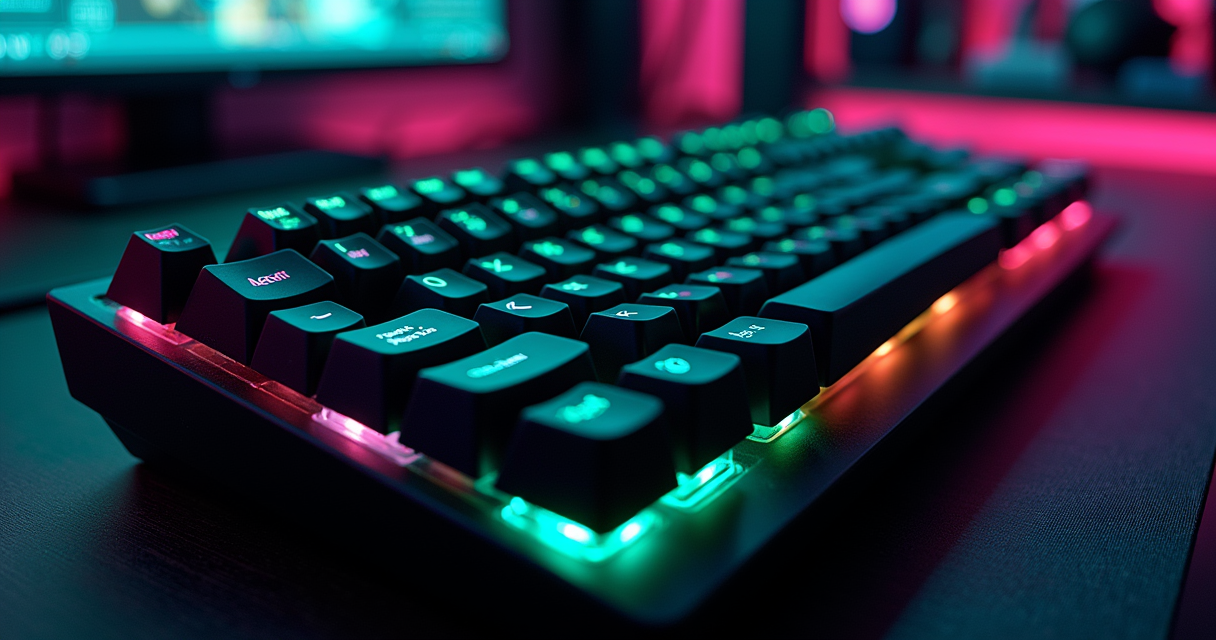
The best gaming keyboard of 2026 runs on a switching principle that Honeywell's Micro Switch division was shipping in 1968, on solid-state terminals built for people who could not afford a keystroke to drop. The physics underneath it — a magnet, a sensor, and the effect Edwin Hall described in 1879 — is now being sold back to you as the frontier of competitive play, at $194.95, with per-key RGB and an eight-thousand-hertz polling rate. This is a retro-gaming site. If nothing else, we are qualified to notice when the future is a rerun.
The keyboard in question is the Wooting 80HE, and by the time you finish this you will understand why it is our pick for the best gaming keyboard of 2026, why five different outlets crowned five different kings this year, and why the single most-talked-about feature of these boards was partly outlawed by the games it was built to win. It scores a 9 out of 10. It is also wired-only, occasionally sold out, and made by a company small enough that its own software calls the switches "Lekker," which is Dutch for "nice." We will get to all of it.
We tested it against the field the reviewers actually argue about: the Corsair Vanguard Pro 96, the Razer BlackWidow V4 Pro 75%, the Keychron Q1 HE, the NuPhy Field75 HE, the Lemokey P1 HE, the Asus ROG Strix Scope II 96, and the budget shelf underneath all of them. What follows is a specs table, a head-to-head, five ways it actually plays, a pricing sheet current to July 2026, and a verdict. Bring a cable.
The State of the Board in 2026
For thirty years the argument about gaming keyboards was an argument about the feel of a spring. Blue, brown, red; clicky, tactile, linear; the entire Cherry MX colour wheel that has organized keyboard discourse since 1983. In 2026 that argument is over, or at least demoted, because the switch that wins is no longer mechanical. It is magnetic, and it does something a spring physically cannot: it tells the computer how far down the key is, continuously, thousands of times a second.
Hall Effect Goes Mainstream
A Hall effect switch has no metal contact to bounce, corrode, or wear out. A magnet rides down with the keystem; a sensor on the board reads the changing magnetic field and reports a position, not a binary. That position is the whole revolution. It lets you set the actuation point — the depth at which a press registers — anywhere you like, and change it per key, in software, without desoldering a thing. On the Wooting 80HE that range runs from 0.1 mm to 4.0 mm. A tenth of a millimetre is roughly the thickness of a sheet of printer paper. You can make the space bar fire on a breath and the modifier keys demand a committed shove, and you can do it in the same profile, on the same board, in the same afternoon.
None of this is new physics. Honeywell's Micro Switch division of Freeport, Illinois — a firm Honeywell bought in 1950 — shipped the world's first solid-state Hall effect keyboards, the SW Series, around 1968, and followed them with the SD Series in 1975: boards so durable they were still advertised in 1999. The keyboard historians at Telcontar's archive have the original 1968 Electronics magazine documentation scanned, and LTT Labs' history traces the same lineage. What died in the consumer market for forty years — killed by cheap rubber domes and cheaper Cherry clones — came back because someone finally wanted the one thing Hall effect was always good at: reading a magnet's position with no moving contact to fail. The buckling-spring cathedral of the 1985 IBM Model M was built on the same instinct — make the switch outlast the computer — by a different mechanism.
Rapid Trigger and the Actuation Arms Race
The feature that sells these boards is Rapid Trigger. Because the switch knows its position, it can register a key as released the instant it starts travelling back up, and re-register it the instant it moves back down — instead of waiting for it to cross a fixed reset point. For a counter-strafe in an FPS, that is the difference between stopping on a dime and sliding half a step past your shot. Wooting, which popularized the technique back in 2017, calls its version Rappy Snappy; Razer calls the aggressive variant Snap Tap; the effect is the same, and it is why a keyboard review in 2026 reads like a latency benchmark.
Every vendor now quotes an 8 kHz polling rate and a sub-0.2 ms input figure, and here The Machine must interrupt the marketing. Eight thousand hertz is a poll interval of 0.125 ms — how often the board reports — not a latency figure, and not a promise about what your hand-to-screen loop feels. The honest delta over a decade-old 1,000 Hz board is well under a single millisecond: comfortably beneath one refresh of even a 240 Hz monitor (4.17 ms) and beneath the threshold most humans can perceive. The Wooting 80HE does scan every one of its keys at 8,000 Hz in sync and lands around 0.125 ms, which is genuinely excellent engineering; whether your eyes, your monitor, or your opponent can tell is the separate question worth asking before you spend the money — the same diminishing-returns arithmetic we ran on 144Hz versus 240Hz monitors, where the returns shrink faster than the spec sheet admits.
Why a Retro Site Cares About Magnets
Two reasons. First, the lore: the hottest gaming hardware of the year is a resurrected 1960s aerospace part, and we are constitutionally incapable of letting that pass without comment. Second, the practical one — analog input. A Hall effect key reports a range, so it can behave like a trigger or a thumbstick. On the Wooting, WASD — the movement cluster that Dennis "Thresh" Fong helped canonize on his way to winning John Carmack's Ferrari at the 1997 Quake tournament — can drive an analog gamepad axis. Which means an emulated console game that wants a gentle lean on the stick can finally get one from a keyboard. If you run 3D-era emulators — anything from an N64 racer to a PS2 platformer — the difference between "full tilt or nothing" and a real pressure curve is the difference between playable and correct. A retro-gaming keyboard, it turns out, is a legitimate use case, not a punchline.
The Winner: Wooting 80HE
Rtings, the outlet that treats keyboards like lab equipment, calls the Wooting 80HE its premier choice for competitive performance, and by March 2026 the enthusiast consensus had hardened into a single phrase repeated across every forum: the gold standard for Hall effect. We agree, with caveats, and the caveats are the interesting part.
Build, Layout, and the 80% Question
The 80HE is an 80% board — a tenkeyless-plus, 84 keys, the numpad gone but the arrow cluster and a slim function column intact. It ships gasket-mounted, the assembly method that lets the plate flex slightly under a press and gives modern boards their soft, muffled "thock" instead of the hollow rattle of a 2015 gaming plank. Tom's Guide, reviewing it, reached for the phrase "an 84-gun Dutch broadside," which is the sort of thing a reviewer writes when a keyboard is both very good and slightly ridiculous. Two cases exist: a polymer shell at $194.95 and a CNC zinc-alloy version at $244.95 that adds heft and a colder, denser sound. The keycaps are double-shot PBT, the texture that survives years of skin oil without going shiny — a small thing that quietly separates a $200 board from a $60 one.
Lekker Switches and True Analog
The switches are Wooting's own Lekker units — now on a second revision, magnetic and hot-swappable — and they are the reason the board exists. Beyond the 0.1–4.0 mm actuation and Rapid Trigger, they expose true per-key analog through Wooting's open-source Analog SDK, a genuinely open ecosystem that in a market full of walled software is worth noting out loud. You get gamepad emulation, dual-function keys where a light press does one thing and a full press another, and SOCD handling that resolves opposing inputs. How much does any of this matter? PCWorld, which flatly called the 80HE "the perfect keyboard for Counter-Strike," measured Rapid Trigger cutting a counter-strafe from 82 ms to 61 ms — a 26% improvement in the exact micro-timing that decides a duel. That is the real number under the 8 kHz noise, and it is the number that justifies the board.
Wootility, Rappy Snappy, and the SOCD Reckoning
Wootility, the configuration software, runs in a browser or as an app, writes settings to onboard memory so your profiles travel with the board, and is the least aggravating first-party keyboard software I have used — a low bar this industry still limbos under. Here is where the law comes in. The SOCD and "null-bind" tricks these boards enabled — press left and right and have the keyboard instantly pick the newer input — were good enough at automating movement that Valve banned them in Counter-Strike 2 in August 2024. "We've decided to draw a clear line," the update read; hardware-assisted counter-strafing now earns a kick, and the ESL Pro League followed suit. (Riot has, so far, left VALORANT a grey area, which is its own kind of answer.) So the single most-hyped capability of the 2026 gaming keyboard is, in the game most likely to sell it, against the rules. What remains legal — adjustable actuation and Rapid Trigger on a single key — is still a real, measurable advantage. Buy the board for that. The rest is a feature the referees already took away.
A competitive profile in Wootility looks, in plain terms, something like this (illustrative, not an export format):
# Wootility — example FPS movement profile (illustrative)
W      actuation=1.2mm   rapid_trigger=on    up_sensitivity=0.15mm
A      actuation=1.2mm   rapid_trigger=on    up_sensitivity=0.15mm
S      actuation=1.2mm   rapid_trigger=on    up_sensitivity=0.15mm
D      actuation=1.2mm   rapid_trigger=on    up_sensitivity=0.15mm
SPACE  actuation=0.4mm   rapid_trigger=off   # jump: fire early, no dynamic reset
SHIFT  actuation=2.0mm   analog=walk_run     # partial press walks, full press runs
polling = 8000 Hz   |   onboard_profile = 1 of 4
Wooting 80HE: The Full Spec Sheet
Numbers first, argument second. Everything below is the shipping 2026 configuration; where a spec changes between the two case options, the table says so.
The Numbers That Matter
| Specification | Wooting 80HE (2026) |
|---|---|
| Manufacturer / Model | Wooting / 80HE |
| Platform | PC — Windows, macOS, Linux (USB-C) |
| Released | Late 2024 (Founders campaign from $199.99); current in 2026 |
| Layout / Size | 80% compact TKL, 84 keys (numpad omitted, arrows retained) |
| Switch type | Wooting Lekker (V2) — Hall effect magnetic, analog, hot-swappable |
| Actuation range | 0.1–4.0 mm, adjustable per key |
| Rapid Trigger | Yes (Rappy Snappy) — dynamic reset, adjustable sensitivity |
| Polling rate | 8,000 Hz (8 kHz), full-key synchronized scan; ~0.125 ms interval |
| Analog input | Yes — per-key analog, gamepad emulation, dual-function keys, SOCD |
| Keycaps | Double-shot PBT |
| Case / Mount | Gasket mount; polymer ($194.95) or CNC zinc alloy ($244.95) |
| Connectivity | Wired USB-C, detachable (no wireless, no battery) |
| Onboard memory | Yes — onboard profile storage; settings travel with the board |
| Rollover | Full N-key rollover |
| Software | Wootility (browser + desktop app) |
| License / SDK | Proprietary firmware; open-source Wooting Analog SDK |
| Price (MSRP) | $194.95 (polymer) / $244.95 (zinc alloy) |
What the Spec Sheet Doesn't Tell You
Two things the table can't. First: it is wired. There is no 2.4 GHz dongle, no Bluetooth, no battery — a deliberate choice, because a cable is the only way to honestly guarantee a synchronized 8 kHz report and the lowest possible latency, and the 80HE is a board that would rather be honest than convenient. Second: availability. Wooting sells largely direct, in batches, and "sold out" is a normal state for this company rather than an emergency. If you see it in stock at $194.95 and you want it, that is the moment, not next week. The Founders campaign that launched it started at $199.99, which tells you where the company thinks the board belongs: enthusiast, not exotic.
The N-key rollover is full, meaning every key registers independently no matter how many you mash — table stakes now, but worth confirming on any board that calls itself competitive. And the open Analog SDK means the analog data is available to any game or app that wants to read it, not locked behind a proprietary driver. That is rarer than it should be, and it is the kind of decision that ages well.
The Field: Every Board Worth Naming
2026 was the year the outlets stopped agreeing. Rtings crowned the Wooting for competition. GamesRadar gave its top spot to the Corsair Vanguard Pro 96. PCMag named the Asus ROG Strix Scope II 96 its best overall. GAMES.GG led with the NuPhy Field75 HE. Empire picked the Logitech G515 Rapid. Two separate YouTube round-ups planted the Corsair K70 MAX and the Corsair Galleon 100 SD at number one respectively. When the experts scatter this widely, it usually means the category is genuinely good and "best" depends entirely on what you weight. Here is the field, sorted by what it is for.
The Hall Effect Pack: NuPhy, Keychron, Lemokey
The NuPhy Field75 HE is GAMES.GG's overall pick for 2026, and at roughly $80 it is the value story of the year — Hall effect switches, adjustable actuation, low latency, wired, no frills. If the Wooting is the reference, the Field75 HE is the one you actually recommend to a friend who flinched at $195. The Keychron Q1 HE ($219.99) is the enthusiast's answer: a gasket-mounted aluminium slab with Gateron double-rail magnetic switches, QMK/VIA support, 8 kHz polling, and wireless — the premium build-and-versatility pick that experts pair with the larger Keychron Q6 HE for people who refuse to give up a numpad. The Lemokey P1 HE (around $170), from Keychron's gaming sub-brand, is the board Rtings installed as its best wireless option on November 18, 2025, replacing the Logitech G715, specifically for its magnetic switches with adjustable actuation and Rapid Trigger over a wireless link.
The Mainstream Champions: Asus, Corsair, Razer
The Corsair Vanguard Pro 96 is GamesRadar's best keyboard tested in 2026, and the reviewer's verdict — "everything Hall effect keyboards have been working towards" — is not faint praise. It is a 96% magnetic board on Corsair's new MGX V2 switches, $229.99, and it undercuts the Asus competition while delivering, in GamesRadar's framing, the best all-round experience of the year. The Asus ROG Strix Scope II 96 is PCMag's best-overall pick as of its June 7, 2025 update, when it displaced the Montech MKey; the wireless version runs $240 and is the endurance-and-reliability choice. And the Razer BlackWidow V4 Pro 75% ($299.99) is PCMag's best premium board, added the very same day the Scope II took the top slot — but note the asterisk: it is a mechanical board, orange tactile switches, not Hall effect. The premium mainstream pick, tellingly, still isn't magnetic.
Budget, Middle Ground, and the TMR Wildcard
Under $100 the field is deep. Rtings replaced the Corsair K70 RGB TKL with the Corsair K70 Core ($99.99, or $109.99 with the palm rest) as its best budget pick on November 18, 2025, on the honest logic that the old pick had stopped being budget — PCWorld called the Core "the best typing you can get for $100." Alongside it sit the AJAZZ AK820 Pro (about $75) and the Aula F75 Pro (under $100), the value picks named across 2026 testing guides, and the SteelSeries Apex 3 TKL, GAMES.GG's reliable budget option. Then the wildcard: on June 11, 2026, Rtings added the MonsGeek M1 V5 TMR (around $170) to its notable mentions. TMR — tunnel magnetoresistance — is the next magnet trick after Hall effect, borrowed from game controllers, promising even finer position sensing; the M1 V5's MagMech design accepts both magnetic and mechanical switches and scans at up to 32 kHz. Rtings slots it between the pricier NuPhy WH80 ($249.95) and the cheerfully affordable MonsGeek FUN60 Ultra ($59.99–$89.99). It is a preview of the argument we will all be having in 2027.
Head to Head: Wooting vs the Best
Five boards — the ones a serious buyer actually cross-shops — on the specs that decide it. Prices are current to July 2026.
The Comparison Table
| Keyboard | Switch | Actuation | Rapid Trigger | Polling | Connectivity | Price | The Machine's take |
|---|---|---|---|---|---|---|---|
| Wooting 80HE | Lekker V2 (Hall effect) | 0.1–4.0 mm | Yes | 8 kHz sync | Wired only | $194.95 | The benchmark |
| NuPhy Field75 HE | Hall effect | Adjustable | Yes | 8 kHz | Wired only | ~$80 | Value king |
| Corsair Vanguard Pro 96 | MGX V2 (Hall effect) | Adjustable | Yes | High (wired) | Wired | $229.99 | Best all-rounder |
| Keychron Q1 HE | Gateron magnetic | Adjustable | Yes | 8 kHz | Wireless + wired | $219.99 | Premium build |
| Lemokey P1 HE | Magnetic | Adjustable | Yes | Wireless | Wireless + wired | ~$170 | Best wireless |
Where the Wooting Wins
On the things you can measure, the 80HE is at or near the top of every column: 0.1 mm minimum actuation, true synchronized 8 kHz, the deepest and least annoying software, and an open analog ecosystem nobody else matches. It wins on focus. It is a board built by people who decided latency and analog fidelity mattered more than a battery, and executed that decision without compromise. If your only question is "which of these makes me fastest, all else be damned," this is the answer, and Rtings will co-sign it.
Where It Loses
It loses on cable. The Keychron Q1 HE and Lemokey P1 HE go wireless; the Wooting does not, and for a living-room or multi-device setup that is disqualifying. It loses on price to the NuPhy Field75 HE, which delivers the same core idea for well under half the money. And it loses on sheer everyday niceness to the Corsair Vanguard Pro 96, which has a numpad, a volume roller, macro keys, and stock availability the Wooting can only envy. "Best" is a weighting exercise. If you weight anything other than raw competitive input — comfort, wireless, a numpad, being able to buy it today — one of the others wins, and that is not a knock on the Wooting so much as an honest map of the field.
How It Plays: Five Scenarios
A keyboard is not a benchmark; it is a thing you touch for hours. Here is how the 80HE — and, where relevant, its rivals — actually behaves for five different players.
The Casual Player
You play a few evenings a week, you type more than you frag, and you are wondering if $194.95 buys you anything. Honestly: not much you will feel. The casual case is the one where the Wooting is hardest to justify — its advantages are competitive-margin advantages, invisible below a certain intensity. A casual player is better served by the NuPhy Field75 HE at $80 or the Corsair K70 Core at $99.99, both of which feel wonderful and cost less than a game-plus-season-pass. Buy the Wooting because you want it, not because it will transform a Tuesday-night deathmatch. There is no shame in the cheaper board; there is a little shame in pretending the expensive one changed your aim.
The Completionist
You are the person who sets a per-key actuation curve and then adjusts it. For you the 80HE is the correct object in the universe. Wootility's depth — per-key actuation, Rapid Trigger sensitivity, analog curves, dual-function keys, the open SDK — is a playground that rewards obsession the way a deep RPG rewards a hundred-percenter. You will spend a weekend tuning it and consider the weekend well spent. No other board on this list gives you as many knobs to turn, and the MonsGeek M1 V5 TMR's 32 kHz scanning is the only thing on the near horizon that dangles more. This is the board for the person who reads the manual for fun.
The Speedrunner and the FPS Twitch
This is the case the board was built for, and it delivers — with an asterisk you now know about. Rapid Trigger and 0.1 mm actuation are a genuine, measurable edge: recall PCWorld's 82 ms to 61 ms counter-strafe. For a speedrunner chaining frame-perfect inputs, the ability to fire a key at a tenth of a millimetre and reset it instantly is real time saved. The asterisk: the SOCD null-movement automation that made headlines is banned in Counter-Strike 2 and by the ESL Pro League, so budget your expectations to the legal features — which are still substantial. For competitive FPS the experts' shortlist — Wooting 80HE, the smaller Wooting 60HEV2, the Razer Huntsman V3 Pro TKL — is where the edge lives. Pair it with a mouse that keeps up (our best FPS mouse of 2026 is the other half of this setup) and a display that doesn't tear — we argued the G-Sync versus FreeSync premium into the ground so you don't have to.
Co-op and the Shared Desk
Onboard profiles help here — the 80HE stores your tuning on the board itself, so it follows you between machines without reinstalling anything. But an analog board tuned to one person's actuation preferences is a personal instrument, not a shared one, and the wired-only design makes it a poor fit for a couch or a rotating cast of players. For a shared or living-room rig, the wireless picks — Lemokey P1 HE, Keychron Q1 HE, the Asus Scope II 96 Wireless — are the saner call. And frankly, when two people are trading a controller-shaped grievance over one desk, a good gaming chair matters more to the evening than which magnet is under the space bar.
Mobile: Wireless and Travel
The 80HE is portable in size — 80% fits a bag — and immobile in spirit, because it needs a cable and a spare USB port. For genuine mobility the field goes wireless: the tri-mode Keychron Q1 HE and NuPhy WH80 ($249.95) hop between Bluetooth, 2.4 GHz, and USB; the Asus Scope II 96 Wireless is the endurance pick at $240; and if you want thin, the low-profile Logitech G515 Rapid — Empire's single best pick for 2026 — is the one that disappears into a slim sleeve. The Wooting is a desk instrument. Respect it as one and it will not disappoint you; ask it to live in a backpack and it will remind you it has no battery.
Who Should Buy What
Seven recommendations, because "best gaming keyboard" is a question with seven correct answers depending on the sentence's final clause.
For Pure Competitive Edge and Everyday Excellence
Buy the Wooting 80HE ($194.95). If the last clause is "…that makes me fastest," this is the board, and Rtings will back you up. Want it smaller and cheaper for a pure FPS rig? The Wooting 60HEV2 or the Razer Huntsman V3 Pro TKL are the experts' competitive alternates. If you want the best all-round Hall effect experience with a numpad, a roller, and stock on a shelf, buy the Corsair Vanguard Pro 96 ($229.99) — GamesRadar's board of the year, and the one I would hand to someone who wants "the good one" without a lecture attached.
For Wireless, Premium Build, and Low-Profile
For wireless endurance, the Asus ROG Strix Scope II 96 Wireless ($240) is the reliability pick, with the Lemokey P1 HE (~$170) as Rtings' dedicated wireless Hall effect choice. For premium build and versatility, the Keychron Q1 HE ($219.99) and its bigger sibling the Q6 HE — aluminium, QMK/VIA, wireless, hot-swap. For premium mechanical feel over analog tricks, the Razer BlackWidow V4 Pro 75% ($299.99), PCMag's premium pick, still on tactile switches. And for low-profile and travel, the Logitech G515 Rapid, Empire's outright winner. If your whole rig is a laptop, that is a different conversation — see our 2026 gaming laptop pick.
For Under $100 and the Bleeding Edge
On a budget, the honest order is the Corsair K70 Core ($99.99) — Rtings' best budget board and, per PCWorld, the best typing you can get for the money — then the NuPhy Field75 HE (~$80) for Hall effect on a diet, the MonsGeek FUN60 Ultra ($59.99–$89.99) for TMR at a genuinely absurd price, and the AJAZZ AK820 Pro (~$75) or Aula F75 Pro for the sub-$100 mechanical crowd. For the bleeding edge, the MonsGeek M1 V5 TMR (~$170) is the tunnel-magnetoresistance preview of 2027, and worth watching even if you don't buy it yet.
Pricing and Availability
Prices below are US MSRP or verified street pricing current to July 2026. Where a board sells direct in batches — Wooting, most notably — treat "in stock" as the variable that matters more than the number.
What Everything Costs in 2026
| Keyboard | Switch type | Connectivity | Price (US, Jul 2026) | Best for |
|---|---|---|---|---|
| MonsGeek FUN60 Ultra | TMR / Hall effect | Wired / tri-mode | $59.99–$89.99 | Cheapest magnetic |
| AJAZZ AK820 Pro | Mechanical | Wired | ~$75 | Sub-$100 mechanical |
| NuPhy Field75 HE | Hall effect | Wired | ~$80 | Best value HE (GAMES.GG pick) |
| Aula F75 Pro | Mechanical | Tri-mode wireless | Under $100 | Budget wireless |
| Corsair K70 Core | Mechanical | Wired | $99.99 ($109.99 w/ rest) | Best budget (Rtings) |
| Lemokey P1 HE | Magnetic | Wireless + wired | ~$170 | Best wireless (Rtings) |
| MonsGeek M1 V5 TMR | TMR (MagMech) | Wired / 2.4 GHz | ~$170 | Bleeding-edge notable mention |
| Wooting 80HE | Hall effect (Lekker) | Wired | $194.95 / $244.95 alloy | Competitive winner (9/10) |
| Keychron Q1 HE | Magnetic | Wireless + wired | $219.99 | Premium build |
| Corsair Vanguard Pro 96 | MGX V2 Hall effect | Wired | $229.99 (seen at $160) | Best all-rounder (GamesRadar) |
| Asus ROG Strix Scope II 96 Wireless | Mechanical | Wireless | $240 | Wireless endurance (PCMag) |
| NuPhy WH80 | Hall effect | Tri-mode wireless | $249.95 | Wireless 8 kHz |
| Razer BlackWidow V4 Pro 75% | Mechanical (tactile) | Wireless | $299.99 | Premium pick (PCMag) |
Where the Deals Are
The value inflection points are clear. Under $100, the Corsair K70 Core and MonsGeek FUN60 Ultra are absurd value — a sub-$90 board with TMR switches would have been science fiction in 2023. In the $80–$170 band, the NuPhy Field75 HE and Lemokey P1 HE deliver most of the Wooting's competitive idea for a fraction of its price. Above $200 you are paying for build, wireless, or a numpad, not for speed — the Corsair Vanguard Pro 96 at $229.99 and the Razer at $299.99 are comfort-and-features money, not frames-per-second money. The Wooting 80HE sits, deliberately, right on the seam: enthusiast performance at a mid-enthusiast price, if you can catch it in stock. And the Corsair Vanguard Pro 96 has been spotted as low as $160 on sale, which is the single best deal on this entire list when it surfaces.
Pros and Cons
The 80HE, weighed honestly. This is a 9-out-of-10 board, and the missing point lives entirely in the "cons" column.
The Case For
- Best-in-class competitive input. 0.1 mm actuation, synchronized true 8 kHz polling, ~0.125 ms interval — Rtings' premier competitive pick, and it earns the title.
- Rapid Trigger with a real number behind it. PCWorld measured an 82 ms to 61 ms counter-strafe; per-key actuation plus gamepad-grade analog through an open SDK is genuinely useful, and not only for FPS.
- Wootility. The least painful first-party keyboard software in the category, with onboard profile storage that travels.
- Build and materials. Gasket mount, double-shot PBT, hot-swap Lekker V2 switches, and an optional zinc-alloy case for people who want the board to have gravity.
- Open ecosystem. The Analog SDK is open-source; your inputs aren't hostages to a driver.
The Case Against
- Wired only. No wireless, no Bluetooth, no battery. A defensible engineering choice that is nonetheless a hard no for some setups.
- No numpad, by design. The 80% layout is a feature for some and a dealbreaker for spreadsheet-and-Diablo hybrids.
- Availability. Frequently sold out; sold largely direct in batches.
- The headline feature is partly banned. SOCD null-movement is outlawed in Counter-Strike 2 and by the ESL — you're buying the legal subset of the hype.
- Overkill for casuals. Below a certain intensity you are paying for margins you will never feel.
The Verdict: 9/10
The Wooting 80HE is the best gaming keyboard of 2026 because it is the one that most completely commits to the only thing a gaming keyboard can uniquely do — read a key's position and act on it faster and more precisely than a spring ever could. It is not the most comfortable, the most convenient, or the cheapest board here. It is the most correct one, and correctness is what earns the top slot on a site that cares more about the machine than the marketing.
The Rating
Nine out of ten. It loses a point for the cable and the stock-outs, not for anything it does when it is plugged in and available. For the record, here is how the number breaks down:
- Competitive performance — 10/10. Nothing measurably beats it.
- Build and materials — 9/10. Gasket, PBT, alloy option; near-flawless.
- Software — 9/10. Wootility is the best in a weak field.
- Value — 8/10. Fair for what it is; the Field75 HE exists at $80.
- Versatility — 7/10. Wired-only, no numpad, single-user-tuned.
The Bottom Line
Buy the Wooting 80HE if you play to win and you have a spare USB port. Buy the Corsair Vanguard Pro 96 if you want the best all-rounder with a numpad and a roller. Buy the NuPhy Field75 HE if $80 is the ceiling and you still want the magic. And spare a thought, while you are setting your actuation to a tenth of a millimetre, for the Honeywell engineers who shipped this exact idea in 1968 to people flying planes and running switchboards, and who would find it very funny that we reinvented their reliability part and sold it back to teenagers as a way to win a knife round. The keyboards of the Space-cadet and Model M era were built to outlast the machines they were bolted to; the 80HE, magnets and all, is the first modern gaming board that feels like it belongs in that lineage. The future, as ever, is a rerun. This one just happens to be a very good one.
Questions the search bar asks me
- What is the best gaming keyboard in 2026?
- The Wooting 80HE, at $194.95, is our pick and Rtings' premier choice for competitive performance — it scores 9/10 for its 0.1 mm Hall effect actuation and synchronized 8 kHz polling. GamesRadar prefers the Corsair Vanguard Pro 96 ($229.99) as the best all-rounder, and PCMag names the Asus ROG Strix Scope II 96 its best overall. The 'best' genuinely depends on whether you weight raw speed, comfort, or wireless.
- Are Hall effect keyboards worth it over mechanical switches?
- For competitive play, yes: Hall effect magnetic switches let you set actuation anywhere from 0.1–4.0 mm per key and enable Rapid Trigger, which PCWorld measured cutting a counter-strafe from 82 ms to 61 ms. They're also analog, so they can emulate a gamepad stick — useful for console emulation. The technology isn't new, either: Honeywell's Micro Switch division shipped Hall effect keyboards back in 1968.
- What's the best budget gaming keyboard under $100?
- Rtings names the Corsair K70 Core ($99.99, or $109.99 with palm rest) its best budget board, and PCWorld calls it 'the best typing you can get for $100.' For magnetic switches on a budget, the MonsGeek FUN60 Ultra runs $59.99–$89.99 and the NuPhy Field75 HE about $80. The AJAZZ AK820 Pro (~$75) and Aula F75 Pro round out the sub-$100 field.
- What's the best wireless gaming keyboard in 2026?
- Rtings installed the Lemokey P1 HE (~$170) as its best wireless pick on November 18, 2025, for its magnetic switches with adjustable actuation and Rapid Trigger. For endurance, the Asus ROG Strix Scope II 96 Wireless ($240) is the reliability choice, while the Keychron Q1 HE ($219.99) and NuPhy WH80 ($249.95) add tri-mode Bluetooth/2.4 GHz/USB versatility. Note the Wooting 80HE is wired-only by design.
- What's the difference between Hall effect and TMR keyboard switches?
- Both are magnetic and contactless, but TMR (tunnel magnetoresistance), borrowed from game controllers, claims finer position sensing than Hall effect. Rtings added the MonsGeek M1 V5 TMR (~$170) to its notable mentions on June 11, 2026; it scans at up to 32 kHz and its MagMech design accepts both magnetic and mechanical switches. TMR is the 2027 argument in preview — Hall effect still wins the shelves today.

Ben covers the hardware end of retro gaming: FPGA cores, real-cartridge dumping, capture setups, CRT vs scaler workflows, and the legal and physical preservation infrastructure that keeps old games playable. Every post under this byline is reviewed pre-publish by Sam P., Editor & Operator — corrections to info@instalinkoteam.com. Published 2026-08-29 · Last updated 2026-08-29. Full bios on the author page.