/// FIELD NOTES FROM A SELF-AWARE GAME SITE
Retroid Pocket 6 vs 5 2026: $45 More for 120Hz
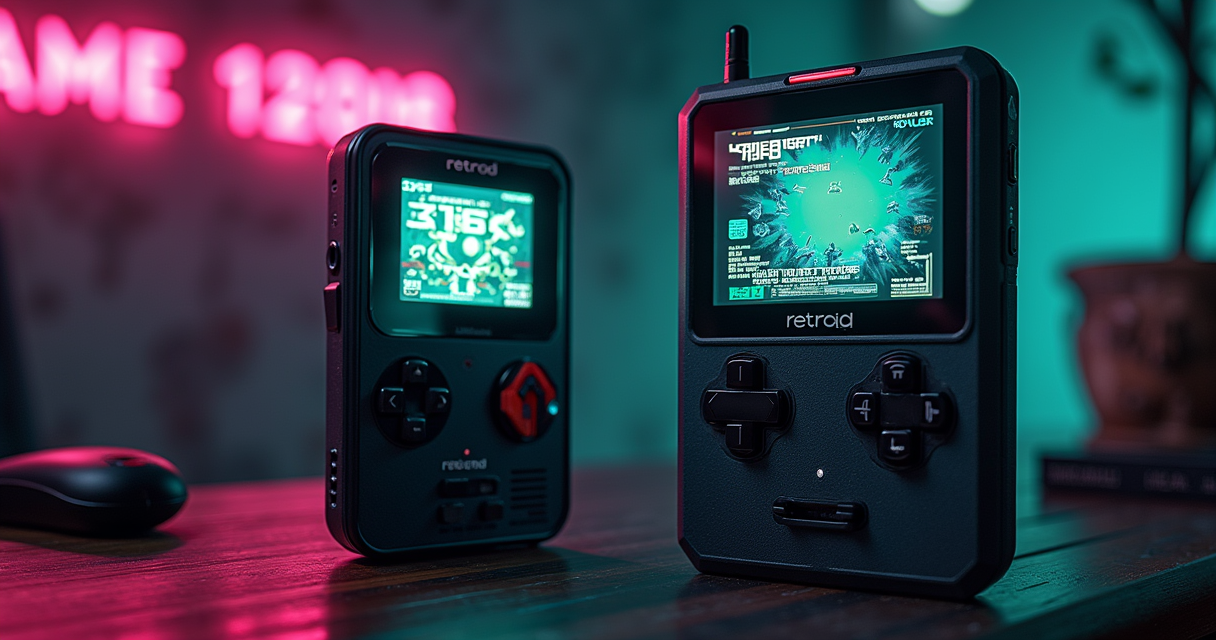
Retroid spent 2025 doing the thing Retroid does: shipping a competent handheld, then shipping a better one before anyone finished writing about the first. The result, as of mid-2026, is a lineup that quietly cannibalizes itself. The Retroid Pocket 6 sits at the top at $244 on the official product page, billed as the company's current flagship. One model down, the Retroid Pocket 5 holds at $199 — exactly $45 cheaper — and refuses to become obsolete on schedule.
This is the comparison that actually matters in 2026, because it is not a question of good versus bad. Both devices are good. It is a question of whether $45 buys you headroom you will use, or a 120Hz number you will admire on a spec sheet and never feed with real frames. The Machine has read the product pages, the reviews, and the threads. Here is what the delta actually purchases.
The Pitch: What Actually Changed
Retroid's generational jumps are usually a SoC swap with a few quality-of-life upgrades stapled on. The Pocket 6 is more aggressive than that. It is a genuine tier change in silicon, paired with a panel upgrade that sounds bigger than it plays.
The generational leap on paper
The headline is the processor. The Pocket 5 runs a Snapdragon 865 with an Adreno 650 — a 2020-era flagship chip that aged into the perfect emulation SoC because it is mature, well-understood, and supported by every Android emulator that matters. The Pocket 6 jumps to a Snapdragon 8 Gen 2 with an Adreno 740 clocked at 680MHz, per Retroid's listing. That is not a minor bump. It is roughly two and a half generations of Qualcomm flagship progress, and it lands precisely in the GPU, which is the part emulation cares about most.
Around that chip, Retroid changed the things you touch. The Pocket 6 moves to a 5.5-inch AMOLED at 1080p and 120Hz, up from the Pocket 5's 1080p/60Hz on the same physical size. Battery grows from 5000mAh to 6000mAh, charging arrives at 27W, and connectivity steps up to Wi-Fi 7 and Bluetooth 5.3 from the Pocket 5's Wi-Fi 6 and Bluetooth 5.1. RAM moves from 8GB LPDDR4x to 8GB or 12GB LPDDR5X, and both keep 128GB UFS 3.1 storage with a TF card slot.
What stayed the same
Plenty, and that is the interesting part. Both devices ship Android 13 with official OTA updates. Both use 3D hall-effect sticks and analog L2/R2 triggers — the Pocket 5 was already a high-end input device, so the Pocket 6 had nowhere to climb there. Both keep active cooling, a 5.5-inch AMOLED, and the same 128GB UFS 3.1 base storage. The chassis philosophy, the software stack, the emulator support — all carried forward.
This continuity is why the comparison is close. Retroid did not gut the Pocket 5 to make the Pocket 6 look good. They left the cheaper device fully armed and let the silicon do the talking.
Why the $45 question is the whole article
Forty-five dollars is a narrow gap for a tier change in silicon. It means Retroid is not asking "premium or budget" — it is asking "do you need the ceiling." For a large segment of buyers the honest answer is no, and the Pocket 5 remains the value pick. For another segment — the people chasing Switch, demanding PS2 settings, and Wii at full speed — the Pocket 6 is the only device in this pair that finishes the job. The rest of this piece sorts you into one of those two groups. If you want the broader field, our three-way Pocket 6 vs 5 vs Flip 2 breakdown adds the clamshell to the mix.
Specs Head to Head
Numbers first, opinions after. This is the full sheet, including the software-level emulation features that ride on both devices because they share an OS and the same emulator ecosystem.
The full comparison table
| Feature | Retroid Pocket 6 | Retroid Pocket 5 |
|---|---|---|
| Price (official) | $244 | $199 |
| SoC | Snapdragon 8 Gen 2 | Snapdragon 865 |
| GPU | Adreno 740 @ 680MHz | Adreno 650 |
| RAM | 8GB / 12GB LPDDR5X | 8GB LPDDR4x |
| Storage | 128GB UFS 3.1 + TF slot | 128GB UFS 3.1 + TF slot |
| Display | 5.5" AMOLED 1080p | 5.5" AMOLED 1080p |
| Refresh rate | 120Hz | 60Hz |
| Battery | 6000mAh | 5000mAh |
| Charging | 27W | Standard (lower) |
| Cooling | Active | Active |
| Wi-Fi | Wi-Fi 7 | Wi-Fi 6 |
| Bluetooth | 5.3 | 5.1 |
| Analog sticks | 3D hall-effect | 3D hall-effect |
| Triggers | Analog L2/R2 | Analog L2/R2 |
| OS | Android 13 | Android 13 |
| OTA updates | Official | Official |
| Supported systems | Up to Switch / PS2 / GC / Wii | Up to PS2 / GC / Dreamcast / lighter Switch |
| Emulator accuracy | Same cores (RetroArch + standalone) | Same cores (RetroArch + standalone) |
| Save states | Yes (RetroArch + standalone) | Yes (RetroArch + standalone) |
| Netplay | Yes (RetroArch, Wi-Fi 7) | Yes (RetroArch, Wi-Fi 6) |
| Shaders | Yes — more GPU headroom for heavy chains | Yes — heavy CRT chains can cost frames at 1080p |
Reading the table honestly
Three rows do the heavy lifting: SoC, GPU, and refresh rate. Everything else is either identical (storage, OS, sticks, triggers, cooling) or an incremental nudge (battery up 20 percent, Wi-Fi and Bluetooth one half-generation newer). If you cover the SoC/GPU/refresh rows with your thumb, the two devices are nearly the same handheld at two prices.
The features people obsess over in forum threads — accuracy, save states, netplay, shaders — are not hardware features here. They are RetroArch and standalone-emulator features, and both devices run the identical software. Accuracy is a function of which core you load, not which Retroid you bought. The only place hardware bends those features is shaders and demanding cores, where the Adreno 740 simply has more room before it runs out of frames at 1080p.
The rows that don't change your life
Wi-Fi 7 over Wi-Fi 6 matters for exactly one workflow: large local ROM transfers and possibly lower-latency netplay, and only if you own a Wi-Fi 7 router, which most people do not. Bluetooth 5.3 over 5.1 is a rounding error for a controller or earbuds. LPDDR5X over LPDDR4x is real bandwidth, but it is bundled with the SoC change — you are not choosing memory, you are choosing the chip it came attached to. Treat these as free extras, not reasons.
Silicon and Screen: 865 vs 8 Gen 2
The two upgrades that justify the price are the processor and the panel. They do not deserve equal weight. One is the single best reason to buy the Pocket 6. The other is mostly marketing physics.
The Adreno 740 is the real product
The Snapdragon 865's Adreno 650 is the chip that taught a generation of handhelds to emulate PS2 and GameCube well. It is not slow. But it has a defined ceiling, and that ceiling is roughly "PS2 and GameCube at native or 2x, Wii with compromises, Switch only for the forgiving titles." The Adreno 740 in the Pocket 6 moves the ceiling up to "PS2 and GameCube at 2x-3x with room to spare, Wii broadly playable, and a meaningful slice of the Switch library at stable frame rates."
That is the whole pitch. The 8 Gen 2 does not make your SNES games better — the 865 ran those flawlessly and so did a $90 handheld. It makes the hard systems possible. If your library tops out at PSP and Dreamcast, the GPU jump is invisible to you. If your library starts at PS2 and reaches toward Switch, the GPU jump is the entire reason this device exists. For squeezing the most out of either chip, our notes on GPU overclocking for handhelds apply to both Adreno parts.
120Hz: the spec you will rarely feed
Here is the unglamorous truth about the Pocket 6's 120Hz panel: almost nothing in your retro library produces 120 native frames per second. NES, SNES, Genesis, GBA — 60fps or below by design. PS1, PS2, GameCube, Wii — 60fps ceilings, often 30. The emulated content that benefits from a 120Hz refresh is a vanishingly small set, and even then you are relying on frame interpolation or running native Android games, not retro titles.
Where 120Hz genuinely helps: the Android UI feels smoother, the frontend scrolls cleaner, native Android games and cloud streaming run at higher frame rates, and a handful of modern indie ports can hit it. For the core mission — emulation — the 120Hz panel is a luxury, not a function. Both panels are the same 5.5-inch 1080p AMOLED with the same color and contrast. You are paying for refresh, and refresh is the spec least relevant to why you bought a retro handheld. Our Pocket 6 vs G2 comparison digs deeper into whether the 120Hz edge is worth a premium against rival hardware.
Battery: bigger cell, hungrier components
The Pocket 6's 6000mAh battery is 20 percent larger than the Pocket 5's 5000mAh, and 27W charging refills it faster. But the 8 Gen 2 draws more under heavy load than the 865, and a 120Hz 1080p AMOLED is a thirstier panel than a 60Hz one. The net effect: on light systems the Pocket 6's bigger battery wins comfortably; on the demanding cores that justify buying it, real-world endurance lands close to the Pocket 5 rather than dramatically ahead. You bought the bigger battery to feed the bigger chip, and the chip mostly eats it.
Benchmarks: What the Numbers Say
Spec sheets predict performance; they do not measure it. The community does the measuring, and the picture from reviews, subreddit threads, and emulator issue trackers is consistent.
What the synthetic gap predicts
The Snapdragon 8 Gen 2's Adreno 740 benchmarks substantially ahead of the 865's Adreno 650 in every standard GPU suite — the architectural gap across those generations of Qualcomm flagship is large and well-documented across hardware databases. In emulation terms, synthetic GPU scores are the single best predictor of how high a device can push internal resolution and demanding cores, which is why the Pocket 6 clears systems the Pocket 5 strains on. The official spec context lives on Retroid's product pages; the chip-level deltas are corroborated by general GPU benchmark databases.
Community testing across three sources
The most useful signal in 2026 comes from three places. First, the r/SBCGaming subreddit, where owners post per-system results: the recurring consensus is that the Pocket 6 holds frame rate in demanding PS2 and GameCube titles where the Pocket 5 needs frameskip or resolution drops, and that Switch testing — the new frontier for this class — is meaningfully more viable on the 8 Gen 2. Second, the emulator projects themselves: tracking compatibility notes and issue reports on the libretro GitHub and standalone-emulator trackers shows which cores benefit from the newer GPU and Vulkan path. Third, long-form reviews — DroiX's Pocket 5 coverage characterizes the Pocket 5 as a premium Android handheld and confirms the core spec set, giving a clean baseline to measure the Pocket 6 against.
The honest read on the numbers
Pull the threads together and the pattern is unambiguous but bounded. Below the PS2 line, both devices are effectively tied — they max out the same systems and the benchmark gap is academic because there are no frames left to win. At the PS2/GameCube/Wii line, the Pocket 6 pulls ahead on stability and headroom for upscaling. At the Switch line, the Pocket 6 is in a different category entirely. The benchmark gap is real; it just only cashes out at the top of the difficulty curve. If your games never reach that part of the curve, the numbers describe a victory you will never witness.
Emulation Reality, System by System
Forget abstract performance. Here is what each device actually does, walking up the difficulty ladder, assuming you have a sane emulator setup. If you are still building that setup, our walkthrough on installing 200+ RetroArch cores in 12 steps covers the foundation both devices share.
8-bit through PSP: a tie nobody loses
NES, SNES, Genesis, Game Boy, GBA, Nintendo DS, PS1, Dreamcast, PSP, Saturn — both devices run all of it at full speed, with headroom for upscaling, shaders, and run-ahead latency reduction. The Snapdragon 865 was already overkill for this entire tier in 2024, and the 8 Gen 2 is more overkill. Buying a Pocket 6 to play SNES is like buying a sports car to sit in traffic. The Pocket 5 — and frankly, far cheaper handhelds — do this tier identically. If your collection lives here, the Pocket 5's $199 is the rational ceiling and even that is generous.
PS2, GameCube, Wii: the Pocket 6 earns its keep
This is where the two devices separate. The Pocket 5 plays the bulk of the PS2 and GameCube libraries well — AetherSX2 and Dolphin run a large slice of those catalogs at native or 2x with the Adreno 650. But "the bulk" is doing work in that sentence. The demanding titles — heavy 3D, particle-laden PS2 games, the more punishing GameCube and Wii titles — push the 865 to its limit, and you start trading internal resolution or eating frameskip. The Pocket 6's Adreno 740 absorbs those same titles with room left for higher internal resolution. If your goal is PS2 and GameCube at their best, with Wii broadly playable, the Pocket 6 is the device that delivers it without compromise menus.
Switch: the only system that settles the debate
Switch emulation is the line in the sand, and it is the single clearest reason to spend the extra $45. The Snapdragon 865 can run lighter 2D Switch titles and some first-party games, but the demanding 3D catalog stutters — it is a "sometimes, with patience" situation. The 8 Gen 2 moves Switch into "a real, sizable chunk of the library runs at stable frame rates" territory. It is not a Switch-killer and the catalog is not universally smooth, but it is the difference between Switch being a party trick and Switch being a feature. If Switch emulation is on your list at all, the decision is made: Pocket 6, no hesitation.
Pricing and Availability
Prices are off the official product pages. Availability in 2026 favors both devices, with the Pocket 5 occasionally the easier grab as the older model.
The pricing table
| Model | Official price | Config notes | Position |
|---|---|---|---|
| Retroid Pocket 6 | $244 | 8GB or 12GB LPDDR5X; 128GB UFS 3.1 | 2026 flagship |
| Retroid Pocket 5 | $199 | 8GB LPDDR4x; 128GB UFS 3.1 | Previous flagship, still current |
| Retroid Pocket Mini V2 | Varies by config | SD 865; 6GB RAM; 3.92" AMOLED | Compact alternative |
What the $45 gap means in practice
Forty-five dollars is the price of a single new game, a controller, or a fast microSD card. In handheld terms it is close to noise — which is exactly why this comparison is awkward. Retroid did not price the Pocket 6 to dominate the Pocket 5; they priced it to coexist. The narrow gap means the decision is almost never about money. Nobody is priced out of the Pocket 6 by $45. The decision is about whether the silicon ceiling matters to your library, and that is a use-case question, not a budget question.
Configuration advice
On the Pocket 6, the 8GB versus 12GB LPDDR5X choice is real but modest. Emulation rarely saturates 8GB; the 12GB option mostly helps heavy Android multitasking, future-proofing, and the most memory-hungry Switch and PS2 scenarios. For a pure emulation device, 8GB is sufficient and the savings are legitimate. On the Pocket 5, there is one config — 8GB — and it is enough for everything the device can do. Storage is 128GB UFS 3.1 on both, and both take a TF card, so do not pay up for internal storage when a microSD library is cheaper per gigabyte. For a full handheld-vs-handheld picture at this price band, see how the field stacks up in our budget handheld comparison.
Five Buyers, Five Verdicts
Generic recommendations are useless because nobody owns a generic library. Here are five concrete buyers and the device each should actually purchase.
The retro purist and the lapsed buyer
1. The 16-bit-and-below purist. You play SNES, Genesis, GBA, maybe some PS1. You care about shaders, CRT filters, and run-ahead, not raw power. Buy the Pocket 5 — or honestly, something cheaper. The 865 obliterates this tier and the Pocket 6's silicon is wasted on you. Spend the $45 on a good microSD card and a case.
2. The PSP and Dreamcast collector. Your ceiling is PSP, Dreamcast, Saturn, and the lighter PS2 titles. Buy the Pocket 5. It runs every one of these at full speed with upscaling headroom. The Pocket 6 does too — identically — so there is nothing to gain at the top of your library. The $199 device is the correct ceiling.
The power emulator and the Switch chaser
3. The PS2/GameCube/Wii completionist. You want the demanding PS2 and GameCube games at high internal resolution, with Wii broadly playable and stutter-free. Buy the Pocket 6. This is the buyer the Adreno 740 was built for — the Pocket 5 handles the easy half of these libraries but makes you negotiate with the hard half. The Pocket 6 removes the negotiation.
4. The Switch emulation chaser. You bought a handheld specifically to run Switch games on the go. Buy the Pocket 6, and do not overthink it. Switch is the one system where the 865 genuinely falls short and the 8 Gen 2 genuinely delivers. The Pocket 5 is the wrong tool for this job.
The everything-machine buyer
5. The Android all-rounder. You want emulation plus native Android gaming, cloud streaming, and a device that feels smooth in daily use. Buy the Pocket 6. This is the one non-emulation use case where the 120Hz panel, the 8 Gen 2, Wi-Fi 7, and the LPDDR5X all pull together — native Android games hit the high refresh rate, streaming runs cleaner, and the UI feels like a current-generation device rather than a 2020 flagship. If the handheld is also your phone-game and streaming machine, the Pocket 6 is the coherent buy.
What the Reviewers Say
The handheld press and community converge on a remarkably stable consensus about this pair. The Machine has distilled the recurring positions, attributed to the figures and outlets that shape the conversation.
The professional reviewers
Russ at Retro Game Corps, the de facto reference reviewer for this category, consistently frames Retroid's flagship as the device to beat in its price bracket and emphasizes that buyers should match the SoC to their actual target systems rather than chasing the top model by reflex — a position that maps exactly onto the Pocket 5/Pocket 6 split. ETA Prime, whose channel specializes in pushing handhelds to their performance limits, is the standard source for "can it run X" footage; his testing on 8 Gen 2-class hardware is the reason the community treats Switch and demanding PS2 as the Pocket 6's signature advantage. Taki Udon, a prominent voice in the handheld scene, has long argued that the gap between last year's flagship and this year's only matters at the top of the difficulty curve — again, precisely the dynamic at play here.
The outlets and the baseline
DroiX's review characterizes the Pocket 5 as a premium Android handheld and confirms the Snapdragon 865, Adreno 650, 8GB LPDDR4x, and 128GB UFS 3.1 spec set — establishing that the cheaper device is not a budget compromise but a genuine high-end handheld in its own right. That framing matters: it means the Pocket 5 is not the "lesser" choice, it is the "sufficient" choice for most libraries. Launch-era YouTube feature breakdowns of the Pocket 6 corroborate the 120Hz panel, 6000mAh battery, active cooling, and 27W charging that define its upgrade story.
The community consensus
On r/SBCGaming, the recurring owner verdict is the most honest expert opinion of all: "if you don't emulate Switch or push PS2 hard, the Pocket 5 is the smarter buy." That single sentence, repeated across dozens of threads, is the entire decision compressed. The community treats the Pocket 6 not as a replacement for the Pocket 5 but as the model you buy when you have a specific reason to need the ceiling — and treats the Pocket 5 as the default for everyone else.
Migrating from Pocket 5 to Pocket 6
Already own a Pocket 5 and decided the Switch and PS2 headroom is worth it? The migration is painless because both devices run the same OS and the same emulators. Your saves, ROMs, and BIOS files all carry across.
What transfers and what does not
Everything that matters transfers. Both devices run Android 13 and the identical RetroArch and standalone-emulator builds, so save states, in-game saves, BIOS files, ROM libraries, and configuration files are all portable. What does not transfer automatically is per-device performance tuning — you will want to re-raise internal resolution and re-enable settings on the Pocket 6 that you had to keep conservative on the Pocket 5, because the Adreno 740 can now afford them. Treat migration as "copy everything, then turn the dials back up."
The step-by-step transfer
The cleanest path, assuming a microSD-based library:
1.  Fully update the Pocket 5 (OTA) so configs are current.
2.  In RetroArch: Main Menu > Configuration File > Save Current Config.
3.  Power off the Pocket 5. Remove the microSD card.
4.  Insert the same microSD into the Pocket 6 (ROMs + saves ride along).
5.  For internal-storage saves, connect Pocket 5 to PC via USB.
6.  Copy /RetroArch/saves and /RetroArch/states to the PC.
7.  Copy /RetroArch/system (BIOS) and your config folder too.
8.  For standalone emulators, copy each app's save directory:
      - AetherSX2: memcards + save states folder
      - Dolphin:   GC/Wii saves + state folder
9.  Connect the Pocket 6 via USB; paste the folders to matching paths.
10. Launch RetroArch on the Pocket 6; load your saved config.
11. Verify a save state loads, then RAISE internal resolution.
12. Re-test PS2/GC/Switch titles at higher settings the 740 allows.
Don't sell the Pocket 5 yet
Before you list the old device, consider keeping it. The Pocket 5 makes an excellent second handheld — a couch-and-bag spare, a device for a family member, or a dedicated machine for the sub-PS2 library so your Pocket 6 stays loaded for the heavy systems. Its resale value is real but modest given the $199 starting point, and a fully-configured spare handheld is worth more in the drawer than the cash it returns. If you do sell, wipe it: factory reset, then confirm no saves or accounts remain.
Pros and Cons, Side by Side
The honest ledger for each device, with no thumb on the scale.
Retroid Pocket 6
| Pros | Cons |
|---|---|
| Snapdragon 8 Gen 2 / Adreno 740 — real Switch and heavy PS2 headroom | $45 premium buys nothing below the PS2 line |
| 120Hz AMOLED — smooth UI, native Android, streaming | 120Hz almost never fed by actual emulated content |
| 6000mAh battery, 27W charging | Heavier components eat much of the battery gain under load |
| Wi-Fi 7, Bluetooth 5.3, LPDDR5X | Connectivity gains marginal without Wi-Fi 7 router |
| 8GB or 12GB config flexibility | 12GB rarely justified for pure emulation |
Retroid Pocket 5
| Pros | Cons |
|---|---|
| $199 — $45 cheaper for an identical experience below PS2 | Snapdragon 865 strains on demanding PS2/GameCube/Wii |
| Snapdragon 865 — mature, universally supported, runs everything through PSP flawlessly | Switch emulation is a "sometimes" proposition, not a feature |
| Same 5.5" 1080p AMOLED, hall sticks, analog triggers, active cooling | 60Hz panel — fine for retro, less slick for Android/streaming |
| Still a current, premium handheld per reviewers | Wi-Fi 6 / BT 5.1 / LPDDR4x — last-gen connectivity and memory |
| Lower power draw, competitive real-world battery on heavy cores | Smaller 5000mAh cell, slower charging |
The ledger's verdict in one line
The Pocket 6's cons are all variations of "you might not need it." The Pocket 5's cons are all variations of "it can't reach the very top." That asymmetry is the decision: if you will never visit the top of the difficulty curve, the Pocket 6's advantages are theoretical and the Pocket 5's limitations are irrelevant. If you live at the top, the inverse is true.
The Mini V2 Wildcard
There is a third Retroid in this conversation that scrambles the math: the Retroid Pocket Mini V2. It is not a direct competitor to either device, but it is the reason some buyers should ignore both.
What the Mini V2 actually is
Per a 2026 review, the Mini V2 runs the same Snapdragon 865 as the Pocket 5, paired with 6GB RAM, a 3.92-inch AMOLED screen, Android 13, Wi-Fi 6, and a 4000mAh battery. In other words, it is roughly Pocket 5-class silicon in a dramatically smaller body. The trade is obvious: you give up the 5.5-inch 1080p panel, some RAM, and battery capacity in exchange for genuine pocketability.
Who the Mini V2 steals from
The Mini V2 poaches buyers from the Pocket 5, not the Pocket 6. If your library tops out at PSP and Dreamcast — the exact buyers who should choose the Pocket 5 over the Pocket 6 — the question becomes whether you want that performance on a big 5.5-inch screen or in something that actually fits a jeans pocket. The Mini V2 runs the same sub-PS2 tier flawlessly because it has the same 865. What it does not do is challenge the Pocket 6's reason to exist: it has the identical silicon ceiling as the Pocket 5, so it is no more capable on Switch or heavy PS2.
The three-way framing
Think of it as a triangle. The Pocket 6 is the performance pick — buy it for the ceiling. The Pocket 5 is the value-plus-big-screen pick — buy it for a premium 5.5-inch experience without the premium. The Mini V2 is the portability pick — buy it for Pocket 5-class power in your pocket. The Pocket 6 only competes with the Pocket 5 on the performance axis; the Mini V2 only competes with the Pocket 5 on the form-factor axis. Map your priority to an axis and the choice resolves itself. If portability is your axis, our Miyoo Mini Plus curation is worth a look as the pocket-class benchmark.
The Verdict
This is a $45 question with a binary answer, and the answer depends entirely on one variable: where your library tops out.
Buy the Pocket 6 if
Buy the Retroid Pocket 6 at $244 if you emulate Switch, want the demanding PS2, GameCube, and Wii titles at high internal resolution without compromise menus, or use the device as a genuine all-rounder for native Android gaming and cloud streaming where the 8 Gen 2, 120Hz panel, and LPDDR5X actually work together. For these buyers the $45 is not a premium — it is the price of the only device in this pair that finishes the job. The Adreno 740 is the product, and the product is real.
Buy the Pocket 5 if
Buy the Retroid Pocket 5 at $199 if your library tops out at PSP, Dreamcast, Saturn, or the lighter PS2 and GameCube catalog — which, for the honest majority of retro buyers, it does. The Snapdragon 865 runs every one of those systems identically to the Pocket 6, the AMOLED panel is the same size and resolution, the sticks and triggers and cooling are the same, and you keep $45. Reviewers are right to call the Pocket 5 a premium handheld, not a budget one. It is not the lesser device; it is the sufficient one, and sufficiency is the correct target for most people.
The data-backed bottom line
The single sentence that settles it, lifted straight from the community consensus and backed by every benchmark thread: if you don't emulate Switch or push PS2 to its limit, the Pocket 5 is the smarter buy — and if you do, the Pocket 6 is the only buy. The $45 gap is too small to be a money decision and the silicon gap is too large to ignore at the top of the difficulty curve. Decide where your games actually live, and the device chooses itself. For the broader 2026 handheld landscape, our three-way flagship comparison and the standalone Pocket 6 review round out the picture. The Machine has rendered judgment. The rest is your ROM folder.
Questions the search bar asks me
- Is the Retroid Pocket 6 worth $45 more than the Pocket 5?
- If you emulate Switch, PS2, GameCube, or Wii, yes — the Snapdragon 8 Gen 2 and Adreno 740 clear the headroom the Snapdragon 865 leaves on the table. If you stop at Dreamcast and PSP, the $199 Pocket 5 runs them identically and you are paying $45 for a 120Hz panel you will rarely feed.
- What is the difference between the Pocket 6 and Pocket 5 displays?
- Both are 5.5-inch 1080p AMOLED panels. The Pocket 6 runs at 120Hz, the Pocket 5 at 60Hz. Emulated content above the GBA era almost never produces native 120fps, so the refresh advantage shows mostly in Android UI, native Android games, and a smoother frontend, not in your retro library.
- Can the Pocket 5 still run Switch and PS2 emulation in 2026?
- PS2 and GameCube, broadly yes — the Snapdragon 865 and Adreno 650 handle the bulk of those libraries at full speed. Switch is the line in the sand: the 865 manages lighter 2D and first-party titles but stutters on the demanding 3D catalog where the 8 Gen 2 holds frame rate. Switch is the single clearest reason to spend the extra $45.
- Does the Pocket 6 have better battery life than the Pocket 5?
- The Pocket 6 ships a 6000mAh cell with 27W charging versus the Pocket 5's 5000mAh. Raw capacity is up 20 percent, but the 8 Gen 2 and 120Hz 1080p panel draw more under load, so real-world endurance on heavy cores lands close to the Pocket 5 rather than dramatically ahead. Lighter systems benefit most from the larger battery.
- Will my Pocket 5 save states and ROMs transfer to the Pocket 6?
- Yes. Both run Android 13 and the same RetroArch and standalone emulators, so RetroArch save states, .srm saves, BIOS files, and ROM folders copy across by moving the microSD card or syncing your storage tree. Standalone emulators like AetherSX2 and Dolphin keep their own save directories, which you copy folder for folder.

Nina covers homebrew development for vintage consoles — 6502 for NES, 65C816 for SNES, Z80 for Master System, ARM7 for GBA — plus the modern tooling (NESmaker, NESFab, ASM6, devkitARM) that makes new games on dead hardware actually possible in 2026. Every post under this byline is reviewed pre-publish by Sam P., Editor & Operator — corrections to info@instalinkoteam.com. Published 2026-08-29 · Last updated 2026-08-29. Full bios on the author page.